
Chicken Road is a single-player crash-style game from InOut Games where you move a chicken forward one step at a time, watch the multiplier rise, and decide when to cash out. InOut Games lists a 98% RTP, four difficulty settings and a release date of April 4, 2024.
Quick takeaways
- Chicken Road uses a step-by-step cash-out mechanic, not reels or paylines.
- The published RTP is 98%, but RTP does not predict a short session.
- The four modes are Easy, Medium, Hard and Hardcore.
- Higher difficulty increases risk and usually makes multiplier growth much steeper.
- The Chicken Road demo is useful for learning the rules without risking real money.
Chicken Road may suit players who like short rounds and active risk decisions. It is less suitable for anyone who prefers traditional slot features or finds fast repeat betting difficult to control.
Chicken Road game overview
Chicken Road was developed by InOut Games as a single-player game built around repeated cash-out decisions. The official provider page describes the goal as helping the chicken reach the golden egg while avoiding danger, with potential winning odds increasing as the difficulty rises.
A round is simple. Choose a stake and difficulty, take a step, then decide whether to collect at the current multiplier or continue. If the next step fails before you cash out, the stake for that round is lost.
| Feature | Chicken Road |
| Provider | InOut Games |
| Game type | Single-player crash-style / step cash-out game |
| Published RTP | 98% |
| Difficulty levels | Easy, Medium, Hard, Hardcore |
| Main decision | Cash out or take another step |
| Release date | April 4, 2024 |
| Demo | Available on compatible demo/operator pages |
Chicken Road is closer to a crash or instant game than a conventional online slot. The multiplier is the central mechanic, and the player’s main choice is when to stop.
Chicken Road RTP explained
Chicken Road has a published RTP of 98% on the InOut Games product page. RTP, or Return to Player, is a theoretical long-run percentage. A 98% RTP corresponds to a theoretical 2% house edge over a very large number of rounds.
That does not mean a player receives $98 back from every $100 session. Short sessions can finish far above or below the theoretical return because individual outcomes remain random. RTP is useful for comparing game mathematics, not for predicting the next round.
Players should also check the rules inside the exact game build offered by their casino. Bet ranges, payout caps and other limits can vary between operators.
Chicken Road difficulty levels
Chicken Road offers four modes: Easy, Medium, Hard and Hardcore. InOut Games confirms all four and states that higher difficulty raises both the possible winning odds and the risk of getting fried.
Recent checks of an InOut demo have reported path lengths of 24 steps on Easy, 22 on Medium, 20 on Hard and 15 on Hardcore. The same checks show much steeper multiplier growth as difficulty rises. Exact ladders and caps should still be checked in the current game rules because builds can differ.
Easy
Easy has the gentlest risk profile and the longest reported path. It is the clearest mode for learning how steps and cash-out decisions work.
Easy is not “safe.” A failed step can still end the round, and repeated small bets can add up quickly.
Medium
Medium increases risk and speeds up multiplier growth. It may appeal to players who find Easy too slow but do not want the extreme swings of Hardcore.
The label “Medium” does not mean a session will be moderate or predictable. It describes the mode’s risk structure, not the outcome you should expect.
Hard
Hard shortens the path and increases the reward offered for surviving additional steps. Bankroll swings can become sharper because losses and higher multipliers arrive faster.
Hard should not be used as a way to recover earlier losses. Increasing difficulty after losing does not improve the next round.
Hardcore
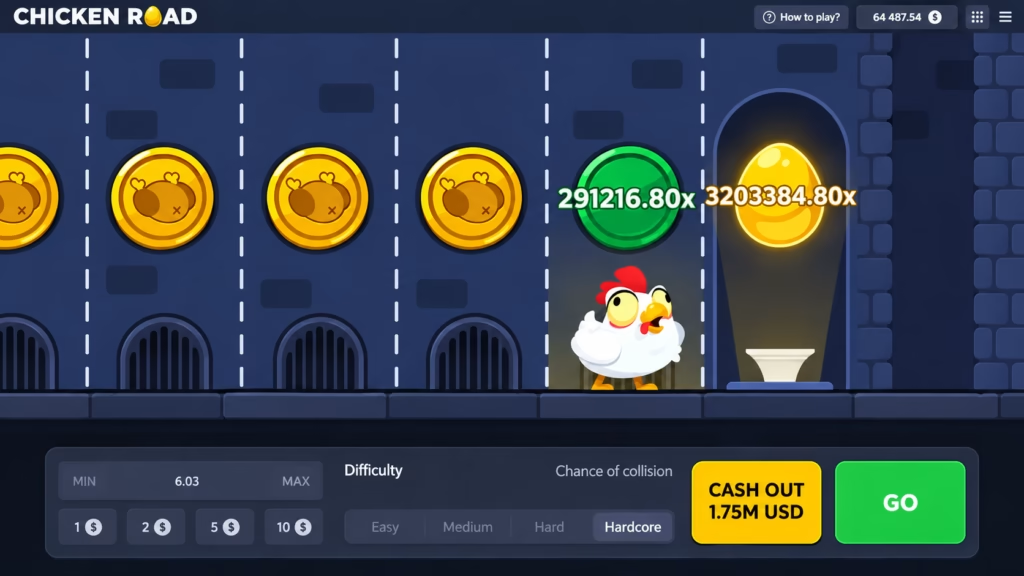
Hardcore is the most aggressive mode, with the shortest reported path and the steepest multiplier ladder in current demo checks.
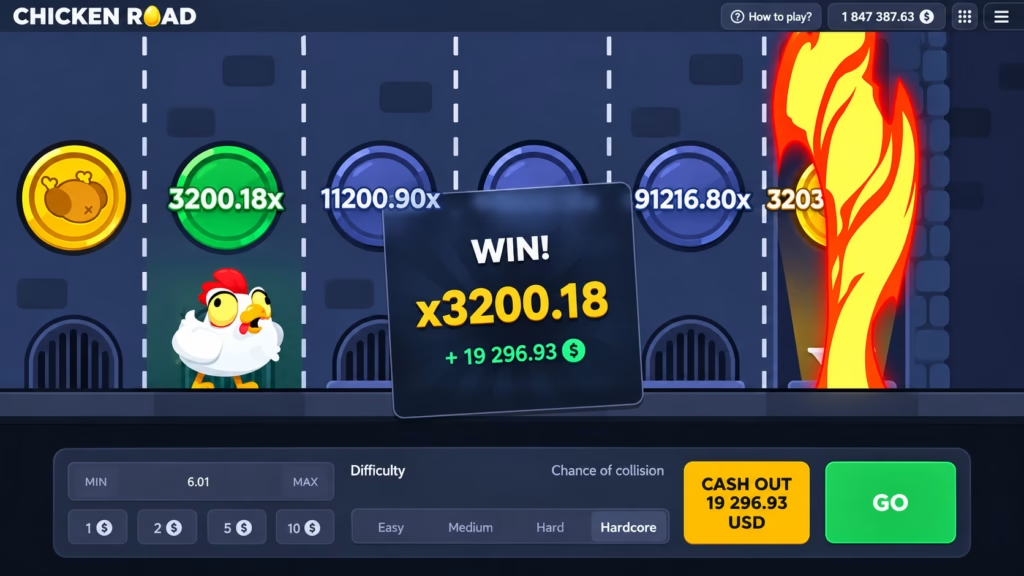
Very large theoretical multipliers should be treated carefully. Reaching later steps requires surviving a chain of risky outcomes, and operator payout caps may limit the amount actually collectible.
Difficulty comparison
| Mode | Reported path length | Risk profile | Demo use |
| Easy | 24 steps | Lowest of the four | Learn the controls and cash-out flow |
| Medium | 22 steps | Higher | Compare moderate and aggressive play |
| Hard | 20 steps | High | See how quickly risk compounds |
| Hardcore | 15 steps | Highest | Understand the extreme end of the game |
The useful question is not which mode “wins more.” Compare how quickly risk rises, how much volatility you are comfortable with and whether the pace encourages you to keep betting after a loss.
Chicken Road demo
A Chicken Road demo lets you learn the game using virtual credits rather than real money. Current demo versions provide the same core decisions, including difficulty selection and cash-out, without requiring a real-money stake.
The demo is most useful for three things: learning the interface, comparing the four modes and seeing how quickly a round can end. It can also help you find the current rules panel before playing for money.
A demo cannot reveal a guaranteed strategy. A winning sequence with virtual credits does not predict future paid rounds. Random outcomes can produce very different short-term results even when the underlying game settings are unchanged.
How to use the demo before playing for money
Use the Chicken Road demo as a rules test, not as a prediction tool.
- Try several rounds on each difficulty.
- Watch how quickly the multiplier changes.
- Find the cash-out control and see how a failed step ends the round.
- Read the current RTP, bet limits and payout cap in the game rules.
- Set a real-money spending limit before leaving demo mode.
The demo has done its job once you understand the mechanics. It has not proven that you can predict the game.
Maximum multipliers and operator differences
Chicken Road specifications beyond the official 98% RTP and four difficulty names are not reported consistently across every site and build. A recent demo check listed a $0.01 to $150 stake range, a $10,000 payout cap and top multipliers ranging from 19.44x on Easy to more than 2.5 million x on Hardcore.
Other pages report different maximums, so those numbers should be treated as a configuration snapshot rather than universal limits. The rules inside the exact casino build should take priority when you check stake size, payout caps or maximum multipliers.
This is especially important on Hardcore. A huge theoretical multiplier can be far above the operator’s actual maximum payout.
Is Chicken Road provably fair?
Recent checks of the InOut Games demo report a provably fair system using client and server seed information. The idea is that the server commits to cryptographic information before the result, allowing a settled round to be checked later.
Provably fair does not mean favorable odds. It is a transparency mechanism, not a way to remove the house edge or improve the chance of winning.
Common Chicken Road myths
“Higher difficulty gives better RTP”
The official provider lists a 98% RTP for Chicken Road. Difficulty changes the risk and multiplier profile, so a more aggressive mode should not be treated as a better mathematical deal unless the current rules explicitly say otherwise.
“A win is due after several losses”
Previous losses do not guarantee that the next round will succeed. Chasing losses because a win feels “due” is a common gambling mistake.
“The demo reveals a winning pattern”
Demo play can teach the rules, but a short sequence of virtual results is not a reliable predictor of future rounds.
Who may like Chicken Road
Chicken Road may appeal to players who prefer simple rules, fast instant games and manual cash-out decisions. It can also suit players who want to adjust the level of risk without learning a complex slot paytable.
It is a poor fit for players who prefer slower sessions or traditional slot features such as reels, wilds, scatters and free spins. It is also worth avoiding if the format makes you want to chase a missed multiplier or immediately raise stakes after a loss.
Practical bankroll and responsible play tips
Set limits before the first paid round. Choose a fixed entertainment budget and a session limit, then stop when either is reached.
Do not use difficulty as a recovery tool. Moving from Easy to Hardcore after a loss can increase the speed at which the remaining budget disappears. Lowering difficulty also does not guarantee a win.
Chicken Road should be treated as entertainment, not as a source of income. If you start chasing losses, hiding spending or using money needed for essential expenses, stop playing and use the responsible gambling tools available through your operator or local support services.
How this information was reviewed
This review prioritizes the official InOut Games product page for the game’s identity, release date, RTP and difficulty names. Current demo-focused sources were used to cross-check path lengths, demo access, cash-out behavior and reported configuration details.
Stake limits, payout caps and top multipliers can differ between builds or operators, so confirm those values in the live game rules. RTP and difficulty describe long-run mathematics and risk structure; neither predicts an individual round.
FAQ
What is the RTP of Chicken Road?
Chicken Road has a published RTP of 98% on the official InOut Games page. That is a theoretical long-run return, not a guarantee for a session.
Who made Chicken Road?
Chicken Road was developed by InOut Games. The provider lists it as a single-player title released on April 4, 2024.
How many difficulty levels are in Chicken Road?
Chicken Road has four difficulty levels: Easy, Medium, Hard and Hardcore. Higher modes increase risk and make multiplier growth more aggressive.
Can I play a Chicken Road demo for free?
Yes. Chicken Road demo versions are available with virtual credits, allowing players to learn the controls and compare the four modes without risking real money. Availability depends on the site or operator.
Does Chicken Road have reels or paylines?
No. Chicken Road is not a traditional reel slot. The main mechanic is taking steps, increasing the multiplier and deciding when to cash out.
Which Chicken Road difficulty is best for beginners?
Easy is the most suitable mode for learning because it has the gentlest risk profile of the four. It is still gambling, so Easy should not be interpreted as safe or profitable.
Is there a guaranteed Chicken Road strategy?
No. No strategy can guarantee a win. Choosing a difficulty and cash-out point changes your exposure to risk, but it does not remove randomness or the house edge.
Is Chicken Road provably fair?
Recent checks of the InOut demo report a client/server seed verification system. Use the verification panel inside the exact version you are playing if you want to check a round.
What is the maximum win in Chicken Road?
The practical maximum can depend on the operator’s payout cap and game configuration. Because published figures differ, check the current in-game rules rather than relying on one universal number.
Brief conclusion
Chicken Road by InOut Games is a straightforward crash-style game built around one repeated choice: cash out now or accept more risk for a higher multiplier. Its published RTP is 98%, and the four difficulty modes meaningfully change the pace and risk profile. The demo is the best place to understand those differences, but neither demo results nor difficulty selection can guarantee a win. Check the current rules, set limits before playing and treat the game as entertainment.