A useful mines game strategy starts with one decision: how many mines should be hidden on the board? On a standard 5×5 Mines grid, choosing fewer mines makes each tile more likely to be safe, while choosing more mines increases the possible payout for surviving a pick. Neither choice makes the game profitable in the long run when the payout includes a house edge.
Quick takeaways:
- 1–3 mines: Higher chance of revealing a safe tile, but modest multipliers after only a few picks.
- 4–8 mines: A middle-ground risk profile, not a mathematical advantage.
- 9–15 mines: Much lower survival odds if you continue opening several tiles.
- 16–24 mines: Very high-risk configurations, where a large multiplier can distract from the probability of losing the stake.
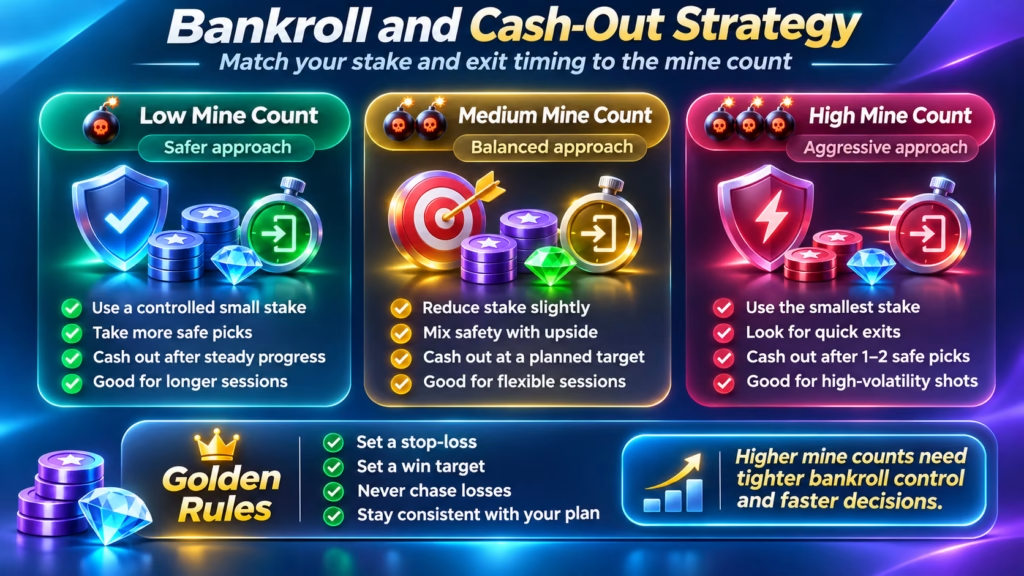
- The key decision: Set a mine count, a cash-out point and a spending limit before starting, rather than reacting to a winning or losing streak.
These ranges are practical descriptions, not official volatility ratings. They suit people comparing Mines risk settings before playing, especially beginners who want to understand the trade-off between hit frequency and payout size. Anyone looking for predictable earnings should avoid treating Mines as an investment or income source.
How Mine Count Changes the Risk in Mines
On the familiar 25-tile layout, each round starts with a chosen number of hidden mines. The other tiles are safe. A safe reveal increases the displayed cash-out multiplier; hitting a mine ends the round and loses that round’s wager. Players can normally cash out after a successful reveal, subject to the rules of the particular game.
The first-pick probability is straightforward: safe tiles ÷ total tiles. With three mines, 22 of the 25 tiles are safe, so the chance of a safe first pick is 22/25, or 88%. With ten mines, only 15 tiles are safe, bringing that chance down to 60%.
That difference does not mean three mines provide a better expected return. In games with a consistently applied house edge, higher success probability is offset by smaller payouts. Stake Mines and Shuffle Mines, for example, currently publish a 99% RTP and 1% house edge across their mine-count options. Other versions may use different payout rules, so their RTP should not be assumed to match.
Mine Count Probability Table for a 25-Tile Board
| Mines | Safe tiles | Chance of 1 safe pick | Chance of 3 safe picks | Chance of 5 safe picks |
| 1 | 24 | 96.00% | 88.00% | 80.00% |
| 3 | 22 | 88.00% | 66.96% | 49.57% |
| 5 | 20 | 80.00% | 49.57% | 29.18% |
| 10 | 15 | 60.00% | 19.78% | 5.65% |
| 15 | 10 | 40.00% | 5.22% | 0.47% |
| 20 | 5 | 20.00% | 0.43% | 0.0019% |
| 24 | 1 | 4.00% | Not possible | Not possible |
These figures are calculated from an evenly randomized 25-tile board. They represent the chance of completing all stated safe picks in a single round, not the chance of earning an overall profit across a session. The payout multiplier, maximum allowed wager and rounding rules are separate questions.

Which Mine Count Fits Each Risk Profile?
One to Three Mines: More Frequent Small Cash-Outs
One to three mines may appeal to players who prefer a relatively high probability of surviving their first few choices. With one mine, the first tile is safe 96% of the time; even five consecutive safe picks have an 80% probability. The trade-off is slow multiplier growth.
Low mine count does not mean a safe bet. A losing tile can still appear on the first click, and opening more tiles steadily increases the cumulative chance that the round ends without a cash-out. Repeating many seemingly comfortable rounds also creates more exposure to the house edge.
Four to Eight Mines: A Middle-Ground Experience
Four to eight mines create a more noticeable balance between short-run survival and multiplier growth. With five mines, the chance of clearing three safe tiles is about 49.57%, effectively a coin-flip proposition before accounting for payout terms.
This range may suit someone comparing different play styles in a demo or zero-stake mode. It is not an objectively optimal setting. If a player finds that the prospect of the next multiplier is pushing them beyond their preselected stop point, the chosen mine count is already encouraging more risk than intended.
Nine to Fifteen Mines: High Variance and Short Runs
Nine to fifteen mines place substantially more hazards on the grid. With ten mines, the chance of surviving three picks falls to 19.78%, while five safe picks have a probability of only 5.65%.
The attraction is a steeper multiplier ladder. The problem is that a single failed reveal wipes out the round’s wager. High mine counts are particularly unsuitable for anyone relying on frequent wins to stay within a tight entertainment budget.
Sixteen to Twenty-Four Mines: Extreme First-Pick Risk
Sixteen or more mines leave very little room for error. At 20 mines, the first pick is safe just 20% of the time. At 24 mines, there is only one safe tile, so the chance of finding it immediately is 4%.
These configurations can display eye-catching multipliers, but the large figure is compensation for a rare event, not evidence of a favorable wager. Even a one-pick cash-out can fail repeatedly. Higher stakes do not improve the underlying probabilities.
How Many Tiles Should You Reveal Before Cashing Out?
A cash-out target determines how much cumulative risk a round takes on. Lower targets produce more frequent successful cash-outs and smaller gross payouts. Higher targets offer larger potential gross payouts but fail more often. The right question is not just “Which multiplier looks good?” but “How likely am I to reach it?”
Consider a three-mine board with a theoretical 99% RTP payout formula. The example below uses rounded multipliers to show the relationship between chance and reward; the actual game display controls the amount paid.
| Cash out after | Chance of reaching target | Illustrative 99% RTP multiplier |
| 1 safe tile | 88.00% | 1.13× |
| 2 safe tiles | 77.00% | 1.29× |
| 3 safe tiles | 66.96% | 1.48× |
| 5 safe tiles | 49.57% | 2.00× |
| 10 safe tiles | 19.78% | 5.00× |
A player who selects two safe tiles rather than ten is accepting a smaller potential payout in exchange for a much higher probability of completing the round. That is a risk preference, not an improvement to the game’s expected value when the same house edge applies.
Why the Next Pick Gets Riskier After Safe Reveals
On a board where mine positions stay fixed within the round, each safe tile removed leaves the same number of mines among fewer unopened tiles. With three mines, the first safe-pick probability is 22/25, or 88%. After two safe tiles have been uncovered, the next pick is safe with probability 20/23, about 86.96%.
This is an important distinction: the chance of a safe next pick decreases slightly after each confirmed safe reveal, even though the possible payout goes up. A player should not interpret a streak of gems as evidence that the board is becoming easier.
Understanding the Mines Probability Formula
For a board with N total tiles, M mines and a target of K safe picks, the chance of surviving all K reveals is:
P(K safe picks) = C(N − M, K) ÷ C(N, K)
Here, C(a, b) means the number of ways to choose b items from a items. The formula assumes uniformly randomized mine placement, no replacement of revealed tiles and K no greater than the number of safe tiles.
For a 25-tile game with three mines and three planned picks, the same result can be written as (22/25) × (21/24) × (20/23) ≈ 66.96%. The odds do not improve because a player chooses a corner, follows a diagonal or clicks a remembered pattern.
If the provider uses the common fixed-edge model, the approximate gross payout multiplier at a target is RTP ÷ probability of reaching the target, where RTP is expressed as a decimal. Thus 0.99 ÷ 0.6696 is approximately 1.48×. Some games cap payouts or apply different rounding and terms, so this calculation is illustrative rather than a universal paytable.
Does a Low-Mine Strategy Beat the House Edge?
No. A low-mine Mines strategy can reduce the probability of losing a particular short round, but it does not automatically improve the mathematical expected return. A 99% theoretical RTP corresponds to an average return of 99 units for every 100 units wagered over a very large number of comparable wagers, not a promise about any session.
For a simple fixed-edge Mines payout, the expected gross return of a one-unit bet remains approximately 0.99 units, whether the player chooses one mine or twenty mines and whether the cash-out target is shallow or deep. Rounding, payout limits and game-specific conditions can affect the exact figures, so always consult the selected version’s rules.
That distinction also explains why “winning often” can be misleading. Cashing out at a small multiplier may produce a high proportion of winning rounds, yet occasional full-stake losses can still outweigh those modest gains.
Building a Practical Mines Risk Plan
A realistic mines game strategy is a plan for limiting exposure, not a method for predicting safe tiles. Before placing a real-money wager, use this sequence:
- Check the specific game. Confirm the board size, allowed mine counts, RTP, cash-out rules, minimum and maximum bets and any payout cap. A demo version may help explain the controls without risking money.
- Choose a mine count for the experience you want. Lower counts typically mean more frequent small cash-outs; higher counts mean a greater chance of losing each round in pursuit of larger payouts.
- Set a cash-out target before the first click. The target should be based on its survival probability, not on an exciting multiplier appearing after a successful pick.
- Use a fixed entertainment budget. Decide on a spending limit and a time limit in advance. Never use money needed for rent, bills, debt payments or savings goals.
- Do not increase bets to recover losses. A doubling system or an escalating stake does not alter tile probabilities and can exhaust the budget quickly.
- Stop when the limit is reached. Use available deposit, loss and session controls. Autobet can accelerate losses, even when its settings appear systematic.
For someone entirely new to the game, studying one- and three-mine examples in a free mode is a clearer introduction than starting with the most dramatic multiplier. There is no need to place a real-money bet to learn the probability model.
Mines Strategy Mistakes That Cost Players Money
Believing that certain tiles are safer. In a properly randomized, symmetric board, an unopened corner and an unopened central tile have the same chance of concealing a mine. A visual pattern is not a predictive tool.
Confusing cash-out frequency with profitability. A sequence of small successful cash-outs may feel consistent, but the relevant calculation includes the size of the losses, the payout on wins and the total amount wagered.
Treating previous rounds as clues. A mine appearing in a position in the previous round does not make that position more or less likely in a new independent round. The Responsible Gambling Council warns against assuming a future win is due after earlier losses.
Ignoring what “provably fair” means. A cryptographic verification feature may let players check whether completed outcomes match committed seeds. It does not reveal the next safe tile, remove the house edge or establish that every other aspect of an operator is trustworthy.
Chasing a multiplier after reaching the plan. When a target has been reached, another click creates fresh exposure to losing the round’s accumulated cash-out value. The higher potential payout does not make the extra pick necessary.
How to Choose a Mines Game Before Playing
Comparing Mines games should start with transparent rules, not the largest advertised multiplier. Look for a readable paytable or payout calculator, a clearly identified RTP, the number of tiles and mines allowed, and an explanation of how rounds are randomized. If the game claims to be provably fair, find the actual verification instructions rather than relying on a badge alone.
For real-money play, also assess the operator’s authorization in your jurisdiction, available safer-gambling controls, wager limits and terms for withdrawals or bonuses. Bonus wagering requirements and eligibility may vary by casino. A higher advertised RTP does not guarantee that any individual session will finish ahead.
How This Information Was Reviewed
The probabilities in this guide follow the combinatorial mathematics of uniformly placed mines on a 25-tile board. Published Mines rules from two operators were checked for the common 5×5 format and their stated 99% RTP examples. General explanations of RTP and gambling misconceptions were cross-checked against the UK Gambling Commission and the Responsible Gambling Council.
The probability tables are calculations, not observed gameplay results. This article does not claim to have tested a casino account or measured real-money outcomes. Always check the current rules of the game you choose, and stop or seek support if gambling becomes stressful or difficult to control. Mines is entertainment, not a reliable way to make money.
FAQ
What is the best number of mines for a Mines strategy?
There is no universally best mine count. Fewer mines produce higher short-round survival probabilities; more mines produce larger possible payouts. In a fixed-house-edge game, changing mine count does not eliminate the house advantage.
Is one mine the safest Mines setting?
One mine gives the highest first-pick survival probability on a standard 25-tile board: 96%. It is only the lowest-risk option for that particular pick, not a guarantee that a session will avoid losses.
Are three mines better than five mines?
Three mines are easier to survive over the same number of picks. For three safe picks, the chance is about 66.96% with three mines versus 49.57% with five mines. The more difficult configuration may offer a higher multiplier; neither is automatically better financially.
Does cashing out after one tile improve RTP?
Not necessarily. In a game using the same fixed house edge across its payout ladder, earlier cash-out changes the win frequency and payout size, not the theoretical expected return. Check the specific game’s multiplier and rounding rules.
Can you predict Mines with a tile pattern?
No reliable pattern predicts mines on a properly randomized board. Corners, diagonals and previously successful tile sequences have no inherent mathematical advantage when all unopened positions are equally likely to contain mines.
Are Mines rounds independent?
New rounds are ordinarily designed to use independently generated outcomes. A loss in the previous round does not make a new round more likely to win. Within a single round, however, each revealed safe tile changes the probability for the remaining unopened tiles.
Is Mines with 24 mines worth trying?
A 24-mine board leaves one safe tile out of 25, so the first-pick survival probability is only 4%. Its headline multiplier reflects extremely low odds. It is unsuitable for anyone expecting regular successful rounds.
Does provably fair mean you can win consistently?
No. Provably fair verification is designed to help check how a completed outcome was generated. It does not predict future outcomes or remove any published house edge, and it does not guarantee a personal profit.
Conclusion
Mine count determines the kind of risk you take, not a way around the mathematics. Choose fewer mines for more frequent small cash-outs or more mines for rare high multipliers, but compare the actual survival odds before choosing either. Check the game’s RTP and paytable, set firm limits, and treat every bet as entertainment spending that may be lost.