Stake Plinko is a Stake Originals ball-drop casino game built around a triangular pin board and multiplier pockets. The current official game page lists a 99% RTP, a 1% house edge, 8 to 16 rows, and four risk settings: Easy, Medium, Hard and Expert. The highest published multiplier is 10,000x, available on Expert with 16 rows. Those settings change volatility and payout distribution, but they do not create a reliable way to predict or force a winning drop.
The game is most likely to appeal to players who want a simple interface, adjustable volatility and short rounds instead of reels, paylines or bonus symbols. Beginners may find Easy or Medium easier to understand because the payout spread is less extreme. Hard and Expert require more caution because lower multipliers can appear frequently while the largest edge multipliers remain rare.
Stake Plinko at a glance
- Provider: Stake Originals.
- Game type: provably fair Plinko-style game of chance.
- RTP: 99.00% on the current official game page.
- House edge: 1%.
- Rows: 8 to 16.
- Risk levels: Easy, Medium, Hard and Expert.
- Maximum published multiplier: 10,000x on Expert with 16 rows.
- Main controls: Manual or Auto play, row selection, difficulty, Autobet, hotkeys and Instant Bet.
- Demo: Stake exposes a Plinko demo route, although access can depend on region and account state.
What is Stake Plinko?
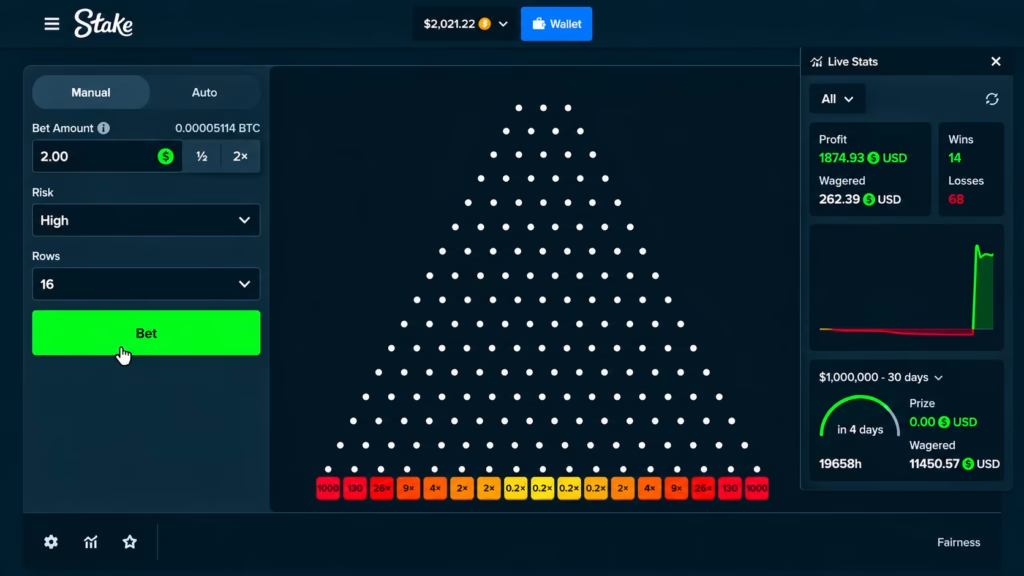
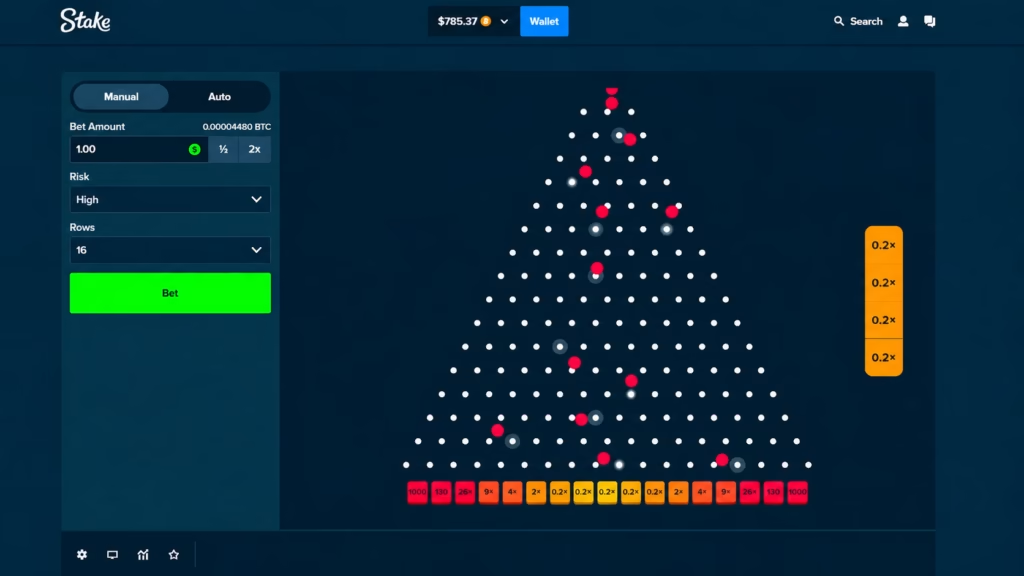
Stake Plinko is an in-house Stake Originals game inspired by the familiar Plinko and pachinko concept. A ball starts at the top of a triangular field of pins, moves left or right at each level and finishes in a multiplier pocket at the bottom. Pockets near the middle usually carry lower multipliers, while the outer positions can offer larger values.
Unlike a slot, Stake Plinko has no reels, paylines, wilds, scatters, free spins or bonus-buy round. The main decisions are the stake size, risk level and number of rows. Those controls change the shape of the payout table and the volatility of the experience, not the mathematical fact that every round is a game of chance.
How Stake Plinko works
A Stake Plinko round is simple: choose a bet amount, select a difficulty, choose between 8 and 16 rows, then drop the ball. The generated path determines which multiplier pocket the ball reaches. The payout for that round is the bet multiplied by the value of the final pocket.
1. Set the amount you are prepared to risk on one drop.
2. Choose Easy, Medium, Hard or Expert difficulty.
3. Select 8 to 16 rows. More rows create more left-or-right decisions and a wider payout spread.
4. Drop the ball manually or use an automated mode if available in your interface.
5. Read the final multiplier as the result of that round. A multiplier below 1x means the returned amount is lower than the stake.
Stake also lists Autobet, desktop hotkeys and Instant Bet. Instant Bet removes the normal animation and returns the result immediately. That makes rounds faster, but faster play does not improve RTP or reduce the house edge. It can simply increase the number of decisions made in a short period.
Stake Plinko risk levels and rows
Risk level and row count are the two settings that most clearly change the feel of Stake Plinko. Higher risk pushes more value toward the extreme edge pockets while making central outcomes less attractive. Increasing the number of rows expands the possible path and, in the current payout table, can also raise the maximum available multiplier.
| Rows | Easy max | Medium max | Hard max | Expert max |
| 8 | 5.6x | 13x | 29x | 50x |
| 9 | 5.6x | 18x | 43x | 100x |
| 10 | 8.9x | 22x | 76x | 201x |
| 11 | 8.4x | 24x | 120x | 324x |
| 12 | 10x | 33x | 170x | 619x |
| 13 | 8.1x | 43x | 260x | 1,012x |
| 14 | 7.1x | 58x | 420x | 2,369x |
| 15 | 15x | 88x | 620x | 5,000x |
| 16 | 16x | 110x | 1,000x | 10,000x |
Easy is the least volatile option and is better suited to someone who wants a narrower payout spread. Medium increases payout potential without moving directly to the most extreme distribution. Hard raises volatility substantially. Expert is the most aggressive setting and reaches 10,000x at 16 rows, but Stake also notes that Expert can include a 0.1x minimum multiplier and longer losing stretches.
RTP, house edge and payout expectations
Stake Plinko currently shows a 99% RTP and a 1% house edge. RTP is a long-run mathematical percentage, not a promise that a player will receive 99% of their money back in a single session. A short sequence can finish far above or far below the theoretical return because individual results are random.
The official Stake how-to guide says a Plinko bet can start at 0.01 per round. A universal maximum stake is not stated consistently across the current public material, so the safest approach is to check the live game interface for the currency and account being used. Bet limits and access can also be affected by location or platform rules.
A high maximum multiplier should not be read as a likely outcome. The 10,000x figure describes the top published payout pocket for Expert with 16 rows. Reaching that edge outcome is not made more predictable by increasing the stake, changing seeds repeatedly, using Autobet or watching previous drops.
Is Stake Plinko provably fair?
Yes. Stake classifies Plinko as a provably fair Stake Original. The platform documents a system that uses a server seed, a client seed, a nonce and a cursor as inputs to an HMAC-SHA256 based random-number process. The server seed is committed through a hash before play, while the client seed provides a player-side input. After the server seed is revealed or rotated, the result can be checked against the earlier commitment.
For Plinko specifically, Stake documents the generated game event as a sequence of left-or-right decisions. The selected row count determines how many directional decisions are needed to construct the path. Stake also notes that Plinko uses two cursor increments to cover as many as 16 decisions.
How to verify a Stake Plinko result
1. Open the fairness or verification area associated with the game or bet history.
2. Identify the client seed, server seed information and nonce for the relevant round.
3. Rotate or reveal the server seed when the interface allows it, so the unhashed value can be checked against the earlier hash commitment.
4. Use Stake’s calculation tool or an independent implementation of the published method to reproduce the generated result.
5. Confirm that the reproduced Plinko path and final outcome match the recorded round.
Provably fair means the result can be independently checked against the published cryptographic process. It does not mean the game has no house edge, that every player receives similar short-term results, or that a seed can be used to forecast the next winning path.
Stake Plinko demo: what it is useful for
A Stake Plinko demo is useful for learning the interface before risking funds. Stake currently exposes a dedicated Plinko demo route, while the exact ability to access or use it can depend on region, authentication and local product availability. If the demo is unavailable where you are, do not assume that an unofficial simulator is identical to the current Stake build.
The strongest use of a Stake Plinko demo is practical rather than predictive. It can help you understand how row count changes the board, how the risk selector changes the multiplier layout, how quickly Instant Bet works and whether Autobet feels too fast. Demo results cannot tell you what will happen in a future real-money session because each real round remains random.
Manual play, Autobet and Instant Bet
Manual play is the clearest option for someone learning Stake Plinko because every drop requires a separate decision. Autobet can automate a chosen number of drops, which is convenient but makes it easier to lose track of total exposure. A fixed number of rounds and a preset budget are more useful controls than trying to stop only after a specific win appears.
Instant Bet removes the visual drop animation and produces the result immediately. This can be useful for a player who only cares about the result, but it also removes natural pauses between rounds. Anyone using Instant Bet should pay closer attention to session length and total amount wagered, because speed changes behaviour even though it does not change the stated RTP.
Common Stake Plinko myths
- The animation does not create a skill shot. Stake’s technical documentation describes the game result through generated left-or-right events, so visual timing is not a reliable control method.
- Changing the client seed does not create a better RTP. The seed changes the input chain, but it does not give the player a way to choose a favorable outcome.
- A long run of centre hits does not make an edge hit due. Previous outcomes do not provide a dependable prediction for the next random round.
- Expert is not automatically better value than Easy. Expert offers a more extreme payout distribution, not a guaranteed improvement in expected return.
- Autobet is not a strategy for beating the game. It is an automation feature and can increase total wagering quickly if limits are not set first.
How to choose a Stake Plinko setup
Choose a setup based on acceptable volatility, not on the largest number visible on the board. A player who dislikes sharp balance swings is generally better matched with Easy and fewer rows. Someone who deliberately wants a wider spread may prefer Medium or Hard, but should reduce stake size if the larger variance would otherwise make each round too expensive.
Expert should be treated as a high-volatility format rather than a shortcut to a 10,000x result. The highest multiplier appears only at the most extreme current configuration, and the lower side of the payout table can be harsh. If the possibility of repeated low returns would cause you to chase losses or increase stakes emotionally, Expert is a poor fit.
Practical bankroll and responsible-play rules
- Set a session budget before opening the game and treat it as entertainment spending.
- Choose a per-drop stake that allows the planned number of rounds without requiring extra deposits.
- Use a fixed round count if you enable Autobet, rather than leaving automated play open-ended.
- Do not increase stakes to recover previous losses. A new drop does not become more favorable because earlier drops lost.
- Use deposit limits, loss limits, session tools or self-exclusion options if gambling is becoming difficult to control.
- Stop playing if the money is needed for bills, debt, savings goals or other essential expenses.
How this information was reviewed
This review prioritizes Stake’s current Plinko game page for live specifications such as RTP, house edge, row range, risk settings and maximum multipliers. Stake’s provably fair implementation and game-event documentation were used for the fairness explanation. Older guides can lag behind product changes, so a live paytable and current game interface should be checked before playing, especially for bet limits, regional access and any future payout-table changes.
RTP, volatility and provably fair verification describe the mathematics and auditability of the game, not a guaranteed personal result. Stake Plinko should be treated as entertainment rather than a way to earn money. If gambling stops feeling controlled, the practical decision is to stop and use the available responsible-gambling tools.
FAQ
What is Stake Plinko?
Stake Plinko is a Stake Originals game where a generated ball path moves through 8 to 16 rows of pins and finishes in a multiplier pocket. The player chooses the stake, row count and one of four risk levels before each round.
What is the RTP of Stake Plinko?
The current official Stake Plinko page lists a 99.00% RTP and a 1% house edge. The 99% figure is a long-run theoretical return and does not predict the return of an individual session.
What is the maximum win in Stake Plinko?
The current maximum published multiplier is 10,000x on Expert difficulty with 16 rows. That is a top payout value, not a typical result or a guaranteed target.
How many risk levels does Stake Plinko have?
Stake Plinko currently has four risk levels: Easy, Medium, Hard and Expert. Higher settings increase volatility and move more payout potential toward the outer pockets.
Is there a Stake Plinko demo?
Stake exposes a Plinko demo route, but availability can depend on region, account state and local access rules. A demo is useful for learning controls and payout layouts, but demo outcomes do not predict real-money results.
Is Stake Plinko provably fair?
Yes. Stake documents Plinko as a provably fair game using cryptographic inputs that include a server seed, client seed, nonce and cursor. Players can verify completed results against the published process after the relevant server seed is revealed.
Can I change the seed to improve my chances?
No reliable advantage comes from changing the client seed. The seed changes an input used to generate results, but it does not let a player know or choose the next favorable path. The house edge and game rules still apply.
Does Autobet change the RTP in Stake Plinko?
No. Autobet automates repeated rounds and does not improve the stated RTP. Its main practical risk is speed, because more rounds can be played with less active attention.
Short conclusion
Stake Plinko is a simple but highly adjustable Stake Originals game with a current 99% RTP, 1% house edge, 8 to 16 rows and four risk levels. Its provably fair system makes completed results verifiable, while Expert mode raises the maximum published multiplier to 10,000x. The demo is best used to understand the interface and volatility, not to search for a pattern. Choose settings by budget and tolerance for variance, and treat every drop as a random gambling outcome rather than a source of income.