Scatter pays in slots are payouts awarded when enough scatter symbols appear during a spin, usually without requiring those symbols to land on a standard payline. Unlike regular matching symbols, scatters may pay or trigger a feature from different positions across the reels, although the exact rules depend on the individual slot.
The main points to know are:
- Scatter symbols usually do not need to appear on the same payline.
- A minimum number of scatters, commonly three or more, may be required for a payout or feature.
- Scatter pays can be separate from a free spins or bonus trigger.
- The value of a scatter win depends on the game’s paytable and betting rules.
- Some slots use scatters only as feature triggers and do not award a separate cash prize.
Scatter mechanics are especially relevant to players who enjoy bonus-oriented slots because scatter symbols frequently unlock free spins, bonus games, multipliers, or other special features. However, seeing scatter symbols does not make future wins more likely. Every spin remains subject to the game’s random outcome generation.
What Is a Scatter Pay in Slots?
A scatter pay is a prize generated by landing the required number of scatter symbols according to a slot’s paytable. The defining difference is that scatter symbols generally do not have to form a conventional left-to-right payline combination.
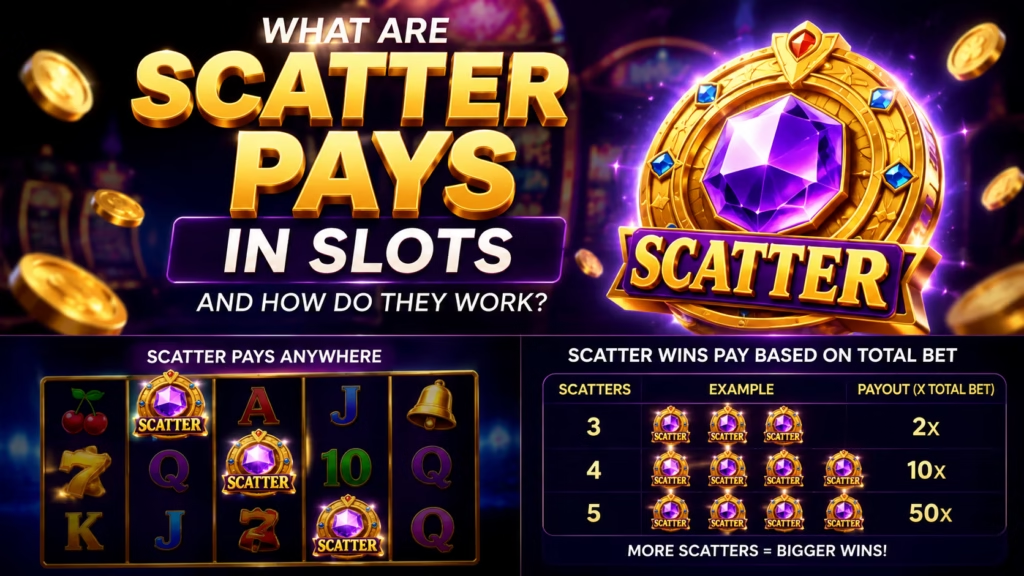
For example, imagine a five-reel slot where three scatter symbols are required. One scatter could appear on reel 1, another on reel 3, and a third on reel 5. If the rules allow scatters to count anywhere on the reels, those three symbols could create a qualifying scatter combination even though they are not aligned horizontally.
This makes scatter pays different from traditional line wins, where matching symbols normally have to follow a specific arrangement defined by the game’s rules.
The word “scatter” does not guarantee that every position on every reel is eligible. Some games restrict where scatter symbols can appear or how they are counted, so the paytable remains the authoritative source for the individual slot.
How Do Scatter Pays Work in Slots?
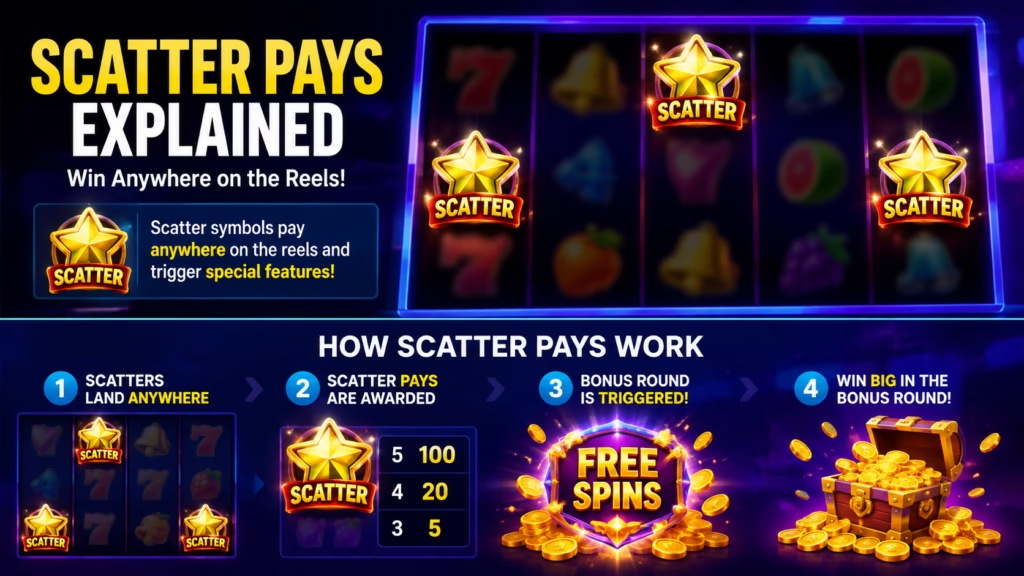
Scatter pays work by counting eligible scatter symbols that appear during a completed spin. When the number reaches one of the combinations listed in the paytable, the game applies the corresponding reward.
A typical process looks like this:
- The reels stop after a spin.
- The game identifies all eligible scatter symbols.
- The number of scatters is compared with the paytable.
- A qualifying scatter payout is calculated.
- Any connected feature, such as free spins, may also be triggered.
A slot might, for example, offer different prizes for three, four, and five scatter symbols. More scatters often correspond to a larger reward, but there is no universal payout structure.
The important distinction is that “scatter pays” describes a method of evaluating scatter symbols. It does not mean every slot pays scatters in the same way.
Do Scatter Symbols Have to Be on a Payline?
Scatter symbols usually do not need to land on the same payline to qualify for a scatter pay. This is one of the main reasons scatters are treated differently from ordinary slot symbols.
In a conventional payline game, a normal symbol might need to appear on consecutive reels along an active line. A scatter may instead be counted wherever it appears within eligible reel positions.
For example:
| Result | Regular Payline Symbol | Typical Scatter Symbol |
| Must follow a payline | Usually | Usually not |
| Must be on consecutive reels | Often | Not necessarily |
| Can trigger free spins | Sometimes | Commonly |
| May pay anywhere | Usually not | Often |
| Rules vary by slot | Yes | Yes |
These are general patterns rather than universal rules. Modern slots can use customized reel systems, cluster mechanics, ways-to-win systems, cascading reels, or special scatter rules that differ from traditional five-reel games.
How Are Scatter Wins Calculated?
Scatter wins are calculated according to the values shown in the game’s paytable. Depending on the slot, the listed scatter award may be based on the total bet, a specific bet unit, a fixed prize, or another calculation defined by the provider.
Consider a hypothetical game with this scatter table:
- 3 scatters: 2x the qualifying bet amount
- 4 scatters: 10x
- 5 scatters: 50x
If the game’s rules define the scatter multiplier as applying to a $1 total bet, three scatters would produce a $2 scatter prize, four would produce $10, and five would produce $50.
This example is only illustrative. Players should not assume that another slot uses the same formula.
Older and newer slots can calculate awards differently, particularly when paylines, coin values, denomination settings, variable bets, or feature purchases are involved. Checking the paytable before playing is the safest way to understand exactly how a specific scatter award is calculated.
Scatter Pays vs Scatter Bonus Triggers
A scatter pay and a scatter-triggered bonus are related concepts, but they are not necessarily the same reward.
A scatter pay is a direct prize produced by a qualifying number of scatter symbols.
A scatter bonus trigger activates another game feature, such as free spins or a bonus round.
Some slots combine both. Three scatters might award a cash prize and simultaneously start ten free spins. Another slot might use three scatters only to unlock the free spins feature without awarding an additional scatter payout.
This distinction matters when comparing slots. A visually prominent scatter symbol does not automatically mean that the symbol has a large direct payout.
Scatter Pays vs Regular Line Pays
The biggest difference between scatter pays and line pays is how the symbols are positioned.
Regular line wins generally depend on matching symbols appearing according to a predefined payline or reel sequence. Scatter pays normally depend on the number of qualifying scatter symbols rather than their alignment.
For example, a regular three-symbol combination might require matching symbols across reels 1, 2, and 3. Three scatter symbols could potentially appear across reels 1, 3, and 5 and still qualify if the game’s rules count scatters anywhere.
This flexibility can make scatters easier to recognize visually, but it should not be confused with a higher probability of making money. Scatter frequency and payout values are determined by the game’s underlying mathematical model.
Can Scatter Symbols Trigger Free Spins?
Yes, scatter symbols commonly trigger free spins when the required number appears, but the required combination varies between slots.
Three scatters are a familiar trigger structure, while other games may require four symbols, use different thresholds, or award different numbers of free spins depending on how many scatters land.
Some games also use scatters during free spins to retrigger the feature. For example, landing another qualifying scatter combination could add more free spins.
Retriggers should always be checked in the game rules because some slots limit them, change the required number of scatters, or disable retriggers entirely.
Different Types of Scatter Mechanics
Paying Scatters
Paying scatters award a direct prize when enough symbols appear. The value normally increases according to the number of scatters, subject to the specific paytable.
Bonus Scatters
Bonus scatters primarily activate a feature such as free spins, a pick-and-win round, or another bonus game. A separate cash award may or may not be included.
Retrigger Scatters
Retrigger scatters appear during an existing bonus and can add spins or extend the feature when the required conditions are met.
Special or Enhanced Scatters
Some modern slots give certain scatters extra properties. They might carry multipliers, contribute to a bonus meter, expand into larger symbols, or interact with another feature.
There is no standardized rule requiring providers to implement scatter symbols in a particular way. The same scatter icon can have very different functions from one game to another.
Are More Scatter Symbols Always Better?
More scatter symbols generally produce a stronger result when the paytable rewards higher scatter counts, but the exact benefit depends on the game.
Five scatters might pay significantly more than three scatters in one slot. In another game, three or more scatters might trigger the same bonus regardless of the final number.
Additional scatters can also matter inside bonus rounds. Some games award extra free spins or enhanced multipliers for landing four or five scatters instead of the minimum requirement.
The paytable should therefore be checked rather than assuming that every extra scatter automatically increases a reward.
Do Scatter Pays Affect RTP?
Scatter payouts can form part of a slot’s theoretical RTP because money allocated to scatter awards and scatter-triggered features contributes to the game’s overall mathematical payout model.
RTP, or return to player, represents a long-term theoretical percentage calculated over a very large number of game outcomes. It does not indicate how much a player should expect to receive during one session.
A slot with valuable scatter bonuses can still have the same overall RTP as a slot with smaller scatter prizes if other parts of their paytables are structured differently.
Players should therefore evaluate RTP separately from individual feature size. A dramatic scatter prize does not by itself indicate that a slot has a higher RTP.
Do Scatter Pays Affect Slot Volatility?
Large or infrequent scatter rewards can contribute to a slot’s volatility profile, but scatter pays are only one part of the game’s mathematical structure.
A game that concentrates a meaningful portion of its potential payout into rare scatter-triggered bonuses may produce more uneven results than a game that distributes more value through frequent smaller base-game wins.
However, volatility cannot reliably be determined simply by looking at the advertised scatter prize. Symbol frequencies, regular payouts, bonus mechanics, maximum wins, multipliers, and other factors also influence the overall distribution of outcomes.
High volatility also does not mean higher RTP. RTP and volatility describe different characteristics of a slot.
Common Misconceptions About Scatter Pays
One common mistake is assuming that a scatter symbol must be “due” after a long period without a bonus. Random slot outcomes do not become obligated to produce a scatter combination because previous spins failed to trigger one.
Another misconception is that two scatter symbols appearing frequently means a third scatter is becoming more likely. Near-misses can be visually noticeable, but previous reel results do not provide a reliable method for predicting the next random outcome.
Players may also assume that every scatter awards money. Some slots use scatters exclusively to unlock bonus features.
Finally, a large advertised scatter multiplier should not be interpreted as a likely return. The size of a possible payout and the probability of receiving that payout are separate factors.
What Should You Check Before Playing a Scatter-Based Slot?
The most useful information is found in the game’s paytable and help section. Before playing, check:
- how many scatters are required;
- where scatters can appear;
- whether scatter wins pay anywhere;
- whether scatters provide a direct payout;
- whether they trigger free spins or another bonus;
- whether four or five scatters improve the feature;
- whether bonus scatters can retrigger free spins;
- how scatter prizes are calculated;
- the game’s stated RTP, where available;
- the game’s volatility information, where provided.
These details make it easier to understand the game mechanics without assuming that one slot follows the rules of another.
Players who particularly enjoy bonus rounds may prefer games where scatters have several functions. Players who prefer simpler base-game mechanics may find a slot with fewer bonus layers easier to understand.
Neither structure improves the ability to predict random outcomes.
Scatter Pays and Responsible Gambling
Scatter pays should be treated as part of a game’s entertainment mechanics rather than a strategy for generating income. A scatter feature can produce a large or small reward, and qualifying combinations may arrive irregularly.
RTP, volatility, scatter frequency, and bonus structure cannot predict what will happen during an individual session.
Setting a spending limit before playing is more useful than increasing bets while waiting for a scatter feature. Chasing a bonus after a losing sequence does not make the bonus more likely to arrive.
If gambling stops being enjoyable or begins affecting finances or everyday life, stopping play is more important than trying to recover previous losses.
How This Information Was Reviewed
The scatter pay explanations in this guide are based on the core differences between scatter combinations, conventional symbol payouts, bonus triggers, RTP, and volatility.
Because providers can implement scatters differently, the paytable and official game rules should always be checked for the specific slot being played. Important details include the required number of scatters, eligible reel positions, payout calculation, free spin triggers, retrigger rules, and whether the scatter awards a separate cash prize.
RTP describes theoretical long-term return, while volatility describes the distribution and variability of outcomes. Neither metric guarantees a particular result, and neither can predict when a scatter or bonus will appear.
Slots should be used for entertainment with predetermined spending limits, not as a method of earning money.
FAQ
What is scatter pays in slots?
Scatter pays in slots are prizes awarded when a required number of scatter symbols appear during a spin. The symbols usually do not need to follow a traditional payline, although the exact qualifying positions and payouts are defined by each game’s rules.
How does scatter pays work in slots?
Scatter pays work by counting eligible scatter symbols after the reels stop and comparing the result with the paytable. If enough scatters appear, the game may award a payout, trigger a bonus, or do both.
How many scatters do you need to win?
Many slots use three scatters as a minimum qualifying combination, but there is no universal requirement. Some games use different thresholds or award different rewards for three, four, and five scatters. Check the game’s paytable for the exact rule.
Do scatter symbols need to be next to each other?
Scatter symbols generally do not need to be adjacent or positioned on one conventional payline. They may count from separate reel positions, provided those positions qualify under the game’s rules.
Do scatters always trigger free spins?
No. Scatter symbols frequently trigger free spins, but some award only a direct payout, some activate another type of bonus, and others provide both a payout and free spins. The function depends on the slot.
Can scatter symbols appear during free spins?
Yes, many slots allow scatters to appear during free spins. They may retrigger additional spins or activate another enhancement, but some games restrict or disable retriggers. The bonus rules should be checked for the specific slot.
Is a scatter the same as a wild symbol?
No. A scatter generally creates a payout or bonus based on the number of scatter symbols present, while a wild typically substitutes for selected regular symbols to help complete winning combinations. Some games combine additional functions, so exact behavior varies.
Are scatter bonuses predetermined to appear after a certain number of spins?
Not necessarily. In RNG-based slots, previous spins do not create a reliable countdown to the next scatter bonus. A long period without a bonus does not mean that a qualifying scatter combination must appear soon.
Does a higher scatter payout mean a better slot?
No. A larger possible scatter payout does not reveal how frequently that payout occurs or whether the overall RTP is higher. RTP, volatility, symbol probabilities, and the complete paytable provide more useful context.
Can you increase your chances of landing scatters?
There is generally no betting pattern that lets a player predict or control the next random scatter result in a standard RNG slot. Some games may change features or mathematical settings with specific bet options, so any such differences should be verified in the official rules before playing.
In short
Scatter pays reward qualifying scatter symbols without usually requiring a conventional payline. Scatters can provide direct payouts, trigger free spins, unlock bonus rounds, or combine several functions.
The number of scatters required, their payout values, eligible positions, and bonus rules vary between games, so the paytable should always be checked before playing. Scatter frequency, RTP, and volatility do not predict the result of an individual session, and slots should be treated as entertainment rather than a way to earn money.