
Cash or Crash by Evolution is a live game show built around one bet, a 20-step payout ladder and repeated cash-out decisions. A green ball moves the round one level higher, a red ball normally ends the round, and the gold ball gives a Shield that can absorb one red ball. After most green-ball draws, the player chooses Take All, Take Half or Continue.
The important part of the Cash or Crash rules is that the player is not choosing the next ball. The choice only changes how much of the current potential win is secured and how much remains exposed to the next draw. The balls are removed from the machine as they are drawn, so the composition of the remaining pool changes during the round.
Cash or Crash quick rules
- One bet starts your participation in the round.
- The game uses a 20-step ladder-style paytable.
- The draw machine starts with 19 green balls, 1 gold ball and 8 red balls.
- Green moves you up one level and normally opens a decision phase.
- Red ends the round unless an active Shield protects you.
- Gold moves you up one level and activates a one-time Shield.
- Take All secures 100% of the current potential winnings and ends your participation in that round.
- Take Half secures 50% and leaves the other 50% exposed to further draws.
- Continue leaves 100% of the current potential winnings in play.
Cash or Crash usually appeals to players who like live game shows with clear risk-reward decisions rather than a passive spin or wheel result. It is less suitable for anyone who finds repeated decisions stressful or who is likely to chase a high multiplier after deciding on a spending limit.
How Cash or Crash works
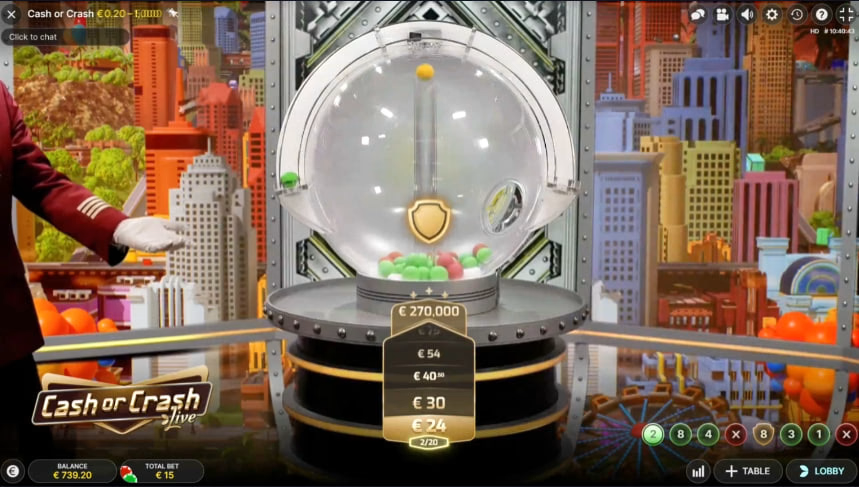
Cash or Crash takes place in a virtual blimp above a city while a physical ball-drawing machine determines the progression of the round. The player places a single bet before betting closes. Once the draw begins, green, gold and red balls determine whether the blimp climbs the ladder, gains protection or crashes.
| Game detail | Cash or Crash |
| Provider | Evolution |
| Game type | Live casino game show |
| Core mechanic | Ball draw with a 20-step payout ladder |
| Starting ball pool | 19 green, 1 gold, 8 red |
| Player decisions | Take All, Take Half, Continue |
| Top published multiplier | Up to 50,000x after the Shield has been broken |
| Published theoretical RTP range | 94.51% to 99.59% in the referenced Evolution rules set |
| Bet limits | Operator and table configuration may vary |
| Availability | Depends on casino, jurisdiction and operator configuration |
Cash or Crash rules step by step
1. Place one bet before the round starts
Cash or Crash uses one main bet rather than several betting positions. The size of that bet determines the cash value represented by the multipliers on the ladder. Minimum and maximum stakes can differ by operator, currency and table configuration, so the live interface is the correct place to check the current limits before betting.
2. The machine draws a colored ball
A green ball moves the player one step higher and increases the potential payout. A gold ball also moves the player up one step, but it adds a Shield. A red ball ends the round if no Shield is active. Drawn balls are not returned to the pool during the same game round, so the remaining mix of balls changes after every draw.
3. Green balls create a cash-out decision
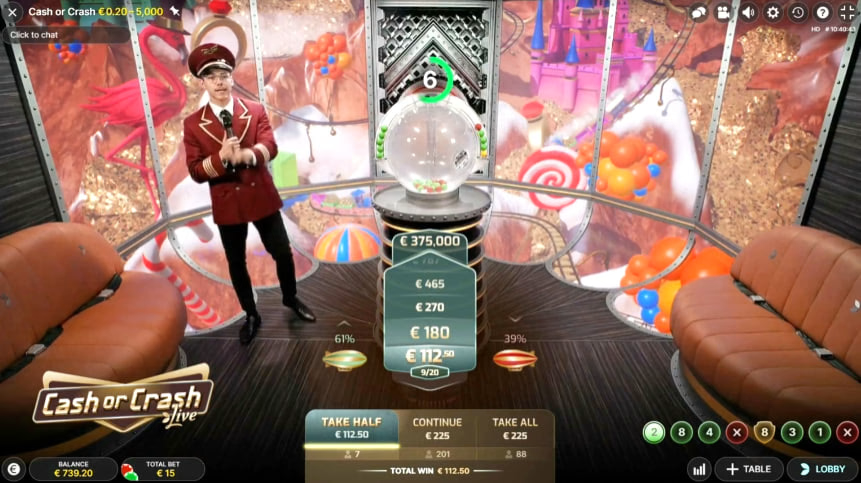
After a green ball, the player normally chooses between Take All, Take Half and Continue. The same decision phase also appears after a Shield has absorbed a red ball and the game returns to normal decision-making. These choices do not influence which ball will be drawn next. They only decide how much of the current value is locked in and how much remains at risk.
Take All vs Take Half vs Continue
| Choice | What you secure | What happens next | Risk effect |
| Take All | Cash out 100% of the current potential winnings | Ends your participation in the current round | Lowest further exposure because nothing remains in play |
| Take Half | Cash out 50% of the current potential winnings | Continue with the remaining 50% | Splits the result between secured value and continued exposure |
| Continue | Cash out nothing at that decision point | Continue with 100% of the current potential winnings | Highest exposure to the next draw |
Take All
Take All is the simplest exit choice. It converts the current potential winnings into cashed-out winnings and removes you from the rest of that round. The trade-off is obvious: you give up any chance to climb to a higher multiplier, but you also stop exposing the current value to a future red ball.
Take Half
Take Half is a partial cash-out. Half of the current potential winnings is secured, while the remaining half stays in the round. The rules allow Take Half to be used more than once when the available amount is high enough. The exact minimum value for this option may be displayed differently across currencies or operator configurations, so the in-game decision panel should be treated as authoritative.
Continue
Continue keeps the full current potential winnings in play. It preserves the largest possible base for the next multiplier step, but it also leaves the entire amount exposed if the next relevant draw ends the round. Continue is therefore a higher-risk choice, not a method for predicting or improving the next ball.
How the Gold Ball and Shield change the round
The gold ball is the key protective feature in Cash or Crash. It moves the player up one level and grants a one-time Shield against a red ball. While the Shield is active, the game enters a quick-drawing phase in which normal player decisions are temporarily skipped until a red ball appears and breaks the Shield.
When a red ball breaks an active Shield, the round does not end. The player remains on the same paytable level. After the next green ball, the published paytable switches to higher post-Shield multipliers. At level 20, the referenced rules show 18,000x before the Shield is broken and 50,000x after it is broken.
Cash or Crash payouts and RTP
Cash or Crash uses a 20-level ladder, so the multiplier increases as the round climbs. The highest published multiplier is 50,000x after the Shield has been broken. Reaching a high level is not guaranteed, and a red ball without an active Shield ends the uncashed part of the round.
The referenced Evolution rules set lists an optimal theoretical RTP of 99.59% at the minimum bet and an RTP range of 94.51% to 99.59%. The lower end is linked in those rules to a maximum payout cap at high bet sizes. Evolution also described the game at launch as having a 99.6% RTP. RTP is a long-run mathematical measure across a large number of plays, not a prediction of what any individual session will return.
Because operators can apply different currencies, stake limits and payout limits, players should check the current in-game rules and paytable before betting. A displayed maximum multiplier is not the same thing as a likely or expected result, and it should never be used as a reason to increase a stake beyond a preset budget.
Which cash-out choice fits different playing styles?
There is no cash-out option that guarantees the best result in every round. Take All, Take Half and Continue change risk exposure, not the random draw itself. A useful way to think about the choices is to match them to a predefined risk limit rather than making the decision only after seeing a larger potential payout.
For a cautious approach
A cautious player may prefer Take All once the current payout reaches a level they had already decided was enough. This removes the temptation to reinterpret the target after every successful green ball. The practical benefit is discipline, not a mathematical guarantee of profit.
For a middle-ground approach
Take Half can suit a player who wants to secure part of the current value while keeping some exposure to the ladder. It still carries loss risk on the portion left in play. Repeated partial cash-outs can also make the round harder to track mentally, so the on-screen total is more reliable than estimating the remaining value from memory.
For a high-risk approach
Continue keeps the entire potential win active and therefore creates the greatest exposure to a future red ball. It may appeal to players who deliberately accept a higher-risk game-show format, but it should not be confused with a stronger strategy. The next draw is not made safer because several green balls have already appeared.
Common Cash or Crash mistakes
- Treating recent rounds as a predictor. Previous game results do not tell you which ball will be drawn in a new round.
- Ignoring the changing ball pool. Balls are removed during the round, so the remaining composition changes as safe balls are drawn.
- Assuming Take Half removes the downside. It only protects the half that was cashed out; the remaining half stays exposed.
- Reading RTP as a session promise. RTP describes theoretical long-run return and does not guarantee a personal result.
- Chasing the 50,000x headline. The maximum multiplier is a possible paytable outcome, not a realistic target for bankroll planning.
- Changing stake size after losses. Raising the bet to recover money increases financial exposure and does not change the randomness of the draw.
Practical checklist before playing
- Open the game information panel and confirm the current stake limits, paytable and payout cap for your operator and currency.
- Set a fixed entertainment budget before placing the first bet.
- Decide in advance what level of loss or cash-out would end the session.
- Understand Take All, Take Half and Continue before the first decision phase appears.
- Do not treat recent green or red streaks as a forecast of the next round.
- Stop if the game is pushing you to increase stakes, chase losses or ignore a limit you set beforehand.
How this information was reviewed
This guide is based on Evolution’s current Cash or Crash product page, Evolution’s published launch information and the Evolution game rules reproduced by operators. The rules were checked for the ball pool, 20-step ladder, Shield behavior, cash-out choices, paytable multipliers and theoretical RTP. Operator-specific stake limits, currency thresholds and availability can change, so those details should always be verified inside the live game before betting.
Cash or Crash should be treated as entertainment, not as a way to make money. RTP, multipliers and the Shield describe how the game is structured, but they do not guarantee a winning session. If gambling stops feeling controlled or enjoyable, the safest decision is to stop playing and use the responsible-gambling tools offered by the operator.
FAQ
What are the basic Cash or Crash rules?
Cash or Crash starts with one bet and a 20-step payout ladder. Green balls move you up, red balls normally end the round, and the gold ball gives a one-time Shield. After most green balls, you choose Take All, Take Half or Continue.
How many balls are used in Cash or Crash?
The published rules list 28 balls at the start of a round: 19 green, 1 gold and 8 red. Drawn balls are kept out of the machine until the round ends, so the composition of the remaining pool changes during play.
What does Take Half do in Cash or Crash?
Take Half cashes out 50% of the current potential winnings and continues the round with the remaining 50%. It reduces exposure but does not make the remaining amount safe from a later red ball.
What happens if a red ball is drawn?
A red ball ends the round when no Shield is active, and uncashed potential winnings are lost. If a Shield is active, the red ball breaks the Shield and the round continues on the same paytable level.
What does the gold ball do?
The gold ball moves the player up one level and activates a Shield. The Shield protects against one red ball, and once it is broken the later paytable can use higher multipliers, including a published maximum of 50,000x at level 20.
What is the RTP of Cash or Crash?
The referenced Evolution rules set lists a theoretical RTP range of 94.51% to 99.59%, with 99.59% stated for the minimum bet. RTP is a long-run theoretical measure and does not predict the return from one session.
Can a player control the outcome by choosing Continue or Take All?
No. Take All, Take Half and Continue control how much current value is secured or left exposed. They do not control which colored ball is drawn next.
Is Cash or Crash available on every online casino?
No. Availability depends on the operator, jurisdiction and local product configuration. Stake limits, currencies and some interface details may also differ, so check the game lobby and rules at the casino you use.
Is 50,000x guaranteed if the Shield appears?
No. The Shield only protects against one red ball and can unlock higher post-Shield multipliers. Reaching the top of the ladder is not guaranteed, and the round can still end on a later red ball.
Short conclusion
Cash or Crash rules are simple to learn but the cash-out decisions create meaningful risk choices. Green climbs, red crashes, gold protects once, and Take All, Take Half or Continue decide how much of the current value remains exposed. The most useful approach is to understand the rules, set limits before the round starts and treat every multiplier as a possible outcome rather than a promise.