
Dream Catcher is a live money-wheel game from Evolution, and the most useful strategy is not a pattern-prediction system. The practical approach is to understand the wheel distribution, prefer bets with the lower mathematical house edge, keep stakes fixed, and treat the 2x and 7x multipliers as random events rather than signals. Under the standard 54-segment layout analyzed for Dream Catcher, the 10 bet has the lowest calculated house edge of the six number bets at about 3.42%. That does not make it profitable. It only makes it less unfavorable than the other available number bets over a very large number of rounds.
Dream Catcher suits players who want a simple live casino game with no card strategy, hand decisions, or complicated side bets. It is less suitable for anyone looking for a reliable way to recover losses, predict the next wheel result, or turn a short bankroll into steady income. Each completed result remains a game-of-chance outcome, and past spins do not create a dependable forecasting edge.
Dream Catcher strategy at a glance
- Best mathematical number bet: 10, based on the commonly analyzed 54-segment wheel and a calculated house edge of about 3.42%.
- Avoid treating 40 as the “best” bet just because it has the largest base payout. Its calculated house edge is higher than the 10 bet.
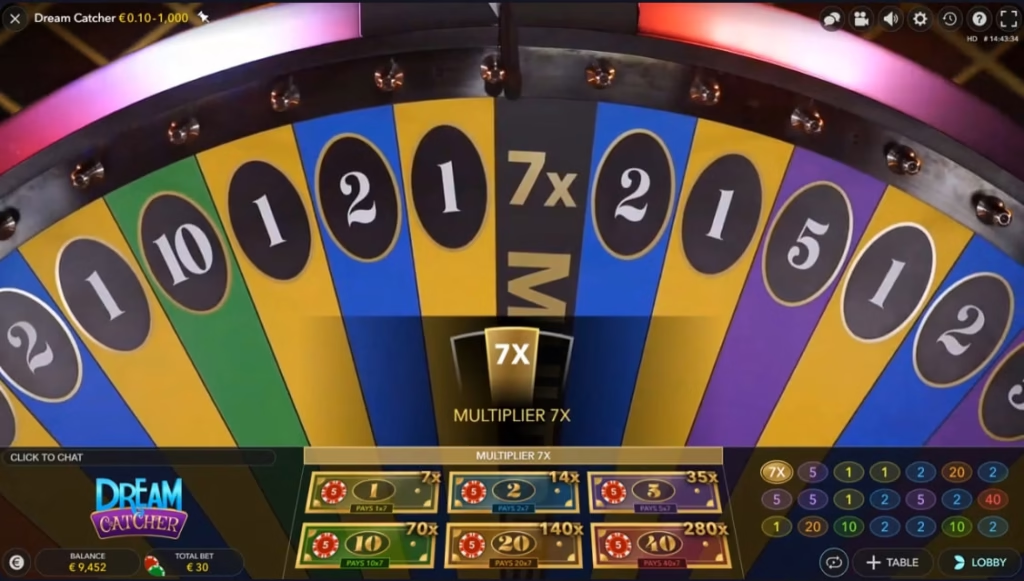
- The 2x and 7x multiplier segments are not bets. They carry existing wagers forward and multiply the eventual winning payout if a number lands afterward.
- Betting on several numbers increases the chance that one of your positions wins, but it also increases the amount exposed on each round.
- No progression system, streak chart, or previous-spin pattern can remove the built-in house advantage.
How Dream Catcher works
Dream Catcher uses a large vertical wheel with 54 equal segments. The numbered outcomes are 1, 2, 5, 10, 20, and 40. Two additional segments are multipliers marked 2x and 7x. Players place wagers on one or more numbered outcomes before betting closes, then the host spins the wheel.
If a numbered segment wins, a wager on that number is paid at corresponding odds. For example, a winning 10 bet pays 10 to 1 in winnings, with the original stake returned separately. If the wheel stops on 2x or 7x, wagers remain in place and the wheel is spun again. A later number result receives the accumulated multiplier. Consecutive multiplier results can multiply together before the final number settles the round.
Standard wheel distribution
| Outcome | Segments | Approx. chance per spin | Base payout |
| 1 | 23 | 42.59% | 1:1 |
| 2 | 15 | 27.78% | 2:1 |
| 5 | 7 | 12.96% | 5:1 |
| 10 | 4 | 7.41% | 10:1 |
| 20 | 2 | 3.70% | 20:1 |
| 40 | 1 | 1.85% | 40:1 |
| 2x | 1 | 1.85% | Multiplier |
| 7x | 1 | 1.85% | Multiplier |
What is the best Dream Catcher betting strategy?
The strongest Dream Catcher betting strategy is to optimize for expected loss rather than chase the biggest displayed payout. Independent mathematical analysis of the standard wheel estimates the house edge at about 3.42% on 10, which is lower than the estimates for 1, 2, 5, 20, and 40. If a player chooses to play, concentrating the main stake on 10 is therefore the clearest math-based choice among the six numbered bets.
This conclusion is about long-run expected value, not the probability of winning the next spin. The 10 segment appears only four times on the 54-segment wheel, so losing runs can occur. A lower house edge does not mean frequent wins, and it does not guarantee that a short session on 10 will perform better than a session on another number.
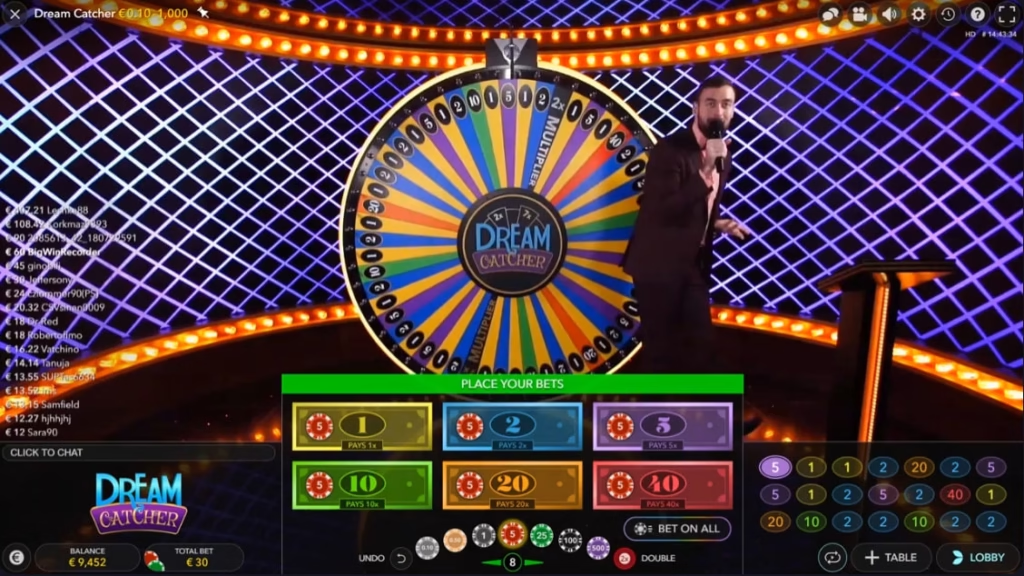
House edge by number bet
| Bet | Calculated house edge | Practical reading |
| 1 | 4.66% | Frequent wheel appearance, but a weaker expected return than 10. |
| 2 | 4.49% | Also relatively frequent, but still not as efficient as 10. |
| 5 | 8.76% | Higher calculated cost despite a medium-size payout. |
| 10 | 3.42% | Lowest calculated house edge among the six number bets. |
| 20 | 7.26% | Rare result with a larger payout and higher expected cost. |
| 40 | 9.19% | Largest base payout, but highest calculated house edge in this comparison. |
These percentages are mathematical estimates for the standard wheel structure and multiplier rules. They describe long-run expectation, not a promised return for any individual session. Casino implementations, limits, or jurisdiction-specific versions should be checked in the live game rules before wagering.
Should you bet only on 10?
Betting only on 10 is the simplest choice if the goal is to minimize the calculated house edge, but it creates a low hit-rate experience. Four of the 54 wheel segments are marked 10, so the number itself appears much less often than 1 or 2. A player who dislikes long stretches without a direct win may find the variance uncomfortable even though the underlying house edge is lower.
A broader spread across 1, 2, and 10 can produce more frequent winning rounds, but that should not be confused with a mathematical advantage. More simultaneous bets mean more money is exposed. Some positions also have worse expected value than 10, so the blended result can carry a higher effective house edge.
How to use the 2x and 7x multipliers
There is no separate betting decision for the 2x and 7x segments. When a multiplier lands, existing number bets remain active and the wheel is spun again. If another multiplier appears, the multipliers can compound before the eventual number result settles the wager. The correct strategic response is therefore not to increase a stake because a multiplier has appeared. The multiplier affects the current unresolved wager, not the probability distribution of a future independent round.
Multiplier sequences create the most dramatic Dream Catcher payouts, which can make them feel like opportunities that can be timed. In practice, a previous 2x or 7x does not provide a reliable reason to raise the next new-round bet. Chasing after a large multiplier sequence is a form of outcome chasing, not an edge.
Flat betting vs. progression systems
Flat betting is the more controlled bankroll method for Dream Catcher because the stake stays constant instead of increasing after losses. A fixed stake does not improve the game’s mathematical expectation, but it makes total exposure easier to estimate and reduces the risk of a progression growing faster than the bankroll.
Martingale-style systems are especially risky in a wheel game because repeated losses can force the required next wager upward quickly. Table limits, personal bankroll limits, and the possibility of a long losing sequence can break the progression before a recovery win arrives. Increasing stakes after losses changes the size of the risk, not the house edge of the underlying bet.
A practical Dream Catcher bankroll plan
A bankroll plan should define the maximum session loss before the first spin. One simple method is to divide the session bankroll into 50 to 100 equal betting units and use one unit as the normal round stake. The exact unit size should be small enough that several losing rounds do not force a decision to chase losses.
- Set a hard session budget that is separate from money needed for bills, debt, savings, or essentials.
- Use a fixed base unit instead of raising bets after losses.
- Decide a stop-loss before play and end the session when it is reached.
- If you set a win target, treat it as a point to leave rather than a signal to increase stakes.
- Do not extend a session because the wheel “looks due” for 10, 20, 40, 2x, or 7x.
The purpose of bankroll rules is damage control, not profit optimization. No staking plan can convert Dream Catcher into a positive-expectation game for the player.
Common Dream Catcher betting mistakes
Chasing the 40 payout
The 40 looks attractive because its base payout is large, but the segment appears only once on the standard wheel and has the highest calculated house edge of the six numbered bets in the referenced analysis.
Assuming frequent numbers are automatically better
The 1 and 2 outcomes appear often, but payout structure matters as much as hit frequency. A high hit rate does not automatically mean a lower house edge.
Reading patterns into recent spins
A sequence such as several 1 results or a long absence of 10 does not make the next 10 “due.” Recent outcomes do not create a dependable prediction rule for the next spin.
Increasing stakes after a multiplier
A 2x or 7x can amplify the current unresolved wager, but it does not justify a larger stake in a later round. The next round still carries the same structural disadvantage.
Confusing coverage with value
Betting on many numbers can make winning rounds more frequent, but the total amount risked also rises. More coverage is a volatility choice, not a way to eliminate the house edge.
Dream Catcher vs. other live wheel games
Dream Catcher is one of Evolution’s earliest live game-show formats and is mechanically simpler than newer wheel games with bonus rounds, random multipliers, or multiple bonus selections. The main decision is only which numbered segment or segments to back. That simplicity makes the game easy to understand, but it also means there is very little strategy beyond bet selection, stake sizing, and session control.
Players who prefer decision-heavy casino games may find blackjack or certain poker-based games more strategic because player choices can affect expected value. Dream Catcher is primarily a probability and bankroll-management game. The wheel result itself is not something the player can influence.
Who Dream Catcher may suit
- Players who want a simple live-hosted game with fast-to-understand rules.
- Players who prefer choosing payout levels rather than learning card strategy.
- Players who accept that multipliers and number results are random and do not try to predict streaks.
- Players who are comfortable using small fixed stakes and strict session limits.
Dream Catcher is a poor fit for anyone who feels pressure to recover losses, needs gambling income, becomes frustrated by losing streaks, or is tempted to raise stakes impulsively. In those situations, not playing is the better decision.
How this information was reviewed
This guide separates official game rules from mathematical strategy analysis. The rules, wheel size, numbered outcomes, and 2x/7x multiplier behavior were checked against Evolution’s current Dream Catcher information. The house-edge comparison is based on an independent probability analysis of the standard 54-segment layout. Before playing, check the in-game rules, payout table, betting limits, and any jurisdiction-specific differences shown by the operator.
House edge describes long-run mathematical expectation and cannot predict a single session. Multipliers can create unusually large wins, but they do not remove the built-in disadvantage. Dream Catcher should be treated as paid entertainment, not as an income method. If play stops feeling controlled or affordable, stop the session and use the responsible-gambling tools available through the casino or local support services.
FAQ
What is the best Dream Catcher casino strategy?
The most defensible math-based strategy is to keep stakes controlled and favor the 10 bet if you want the lowest calculated house edge among the six standard number bets. Independent analysis puts the 10 bet at about 3.42% house edge under the standard 54-segment rules. That still gives the casino a long-run advantage.
Is there a guaranteed Dream Catcher betting strategy?
No. Dream Catcher is a game of chance, and no betting system guarantees a profit. Streak systems, pattern tracking, and loss-recovery progressions change how much you wager, not the underlying probability of the wheel result.
Why is 10 considered the best Dream Catcher bet?
The 10 bet combines four wheel segments with a 10-to-1 payout, and the standard probability analysis produces a lower calculated house edge for 10 than for 1, 2, 5, 20, or 40. A lower house edge means a smaller expected loss over a very large sample, not a higher certainty of winning the next round.
Should I bet on 1 because it lands most often?
Not necessarily. The 1 segment appears most often, but its payout is only 1 to 1. Hit frequency and payout must be evaluated together. The standard mathematical comparison gives 1 a higher house edge than 10.
Are the 2x and 7x multipliers worth chasing?
No separate wager is placed on the multiplier segments, so there is nothing to chase directly. A multiplier keeps current number bets active and multiplies the eventual winning payout. Previous multiplier results do not make another multiplier more predictable.
Does Martingale work on Dream Catcher?
Martingale does not remove the house edge. It can create rapidly increasing stakes during a losing sequence, and table limits or bankroll limits can stop the progression before a recovery win occurs.
Can I predict Dream Catcher from recent results?
Recent spins do not provide a reliable prediction method for the next result. A number being absent for many spins does not mean it is due, and a hot streak does not guarantee continuation.
What is a sensible bankroll for Dream Catcher?
Use only discretionary money that you can afford to lose and choose a unit small enough to survive normal variance without increasing stakes. A practical structure is 50 to 100 fixed units for a session, combined with a predetermined stop-loss. This limits exposure but does not create a winning expectation.
Is Dream Catcher the same as First Person Dream Catcher?
The core concept and number-plus-multiplier rules are closely related, but First Person Dream Catcher is an RNG-based 3D version rather than the live-hosted game. Availability and interface features can differ by operator and jurisdiction.
Brief conclusion
Dream Catcher strategy is mostly about choosing the least unfavorable bet and controlling exposure. On the standard wheel, 10 has the lowest calculated house edge among the six number bets, while 40 has the highest in the commonly cited analysis. Flat stakes, strict limits, and avoiding pattern-chasing are more rational than progression systems. None of these methods guarantee a win, and the game should remain entertainment rather than a way to make money.