Mega Ball vs MONOPOLY Big Baller is mainly a choice between simplicity and layered bonus action. Both are Evolution live game shows built around bingo-style cards and automated ball draws, but Mega Ball keeps the round focused on completing lines and landing a 5x to 100x Mega Ball multiplier, while MONOPOLY Big Baller adds Chance and Free Space cards, several multiplier types, and a separate 3D MONOPOLY board bonus.
For players who want the cleaner and faster format, Mega Ball is usually easier to follow. For players who prefer more moving parts and a stronger game-show feel, MONOPOLY Big Baller offers more ways for a round to develop. Published Evolution live-game RTP tables list Mega Ball at 95.40% and MONOPOLY Big Baller at about 96.1%, but RTP is a long-term theoretical measure and does not predict what will happen in a single session.
Quick comparison
- Mega Ball is the simpler game: 20 of 51 balls are drawn, then one or two Mega Ball bonus draws can apply a 5x to 100x multiplier.
- MONOPOLY Big Baller is more complex: 20 of 60 balls are drawn, with Chance or Free Space cards, multiple multiplier types, and optional 3 Rolls and 5 Rolls bonus bets.
- Published RTP figures favor MONOPOLY Big Baller slightly, at roughly 96.1% versus 95.40% for Mega Ball.
- Mega Ball may suit players who want fast bingo-style rounds without learning many side mechanics.
- MONOPOLY Big Baller may suit players who enjoy bonus layers and a more theatrical live game-show experience.
Mega Ball vs MONOPOLY Big Baller at a glance
| Feature | Mega Ball | MONOPOLY Big Baller |
| Provider | Evolution | Evolution |
| Format | Live bingo-style game show | Live bingo-style game show with MONOPOLY bonus |
| Main draw | 20 of 51 balls | 20 of 60 balls |
| Cards | 5×5 cards; current Evolution how-to page says up to 400 | 1 to 4 Chance or Free Space cards |
| Main multiplier feature | Mega Ball multiplier from 5x to 100x | Standard, Line and Global multipliers |
| Extra bonus | One or two Mega Ball bonus draws | 3 Rolls or 5 Rolls 3D MONOPOLY board bonus |
| Published RTP | 95.40% | About 96.1% |
| Best fit | Simpler, faster rounds | More layered bonus gameplay |
| Mobile | Desktop, tablet and smartphone | Desktop, tablet and smartphone |
How Mega Ball works
Mega Ball uses 5×5 bingo-style cards with a free center square. After betting closes, 20 balls are drawn from a pool of 51. Matching numbers are marked automatically, and completed horizontal, vertical or diagonal lines create the base result for each card.
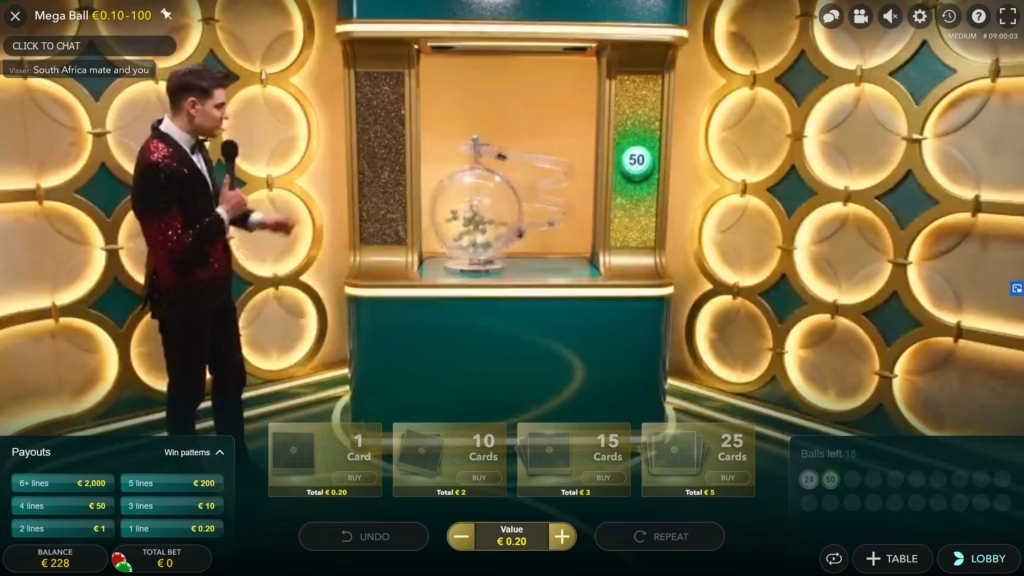
The defining feature comes after the main draw. Evolution generates a Mega Ball multiplier from 5x to 100x, then draws an additional ball. If that Mega Ball completes a winning line, the payout on that card receives the multiplier. A second Mega Ball round can occur, but if more than one Mega Ball contributes to winning lines on the same card, the rules apply only the higher multiplier rather than stacking both.
Mega Ball is therefore easy to understand at a glance: buy cards, watch 20 numbers, then see whether the bonus ball completes a line at an enhanced value. That simplicity is one of its strongest advantages for players who dislike side bets and multi-stage bonus systems.
How MONOPOLY Big Baller works
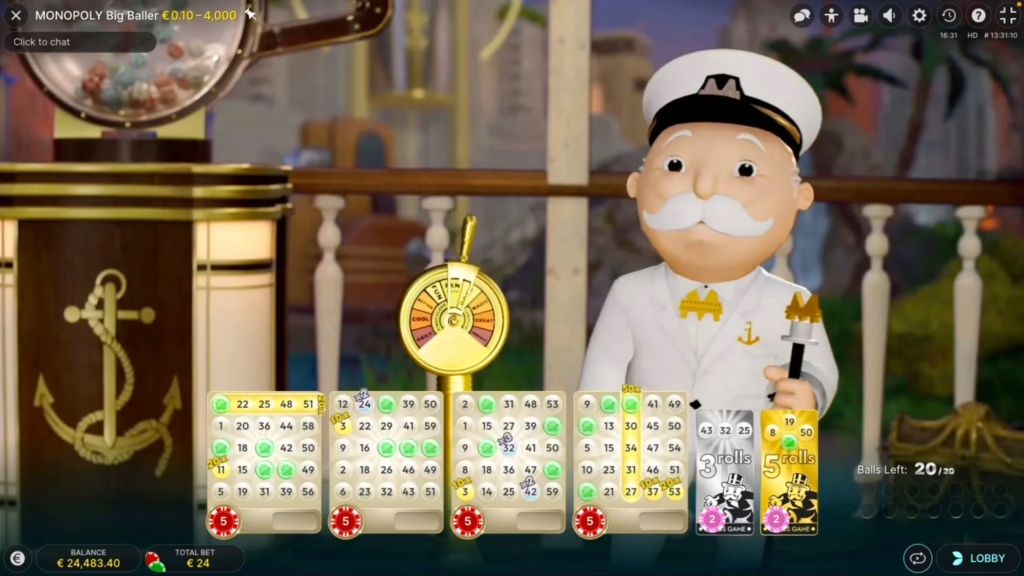
MONOPOLY Big Baller keeps the bingo-style core but adds more decisions before the draw. Players can bet on one to four 5×5 cards and switch each card between Free Space and Chance formats. A Free Space card starts with the center cell already counted as a drawn number, while a Chance card guarantees a multiplier in the center and can gain additional free spaces later.
MONOPOLY Big Baller then adds three multiplier categories. Standard multipliers are 10x or 20x and apply when their numbered square forms part of a winning line. Line multipliers are 20x or 50x and apply to the specified line. Global multipliers are 2x or 3x and can multiply winning lines across the card, including other qualifying multipliers.
The separate Bonus Game is the biggest structural difference. Bets on 3 Rolls or 5 Rolls can qualify a 3D MONOPOLY board round after the 20-ball draw. The bonus uses two dice, MR. MONOPOLY moves around the board, properties carry multipliers, and passing GO doubles the prizes currently on the board. This makes Big Baller feel closer to a full live game show than a straightforward bingo draw.
Which game has the better RTP?
MONOPOLY Big Baller has the slightly higher published theoretical return. A published Evolution live-game RTP table lists Mega Ball at 95.40% and MONOPOLY Big Baller at 96.11%. Some casino interfaces round Big Baller to 96.10%, so the practical comparison is roughly 95.4% versus 96.1%.
That difference does not mean Big Baller will return more money in a short session. RTP is calculated across a very large number of rounds and cannot predict the outcome of the next draw. The cost of the way you actually bet also matters, especially if you buy many Mega Ball cards or cover several Big Baller cards and bonus spots at the same time.
Mega Ball vs Big Baller bonus features
Mega Ball concentrates most of its excitement into one clear event: whether the extra Mega Ball completes a line and activates the 5x to 100x multiplier. The result is easier to read because the player is not tracking multiple card types, bonus qualification spots and different multiplier categories at once.
MONOPOLY Big Baller spreads its bonus potential across the full round. Chance cards can carry Standard, Line and Global multipliers, while 3 Rolls and 5 Rolls create a separate board sequence. The official rules list base line payouts from 2:1 to 39:1 on Free Space cards and 2:1 to 199:1 on Chance cards before the relevant multiplier effects are considered.
For a player comparing spectacle rather than simplicity, Big Baller has the advantage. For a player who wants to understand the key win condition within a few seconds, Mega Ball is the cleaner option.
Which game is better for a smaller budget?
Neither game is automatically better for a small bankroll because the total round cost depends on how many betting units you add. Mega Ball lets players purchase many cards, and Evolution’s current how-to section says the card value can be set from EUR 0.10 to EUR 100 with up to 400 cards available. Buying more cards increases total exposure quickly even when the per-card amount looks small.
MONOPOLY Big Baller can also become expensive if a player covers several cards plus both Bonus Game spots. A useful budget rule is to compare the total amount committed per round, not the smallest displayed chip or card price. Set a fixed session limit first and avoid increasing the number of simultaneous bets simply because the interface makes them easy to add.
Which game is easier for beginners?
Mega Ball is easier for beginners because the core decision is mostly how many cards to buy and what value to assign to them. The draw, line completion and Mega Ball multiplier are visually straightforward, so a new player can understand the round without learning several multiplier categories.
MONOPOLY Big Baller is still accessible, but a beginner has more to track: Chance versus Free Space cards, three multiplier types, the 3 Rolls and 5 Rolls qualification bets, and the MONOPOLY board rules. Players who enjoy learning a feature-rich game may prefer that depth, but it is less immediately transparent than Mega Ball.
Common mistakes when comparing the two games
The first mistake is treating the higher RTP as a short-term advantage. A difference of roughly 0.7 percentage points is meaningful as a theoretical property of the game, but it does not make any individual Big Baller session predictable or safer.
The second mistake is comparing only the advertised minimum bet. Mega Ball can involve many cards, while Big Baller can involve multiple cards and bonus bets. Total round stake is the number that matters for bankroll control.
The third mistake is assuming more multipliers mean better odds. Big Baller has more multiplier mechanics, but they are already part of the game’s mathematical model. Mega Ball’s simpler multiplier system is not inherently worse, and neither format provides a strategy that guarantees profit.
How to choose between Mega Ball and MONOPOLY Big Baller
Choose Mega Ball if you want a faster, cleaner bingo-style game with one main bonus concept. It is usually the better fit for players who value simple rules, quick visual feedback and a direct 5x to 100x multiplier mechanic.
Choose MONOPOLY Big Baller if you want more variety inside each round. It is usually the stronger fit for players who enjoy card choices, layered multipliers, qualification bets and a separate board-based bonus sequence.
If RTP is your main comparison point, Big Baller has the edge on the published figures. If ease of understanding and lower decision load matter more, Mega Ball has the edge. In either case, check the live game’s current rules and limits because operator configurations and regional availability can differ.
How this information was reviewed
This comparison was based on Evolution’s current game pages, Evolution game rules, and published operator RTP documentation for the two live titles. The comparison focuses on verifiable mechanics: ball pools, card formats, multiplier rules, bonus qualification, device support and published theoretical RTP.
Players should still check the in-game help panel before betting because limits, availability and displayed configurations can vary by casino or jurisdiction. RTP describes long-run theoretical return, not a guaranteed result, and neither game should be treated as a way to earn income. Set spending and time limits before playing, and stop if gambling is no longer entertainment.
FAQ
Is Mega Ball the same as MONOPOLY Big Baller?
No. Both are Evolution live bingo-style game shows, but Mega Ball uses a simpler 20-of-51 draw with a 5x to 100x Mega Ball multiplier, while MONOPOLY Big Baller uses 20 of 60 balls, Chance and Free Space cards, several multiplier types, and an optional MONOPOLY board bonus.
Which has the higher RTP, Mega Ball or MONOPOLY Big Baller?
MONOPOLY Big Baller has the higher published theoretical RTP. Published Evolution live-game tables list Mega Ball at 95.40% and Big Baller at about 96.1%. RTP is a long-run mathematical measure and does not predict a particular session.
Which game is easier to play?
Mega Ball is easier to learn because it has fewer layers. Players mainly follow line completion and the Mega Ball multiplier. Big Baller adds card types, three multiplier categories and 3 Rolls or 5 Rolls bonus qualification.
Does Mega Ball have a bonus round?
Yes. After the 20-ball main draw, one or two Mega Ball bonus rounds can occur. A multiplier from 5x to 100x is generated, and an extra ball can multiply a card payout if it completes a winning line.
How does the MONOPOLY Big Baller bonus work?
The Big Baller Bonus Game is triggered through qualifying 3 Rolls or 5 Rolls bets. The bonus uses two dice on a virtual 3D MONOPOLY board, where MR. MONOPOLY collects prizes and multipliers over the available rolls.
Which is better for mobile play?
Both are designed by Evolution for desktop, tablet and smartphone use. The better mobile choice is therefore more about interface preference: Mega Ball is simpler to monitor, while Big Baller displays more simultaneous features.
Can a strategy guarantee wins in either game?
No. Neither Mega Ball nor MONOPOLY Big Baller has a strategy that guarantees wins. The ball draws and bonus outcomes are chance-based, and multiplier features are part of the game mathematics rather than a way to control the result.
Which game should a beginner choose?
Mega Ball is usually the easier starting point because the rules are more compact. A beginner who specifically enjoys feature-rich game shows may prefer Big Baller, but should read the card and bonus rules before betting.
Short conclusion
Mega Ball is the better choice for simplicity, while MONOPOLY Big Baller is the better choice for layered features and a slightly higher published RTP. Mega Ball centers the experience on completing lines and landing a 5x to 100x multiplier. Big Baller adds Chance and Free Space cards, multiple multiplier types, and a separate MONOPOLY board bonus. Choose based on the kind of live game experience you prefer, compare the total cost per round, and treat both games as entertainment rather than a source of income.