
MONOPOLY Big Baller statistics show what happened in previous rounds of Evolution’s live bingo-style game show. A results tracker can reveal how often 3 Rolls and 5 Rolls appeared, the gaps between bonuses, recent multipliers and the history of recorded draws. Those figures describe the past. They do not tell you which bonus will arrive next.
Key points at a glance:
• Each main round draws 20 numbers from a pool of 60.
• The 3 Rolls and 5 Rolls bets qualify through different sets of numbers, not through a spinning wheel.
• Results history is useful for checking records and understanding the game’s pace, not for forecasting wins.
• The published theoretical RTP differs by betting option, even though all bets share the same live draw.
This guide is for players comparing the card game with its Monopoly board bonuses, as well as anyone trying to make sense of a live results page. If you are looking at statistics to recover losses or decide when a bonus is “due,” the history is not a reliable basis for another wager.
What MONOPOLY Big Baller Statistics Actually Show
MONOPOLY Big Baller has two kinds of information worth separating: the numbers drawn in the bingo-style base game and the bonus events attached to 3 Rolls or 5 Rolls. A tracker may combine both in a single timeline, but a round marked “No bonus” can still contain winning lines on ordinary cards.
A useful statistics page typically records the result category, settlement time, any reported bonus multiplier, and the number of rounds since that category last appeared. Some trackers also show the 20 drawn numbers, a searchable archive or a replay. The completeness of that information depends on the feed and on what the tracker stores.
A displayed multiplier deserves special care. It may refer to a reported bonus-round result or a high result associated with the table, not the return that every player received. Card selections, completed lines and individual stakes can change a player’s payout within the same round.
How the Game Produces Its Results
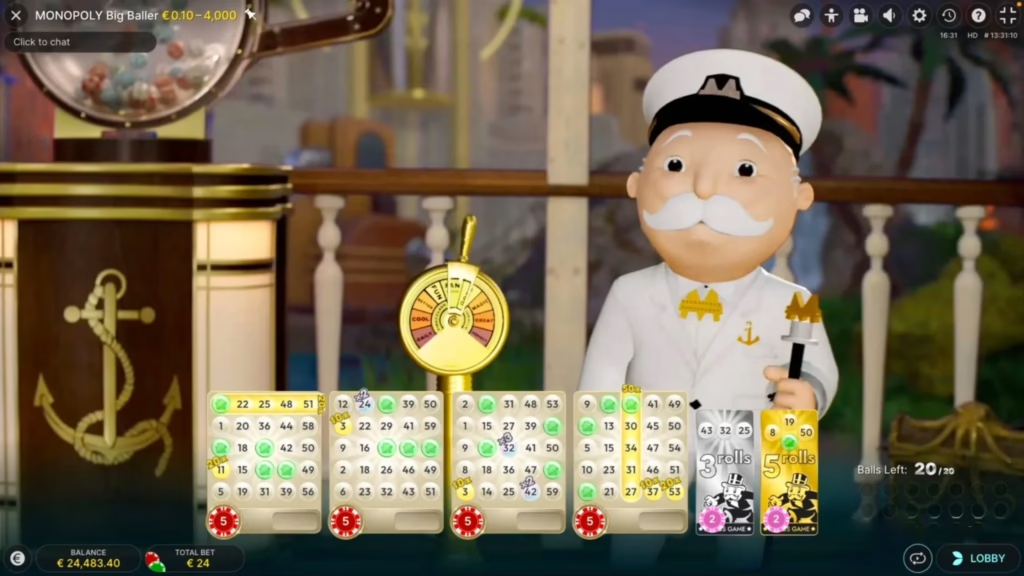
The 20-Ball Draw and the 5×5 Cards
Evolution’s MONOPOLY Big Baller lets players wager on one to four 5×5 cards. Numbers are generated from 1 to 60, and the machine draws 20 distinct balls after betting closes. Matching numbers are marked automatically. A completed line produces a card win under the game’s payout rules.
Before the draw, the game can add random free spaces, known as daubs, and multipliers. That matters when reading a statistics chart: a simplistic calculation based only on 20 drawn balls may miss effects created before the draw begins.
Free Space vs Chance Cards
A Free Space card begins with its center square marked, making a completed line easier to achieve. A Chance card instead has a guaranteed multiplier in the center, potentially changing the size of a qualifying payout. More free spaces or multipliers may be assigned later.
Neither card type changes what balls the machine draws. The distinction is how your particular card can turn those same numbers into a payout. A history of drawn numbers alone cannot reconstruct every possible card win.
How to Read MONOPOLY Big Baller Results History
Start with the timestamp and the result label. Then check the tracker’s reporting rules before comparing two entries. The following fields answer different questions.
| Tracker field | What it tells you | What it does not tell you |
| Time or round ID | When a recorded round settled | Whether the feed captured every intervening round |
| No Bonus | Neither listed board bonus was recorded | Whether standard bingo cards won |
| 3 Rolls | The 3 Rolls bonus qualified | What your personal stake returned |
| 5 Rolls | The 5 Rolls bonus qualified | That the next bonus will arrive soon |
| Reported multiplier | A recorded bonus or table-level result | A universal payout for all players |
| Rounds since last hit | The length of a past gap | The probability of the next round changing |
For accurate comparisons, use the same table, time zone and sample window. A seven-day chart and a thirty-day chart are not contradictory merely because their percentages differ. One covers a smaller sequence of random outcomes.
A Real Historical Statistics Snapshot
An independent Cassino Stats archive displayed the following 30-day sample as of October 31, 2026. It covered 31,363 recorded MONOPOLY Big Baller rounds. These are historical observations, not live counts or official probabilities.
| Recorded outcome | Rounds | Share of sample |
| No bonus | 29,769 | 94.9% |
| 3 Rolls | 1,158 | 3.7% |
| 5 Rolls | 436 | 1.4% |
In this sample, the ordinary no-bonus outcome dominated the timeline. The 3 Rolls result appeared more frequently than 5 Rolls. These figures can help explain why a session may contain many standard rounds between board bonuses. They cannot establish a timing system, and another date range can show different proportions.
The archive also reported a 513x 5 Rolls record on October 4, 2026. That figure is a recorded event in one tracker, not a published maximum multiplier or a payout a new player should expect. Large historical results are often the most eye-catching part of a tracker and the least useful for estimating an individual session.
3 Rolls and 5 Rolls Bonus Statistics Explained
The two board-bonus bets have separate qualification rules. According to Evolution, 3 Rolls requires all three of its unique numbers to be marked, while 5 Rolls requires all four of its unique numbers. A qualifying bonus begins after the twenty-ball draw, and pre-draw free spaces can help mark bonus numbers.
| Bonus bet | Numbers required | Initial dice rolls |
| 3 Rolls | Three unique numbers | Three |
| 5 Rolls | Four unique numbers | Five |
The bonus game moves Mr. Monopoly around a virtual board with property multipliers. Dice doubles can add rolls. Passing GO doubles the prizes on the board. Chance, Community Chest, taxes and Jail can affect what happens during the bonus sequence. As a result, even two 3 Rolls events can finish with very different values.
A tracker might report “3 Rolls last seen 40 rounds ago.” This is a description of elapsed rounds, not a countdown. A bonus that has been absent for longer than usual is not owed to the table. Nor does a recent 5 Rolls outcome make another one impossible.
Understanding Multipliers and Payouts
The base game contains several multiplier types, and they do not all work in the same way. Evolution describes Standard multipliers of 10x or 20x that apply when their number is drawn as part of a winning line. Line multipliers of 20x or 50x depend on completing a specified line. Global multipliers of 2x or 3x can multiply a winning card’s other eligible multipliers.
That makes the distinction between a card multiplier and a board-bonus multiplier important. A 20x marker on an unfinished bingo line does not automatically award 20 times the bet. Likewise, seeing a 100x bonus in a tracker does not mean every Chance or Free Space card received 100x.
The operator-hosted rules published by Loto-Québec state that a winning card without multipliers pays a base 3x. If two lines win without multipliers, their base payouts add to 6x. Where a Standard or Line multiplier applies, it replaces the corresponding base multiplier rather than simply being added to it. Check the active game’s help screen for the exact settlement rules on your table.
RTP vs Observed Results: They Are Not the Same Metric
Return to player, or RTP, is a theoretical long-run percentage of stakes returned across many outcomes. It is not the chance that the next ball, line or bonus will win. A tracker measures events it has observed, while RTP comes from the game’s mathematical payout model.
The documented configuration in Loto-Québec’s MONOPOLY Big Baller rules lists these bet-specific values:
| Betting option | Documented theoretical RTP | Payout description |
| Free Space card | 96.10% | 2 to 39:1 per line |
| Chance card | 96.10% | 2 to 199:1 per line |
| 3 Rolls | 95.80% | Board bonus game |
| 5 Rolls | 95.20% | Board bonus game |
The figures describe that rulebook’s configuration. Operators may have different limits or terms, so verify the RTP and help file in the game you are actually opening. An RTP of 96.10% does not mean you will get back 96.10% of a short session’s wagers. Actual results can vary widely.
The two card types have the same listed RTP but distribute their potential wins differently. Free Space favors line completion through its pre-marked center; Chance emphasizes multiplier opportunities. The two bonus bets offer a more concentrated board-game experience with lower listed RTPs in this configuration. More dramatic payouts are not evidence of better value.
Where to Find Results and How to Judge a Tracker
For the rules, start with Evolution’s MONOPOLY Big Baller game information and the Help or Paytable menu inside your operator’s live table. For extended histories, independent services such as Cassino Stats and Spinlogs publish archives and bonus summaries. They are third-party trackers, not Evolution’s official result certification.
Before relying on a statistics page, check four things: when it last updated, which time zone it uses, whether it reports missing rounds, and what a “multiplier” means in its data. A chart that calls itself live but shows an old settlement time is not current. A record with collection gaps should not be treated as a complete history.
For comparing play options, also inspect the casino’s available stakes, game access in your jurisdiction, any promotional conditions, and the relevant game rules. A visually appealing tracker is not proof that the casino offering the game is suitable for you.
Common Mistakes When Reading the Numbers
The most damaging mistake is treating “rounds since last hit” as a signal that a bonus is due. MONOPOLY Big Baller’s ball draw is random, and an earlier sequence does not create a debt for the next one. A hot-streak indicator merely labels a past cluster.
Another mistake is confusing frequency with RTP. A result can happen relatively often while paying less, and a rare result can pay more without improving the wager’s theoretical return. Both how often a bet wins and how much it pays matter.
A third error is comparing trackers that use different definitions. One might show the largest multiplier associated with a round; another might display only a board-bonus multiplier. Compare their methodology before deciding that one has captured a bigger win.
Finally, do not assume a bonus history can validate your own settlement. If you are checking a disputed payout, use your casino’s transaction record, the game round ID and the operator’s support process. Public trackers may be incomplete or lack your individual bet details.
Practical Ways to Use the Statistics
Use result archives as a reference, not an entry signal. If you want to understand the rhythm of the game, look at a broad sample of ordinary rounds and bonus appearances instead of selecting a single spectacular result. Check the sample size and date before repeating any percentage.
If you decide to play, select the bet type because its rules and stakes suit your entertainment budget, not because a graph appears to promise a turnaround. Compare Free Space, Chance, 3 Rolls and 5 Rolls in the game’s own paytable. Set a fixed spending limit and an end time before opening a real-money table. Avoid raising stakes after losses to chase a board bonus.
Watching a free-play presentation, where available, may help you understand the cards and bonus animations without placing real-money bets. Availability depends on jurisdiction and operator. If gambling stops feeling recreational, stop rather than trying to recover losses through more rounds.

How This Information Was Reviewed
The game mechanics and multipliers in this guide were checked against Evolution’s game materials, while the RTP and base payout examples were checked against Loto-Québec’s hosted rules. The dated statistics example is identified as third-party historical data rather than an official or ongoing live count. Rules, stakes, data feeds and operator availability can change.
No result archive can prove that the next round will win, and no theoretical RTP can guarantee the return of an individual session. MONOPOLY Big Baller is a casino game to approach as entertainment, not as a way to earn money.
FAQ
Where can I check MONOPOLY Big Baller results history?
Independent results trackers offer searchable timelines, bonus frequencies and recorded multipliers. Check their last update time and missing-data policy. For your own payouts, the casino’s game history and round ID are more authoritative.
How often does 3 Rolls appear in MONOPOLY Big Baller?
The observed rate varies with the period and completeness of the feed. In one third-party 30-day snapshot ending October 31, 2026, 3 Rolls appeared in 1,158 of 31,363 recorded rounds, or about 3.7%. This does not predict the next event.
How often does the 5 Rolls bonus hit?
The same historical sample recorded 436 5 Rolls results across 31,363 rounds, about 1.4%. That figure is a sample observation, not a universal fixed frequency or a reason to increase your stake.
Can MONOPOLY Big Baller statistics predict the next bonus?
No. Historical frequencies, streaks and gaps tell you what a tracker recorded, not what the next random draw will produce. A long dry spell is not evidence that a bonus is overdue.
What is the RTP of MONOPOLY Big Baller?
The Loto-Québec-hosted rules list 96.10% for Free Space and Chance cards, 95.80% for 3 Rolls and 95.20% for 5 Rolls. Confirm the values displayed in your casino’s active game rules, as RTP is theoretical and not a session guarantee.
Does a No Bonus result mean nobody won?
No. “No Bonus” generally means the recorded board-bonus outcomes did not trigger. Players may still win on completed Free Space or Chance card lines during the ordinary draw.
Do all players receive the same multiplier in a round?
No. Players can wager on different cards and betting options, so their settlements may differ. A tracker-wide or bonus-round multiplier should not be mistaken for every individual’s return.
Is MONOPOLY Big Baller the same as MONOPOLY Live?
No. Both are Evolution games using Monopoly branding and a board-bonus theme, but MONOPOLY Big Baller starts with a bingo-style 20-ball draw. MONOPOLY Live uses a different core game format. Keep their results histories separate.
Short Takeaway
MONOPOLY Big Baller statistics are best used to understand recorded draws, compare the relative appearance of 3 Rolls and 5 Rolls, and verify a historical result. For betting decisions, the game’s current rules, payout table and your spending limits matter more than any streak chart. Past results cannot predict future wins.