
No KYC crypto casinos are online casinos that allow players to create an account, deposit cryptocurrency, and in some cases withdraw funds without submitting identity documents during the normal registration process. The important distinction is that “no KYC” rarely means verification can never be requested. Many operators reserve the right to ask for identification when certain withdrawal limits, security checks, regulatory obligations, or account reviews are triggered.
Quick takeaways
- No KYC usually means no routine document verification at sign-up, not guaranteed anonymity forever.
- Some casinos require only an email address or username, while others support direct crypto-wallet access.
- Bitcoin, USDT, Ethereum, Litecoin, and other cryptocurrencies may be available, but supported networks and fees vary by operator.
- A casino can request KYC later if its terms allow verification for withdrawals, security, AML checks, or unusual account activity.
- Players should check licensing, withdrawal rules, restricted countries, wallet networks, and KYC triggers before depositing.
No KYC crypto casinos are mainly attractive to players who value faster registration and prefer not to upload passports, utility bills, or selfies unless necessary. Players who prioritize strong regulatory protection and formal dispute procedures may prefer fully verified casinos operating under stricter local licensing systems.
What Is a No KYC Crypto Casino?
A no KYC crypto casino is a gambling site where the standard account-opening process does not require traditional Know Your Customer documentation. Registration may involve an email address, username, password, crypto wallet, or another lightweight authentication method instead of an immediate passport or proof-of-address check.
The term should not be confused with a promise of complete anonymity. A casino can know less about a player during registration while still collecting technical or transactional information such as IP data, device information, wallet addresses, deposit records, and account activity.
Crypto casinos without verification also exist on a spectrum. One operator may allow deposits and normal withdrawals without documents but reserve verification for exceptional situations. Another may let players register without KYC while imposing a verification threshold for larger withdrawals. Reading the casino’s verification policy matters more than relying on the “no KYC” marketing label.
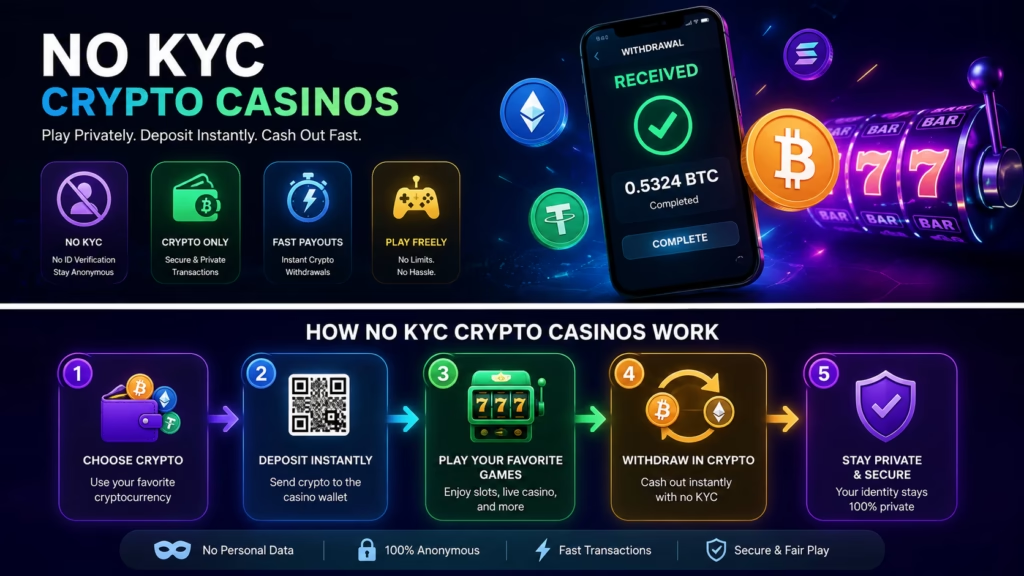
How No KYC Crypto Casinos Work
The typical no KYC process is simpler than traditional casino onboarding.
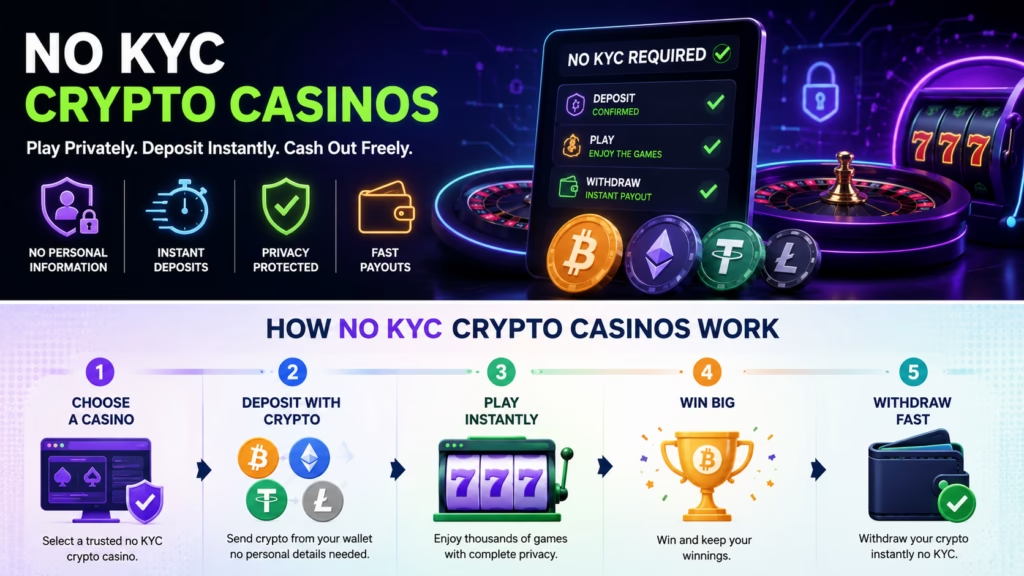
A player creates an account or connects a supported wallet, selects a cryptocurrency, and sends funds to the deposit address provided by the casino. After the required blockchain confirmations, the balance becomes available for casino games.
Withdrawals usually reverse the process. The player enters a wallet address, selects the amount, and requests a cryptocurrency payment. The casino may process the withdrawal automatically or review it before releasing the transaction.
- Create an account or connect a crypto wallet.
- Select a cryptocurrency and blockchain network.
- Copy the casino deposit address.
- Send the crypto from a compatible wallet.
- Wait for the required network confirmations.
- Play casino games using the deposited balance.
- Request a withdrawal to a compatible wallet.
- Complete additional checks if the casino legitimately requires them under its terms.
The last step is why players should never assume that “no KYC” guarantees document-free withdrawals under every circumstance.
Can a No KYC Casino Ask for Verification Later?
Yes. A casino advertised as no KYC may still request verification later if its terms permit it or applicable rules require it.
Possible triggers can include unusual account activity, account-security concerns, large transactions, sanctions screening, payment ownership questions, duplicate accounts, bonus investigations, age or location concerns, or other compliance checks.
This distinction is especially important for withdrawals. Before depositing, players should look for sections titled KYC Policy, AML Policy, Verification, Withdrawal Policy, Terms and Conditions, or similar wording.
Jurisdiction also changes what is possible. For example, Great Britain’s Gambling Commission requires licensed remote operators to establish a customer’s identity before allowing that customer to gamble. Current rules require verification including name, address, and date of birth.
Curaçao also places gambling operators within an AML/CFT framework that includes identification requirements and supervision by the Curaçao Gaming Authority.
For this reason, “no KYC” is an operator- and jurisdiction-specific model, not a universal regulatory category.
No KYC vs Standard KYC Crypto Casinos
| Feature | No KYC Crypto Casino | Standard KYC Crypto Casino |
| Registration | Usually minimal | Personal information normally required |
| Documents at sign-up | Often not requested | May be required |
| Crypto deposits | Common | Common at crypto-friendly operators |
| Later verification | Possible | Expected |
| Registration speed | Usually faster | Can take longer |
| Privacy | More limited data requested initially | More identity data collected |
| Large withdrawal checks | May occur | More likely to follow established verification procedures |
| Availability | Depends heavily on jurisdiction | More common in tightly regulated markets |
A no KYC casino is therefore mainly a different onboarding model, rather than a completely different form of gambling.
Are No KYC Crypto Casinos Anonymous?
No KYC crypto casinos can reduce the amount of personal documentation submitted directly to the casino, but they should not automatically be described as anonymous.
Most major cryptocurrencies use public blockchains. Wallet addresses do not necessarily display a person’s legal name, but transfers can remain permanently visible on the blockchain. A transaction can also interact with exchanges or payment services that already know the wallet owner’s identity.
The more accurate description is usually privacy-oriented or reduced-verification gambling, rather than completely anonymous gambling.
Players should also avoid assuming that using a VPN, alternative wallet, or different cryptocurrency overrides casino restrictions. Circumventing geographic or account rules can violate an operator’s terms and may create problems when a withdrawal is reviewed.
Which Cryptocurrencies Can No KYC Casinos Support?
Supported cryptocurrencies depend on the operator. Common possibilities include:
- Bitcoin
- Ethereum
- Tether
- USD Coin
- Litecoin
- Dogecoin
- Tron
- Bitcoin Cash
- Solana or other supported networks
Stablecoins such as USDT or USDC can appeal to players who want to reduce exposure to rapid cryptocurrency price movements while their casino balance is held in crypto.
Network selection is just as important as the coin itself. For example, the same stablecoin can exist on several blockchains. Sending funds through an unsupported network can cause delays or permanent loss, depending on whether the operator can recover the transaction.
Always match the coin, network, and deposit address before sending cryptocurrency.
How to Choose a No KYC Crypto Casino
The strongest no KYC casino is not simply the operator asking for the least information. Withdrawal reliability, transparent rules, licensing information, game fairness, and account security matter more.
Check the KYC policy before depositing
Search the terms for situations in which identity verification can be requested. Pay particular attention to withdrawal thresholds, enhanced verification, source-of-funds checks, payment ownership, and suspicious activity provisions.
If a casino advertises “no verification” but its terms allow unrestricted document requests without explaining the circumstances, the marketing claim provides little practical certainty.
Review withdrawal limits
Withdrawal rules can matter more than deposit limits.
- minimum withdrawal;
- maximum withdrawal per transaction;
- daily, weekly, or monthly limits;
- progressive jackpot payment rules;
- manual review requirements;
- cryptocurrency withdrawal fees;
- expected processing procedure.
A high balance is much less useful if the operator allows only small withdrawals or has unclear payment conditions.
Verify the casino’s licensing information
A casino should clearly identify the company operating the site and any licence it claims to hold. Licensing does not eliminate gambling risk, but it gives players more information about the rules under which the operator is supposed to operate.
Do not rely only on a licence logo in the footer. Where possible, confirm licensing details through the regulator’s own records.
Check country restrictions
A worldwide crypto casino is not necessarily legal or available everywhere.
Online gambling laws differ significantly between countries and sometimes between states or provinces within the same country. Players are responsible for checking whether online casino gambling and the specific operator are permitted where they live.
Using technology to bypass a casino’s restricted-country policy can also breach its terms.
Examine game fairness
For traditional casino games and slots, check which recognized software providers supply the games and whether information about RTP, game rules, and testing is available.
For blockchain-based games, some operators offer provably fair systems. Provably fair technology can allow players to verify that a cryptographic process was used to generate or commit to game outcomes, but it does not make the game profitable or remove the house edge.
Review security
A low-verification account still needs strong account protection.
Useful features can include:
- two-factor authentication;
- withdrawal-address controls;
- login alerts;
- session management;
- anti-phishing tools;
- clear account-recovery procedures.
Players keeping significant balances online should also understand that a casino account is not the same as self-custody in a personal cryptocurrency wallet.
No KYC Casino Bonuses
No KYC crypto casinos may offer deposit bonuses, cashback, free spins, reload promotions, or cryptocurrency-specific rewards.
The headline bonus amount is less important than the conditions attached to it.
Check wagering requirements, eligible games, maximum bets while wagering, withdrawal limits, minimum deposits, excluded payment methods, expiry periods, and any maximum amount that can be converted from bonus funds to withdrawable funds.
A large bonus with restrictive conditions can be less useful than a smaller promotion with clearer rules.
Bonus availability and conditions depend on the casino and player location, so current terms should always be checked before opting in.
Common No KYC Crypto Casino Mistakes
Assuming no KYC means no verification forever
This is one of the most important misconceptions. “No KYC” can simply mean that documents are not routinely requested at registration.
Depositing before reading withdrawal terms
Players often focus on deposits because crypto payments can be fast. Withdrawal rules are more important because they determine how funds can leave the casino.
Sending crypto over the wrong network
A correct wallet address does not guarantee a correct transfer if the selected blockchain network is unsupported.
Treating crypto as completely anonymous
Public blockchain transactions can remain traceable even when a wallet address does not display a legal identity.
Ignoring local gambling laws
Cryptocurrency does not automatically make an online casino legal in a player’s jurisdiction.
Keeping more money in a casino account than necessary
Casino balances involve operator risk. Cryptocurrency held inside a casino account is normally controlled according to the operator’s custody and withdrawal systems rather than the player’s personal wallet keys.
Who Might Prefer a No KYC Crypto Casino?
No KYC crypto casinos may suit experienced cryptocurrency users who understand wallet addresses, blockchain networks, transaction fees, confirmations, and private-key security.
They can also appeal to players who want a short registration process and prefer limiting unnecessary document sharing.
A standard regulated casino may be a better fit for someone who values formal local consumer protections, established verification procedures, or regulator-backed complaint mechanisms more than minimal onboarding.
Neither format changes the underlying nature of casino games. Random games remain uncertain, and using cryptocurrency does not improve the mathematical probability of winning.
How This Information Was Reviewed
The practical criteria for evaluating no KYC crypto casinos include verification rules, withdrawal conditions, operator information, jurisdiction restrictions, cryptocurrency networks, account security, game transparency, bonus terms, and responsible gambling controls.
Casino policies can change, so players should confirm the current terms directly before depositing. A “no KYC” statement should never be interpreted as proof that identification cannot be requested later.
Crypto payments also do not change RTP, house edge, volatility, or random game outcomes. Casino gambling should be treated as paid entertainment rather than a method of earning money. Set spending and time limits before playing, never gamble with money needed for essential expenses, and stop if gambling stops being recreational.
FAQ
What are no KYC crypto casinos?
No KYC crypto casinos are online casinos that normally allow registration and crypto deposits without requiring identity documents during the standard sign-up process. Some can still request verification later under their terms or regulatory obligations.
Can I withdraw from a crypto casino without verification?
Some casinos allow normal cryptocurrency withdrawals without document verification, but this is not guaranteed. Withdrawal size, account activity, security checks, AML procedures, or other conditions can trigger additional verification.
Are no KYC crypto casinos completely anonymous?
No. Reduced identity verification does not guarantee anonymity. Public blockchain transactions can be traceable, and casinos may collect wallet addresses, IP information, account activity, and other technical data.
Are no KYC crypto casinos legal?
Legality depends on the player’s jurisdiction and the operator’s regulatory status. Some regulated markets require identity verification before gambling, while other jurisdictions use different rules. Players should check local law and the casino’s permitted-country list before registering.
Why would a no KYC casino request my ID?
A no KYC casino may request identification because of account-security concerns, transaction reviews, regulatory obligations, withdrawal checks, suspected duplicate accounts, payment ownership questions, or other circumstances described in its terms.
Which crypto is best for casino deposits?
There is no single cryptocurrency that is best for every player. Transaction cost, network speed, price volatility, wallet support, casino compatibility, and withdrawal options all matter. Stablecoins may reduce price volatility, while other networks may offer lower transaction costs.
Do crypto casinos pay withdrawals faster than regular casinos?
Crypto can reduce the time required for the payment network to transfer funds, but casino processing time still matters. A withdrawal may remain pending while the operator performs internal reviews, security checks, bonus checks, or verification.
Does no KYC mean I can bypass country restrictions?
No. A no KYC policy does not remove geographic restrictions. Trying to conceal a restricted location can violate casino terms and may create problems with account access or withdrawals.
Are provably fair games guaranteed to pay?
No. Provably fair systems are designed to provide a method for verifying aspects of game-result generation, not to guarantee winning outcomes. House edge still applies where relevant, and individual results remain uncertain.
Can no KYC crypto casinos be used to make money?
Casino gambling should not be treated as a reliable source of income. Crypto payments and reduced verification do not change the mathematical advantage built into casino games. Set limits, treat gambling as entertainment, and never chase losses.
Quick Conclusion
No KYC crypto casinos can provide faster registration and reduce the amount of identity documentation requested upfront, but no KYC does not necessarily mean no verification ever.
Before depositing, check exactly when KYC can be triggered, who operates the casino, its licensing information, withdrawal limits, restricted countries, supported crypto networks, security features, game rules, and bonus conditions. A transparent withdrawal and verification policy is more valuable than an aggressive promise of “anonymous gambling.”
Cryptocurrency can change how casino payments are made. It does not remove gambling risk, change the house edge, or guarantee winnings.