
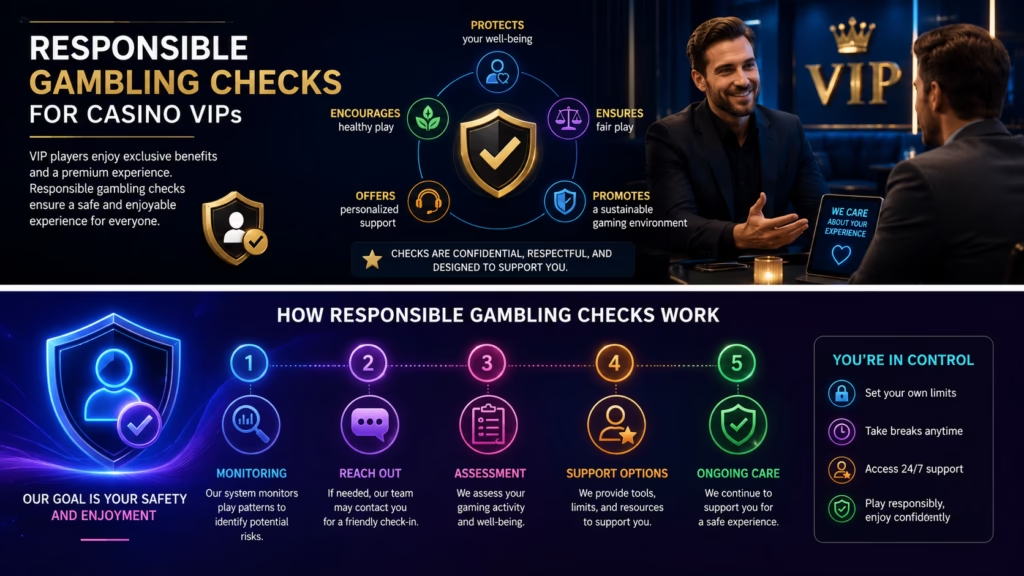
Responsible gambling checks for casino VIPs are used to determine whether a high-spending player can continue gambling, receive VIP incentives or access higher limits without creating an unacceptable risk of financial or gambling-related harm. Depending on the casino’s licence, these checks may review spending patterns, affordability, source of funds, gambling behaviour, account activity and signs of financial vulnerability.
High-value customer checks are not identical worldwide. A casino licensed in Great Britain may operate under different requirements from an MGA-licensed casino or a Dutch operator. Players should therefore check the casino’s licence, responsible gambling policy and VIP terms rather than assuming that one universal threshold applies.
Key points for casino VIPs:
- High spending can trigger additional checks even if an account has already passed standard KYC verification.
- Affordability, responsible gambling and source-of-funds checks serve different purposes.
- A casino may ask questions or request documents before granting or continuing VIP benefits.
- Passing identity verification does not automatically mean a player qualifies for higher gambling limits.
- VIP status does not exempt a player from deposit limits, responsible gambling controls or regulatory checks.
In Great Britain, the Gambling Commission treats high-value customers as potentially higher risk because of their level of spending, gambling frequency or both. Its HVC guidance expects operators offering VIP incentives to consider affordability, safer gambling and enhanced due diligence before accepting a customer into a high-value programme.
What Are Responsible Gambling Checks for Casino VIPs?
Responsible gambling checks for casino VIPs are reviews designed to identify whether high levels of gambling may be associated with financial difficulty, loss of control or other signs of harm. The purpose is not simply to verify that a player has money. A responsible gambling assessment considers whether the customer’s activity remains sustainable and whether their behaviour creates additional risk.
- deposits and withdrawals;
- changes in deposit frequency;
- increasing gambling expenditure;
- session length;
- repeated attempts to increase limits;
- failed deposits;
- changes in payment methods;
- chasing losses;
- repeated time-outs or previous self-exclusion;
- communications suggesting financial or personal difficulty.
For British remote operators, customer monitoring can include spend, patterns of spend, time spent gambling, behavioural indicators, customer contact, use of gambling-management tools and account indicators.
A large deposit by itself does not prove that someone has a gambling problem. Equally, a wealthy customer is not automatically low risk. Operators are generally expected to consider several pieces of information together rather than judging a player solely by apparent income or VIP status.
Why Casino VIPs Receive More Checks
Casino VIPs can attract additional scrutiny because high-value programmes combine substantial gambling activity with bonuses, rewards, account managers, hospitality or preferential treatment. This creates a potential conflict if commercial incentives encourage a customer to continue gambling when their behaviour indicates financial or gambling-related harm.
The British Gambling Commission states that high-value customers present heightened risk because they are more heavily engaged through spend, frequency or both. Before a customer is treated as an HVC, its guidance expects an assessment of affordability, safer gambling risk and enhanced due diligence.
This means a casino may refuse VIP status even when the customer has sufficient funds available at that moment. The casino may consider whether the level of gambling appears sustainable rather than simply whether a bank balance can cover another deposit.
Affordability Checks vs Responsible Gambling Checks
A high value customer affordability check asks whether the customer’s level of gambling appears financially sustainable. A responsible gambling check looks more broadly at whether gambling behaviour indicates harm or increased vulnerability.
The two can overlap, but they are not identical.
| Check | Main purpose | What may be reviewed |
| Affordability or financial sustainability | Assess whether gambling expenditure appears financially sustainable | Income, disposable resources, financial circumstances, expenditure patterns |
| Responsible gambling assessment | Identify possible gambling-related harm | Spend escalation, chasing losses, session length, limit changes, account behaviour |
| Financial vulnerability check | Identify signs of financial difficulty | Bankruptcy, judgments, debt-related public records or other permitted financial data |
| Source of funds | Establish where gambling money originates | Salary, business income, investment proceeds, savings or another legitimate funding source |
| Enhanced due diligence | Assess wider compliance risk | Identity, occupation, transactions, source of funds and risk profile |
Players often describe all of these processes as affordability checks, but regulators may use narrower definitions.
For example, the British Gambling Commission distinguishes Financial Risk Assessments from traditional affordability checks. In July 2026, it confirmed a staged introduction of FRAs aimed specifically at identifying high-spending customers in current financial difficulty.
What Can Trigger a VIP Casino Check?
A VIP check can be triggered by spending levels, behavioural changes or compliance requirements. There is no worldwide trigger that applies to every online casino.
- Applying for VIP or high-value customer status. Some operators conduct additional checks before providing personalised incentives or higher-value rewards.
- A sudden increase in deposits. Moving quickly from moderate deposits to substantially larger amounts can change the account risk profile.
- Increasing deposit or loss limits. Operators may examine whether the requested increase appears reasonable given the information available about the customer.
- Unusual gambling patterns. Longer sessions, increasingly large wagers, chasing losses or rapid redepositing may result in a safer gambling interaction.
- Financial vulnerability indicators. Certain regulatory systems require checks when financial thresholds are reached.
- Source-of-funds concerns. Deposits that appear inconsistent with a player’s known occupation or financial profile can lead to additional compliance questions.
- Previous responsible gambling activity. Earlier time-outs, self-exclusion, repeated limit changes or previous interventions can influence subsequent risk assessments.
What Documents Can a Casino Ask a VIP Player to Provide?
Casino VIP verification may require financial evidence when automated or publicly available information does not provide enough assurance. The exact documentation depends on the jurisdiction, operator and reason for the review.
Possible requests can include bank statements, proof of income, employment information, business records, investment documentation or evidence explaining a specific source of funds. Some operators may use open-banking processes instead of asking customers to upload multiple documents.
The important distinction is that documents should relate to the question the casino is trying to answer. A source-of-funds review is intended to understand the origin of money being used for gambling, while an affordability review focuses more on whether the gambling expenditure appears sustainable.
In Great Britain, the Gambling Commission has specifically warned that source-of-funds checks should establish the actual origin of gambling funds rather than rely only on assumptions about a customer’s apparent wealth.
Financial Vulnerability Checks in Great Britain
Great Britain provides one of the clearest examples of how financial checks can operate separately from a VIP programme.
Since 28 February 2025, relevant remote operators must perform a financial vulnerability check when a customer’s deposits minus withdrawals exceed £150 within a rolling 30-day period, unless an applicable check or assessment has already been completed within the previous 12 months. The required check includes specific public-record indicators such as bankruptcy and certain judgments or debt arrangements.
These Financial Vulnerability Checks are not limited to VIP players. A customer does not have to belong to a casino loyalty programme to reach the applicable threshold.
A separate system of Financial Risk Assessments is also being introduced in stages. As announced on 7 July 2026, the first stage is intended to apply at very high net deposit levels. For most customers aged 25 or over, the initial stage uses a £5,000 net deposit threshold within a rolling 24-hour period. The planned fully implemented thresholds are lower, including £1,000 within 24 hours or £3,000 within 90 days for customers aged 25 and over, with lower thresholds for younger customers. The implementation timetable is being staged, so players should check the current Gambling Commission rules rather than assuming the final thresholds already apply universally.
Responsible Gambling Rules Differ by Country
There is no single worldwide system for responsible gambling checks on casino VIPs.
Malta Gaming Authority licensees, for example, must provide specified safer gambling tools including self-exclusion, reality checks and either deposit or wagering limits. The MGA also requires player-protection information and access to responsible gambling tools.
The Netherlands uses a different model. Since October 2024, players seeking to set a gross deposit limit above €350 per month, or €150 for players under 24, must contact the gambling operator and receive information about the risks associated with a high limit.
These examples show why a player should check the casino’s actual licensing jurisdiction. A VIP casino label tells you very little about the regulatory process by itself.
Can a Casino Remove or Suspend VIP Status?
Yes. A casino may suspend VIP benefits if responsible gambling, affordability or compliance concerns have not been resolved.
British HVC guidance states that if a high-value customer fails relevant checks, HVC status should be suspended until the identified risk has been addressed. Possible actions can include customer interaction, account limits or ending the customer relationship depending on the circumstances.
A customer who refuses to provide information may also become ineligible for VIP incentives. This does not necessarily mean the casino has concluded that the customer has a gambling problem. It can simply mean the operator does not have enough information to justify continuing preferential treatment under its compliance framework.
How Often Are VIP Checks Repeated?
Responsible gambling checks are usually ongoing rather than a one-time approval.
A player who passed a financial review six months ago may face another assessment if gambling behaviour or financial circumstances change substantially. Casino monitoring systems may also identify new behavioural or account indicators without waiting for a fixed review date.
For British HVC programmes, Gambling Commission guidance says operators should conduct ongoing checks and, where the underlying risk assessment has not changed, review an HVC account at least quarterly.
This is one reason casino VIP status should not be viewed as permanent access to unrestricted gambling.
How to Evaluate a Casino’s VIP Responsible Gambling Policy
A credible VIP programme should make its player-protection rules reasonably clear before a customer starts depositing at high levels.
- which regulator licenses the operator;
- whether VIP eligibility requires additional verification;
- what deposit, wagering or loss limits are available;
- how limit increases are handled;
- whether time-outs and self-exclusion are easy to activate;
- whether VIP rewards stop during responsible gambling interventions;
- what financial documentation may be requested;
- whether the operator explains how personal and financial data is handled;
- how withdrawals are treated while compliance reviews are taking place.
A larger bonus or dedicated VIP manager should not outweigh weak player-protection policies. High limits can increase the speed at which substantial losses occur, while VIP rewards do not change the mathematical house advantage of casino games.
Common Misconceptions About VIP Affordability Checks
If I can prove I am wealthy, I automatically pass
Not necessarily. Responsible gambling checks evaluate more than wealth. Behaviour, gambling frequency, financial sustainability and vulnerability can all affect the decision.
Source of funds and affordability are the same thing
They are different. Legitimate funds can still be spent at an unsustainable level. Conversely, apparent wealth does not establish where a particular gambling deposit originated.
VIP players are exempt from normal limits
VIP status does not override regulatory obligations. Depending on the jurisdiction, player-protection rules may restrict marketing, limits or incentives regardless of customer value.
A responsible gambling check means the casino thinks I have a gambling problem
Not necessarily. Checks can be triggered automatically by spending thresholds or internal risk rules. They are designed to identify risk before serious harm develops, not only after a customer has already experienced it.
Practical Advice for High-Value Casino Players
Set your own maximum gambling budget before discussing VIP limits with an operator. A casino limit represents what the operator is prepared to accept, not what you personally should spend.
Keep gambling funds separate from money required for housing, debt payments, bills, savings and everyday expenses. If maintaining VIP status requires gambling more frequently or depositing more than originally planned, the programme is working against responsible play.
Treat bonuses, cashback and personalised rewards as casino marketing rather than additional income. These incentives may reduce the effective cost of some play, but they do not eliminate the house edge or guarantee a profitable result.
If gambling expenditure is becoming difficult to control, use deposit limits, time-outs or self-exclusion rather than trying to preserve VIP privileges. Casino gambling should be treated as entertainment, not as a source of income.

How This Information Was Reviewed
This guide separates responsible gambling checks, financial sustainability reviews, financial vulnerability assessments and source-of-funds procedures because these processes can have different regulatory purposes.
The regulatory examples in this guide reflect published frameworks from the UK Gambling Commission, Malta Gaming Authority and Netherlands Gambling Authority. Regulatory requirements can change, and individual operators can apply additional risk controls. Players should therefore verify the casino’s current licence, VIP rules and responsible gambling terms before depositing substantial amounts.
No responsible gambling check can make casino gambling financially safe or predict the outcome of a game. Casino results remain uncertain, and spending limits should be based on money a player can afford to lose.
FAQ
What are responsible gambling checks for casino VIPs?
Responsible gambling checks for casino VIPs assess whether high levels of gambling create signs of financial or behavioural risk. Operators may examine spending, deposit patterns, session behaviour, use of gambling controls and financial circumstances before granting or continuing VIP privileges.
What are high value customer affordability checks?
High value customer affordability checks assess whether a customer’s gambling expenditure appears financially sustainable. The exact process depends on the operator and jurisdiction, and the term affordability check is sometimes used informally for several different types of financial review.
Do all VIP casino players need to provide bank statements?
No. Bank statements are not automatically required from every VIP customer. Some checks can use existing account information, public records or other permitted data. Documents may be requested when the operator needs additional evidence about financial risk, affordability or the source of gambling funds.
Can a casino ask where my gambling money came from?
Yes. A casino may request source-of-funds information when required by its regulatory or anti-money-laundering obligations. The purpose is to establish the legitimate origin of the money being used rather than simply confirm that the customer currently possesses the funds.
Can a casino stop me from increasing my deposit limit?
Yes. Depending on the jurisdiction and operator policy, a casino can refuse or delay a limit increase when responsible gambling or financial-risk concerns exist. Some jurisdictions also impose specific procedures around higher deposit limits.
Can I lose my VIP status after an affordability check?
Yes. VIP status can be suspended or removed if the operator cannot resolve affordability, safer gambling or compliance concerns. A customer may also lose access to VIP incentives when required information is not provided.
Are casino affordability checks the same worldwide?
No. Responsible gambling and financial-check requirements vary significantly between jurisdictions. Great Britain, Malta and the Netherlands, for example, use different player-protection frameworks, thresholds and intervention mechanisms.
Does passing an affordability check mean it is safe to gamble more?
No. Passing a casino check does not establish a personally safe gambling amount and does not guarantee that losses will remain affordable in the future. Players should set their own limits based on disposable entertainment money rather than the maximum amount a casino allows.
Do VIP bonuses make high-stakes gambling less risky?
No. VIP bonuses, cashback or rewards do not remove the underlying risk of gambling or guarantee a positive return. Casino games retain their mathematical advantage, and individual outcomes remain uncertain.
Short Conclusion
Responsible gambling checks for casino VIPs are designed to prevent high-value status from overriding player protection. Depending on the jurisdiction, a casino may review affordability, spending behaviour, financial vulnerability, source of funds and safer gambling indicators before allowing higher limits or VIP incentives.
The most important distinction is simple: being able to deposit a large amount is not the same as being able to sustain that level of gambling safely. Check the casino’s licence and current VIP rules, set personal limits before playing, and treat casino gambling as entertainment rather than a way to generate income.