Ankh of Anubis is a Play’n GO video slot with 576 ways to win, a high-volatility profile and a free spins feature built around collecting Ankh symbols. Its headline RTP is 96.20%, but lower-return versions have also been documented. That difference matters more when choosing where to play than the game’s striking Egyptian artwork or its advertised 15,000x maximum win.
The key attraction is a two-part Wild mechanic. Anubis can add Wild symbols at random in the base game. During free spins, collecting five Ankh symbols activates another Wild addition, so the bonus has a clear progression element rather than simply repeating ordinary spins.
Game Details at a Glance
| Specification | Ankh of Anubis |
| Developer | Play’n GO |
| Original release | 2019 (Play’n GO lists 12 May) |
| Format | Five reels in a 3-4-4-4-3 arrangement |
| Winning structure | 576 left-to-right ways |
| Headline RTP | 96.20%; alternative configurations reported |
| Volatility | High |
| Maximum advertised win | 15,000x the total stake |
| Typical published bet range | 0.10 to 100 units per spin; operator limits vary |
| Main features | Anubis Wilds, Free Spins, Ankh collection |
| Free demo | Available from the developer |
Play’n GO’s official game page confirms the reel count, 576 payways and feature rules. The 15,000x ceiling, volatility classification, typical bet range and multiple RTP configurations are also documented in specialist game reviews, including BigWinBoard. The exact bet limits and RTP offered to a player depend on the casino and jurisdiction.
Ankh of Anubis RTP: Why the Casino Version Matters
The commonly quoted Ankh of Anubis RTP is 96.20%. This is a theoretical return calculated across a very large number of wagers, not a forecast for one session. A game running that configuration has a corresponding theoretical house edge of 3.80%.
Published game-data references also identify four lower RTP configurations: 94.20%, 91.20%, 87.20% and 84.20%. The provider’s currently accessible public game page describes the mechanics but does not display those percentages. However, an operator’s published help page for Ankh of Anubis specifies 96.20%, showing why the actual operator’s information is more useful than an unqualified figure on a review site.
The gap is substantial. At 94.20% RTP, the theoretical house edge is 5.80%. At 84.20%, it is 15.80%. For every 1,000 units wagered, the mathematical expected return would be 962 units at 96.20% and 842 units at 84.20%, a difference of 120 units. These are long-run averages, not outcomes that a player should expect after wagering exactly 1,000 units.
Before playing for money, open the game information or help panel at the selected casino. Look for the RTP applying to that particular game instance. If the figure is missing, ask the operator for the game’s configured return rather than assuming it uses the highest published setting.
How the Unusual Reel Layout Works
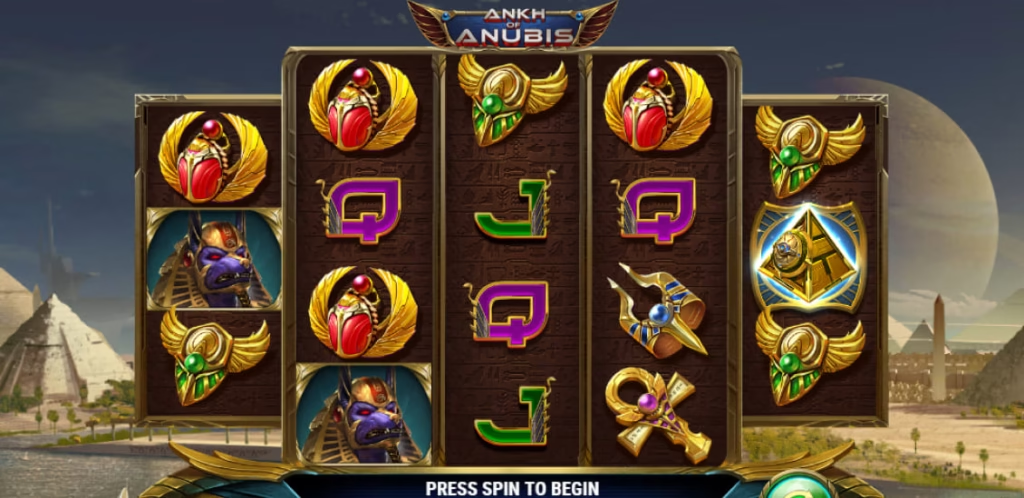
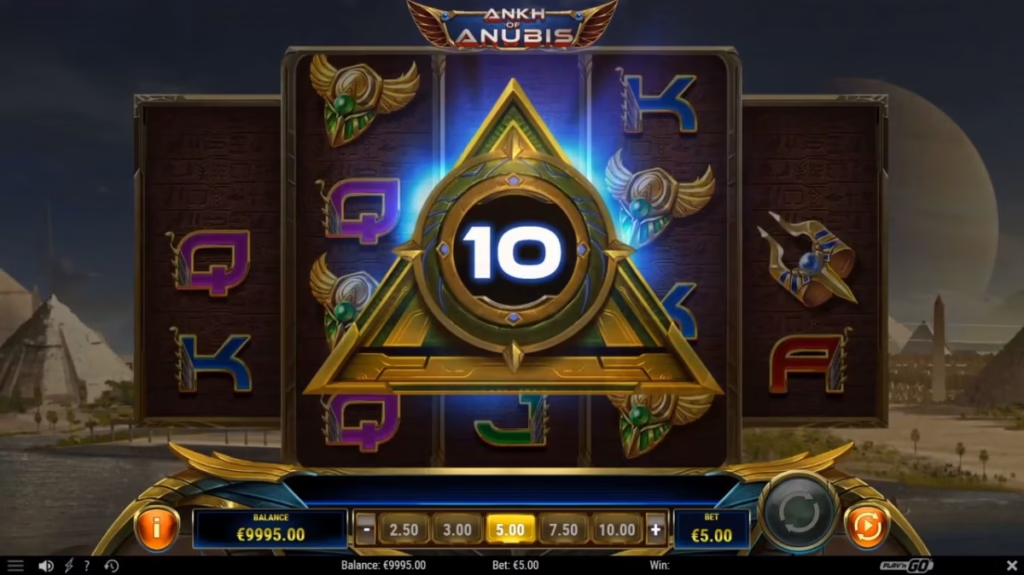
Most familiar video slots use rectangular grids. Ankh of Anubis has three visible symbols on the first and fifth reels, with four symbols on each of the three middle reels. Multiplying those heights gives 3 × 4 × 4 × 4 × 3 = 576 possible symbol routes across the five reels.
Wins are assessed from left to right on adjacent reels, using ways rather than a set of individually selected paylines. The player’s stake covers this ways-based structure. A matching combination does not have to sit on a particular drawn line.
The larger middle reels create more symbol positions where an added Wild might help form a winning route. However, 576 ways does not mean 576 guaranteed payouts, a 576% return or a known chance of hitting a winning spin. The actual probabilities depend on the game’s underlying math, which the public feature description does not disclose.
Visually, the slot blends Egyptian treasures, pyramid imagery and a science-fiction atmosphere. It is more unusual in its reel shape than in its basic spin controls. The design makes the expanding role of Anubis Wilds easy to notice without adding a complicated sequence of separate bonus games.
Bonus Features and Wild Symbols Explained
Three symbols have distinct jobs in Ankh of Anubis, and confusing them can lead to a mistaken reading of the bonus rules.
Anubis Wilds in the Base Game
Anubis is the Wild symbol. It substitutes for regular paying symbols, but not for the Pyramid Scatter. The Anubis Wilds feature can activate randomly on a base-game spin, adding Wild symbols while the reels are still moving. These added symbols can create or improve winning combinations, but Play’n GO explicitly states that the feature does not guarantee a win.
Published reviews describe Wild additions that can occupy several vertically stacked positions. The important confirmed behavior is the random addition itself, not a guaranteed number of Wilds or a published trigger probability. A screen full of promising Wild symbols is still evaluated under the game’s normal payout rules.
Pyramid Scatters Start Free Spins
The Pyramid is the Scatter symbol. Landing at least three Scatters starts the feature. The initial award depends on how many land in the triggering spin:
| Pyramid Scatters | Initial free spins | Extra spins if repeated during the feature |
| 3 | 10 | 3 |
| 4 | 15 | 4 |
| 5 | 20 | 5 |
That distinction is easily missed. Four Scatters trigger 15 spins from the base game, but four Scatters during an existing free spins round add only four spins. The developer states that retriggers are unlimited in number, although the feature stops if the game’s maximum win is reached.
Five Ankhs Activate More Wilds
The Ankh is a paying symbol with an additional collection role in free spins. Ankhs collected during the feature accumulate on a meter. Each group of five triggers the Anubis Wilds effect, placing more Wild symbols on the reels at the end of the relevant spin. The game then calculates the resulting payout.
Collected Ankhs carry over between spins within the same bonus round. They do not carry over to the next bonus, because the meter resets when the feature finishes. This is why the Ankh mechanic matters: a spin that adds to the collection without producing a large immediate payout can still move the current bonus toward another Wild event.
Consider a purely illustrative sequence. A player enters with 10 free spins after landing three Scatters. Over several spins, the Ankh meter reaches five, activating extra Wilds. A later spin lands four Scatters and adds four more free spins. None of these events guarantees a profit, and this example does not claim to represent an observed session or the odds of that sequence occurring.
Volatility and the 15,000x Maximum Win
Ankh of Anubis is generally classified as a high-volatility slot. That means its payout distribution is more uneven than that of a lower-volatility game, with the potential for longer stretches of modest returns or losses between substantial wins. Volatility says nothing precise about when the next bonus will arrive.
The published top prize is 15,000 times the stake. At a hypothetical 1-unit bet, the multiplier corresponds to 15,000 units before any applicable operator-specific payout cap. It is a ceiling, not an average bonus result and not a stated probability. The official feature rules also provide an important qualification: free spins end if the maximum win is reached.
This creates a clear trade-off. The collection meter and unlimited possible retriggers allow a bonus to develop over several spins, but a player cannot calculate the likelihood of reaching 15,000x from those rules alone. Neither the developer’s public description nor the operator rules consulted provide a verified bonus-trigger frequency for the original game.
For readers who prefer frequent, relatively even payouts, the combination of high volatility and a bonus-dependent upside may be a poor fit. Players interested in the mechanics can examine the demo without exposing money to that variance.
Free Demo, Mobile Play and What to Check Before Betting
Play’n GO provides an official free-play version. It is useful for seeing the 576-way grid, recognizing the Pyramid Scatter and observing how the Ankh collection meter works. Demo credits have no cash value, and a short demo session cannot validate the advertised RTP or reveal a future winning pattern.
The game is also listed as playable on mobile devices. Availability at a particular real-money casino, however, depends on that operator’s games catalogue, local restrictions and device support. An operator advertising Play’n GO games does not automatically guarantee that this specific title is available in every market.
A sensible pre-play check has three parts: verify the in-game RTP, confirm the stake limits and any payout cap, and read the free spins rules shown by the operator. Do not treat a casino promotion offering free spins as the same thing as this game’s built-in Scatter-triggered feature. Promotional spins can have separate wagering and withdrawal conditions.
Review Verdict: Who Is This Slot For?
Ankh of Anubis has a more coherent identity than its familiar Egyptian setting first suggests. The 3-4-4-4-3 layout supplies 576 ways, random Wilds create occasional shifts in the base game, and the free spins meter makes collecting Ankhs relevant across multiple spins. These are tangible differences from a conventional five-reel slot with a basic free spins multiplier.
Its main drawback is not a lack of features. It is the combination of high volatility, uncertain bonus frequency and potentially large differences between RTP configurations. The headline 15,000x win is impressive on paper but offers little practical guidance about a typical session.
The original Ankh of Anubis should also not be confused with Ankh of Anubis Awakening, a later Play’n GO title that adds a separate Re-Spin mechanic. Features documented for the sequel should not be assigned to this 2019 release.
For a player comparing available versions, the highest confirmed RTP at the chosen operator is the most meaningful numerical distinction. For someone mainly curious about the reel mechanics, the free demo supplies the experience without requiring a deposit.
FAQ
Is the Ankh of Anubis RTP always 96.20%?
No. While 96.20% is the headline figure and is documented by at least one operator, lower configurations of 94.20%, 91.20%, 87.20% and 84.20% have been reported. Check the actual game’s help screen before real-money play. The RTP shown for one casino should not be assumed to apply everywhere.
Are the Ankh and Anubis Wild the same symbol?
No. Anubis is the Wild that substitutes for ordinary paying symbols, while the Ankh is a separate symbol collected during free spins. Collecting five Ankhs triggers an addition of Anubis Wilds. The Pyramid, not the Ankh, is the Scatter that starts the bonus.
Can Ankh of Anubis free spins continue indefinitely?
The developer places no numerical limit on retriggers. Landing three, four or five Scatters during the feature adds the corresponding number of extra spins. That does not mean a bonus literally lasts forever: it ends when the awarded spins run out, or earlier if the maximum-win limit is reached.
Does the original Ankh of Anubis include Anubis Re-Spins?
The original game’s published feature rules describe random Anubis Wilds and Scatter-triggered Free Spins with Ankh collection. The separate Anubis Re-Spins feature belongs to Ankh of Anubis Awakening, the later sequel. Check the title shown in the game’s information panel before relying on a review or video.
Conclusion
Ankh of Anubis is most interesting for its combination of 576 ways, randomly added Wilds and an Ankh-powered free spins round. Its 15,000x ceiling is secondary to a more immediate decision: confirm which RTP version your casino actually runs. The demo is the better starting point for understanding the mechanics; real-money play still carries the risks of a high-volatility game.