This Catemple slot review examines how ELK Studios combines scatter pays with a coin collection system and spreading Hot Wilds. Released on November 21, 2024, the game has a documented RTP of 94%, medium volatility and a maximum payout of 10,000 times the base stake.
The interesting part is not simply how many coins appear. It is whether those coins reach the bottom of the grid while other features are active. That distinction explains why two rounds with apparently similar symbols can produce very different results.
Catemple slot specifications
| Game parameter | Details |
| Developer | ELK Studios |
| Release date | November 21, 2024 |
| Theme | Ancient temple and cats |
| Grid | 35 positions (5 × 7) |
| Winning system | Scatter pays, 7 or more matching symbols |
| Documented RTP | 94%; 87% also reported |
| Volatility | Medium (6/10) |
| Maximum win | 10,000× base stake |
| Documented base bet range | €0.20 to €100 |
| Bonus modes | Bonus and Super Bonus |
| Feature purchases | X-iter, where offered |
| Demo | Available through the developer’s game page |
The 94% RTP and euro stake range are confirmed by the published PokerStars Italy game rules. They describe a specific configuration rather than conditions guaranteed at every casino. The lower RTP figure of 87% appears in independent game databases, but its deployment at individual operators has not been established here. Published descriptions also disagree on the orientation of the rectangular grid, although they agree on its 35 positions.
Why symbol position matters even without paylines
Catemple does not require matching symbols to touch each other or appear along a line. A group of seven matching paying symbols distributed across the board is sufficient to qualify for a scatter win. Higher counts of the same symbol correspond to different paytable values.
After a payout, cleared spaces allow remaining symbols to descend and new symbols to enter. Additional wins can occur during the same paid round without another base stake being deducted. This cascading structure creates two parallel processes: ordinary symbol payouts and the movement of special coins towards the collection area.
That makes the layout relevant in a different way from conventional reel slots. A gem’s position does not determine whether it contributes to a scatter combination. A Golden Coin’s position, however, determines whether its particular reward can activate. A coin visible near the top is not equivalent to money already won.
How the Catemple Collect Zone works
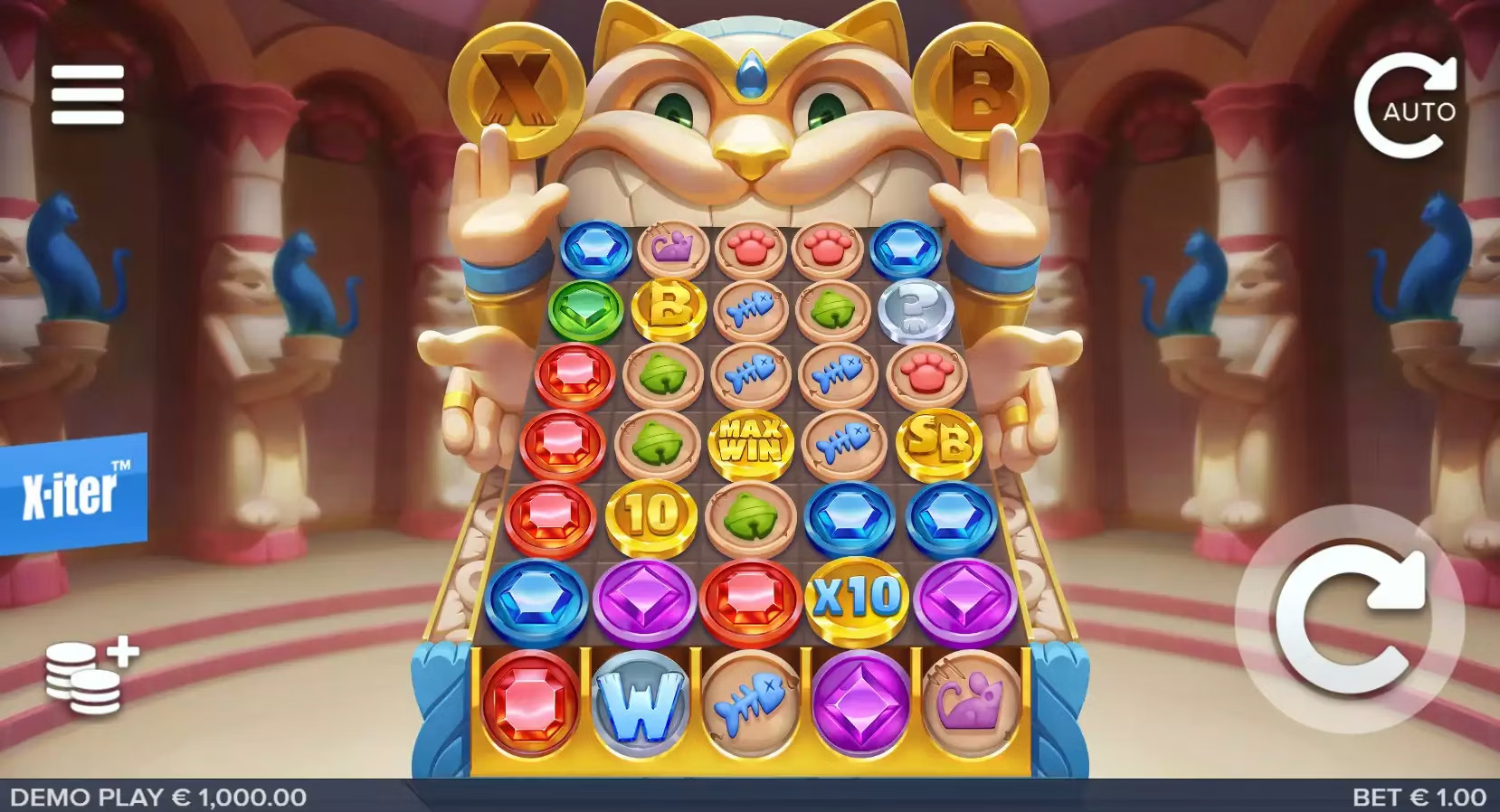
During normal play, the bottom row is the designated collection area. Golden Coins can appear above it and move down as spaces open underneath them. Once a coin enters the zone, its type determines the result.
| Collected symbol | Function |
| Cash coin | Adds a stake-based cash award |
| Multiplier coin | Adds its number to the global multiplier |
| Bonus coin | Counts towards a regular bonus trigger |
| Super Bonus coin | Activates or upgrades the bonus mode |
| MAX WIN coin | Supplies the remaining amount up to the round’s payout cap |
The important distinction is between a cash coin displaying a stake multiple and a multiplier that modifies other payouts. They are not interchangeable. A cash coin provides an award, whereas a multiplier changes the value of eligible wins during the current round.
How the global multiplier changes coin payouts
The multiplier begins at 1× in each new base-game round. Collected multiplier values are added to it rather than multiplied together. Its effect extends beyond ordinary scatter wins to collected cash prizes.
For a simplified mathematical example, suppose the active multiplier is 4× and a cash coin worth 5× the base stake is collected. At a €0.20 base bet, that coin represents €1 before multiplication and €4 after multiplication, assuming the payout cap has not been reached.
This illustrates the interaction between the two features, not the probability of either occurring. It is possible to see valuable-looking symbols on the grid without receiving the illustrated amount, particularly when a coin never enters the collection area.
Hot Wilds, Mystery symbols and Paw Strike
The mystery symbol adds uncertainty to the board because its identity is revealed after it appears. A reveal can produce an ordinary Wild, a Hot Wild, Paw Strike or one of the coin-related features.
Hot Wilds differ from regular substitutes because a revealed Hot Wild creates between one and three additional Wild or Hot Wild symbols. Newly generated Hot Wilds repeat the spreading process. The original symbol then acts as a normal Wild.
The immediate effect is an increase in possible matching combinations. There is also an indirect effect: when those combinations are removed, coins above them can move closer to the bottom. Hot Wilds therefore interact with collection mechanics without directly guaranteeing a coin award.
Paw Strike takes another approach. Instead of adding substitutes, it clears paying symbols and allows the remaining special symbols to descend. This can change the position of a coin even when the preceding board would not have delivered an ordinary scatter win.
These features make individual cascades more meaningful than simply counting successive payouts. A small symbol win can change the board substantially, while a large number of visible special symbols does not necessarily translate into a large return.
Bonus and Super Bonus: what a win drop really means
The standard Bonus begins after at least one Bonus coin has been collected and the current cascade sequence finishes. Collecting more qualifying Bonus coins increases the starting number of winning drops.
| Bonus coins collected at entry | Initial winning drops |
| 1 | 3 |
| 2 | 5 |
| 3 | 7 |
| 4 | 9 |
The standard feature expands the Collect Zone to the bottom two rows. Super Bonus expands it to three. This changes the spatial requirement for activating coins: they no longer have to descend as far as they do in the base game.
Why three winning drops are not just three spins
A distinctive rule in the published game instructions is that the bonus counter measures drops containing a win. A drop with no payout does not consume one of those winning drops. Instead, it increases the global multiplier by one.
Imagine a bonus starting with three winning drops and a 2× multiplier. Two consecutive non-winning drops would leave the counter at three while raising the multiplier to 4×. The next winning drop would reduce the counter to two, unless another collected feature changes it. This is a hypothetical sequence, not a recorded result.
The multiplier also carries into the feature from the triggering round and remains active between bonus drops. Additional collected Bonus symbols can extend the feature. A Super Bonus symbol collected during the ordinary bonus changes it into Super Bonus and adds a winning drop.
A larger collection area and a persistent multiplier explain the mechanical distinction between the two modes. Neither establishes a minimum profitable return. Even a bonus containing several winning drops can deliver a small payout relative to the amount spent entering it.
RTP, volatility and the actual cost of play
At 94% theoretical RTP, Catemple has a mathematical house edge of 6%. For €100 of total wagering under that configuration, the theoretical long-run loss is €6. At the reported 87% setting, the equivalent expectation would be €13. The difference is €7 per €100 wagered.
These figures concern turnover, not deposits. Reusing a €20 balance across multiple rounds can produce considerably more than €20 in total wagers. Nor does the expected loss describe what happens in an individual session; the actual outcome can be much higher or lower.
Medium volatility, reported as 6 on ELK’s ten-point scale, describes payout variability rather than the chance of leaving with a profit. It should not be interpreted as a safety rating. The presence of multiple bonus features does not cancel the house edge.
The 10,000× maximum is a cap on the entire round, not a separate jackpot paid in addition to previous wins. At a €0.20 base stake, it corresponds to €2,000 in total potential gross payout. If the limit is reached, the round ends. The maximum tells readers nothing by itself about how frequently that outcome occurs.
X-iter feature purchases and their price
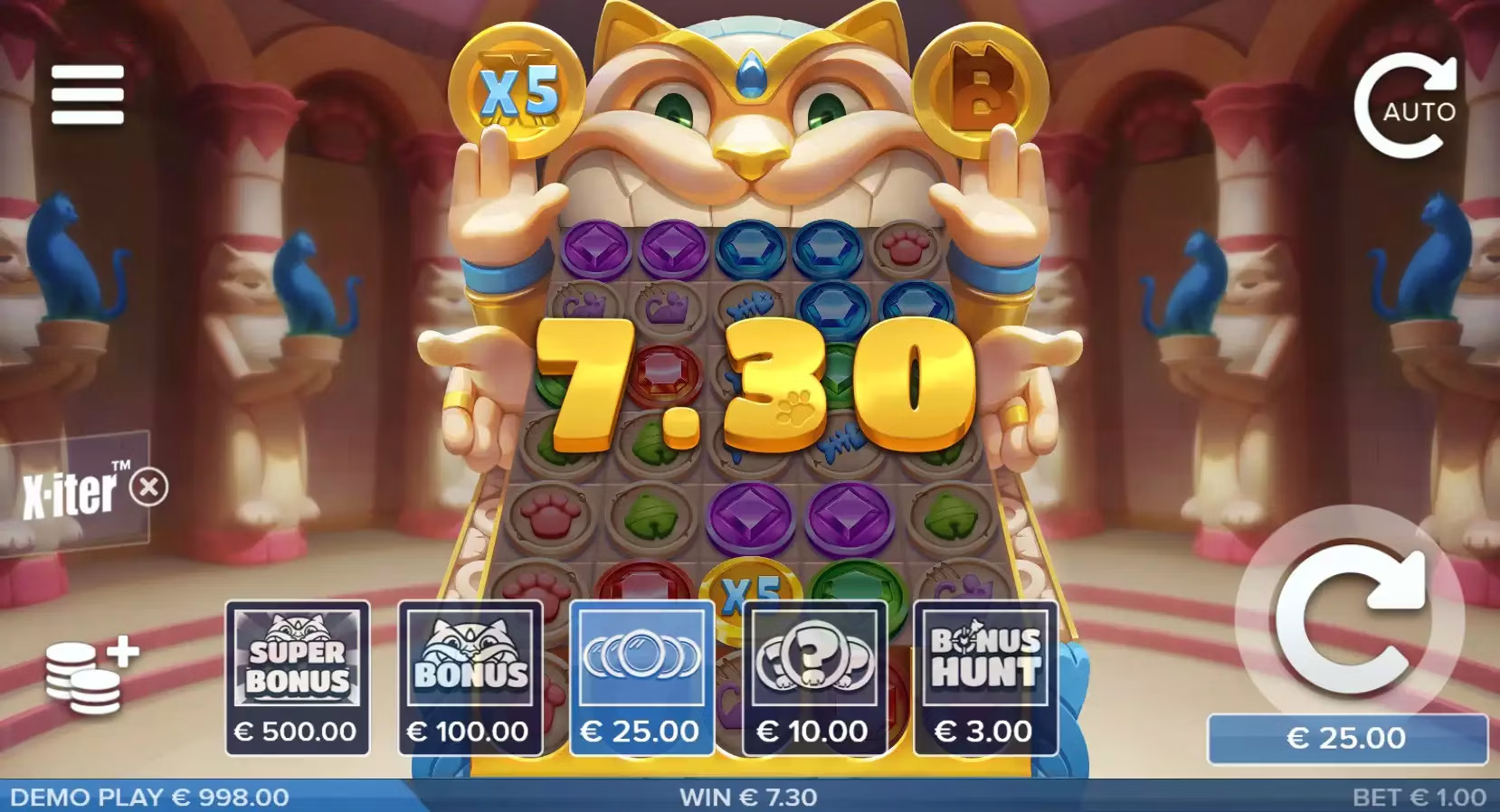
Catemple includes five optional X-iter modes in configurations that support feature purchases. The following table uses the published game rules and a €0.20 base stake to distinguish the displayed stake from the amount actually charged.
| X-iter mode | Cost multiple | Example total cost | Starting condition |
| Bonus Hunt | 3× | €0.60 | More than triple the bonus trigger chance |
| Mystery Symbols | 10× | €2 | At least three mystery symbols |
| Coin Row | 25× | €5 | One row of instant-pay coins |
| Bonus | 100× | €20 | Seven winning drops |
| Super Bonus | 500× | €100 | Nine winning drops |
The relevant comparison is the full price of the selected mode, not the base stake shown elsewhere in the interface. A €100 Super Bonus purchase at a €0.20 base stake would require a gross return of 500× that base stake merely to recover the purchase price. The published 94% configuration specifies the same theoretical RTP for the X-iter modes, so paying for feature access should not be confused with obtaining a mathematical advantage.
Feature availability and prices displayed in local currency depend on the operator’s configuration and applicable rules.
Is Catemple different from other ELK Studios slots?
Catemple has a different collection mechanism from Pirots 2, where moving bird characters gather matching coloured symbols. Dam Beavers uses ELK’s CollectR mechanic alongside an expandable board. Catemple instead uses gravity and a designated collection area, with conventional scatter payouts running alongside its coin system.
Its main strengths are the interaction between features and the clearly distinguishable regular and Super Bonus modes. The drawbacks are the relatively modest documented RTP, possible lower-return configuration and substantial X-iter costs. The number of simultaneous features can also make it harder to distinguish an actual win from a symbol that has not activated yet.
A free demo is useful for examining these distinctions without spending money. This review is based on published rules and developer information rather than a measured gameplay session. Demo results cannot establish real-money payout probabilities. For real-money play, legal availability, minimum age and the specific in-game rules must be checked locally; gambling should never be treated as income.
FAQ
Do Hot Wilds stay on the grid for the entire Catemple bonus?
The published rules describe Hot Wilds as spawning additional substitutes before becoming ordinary Wilds. Each new free drop starts with a fresh grid. The persistent feature is the global multiplier, not a permanent collection of Wild symbols.
Does the Catemple global multiplier carry over to the next paid spin?
No. A new base-game round resets it to 1×. It persists within the round and through any associated bonus feature.
Can a Bonus become a Super Bonus without a feature purchase?
Yes. Collecting a Super Bonus symbol during the regular bonus upgrades the mode, enlarges the Collect Zone and adds one winning drop.
Is the MAX WIN coin worth another 10,000× on top of existing wins?
No. Its value is the difference between the accumulated payout and the 10,000× round limit. The accumulated amount cannot exceed that limit.
Is the Catemple demo available without real-money betting?
A play option is provided on the ELK Studios game page, and free-play versions are documented by independent game sites. Access can vary by location. Demo credits have no cash value.
Conclusion
Catemple stands out through the relationship between Hot Wilds, falling coins and an expanding Collect Zone. Its winning-drop bonus counter and persistent multiplier are more distinctive than its advertised maximum payout. The documented 94% RTP, possible lower-return version and high feature-purchase costs are important limitations. The most useful way to assess the game is to understand its collection rules and verify the exact configuration rather than judge it by the number of visible coins or the size of its maximum win.