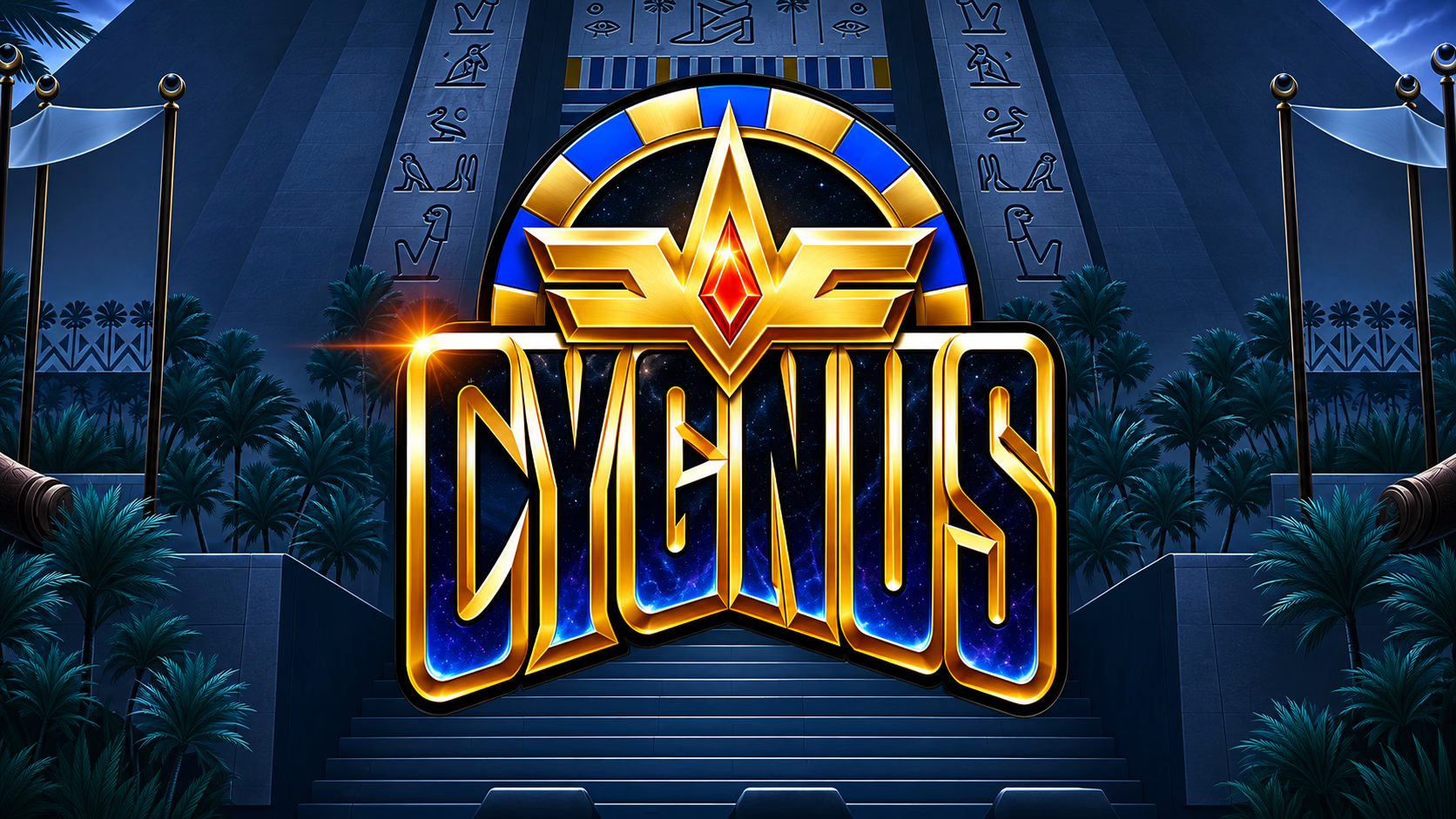
The Cygnus slot by ELK Studios is a high-volatility video slot with a published RTP of 96.10%, up to 262,144 ways to win and a maximum payout of 5,000 times the total bet. Released in December 2019, the original game combines an ancient Egyptian setting with a gravity-based system of rolling symbols, expanding rows and multipliers of up to 64×.
Its most distinctive feature is the way symbols move across the board. A marble that initially seems irrelevant to a winning combination can change columns after other symbols disappear. The same movement determines whether special symbols activate and whether the Free Drops bonus begins.
Cygnus slot specifications
| Game parameter | Original Cygnus |
| Developer | ELK Studios |
| Release date | 3 December 2019 |
| Theme | Ancient Egypt and the cosmos |
| Published RTP | 96.10% |
| Volatility | High (8/10) |
| Reported hit frequency | 23% |
| Grid | 6 columns, 4 to 8 rows |
| Ways to win | 4,096 to 262,144 |
| Documented bet range | €0.20 to €100 |
| Maximum win | 5,000× total bet |
| Maximum active multiplier | 64× |
| Bonus | 7 Free Drops, retriggerable |
| Demo | Listed by the developer |
The numerical specifications describe the original release, rather than its sequels. The rules published by the Lithuanian gambling regulator document the euro stake range, but individual operators and jurisdictions can impose different limits. The RTP figure should also be checked against the information displayed in the actual game.
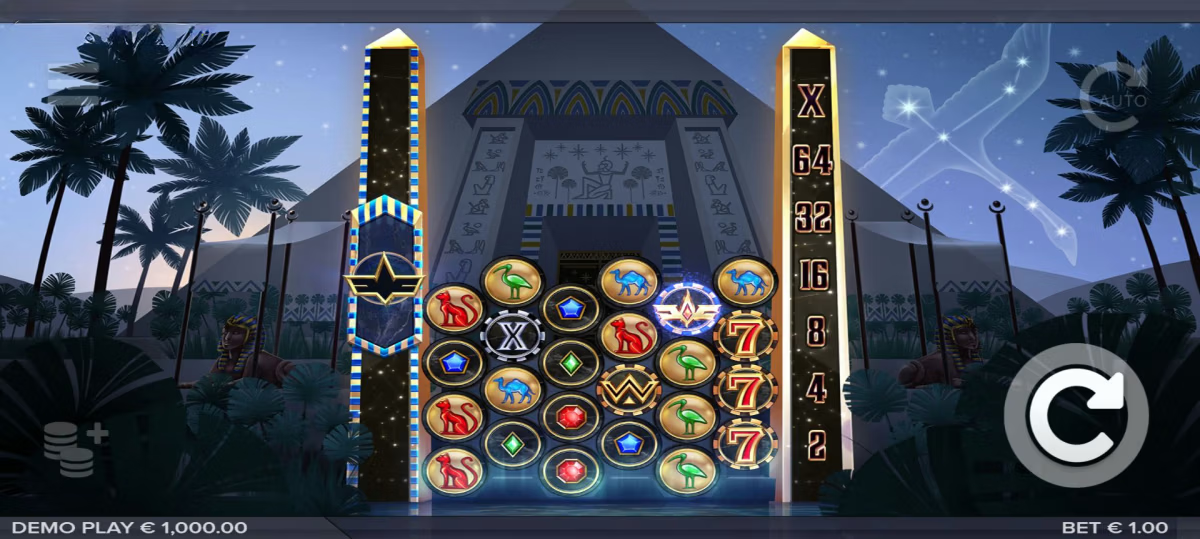
How gravity changes the avalanche mechanic
The setting draws on the Northern Cross constellation and the pyramids of Giza. Rather than depicting conventional rectangular reel symbols, the game uses circular pieces that roll into spaces left by successful combinations. The hidden treasure concept is part of the Egyptian and celestial theme, not a separately named jackpot feature.
A winning combination disappears after its payout is calculated. Remaining pieces settle into open positions, potentially moving sideways as well as downward. If another combination forms, the process continues. Refills can introduce an additional row, expanding the board until it reaches eight rows.
The distinction matters because horizontal movement can change which column a symbol occupies. In an ordinary vertical cascade, a symbol usually remains within its original reel. Here, a piece can become relevant to a different combination after the board rearranges itself. This also explains why the game uses positional triggers for its special symbols.
How many ways to win are active?
With six columns of equal height, the number of possible complete symbol paths is the row count raised to the sixth power.
| Active rows | Symbol positions | Possible ways |
| 4 | 24 | 4,096 |
| 5 | 30 | 15,625 |
| 6 | 36 | 46,656 |
| 7 | 42 | 117,649 |
| 8 | 48 | 262,144 |
The board doubles in size between the four-row and eight-row stages, while its number of potential paths increases 64-fold. These paths are not independent chances of winning. They share symbols, and their payouts depend on the actual arrangement and paytable. A board with eight rows can still produce no winning combination.
Symbols and their payout values
The lucky seven is the highest-paying regular symbol. Egyptian animal designs occupy the middle of the paytable, while red, blue and green jewels have lower individual values. Wins form from matching symbols on consecutive columns, beginning at the left edge.
The following values come from the documented paytable, where a total bet represents 100 credits. They are expressed as multiples of that total bet for one matching way, before any active multiplier.
| Symbol | 3 matching | 4 matching | 5 matching | 6 matching |
| Lucky seven | 5× | 10× | 15× | 30× |
| Red cat | 0.5× | 1× | 2× | 3× |
| Blue camel | 0.3× | 0.6× | 1.2× | 2× |
| Green bird | 0.2× | 0.4× | 0.6× | 0.8× |
| Red gem | 0.15× | 0.2× | 0.25× | 0.3× |
| Blue gem | 0.1× | 0.15× | 0.2× | 0.25× |
| Green gem | 0.05× | 0.1× | 0.15× | 0.2× |
A regular Wild, marked W, replaces ordinary paying symbols but cannot substitute for the bonus icon or the X multiplier scatter. Consequently, a wild can complete a payout without helping to satisfy either special-symbol trigger directly.
Why multiplier timing matters
An X symbol must arrive at the lowest row before it affects payouts. The active multiplier begins at 1× and doubles on each successful activation: 2×, 4×, 8×, 16×, 32× and finally 64×. It applies to subsequent winning combinations rather than retroactively increasing amounts already awarded.
Consider a hypothetical round in which a €0.50 payout occurs before the multiplier activates. A later combination has an unmultiplied value of €2, with the current multiplier already at 4×. Its payout becomes €8, bringing the combined return from those two wins to €8.50. This illustrates the rule, not a recorded game result or a prediction.
A high multiplier is therefore insufficient on its own. A winning combination must occur while that multiplier is active. In the base game, the multiplier resets before the next paid round.
Free Drops and the left-pillar trigger
Free Drops begins when a bonus emblem makes its way into the first column. One qualifying emblem is sufficient. Simply seeing the emblem elsewhere on the board does not establish that the feature has been triggered.
The initial award consists of seven drops on the expanded eight-row grid. The bonus opens at 1×, regardless of any multiplier reached in the triggering base-game round. Activated multiplier symbols persist across bonus drops, preserving their effect until the feature ends. Another qualifying bonus emblem can retrigger the feature.
An unusual detail in the documented rules concerns a bonus emblem trapped in a position from which it cannot reach the left column. That emblem disappears and a replacement arrives with the next refill. The replacement does not guarantee entry to Free Drops.
The bonus ends when its remaining drops are exhausted or the maximum win is reached. No additional stake is charged for the awarded drops, although the paid round that triggered them was still a wager. A full grid and sticky multipliers do not guarantee a positive return from the feature.
RTP, volatility and the 5,000× limit
At the published 96.10% RTP, the theoretical house edge is 3.90%. For example, €100 in cumulative paid wagers has a mathematical expected return of €96.10 and an expected net loss of €3.90. The amount refers to turnover, not necessarily the money originally deposited. Actual results over a short session can differ substantially.
The reported hit frequency of 23% is a separate statistic. It describes the frequency of paying outcomes, not the probability of making a profit. Some payouts are smaller than the original stake, and the figure does not establish how often Free Drops or the maximum payout occurs.
The high volatility rating indicates substantial variability in returns. The 5,000× maximum corresponds to a €1,000 payout on a €0.20 total bet or €5,000 on a €1 bet. Neither figure reveals the probability of reaching the cap. A reliable bonus-trigger frequency was not available in the reviewed documentation.
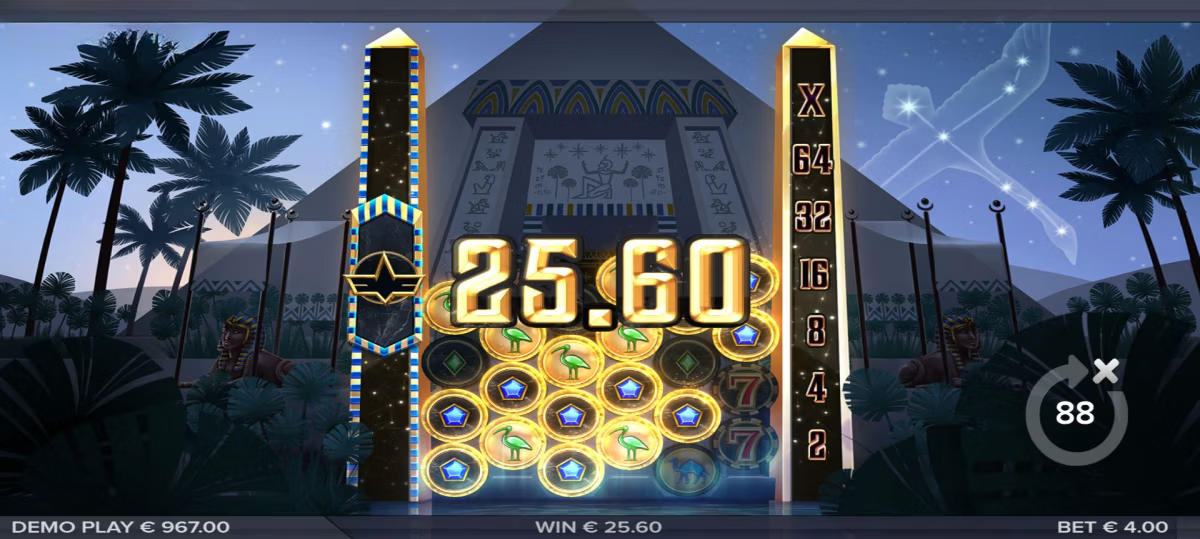
Cygnus slot demo and version differences
ELK Studios lists the original game in its catalogue with a play option. Demo access depends on location and browser support. The game was designed for mobile play as well as desktop browsers, although the demo was not independently launched for this review.
A free-play balance has no cash withdrawal value. Demo results cannot predict outcomes in real-money rounds. Availability of a demo also does not establish that real-money play is permitted in a particular jurisdiction.
The game title is especially important because subsequent Cygnus releases use related imagery but different bonus rules.
| Game | Distinguishing mechanic | Published max win* |
| Cygnus | Bottom-row multipliers and seven initial Free Drops | 5,000× |
| Cygnus 2 | Left-column multiplier activation and Wild conversion | 50,000× |
| Cygnus 3 | Cygnus Wheel with coin prizes, free drops and fixed jackpots | 10,000× |
*Multiples of the total bet as listed for each title; Cygnus 3 also advertises separate fixed jackpots.
Unlike its numbered successors, the original’s documented rules do not feature an X-iter bonus purchase. There is no basis for treating the sequels’ bonus mechanics or higher maximum payouts as part of this version. A larger maximum win also does not establish a higher RTP or a greater chance of finishing ahead.
FAQ
Is Cygnus a Megaways slot?
No. Cygnus uses ELK Studios’ own expanding ways-to-win design, with six columns and a maximum of eight rows.
How many multiplier scatters are needed to reach 64×?
Six successful doubling activations are required, starting at 1×. Simply landing six X symbols without activating them is not sufficient.
Can the stake change during Free Drops?
No. The documented rules prohibit stake changes during a symbol-drop sequence and the bonus game.
Does Cygnus have a progressive jackpot?
The original game’s published features do not include a progressive jackpot. Its documented maximum payout is expressed as a multiple of the wager. Do not confuse it with the fixed jackpot features introduced in Cygnus 3.
Conclusion
The original Cygnus stands apart from conventional cascading slots because symbol movement determines both winning combinations and bonus activation. Its expanding board, positional triggers and persistent bonus multipliers add mechanical complexity, while the high volatility limits the predictability of returns. Its rules and 5,000× payout cap should be evaluated independently of the later games in the series. Gambling involves financial risk, and no feature eliminates the house edge.