Reactoonz is a high-volatility cluster pays slot developed by Play’n GO, featuring a 7×7 grid, cascading wins, four Quantum Features and a giant Gargantoon Wild. The game has a default RTP of 96.51% and a documented maximum win of 4,570.3 times the total bet.
What makes Reactoonz different from conventional video slots is the relationship between ordinary wins and bonus features. Winning clusters generate energy, which charges the Quantum Leap meters and unlocks additional effects within the same paid round. There is no traditional free spins bonus.
Reactoonz Slot Specifications
| Game characteristic | Details |
| Game provider | Play’n GO |
| Release date | October 23, 2017 |
| Slot type | Cluster Pays |
| Theme | Aliens and science fiction |
| Grid size | 7×7 |
| Minimum winning cluster | 5 matching symbols |
| Default RTP | 96.51% |
| Alternative RTP | 94.51%, 91.49%, 87.50%, 84.51% |
| Volatility | High |
| Maximum win | 4,570.3× total bet |
| Standard betting range | $0.20–$100 |
| Free spins round | No |
| Bonus features | Quantum Leap, Gargantoon, Giantoonz, Fluctuation |
| Demo mode | Available |
| Mobile compatibility | Yes |
The specifications apply to the original Reactoonz released in 2017, rather than Reactoonz 2 or Reactoonz 100. Betting limits and RTP configurations can differ between gambling operators and jurisdictions.
Reactoonz RTP and Volatility
The default Reactoonz RTP is 96.51%, corresponding to a theoretical house edge of 3.49%. However, Play’n GO documents five mathematical configurations for this slot.
| RTP configuration | House edge | Theoretical loss per $1,000 wagered |
| 96.51% | 3.49% | $34.90 |
| 94.51% | 5.49% | $54.90 |
| 91.49% | 8.51% | $85.10 |
| 87.50% | 12.50% | $125.00 |
| 84.51% | 15.49% | $154.90 |
These figures represent mathematical expectations over a large number of rounds, not predicted individual session results.
The difference between the highest and lowest RTP configurations is 12 percentage points. Two visually identical versions of Reactoonz can therefore have substantially different long-term mathematical returns.
High volatility also means that returns can be distributed unevenly. Smaller payouts and losing rounds can occur between much larger combinations. RTP does not indicate how frequently Gargantoon appears or how long a player must wait for a Quantum Feature.
Check the actual RTP configuration in the game information or ask the operator if it is not displayed.
How Cluster Pays Works in Reactoonz
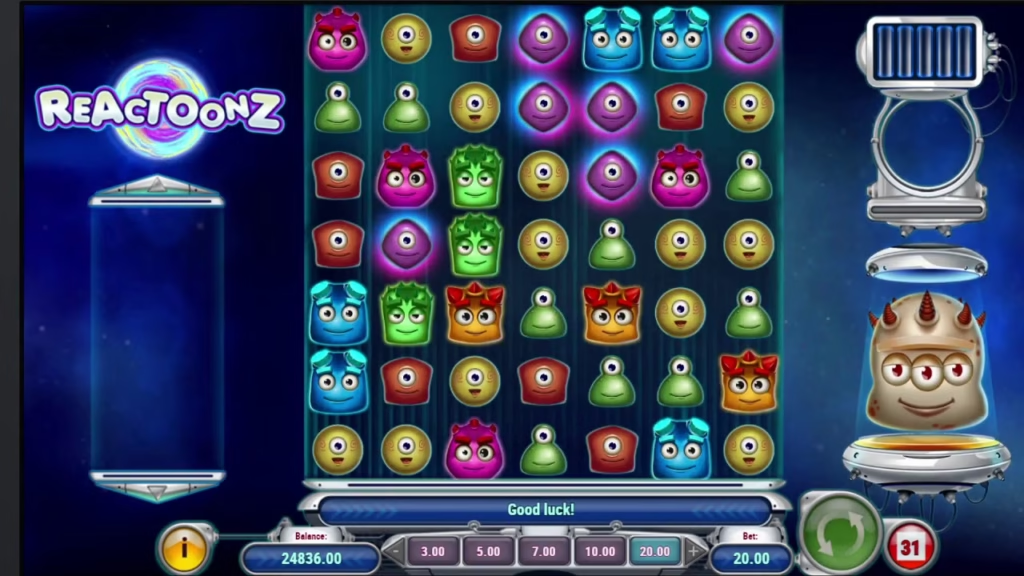
The grid contains 49 positions. A paying group can form anywhere on the board, provided at least five matching aliens are linked along their sides. A cluster can bend around a corner, but symbols touching only diagonally do not connect.
Once a group pays, its symbols disappear and replacements fall into the available spaces. A single wager can consequently produce several payouts as the board changes. No additional stake is deducted for each cascade.
The number of winning symbols matters independently of their cash value. A relatively small payout involving numerous low-value aliens can contribute more energy to the Quantum Leap system than a smaller cluster of premium symbols. A low-paying cluster is therefore not necessarily insignificant to the feature sequence.
Symbol Values and Payouts
Reactoonz has four premium two-eyed aliens and four lower-paying one-eyed aliens. Payouts are calculated using the full stake, rather than a separate line bet.
| Alien symbol | 5-symbol cluster | 15+ symbol cluster |
| Pink, two-eyed | 1× | 750× |
| Green, two-eyed | 0.8× | 300× |
| Orange, two-eyed | 0.6× | 150× |
| Blue, two-eyed | 0.5× | 75× |
| Red or purple, one-eyed | 0.15× | 10× |
| Yellow or green, one-eyed | 0.1× | 3× |
At a hypothetical $1 stake, five pink aliens pay $1 before modifiers, whereas fifteen pay $750. The increase illustrates why the size and identity of a cluster can matter more than the number of individual winning combinations. Ordinary Wilds substitute for alien symbols rather than carrying an independent payout.
How the Quantum Leap Features Activate
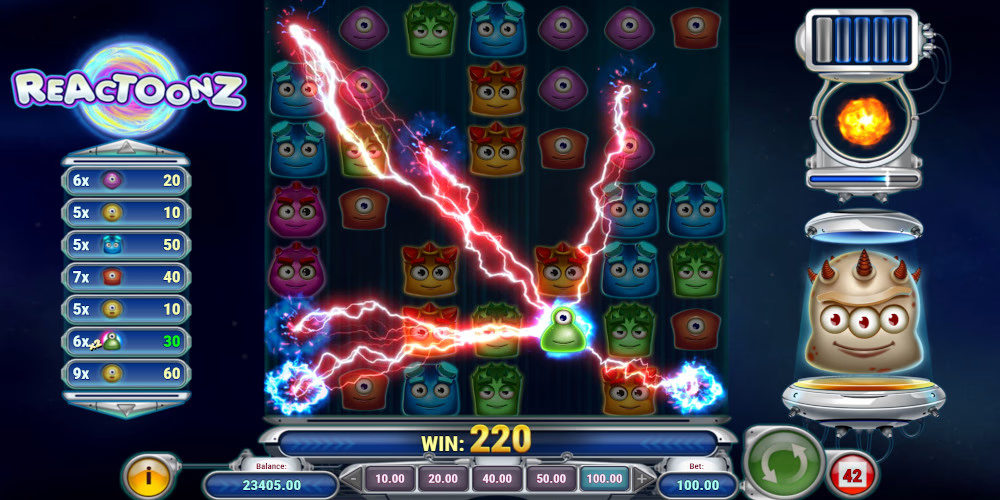
Five sequential charge meters control the game’s main bonus system. According to the in-game paytable, every 25 winning symbols complete one charge. The first four charges add Quantum effects to a queue, with the fifth reserved for Gargantoon.
A full meter does not interrupt a cascade already in progress. The queued effect waits until the board has no further winning combinations. If it creates another cluster, the resulting cascade can contribute additional energy and extend the round.
For example, three cascades clearing 8, 10 and 7 winning symbols would account for the first 25-symbol charge. This is an illustration of the rules, not a recorded spin or a prediction of how often the feature occurs.
The Four Quantum Features
| Feature | Effect |
| Implosion | Creates 3–6 Wilds and clears their neighboring symbols. |
| Alteration | Converts every instance of a selected symbol type into another symbol, normally starting with a one-eyed alien. |
| Demolition | Clears the one-eyed aliens from the board. |
| Incision | Places a central Wild and fills both intersecting diagonals with one randomly selected symbol type. |
The four effects solve different problems on the grid. Implosion creates substitutes and vacancies, Demolition makes room for incoming symbols, Alteration changes the existing distribution, and Incision establishes a new pattern across the board. None guarantees a profitable result.
Gargantoon Wild and Giantoonz Multipliers
The Gargantoon Wild is the final reward in the Quantum Leap sequence. Once all five meters are charged and the queued feature activates, the giant character changes the board in three stages.
First, a 3×3 Wild occupies nine grid positions. When the available cascades finish, it divides into two 2×2 Wilds. After the next cascade sequence ends, nine individual Wilds appear. Fresh symbols enter the grid between stages, allowing new combinations to be evaluated.
Gargantoon can also intervene on an initially losing spin by dropping four to eight ordinary Wilds. This random intervention does not require a fully charged meter.
Giantoonz serves a different purpose. Four identical normal aliens arranged in a 2×2 square form an oversized symbol. If that symbol participates in a paying cluster, the cluster’s award doubles. The rules specify a double payout for one or more Giantoonz in the combination, not a separate ×2 multiplier for every giant symbol.
For instance, a qualifying cluster with a normal value of $5 returns $10 when the Giantoonz doubling rule applies. Gargantoon itself is not an automatic multiplier across every win in the round.
Fluctuating Symbols
One of the one-eyed alien types is randomly marked for each spin. When marked symbols contribute to a win, two Wilds are left behind. The mechanic gives selected low-paying aliens an additional role beyond their paytable values and can reconnect groups during the next cascade.
Maximum Win and the Limits of the Feature System
The developer’s game settings document lists maximum exposure of $457,030 at the standard $100 maximum stake. This corresponds to 4,570.3× the total bet, often rounded to 4,570× in game listings. The same document places the probability of maximum exposure below one in a billion.
That figure does not describe the probability of triggering Gargantoon. A giant Wild can appear without producing anything close to the maximum payout. The final award depends on which symbols connect, their cluster sizes, the applicable doubling effect and subsequent cascades.
Another important limitation is that Quantum progress resets when the game round ends. A near-complete meter on a finished spin does not mean the following paid spin is closer to a bonus. Increasing the stake after an unsuccessful sequence does not change that rule.
Reactoonz Demo and Similar Slots
Play’n GO provides a free browser demo of the original Reactoonz. Desktop and mobile versions are documented. The demo is useful for understanding the grid, feature queue and payout information without risking money. Virtual-credit results do not establish what a real-money session will return.
The original game does not use a conventional free spins round or an ordinary feature-buy option. Its principal modifiers arise during the paid game cycle.
Reactoonz 2 changes the energy system by introducing Electric Wilds and the Fluctometer, while Reactoonz 100 incorporates a multiplier that can reach 100×. Those mechanics belong to separate games, not alternative RTP settings of the original Reactoonz.
The original is particularly relevant to readers who want to understand a cluster slot where a single round can evolve through multiple distinct board changes. Its drawbacks are high volatility, variable RTP and the lack of persistent bonus progress between paid rounds. Real-money availability depends on local law and operator rules. Gambling involves financial risk, and losses should never be chased.
FAQ
Does the Reactoonz Quantum Leap meter carry over to the next spin?
No. Meter progress belongs to the current game round and resets once all wins and queued effects have finished.
Do diagonal clusters pay in Reactoonz?
No. A qualifying cluster requires horizontal or vertical connections. Incision creates diagonal lines of symbols, but the usual cluster connectivity rule still determines payouts.
Can you choose which Quantum Feature appears?
No. The game selects the Quantum effect automatically. Players cannot choose the order or force a particular feature to activate.
Is the Reactoonz maximum win a progressive jackpot?
No. The published maximum is a mathematical payout ceiling for the game, rather than a progressive prize pool shared between players.
Is the Reactoonz bonus frequency published?
The reviewed game documentation does not provide a verified frequency for Gargantoon or individual Quantum Features. Neither RTP nor the number of charge meters is sufficient to calculate it.
Conclusion
Reactoonz builds its identity around the interaction between cluster payouts, Quantum Leap effects and the three-stage Gargantoon Wild. Giantoonz adds a separate doubling mechanic, while the five RTP configurations make version identification important. The game is best understood through its round-based feature system, not its headline maximum win. The demo offers a way to learn those mechanics without exposure to real-money losses.