
Take the Money is a high-volatility online slot from Red Tiger built around a repeating 20-spin bank-heist cycle. Instead of relying only on ordinary payline wins, the game tracks a shared Heist Score and the player’s Cut percentage, then awards the calculated share when the cycle ends. This review covers the game’s mechanics, RTP, bonus features, risks and suitability for different players.
Quick facts about Take the Money:
- 5 reels, 3 rows and 25 fixed paylines
- Default RTP of 96.11%
- Maximum payout of 10,009x the bet
- High-volatility mathematical model
- 20-spin Bank Heist cycles
- Free Spins, Gold Coins, Cut Scatters and Score Multipliers
- Official bet range of €0.10 to €40 per spin
Take the Money may suit players who enjoy heist themes, persistent meters and bonus mechanics that develop over several spins. The slot may be less suitable for players who prefer low volatility, frequent meaningful payouts or complete independence between spins.
Take the Money slot overview
Take the Money was released by Red Tiger on September 4, 2025. The game uses a conventional 5×3 reel grid with 25 paylines, but its main mechanic is less conventional: every 20 paid spins form one Bank Heist cycle. During that cycle, special symbols may increase the Heist Score, increase the player’s Cut or multiply the accumulated score.
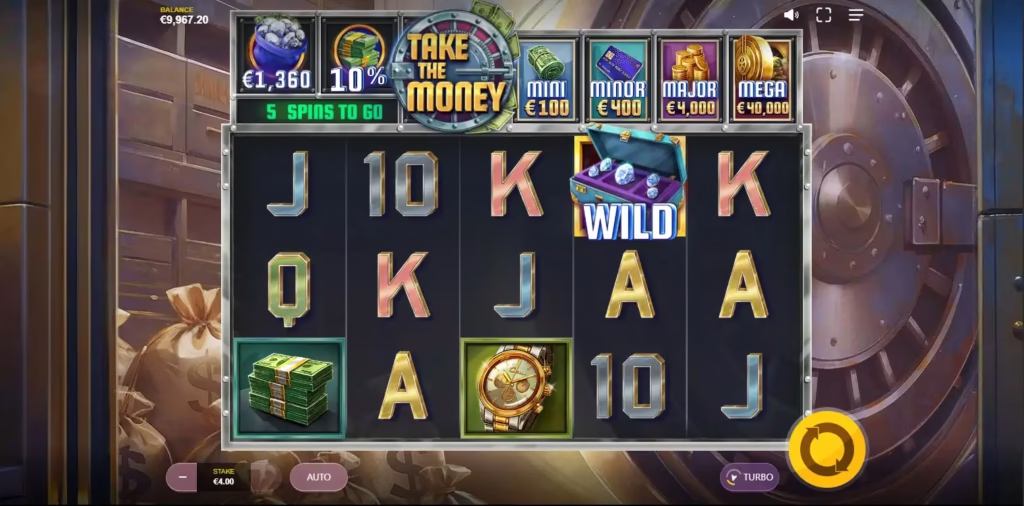
The bank-robbery theme is presented through a vault setting, cash, valuables and masked-robber imagery. Two meters positioned around the reels show the current Heist Score and Cut percentage, while four Big Heist prizes display the Mini, Minor, Major and Mega values. The interface therefore gives players visible progress throughout each 20-spin sequence rather than presenting every spin as a completely isolated event.
| Game detail | Take the Money specification |
| Provider | Red Tiger |
| Game type | Online video slot |
| Reels and rows | 5×3 |
| Paylines | 25 |
| Default RTP | 96.11% |
| Volatility | High |
| Hit frequency | 35.50% |
| Maximum payout | 10,009x |
| Official bet range | €0.10 to €40 |
| Main feature | 20-spin Bank Heist |
| Free Spins | 8, 12 or 20 |
| Demo mode | Available through the provider, subject to regional access |
The default game configuration lists an RTP of 96.11%, a 35.50% hit frequency and a maximum payout of 10,009 times the stake. Casino operators may use different game configurations or betting limits, so the RTP and permitted stake shown inside the actual game should be checked before playing.
How the Take the Money slot works
Take the Money awards standard line wins when matching symbols land from left to right on one of the 25 paylines. The regular symbol set includes card ranks from 10 to ace, together with thematic premium symbols such as banknotes, watches, valuables and a masked robber. A Wild symbol can substitute for regular paying symbols to complete a valid combination.
The central difference between Take the Money and a basic 5×3 slot is the Bank Heist cycle. A countdown tracks 20 paid spins, and special symbols landing during those spins can modify two values:
- Heist Score: the total amount collected by the crew.
- Cut percentage: the percentage of the Heist Score awarded to the player.
At the end of the twentieth spin, the current Heist Score is multiplied by the Cut percentage. For example, a Heist Score of 100x combined with a 20% Cut would produce a 20x cycle payout. This example only explains the calculation and does not indicate how frequently a particular result occurs.
The mechanic creates two separate objectives. Building a large Heist Score is not enough if the Cut remains small, while a high Cut produces limited value when the Score is low. The strongest cycle result requires both meters to develop, but the random number generator determines which symbols appear and neither meter can be controlled by the player.
Bank Heist feature explained
The Bank Heist feature runs continuously in cycles of 20 paid spins. Gold Coins, Big Heist symbols and Score Multipliers can raise the Heist Score, while Cut Scatters raise the Cut percentage. The Heist Score is capped at 10,000x the stake, and the Cut cannot exceed 100%.
After the last spin in the cycle, Take the Money awards the percentage of the Score represented by the Cut meter. Both meters then return to their starting state for a new heist. This creates a clear beginning and end to each sequence, which may appeal to players who prefer visible objectives rather than an open-ended series of unrelated spins.
The cycle structure can also create frustration. A valuable Big Heist symbol may produce only a limited final payout when the Cut percentage remains low. Conversely, several Cut Scatters may increase the player’s percentage without creating a worthwhile result when the Score remains small. A nearly complete meter should not be treated as evidence that a large payout is due.
Gold Coins and the Heist Score
Gold Coin symbols add a fixed stake multiplier to the Heist Score. Possible Gold Coin values are 1x, 2x, 3x, 5x, 10x, 15x and 20x. Each value is added to the accumulated Score rather than being paid immediately as a separate cash prize.
Gold Coins are the most straightforward way to build the Score, but their practical value depends on the eventual Cut percentage. A 20x Gold Coin does not necessarily produce a 20x payout because the player receives only the calculated share of the final Score.
Cut Scatter values
The Cut Scatter increases the percentage of the Heist Score that the player receives after spin 20. Available Cut values are 1%, 2%, 3%, 5%, 10%, 20% and 50%, with the total Cut capped at 100%.
Cut Scatters do not create direct payline wins. Their purpose is to improve the conversion of the accumulated Heist Score into the final cycle payout. The difference between a 10% Cut and a 50% Cut can be substantial, but a high percentage still requires a useful Score to have meaningful value.
Big Heist prizes
Take the Money displays four Big Heist values above the reels:
- Mini: 25x the bet
- Minor: 100x the bet
- Major: 1,000x the bet
- Mega: 10,000x the bet
When a matching Big Heist symbol lands, its value is added to the Heist Score. The Mega value can take the Score directly to its 10,000x cap, although the amount ultimately awarded still depends on the Cut percentage.
The Big Heist labels should not be confused with progressive jackpots. The displayed values are fixed stake multipliers within the game’s bonus system, and Take the Money has an overall maximum payout of 10,009x the bet.
Score Multiplier
The Score Multiplier can carry a value of x2, x3, x5 or x10. When the symbol appears, Take the Money first adds any Gold Coin and Big Heist values from that spin, then applies the multiplier to the accumulated Heist Score. The resulting Score cannot exceed the 10,000x cap.
A Score Multiplier becomes more valuable after the meter has already collected a substantial amount. However, the timing of the symbol is random, and increasing the Score does not guarantee an equivalent payout unless the Cut meter also reaches a useful level.
Free Spins feature
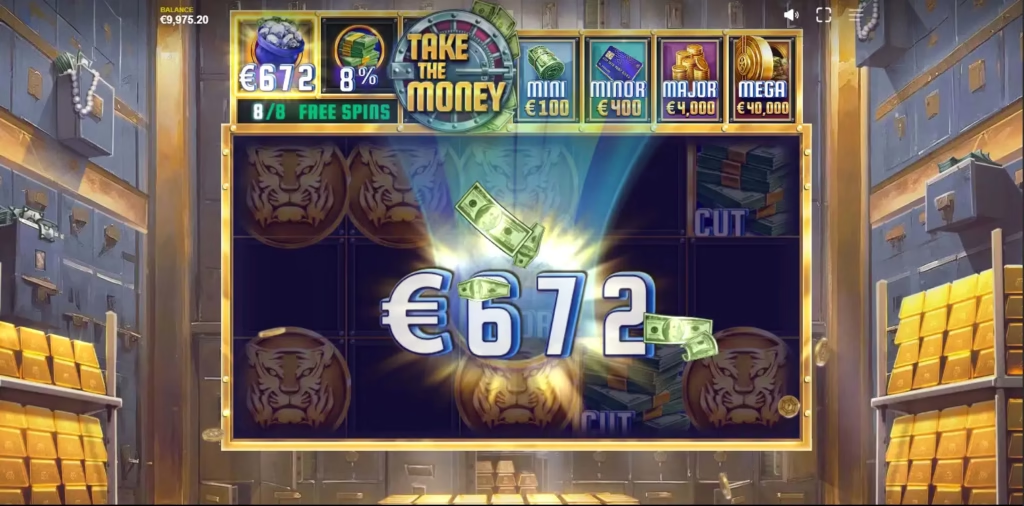
Landing three, four or five Free Spins Scatters awards 8, 12 or 20 free spins respectively. During the bonus, the reels focus on Gold Coins, Big Heist symbols, Score Multipliers and Cut symbols, giving the feature a direct role in developing the two Bank Heist meters.
Free Spins do not reduce the regular 20-spin Bank Heist countdown. They provide additional opportunities to improve the Score and Cut before the paid-spin cycle reaches its conclusion. This is important because the bonus does not operate as a separate conventional free-spins round with ordinary line symbols and its own independent total. Its value is linked to the active heist.
The feature can award a strong result when Score-increasing symbols and Cut Scatters work together. It can also produce a modest outcome when one meter develops without the other. Triggering Free Spins therefore does not guarantee a profitable session or a large cycle payout.
RTP, volatility and hit frequency
Take the Money has a default RTP of 96.11%. RTP represents the theoretical percentage returned across a very large number of simulated or completed wagers, not the amount an individual player should expect to receive during one session. A 96.11% RTP does not mean that every €100 wagered will return exactly €96.11.
Take the Money uses a high-volatility model. High volatility normally means that results can be uneven, with longer periods of limited returns balanced by the possibility of less frequent, larger payouts. This model is generally better suited to players who accept substantial short-term variation.
The listed hit frequency is 35.50%, but hit frequency should not be interpreted as the probability of making a profit on a spin. A counted hit can be smaller than the original wager, and the figure does not show how winnings are distributed by size.
Maximum win and betting range
The maximum payout in Take the Money is 10,009x the bet. At a €1 stake, the theoretical maximum would equal €10,009 before any casino-specific limits, account restrictions or jurisdictional rules are considered. The probability of reaching the maximum is not publicly stated in the standard game description.
The standard betting range is listed as €0.10 to €40 per spin. Some casino versions may show a lower maximum stake, which suggests that operators can apply different betting configurations. The game interface and paytable at the selected casino should be treated as the relevant source for the available stake range.
Because the slot resolves part of its value at the end of a 20-spin cycle, players should consider the cost of a complete cycle rather than only the cost of one spin. At €0.50 per spin, 20 paid spins cost €10 before any additional play. At €2 per spin, the same cycle costs €40.
Who may enjoy Take the Money?
Take the Money may suit players who enjoy:
- High-volatility slots with a payout ceiling above 10,000x
- Bank-robbery and crime-caper themes
- Progress meters that remain active across multiple spins
- Bonus mechanics based on percentages and multipliers
- Free Spins that directly improve an ongoing feature
- Traditional paylines combined with a modern collection system
The game may also appeal to players who like watching a result develop over a defined period. The 20-spin cycle provides a clear short-term objective and makes every Score or Cut symbol relevant to the final calculation.
Who should avoid Take the Money?
Take the Money may be unsuitable for players who prefer:
- Low-volatility games
- Frequent, predictable-sized payouts
- Simple slots without persistent meters
- Free Spins based mainly on ordinary symbol wins
- Games where each spin feels independent
- Very small session budgets
Players who dislike delayed resolutions may find the Bank Heist mechanic repetitive. A large Score paired with a weak Cut can also make a promising cycle feel disappointing, even though the calculation follows the published rules.
Common mistakes and misconceptions
A high Heist Score does not equal the final payout
The player receives only the percentage shown by the Cut meter. A 1,000x Score with a 5% Cut produces a 50x cycle award, not a 1,000x award.
A high Cut does not guarantee a large result
The Cut percentage has limited value when the Heist Score remains small. Both meters must develop for the final calculation to become substantial.
Completing several weak cycles does not make a strong cycle due
Each symbol outcome is random. Previous cycles do not force the next cycle to contain better Gold Coins, Big Heist symbols or Cut Scatters.
Increasing the stake does not improve the RTP
A higher bet increases the monetary value of wins and losses, but it does not provide control over the reels or make valuable symbols more likely unless the official rules explicitly state otherwise.
The maximum payout is not a typical payout
The 10,009x maximum describes the game’s upper limit. It does not indicate the average result, the likelihood of reaching that limit or what a player should expect from a normal session.
Practical tips before playing
Check the RTP displayed inside the game because the same slot may be supplied in more than one configuration. The casino’s version may not use the highest theoretical return available.
Choose a stake that allows for several complete 20-spin cycles. Judging the game by the first few spins can encourage impulsive stake increases, while budgeting by full cycles makes the real cost easier to understand.
Use demo mode to learn how the Score and Cut interact before wagering real money. Demo results do not predict paid results, but the mode can clarify how the final payout is calculated.
Set a fixed spending limit and stop point before starting. The visible countdown and nearly completed meters can encourage players to continue, but progress on the screen does not remove the risk of losing money.
How this information was reviewed
This Take the Money slot review is based on the game’s published specifications, paytable structure and feature descriptions. The evaluation focuses on RTP, volatility, hit frequency, payout limits, symbol behavior, bonus mechanics and the practical cost of completing the recurring 20-spin cycle.
Players should verify the RTP, stake limits, paytable, regional availability and casino bonus conditions directly inside the game. RTP, hit frequency, volatility, Free Spins and multipliers describe the mathematical design, but none of these features can predict the result of a particular spin or session.
Take the Money should be treated as paid entertainment rather than a source of income. Do not chase losses, borrow money to gamble or continue because a meter appears close to a valuable result. Stop playing when the planned limit is reached or when gambling stops feeling controlled.
FAQ
What is the Take the Money slot?
Take the Money is a 5×3, 25-payline online slot from Red Tiger. Its main feature is a repeating 20-spin Bank Heist in which players collect a Heist Score and increase their Cut percentage before receiving a calculated share of the Score.
What is the RTP of Take the Money?
The default RTP of Take the Money is 96.11%. A casino may offer a different game configuration, so the percentage displayed in the paytable should be checked before playing. RTP is a long-term theoretical value and does not predict an individual session.
Is Take the Money a high-volatility slot?
Yes. Take the Money uses a high-volatility model, which means payouts may be uneven and meaningful wins may occur less regularly than in a low-volatility slot. High volatility does not guarantee larger overall returns.
What is the maximum win in Take the Money?
The maximum payout is 10,009x the bet. This is the game’s theoretical upper limit, not a typical result, and the probability of reaching it is not stated in the standard game description.
How does the Bank Heist feature work?
The Bank Heist lasts for 20 paid spins. Special symbols increase the Heist Score or Cut percentage, and after the twentieth spin the player receives the current Score multiplied by the Cut. The Score is capped at 10,000x and the Cut at 100%.
How are Free Spins triggered?
Three, four or five Free Spins Scatters trigger 8, 12 or 20 free spins. The bonus can add Gold Coins, Big Heist prizes, Score Multipliers and Cut values without reducing the regular 20-spin countdown.
Does Take the Money have a bonus buy feature?
The standard feature description focuses on the naturally triggered Free Spins round and does not clearly list a regular player-operated bonus purchase. Availability of any accelerated or operator-specific feature should be checked inside the casino version.
Can Take the Money be played on mobile devices?
Take the Money is designed for modern desktop and mobile casino platforms. Actual availability depends on the casino, the player’s jurisdiction and the device or browser being used.
Can I play Take the Money for free?
A demo version may be available through the provider or participating casinos, although access can depend on location, age-verification rules and operator restrictions. Demo play uses virtual credits and cannot predict the outcome of later real-money play.
Is there a strategy for winning Take the Money?
No strategy can predict or control the results in Take the Money. Players can manage risk by checking the RTP, using a small stake, budgeting for complete 20-spin cycles and setting firm limits, but these decisions cannot guarantee a win.
Brief conclusion
Take the Money combines a traditional 5×3 payline layout with an unusual 20-spin Score-and-Cut system. Its 96.11% default RTP, high volatility and 10,009x maximum payout may appeal to players who enjoy structured bonus cycles and heist-themed slots. The game is less suitable for anyone seeking low volatility or predictable returns, and it should only be played with predetermined spending and time limits.