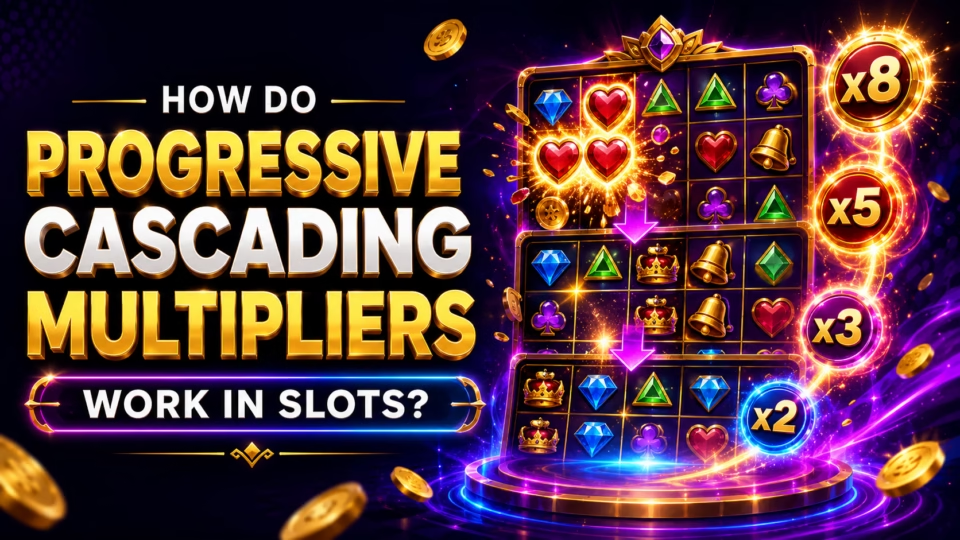
Progressive multipliers in slots increase the value applied to qualifying wins as specific conditions are met. Instead of staying at a fixed x2 or x3, a progressive multiplier may rise from x2 to x3, x4, x5 and beyond during a bonus feature, winning sequence or other defined event. Cascading multipliers in slots usually increase during consecutive cascades, tumbles or avalanches, where winning symbols disappear and new symbols fall into their places.
The key difference is what causes the multiplier to grow. A progressive multiplier can advance through many types of triggers, while a cascading multiplier is specifically connected to consecutive cascades or similar symbol-removal mechanics.
Quick takeaways:
- Progressive multipliers increase according to predefined game rules.
- Cascading multipliers usually rise after consecutive winning cascades.
- A cascading multiplier can also be progressive if its value increases after each cascade.
- Multipliers may reset after a losing spin, at the end of a cascade sequence or after a bonus round.
- A large multiplier does not guarantee a large payout because a qualifying win must still occur while that multiplier is active.
These mechanics usually appeal to players who enjoy bonus-heavy slots, chain reactions and the possibility of increasingly valuable wins within one sequence. Players who prefer simpler slots with predictable mechanics may find progressive multiplier systems unnecessarily complex.
What Is a Progressive Multiplier in Slots?
A progressive multiplier is a multiplier whose value increases when specific conditions are satisfied. For example, a slot may start a bonus round with a x1 multiplier and increase it to x2, x3, x4 and higher after qualifying events.
The term “progressive” describes the way the multiplier changes. It progresses upward rather than remaining fixed.
A simplified example could look like this:
1. Bonus round begins at x1.
2. The player triggers a qualifying win.
3. The multiplier increases to x2.
4. Another qualifying event raises it to x3.
5. A later win is calculated using the current x3 multiplier.
The exact trigger varies between slots. A progressive multiplier might increase after winning spins, cascades, collected symbols, special symbols, consecutive wins or completed bonus objectives.
The game rules or paytable should always be checked because multiplier progression is not standardized across all slots.
How Do Progressive Multipliers Work?
Progressive multipliers work by storing a multiplier value and changing that value when the player reaches a trigger defined by the game’s rules.
For example, imagine a €5 win occurring while a x4 progressive multiplier is active. If the entire win qualifies for the multiplier, the adjusted value would be:
€5 × 4 = €20
However, slots may apply multipliers differently. Some multiply the complete winning combination, while others multiply only particular symbols, clusters or feature wins.
The most important rule is persistence. A multiplier may:
- remain active for the entire bonus round;
- increase only during consecutive winning spins;
- remain active until a losing spin occurs;
- reset after each base-game spin;
- continue increasing during a special feature;
- have a maximum multiplier limit.
A progressive multiplier that reaches x10 does not necessarily remain at x10 indefinitely. Many slots reset the value once the relevant sequence or feature ends.

What Is a Cascading Multiplier in Slots?
A cascading multiplier is a multiplier connected to a cascading reels mechanic. Cascading reels remove symbols involved in winning combinations and replace them with new symbols, potentially creating another win without requiring a completely new paid spin.
Cascading multipliers commonly increase when several winning cascades happen consecutively.
A simplified sequence might work like this:
| Cascade | Multiplier |
| Initial win | x1 |
| Second winning cascade | x2 |
| Third winning cascade | x3 |
| Fourth winning cascade | x4 |
| Fifth winning cascade | x5 |
If the fourth cascade produces a €6 qualifying win at x4, the resulting value would be €24 before any other game-specific calculations.
This structure makes later cascades potentially more valuable than earlier ones, but only if the cascade sequence continues producing qualifying wins.
How Cascading Multipliers Work Step by Step
A typical cascading multiplier sequence begins when the original symbol layout creates a winning combination.
The process may then work as follows:
1. Winning symbols are identified.
2. Those symbols disappear.
3. New symbols fall or appear in the empty positions.
4. The game checks the new layout for another win.
5. If another qualifying win occurs, another cascade begins.
6. The multiplier increases according to the game’s rules.
7. The sequence ends when no new qualifying win appears.
The multiplier usually resets once the entire cascade chain ends, although some games allow multipliers to persist throughout a free spins feature.
This distinction can dramatically change how a mechanic behaves. A base-game cascading multiplier that resets every spin has much less time to grow than a free-spins multiplier that carries its value into subsequent spins.
Progressive vs Cascading Multipliers
Progressive and cascading multipliers overlap, but they are not identical mechanics.
| Feature | Progressive Multiplier | Cascading Multiplier |
| Main concept | Multiplier increases over time | Multiplier changes during cascades |
| Trigger | Depends on game rules | Usually consecutive cascades |
| Requires cascading reels | No | Usually yes |
| Can persist across spins | Sometimes | Sometimes |
| Can reset after losing event | Yes | Commonly |
| Can appear in bonus rounds | Yes | Yes |
A cascading multiplier can be progressive. For example, a slot that increases its multiplier from x1 to x2 to x3 after successive tumbles is using both concepts simultaneously.
A progressive multiplier does not require cascading reels. It might instead increase after consecutive wins, collected symbols or completed bonus objectives.
Fixed Multipliers vs Progressive Multipliers
A fixed multiplier always applies the same value when triggered. A progressive multiplier can change.
Fixed multiplier
A special Wild symbol multiplies every associated win by x3.
Progressive multiplier
A feature begins at x2 and increases by one level after each qualifying event, potentially reaching x3, x4, x5 and higher.
Fixed multipliers are easier to understand because their effect is immediately known. Progressive multipliers create more variation because the value depends on how far the feature progresses.
Neither mechanic guarantees a better result. The final payout still depends on the game’s random outcomes and the combinations created while the multiplier is active.
Where Are Progressive Multipliers Commonly Used?
Progressive multipliers can appear in several slot mechanics rather than being limited to one type of bonus.
Free Spins
Free spins frequently use multipliers that increase after winning combinations, special symbols or consecutive cascades.
A major detail to check is whether the multiplier resets between free spins. If it persists, later free spins can theoretically operate with a higher multiplier than earlier ones.
Cascading Reels
Cascades, tumbles and avalanches are particularly well suited to progressive multipliers because a single paid spin can generate multiple consecutive winning evaluations.
Each successful cascade may increase the multiplier until the chain ends.
Collect Features
Some slots increase a multiplier when special symbols, coins or other feature objects are collected.
The progression may continue until the bonus finishes or a maximum level is reached.
Consecutive-Win Features
A slot may increase the multiplier after consecutive winning spins rather than cascades.
In this format, a losing spin frequently resets the progression.
Why Multiplier Persistence Matters
Multiplier persistence determines how long the player has an opportunity to benefit from an increased value.
Consider two theoretical slots.
Slot A increases its multiplier after every cascade but resets immediately when the cascade sequence finishes.
Slot B increases its multiplier during free spins and keeps the multiplier for the remainder of the bonus.
Both games may advertise progressive multipliers, but their practical behavior is very different.
When evaluating the mechanic, check:
- what increases the multiplier;
- whether increases are automatic or conditional;
- whether the multiplier survives between spins;
- what causes the multiplier to reset;
- whether there is a maximum value;
- which wins actually receive the multiplier.
The maximum advertised multiplier tells only part of the story. The rules governing how that multiplier is reached are equally important.
Do Higher Multipliers Mean Better Winning Chances?
Higher multipliers do not mean that a slot is more likely to produce a winning combination.
A multiplier changes the value of a qualifying payout. It does not necessarily change the probability that the required symbols will appear.
For example, reaching a x20 multiplier can look significant, but the multiplier produces no additional payout if the next symbol arrangement does not create a qualifying win.
This is one of the most important distinctions when interpreting multiplier mechanics. Multiplier size affects potential win value, while hit frequency concerns how often winning outcomes occur.
The exact mathematical relationship depends on the individual game’s design.
Do Progressive Multipliers Increase RTP?
Progressive multipliers do not automatically mean a slot has a higher RTP.
RTP, or return to player, is a theoretical long-term percentage calculated across the complete mathematical model of the game. Multipliers can contribute to that model, but the developer can balance them through symbol probabilities, paytable values, bonus frequency and other mechanics.
Two slots could therefore use similar multiplier systems while having different RTP values.
Players should check the RTP shown in the game’s official information or paytable because some games may also be offered in multiple RTP configurations depending on the operator.
RTP describes long-term theoretical return and cannot predict what will happen during an individual session.
How Multipliers Can Affect Slot Volatility
Large or rapidly increasing multipliers can contribute to a more volatile payout structure when a significant portion of a game’s potential return depends on relatively uncommon multiplier combinations.
However, the presence of progressive multipliers alone is not enough to classify a slot as high volatility.
Volatility depends on the complete mathematical model, including:
- probability of winning combinations;
- distribution of payout values;
- frequency of bonus rounds;
- maximum payout potential;
- multiplier behavior;
- frequency of high-value outcomes.
A slot with multipliers can still have a different risk profile from another slot using apparently similar mechanics.
Check the provider’s volatility information when available rather than estimating volatility from the multiplier alone.
Common Misconceptions About Cascading Multipliers
The multiplier keeps increasing until I win big
Usually not. The progression stops according to specific game rules, commonly when a cascade sequence ends or the bonus round finishes.
A high multiplier means the next spin is more likely to win
A multiplier generally affects payout value, not the probability of the next random result.
Cascades are free spins
Cascades and free spins are different mechanics. Cascades typically occur within the resolution of an existing spin, while free spins are additional spins awarded through a bonus mechanic.
A x100 multiplier guarantees a huge payout
A multiplier requires a qualifying win to multiply. A large multiplier applied to a small base payout may still produce a moderate result, while no qualifying win means there may be nothing to multiply.
Progressive multipliers always carry over
Persistence depends entirely on the slot’s rules. Some reset after every sequence, while others continue through a complete bonus feature.
What Should You Check Before Playing a Multiplier Slot?
The most useful information is not simply the highest multiplier advertised on the game screen.
1. Starting multiplier: Does progression begin at x1, x2 or another value?
2. Increase condition: What event raises the multiplier?
3. Progression rate: Does it rise by +1, double or follow another structure?
4. Reset condition: What causes progression to end?
5. Persistence: Does the multiplier survive between cascades or spins?
6. Maximum multiplier: Is progression capped?
7. Eligible wins: Does the multiplier affect every win?
8. Bonus restrictions: Is the mechanic available only during free spins?
9. RTP configuration: Does the game’s RTP vary between operators?
10. Volatility: How concentrated are payouts around less frequent outcomes?
This gives a much clearer picture of how a multiplier actually functions than focusing only on its maximum theoretical value.
Who May Prefer Progressive and Cascading Multiplier Slots?
Progressive and cascading multiplier slots may appeal to players who enjoy visually clear progression, chain reactions and bonus features in which one successful event can lead into another.
Cascading multiplier slots are particularly attractive to players who enjoy tumble, avalanche or cluster-style mechanics because several winning evaluations can occur during a single sequence.
Players who prefer straightforward reels, fixed paylines and minimal bonus complexity may find fixed multipliers easier to understand.
Neither format should be chosen because it appears capable of generating predictable profit. Slot outcomes remain random, and multiplier mechanics do not provide a reliable way to forecast future results.

How This Information Was Reviewed
This explanation evaluates multiplier mechanics according to five practical criteria: what activates the multiplier, what increases it, how long it persists, what causes it to reset and which winning combinations receive its value.
Exact multiplier rules can vary substantially between individual slots. Players should therefore verify the official paytable, game information screen and bonus rules before relying on a specific multiplier value or progression pattern.
RTP, volatility, multipliers and bonus features describe characteristics of a game’s mathematical design. They do not predict the outcome of a particular spin or guarantee a winning session.
Slots should be treated as entertainment rather than a way to generate income. Set spending and time limits before playing, avoid chasing losses and stop if gambling stops being enjoyable or begins affecting money needed for other purposes.
FAQ
What are progressive multipliers in slots?
Progressive multipliers in slots increase from one value to another when predefined conditions are satisfied. A multiplier might progress from x1 to x2, x3 and x4 after consecutive wins, cascades, collected symbols or another game-specific trigger. The exact progression and reset rules should be checked in the game’s paytable.
What are cascading multipliers in slots?
Cascading multipliers increase or change during consecutive cascade sequences. Winning symbols disappear, new symbols replace them and another winning combination can trigger a higher multiplier. The multiplier commonly resets when no further cascade is created, although some bonus rounds allow it to persist longer.
Are cascading and progressive multipliers the same?
Cascading and progressive multipliers are related but not identical. “Progressive” describes a multiplier that increases, while “cascading” describes its connection to a cascade or tumble mechanic. A multiplier that rises after every cascade is both cascading and progressive.
Can a progressive multiplier keep increasing during free spins?
Yes, some slots allow progressive multipliers to increase and persist throughout free spins. Other games reset the multiplier after each free spin or cascade sequence. Persistence is game-specific, so the bonus rules should be checked before playing.
Does a multiplier apply to the entire win?
Not necessarily. Some slots multiply the entire qualifying payout, while others apply multipliers only to certain symbols, clusters, paylines, positions or bonus wins. The paytable should specify exactly how the multiplier is calculated.
Do bigger slot multipliers increase the chance of winning?
No. A larger multiplier normally increases the value of a qualifying win rather than increasing the probability of creating that win. The outcome of each spin remains determined by the game’s random mechanics.
Are progressive multiplier slots higher volatility?
Not automatically. Progressive multipliers can contribute to volatility, particularly when large payouts depend on uncommon high-multiplier sequences, but volatility is determined by the game’s complete mathematical model rather than one feature alone.
Do progressive multipliers improve RTP?
Progressive multipliers do not automatically increase RTP. RTP incorporates the complete payout model, including symbol probabilities, base-game payouts, bonuses and multipliers. The published RTP should be checked separately, and some games may have different RTP configurations at different casinos.
When does a cascading multiplier reset?
A cascading multiplier commonly resets when a cascade sequence ends, but some slots keep it active throughout a free-spins or bonus feature. The reset condition varies by game and should be confirmed through the official game rules.
What is the most important multiplier rule to check?
Multiplier persistence is one of the most important rules because it determines how long an increased multiplier remains active. Players should also check the progression trigger, reset condition, maximum value and which wins qualify for multiplication.
Brief Conclusion
Progressive multipliers increase according to predefined game conditions, while cascading multipliers are specifically linked to consecutive cascades, tumbles or avalanches. A cascading multiplier can also be progressive when its value rises after each successful cascade.
The maximum multiplier alone does not show how valuable a mechanic is. The trigger, persistence, reset rules and eligible wins are equally important. Multipliers can increase the value of qualifying payouts, but they do not guarantee wins or predict future outcomes. Always check the game’s paytable and treat slots as entertainment rather than a source of income.