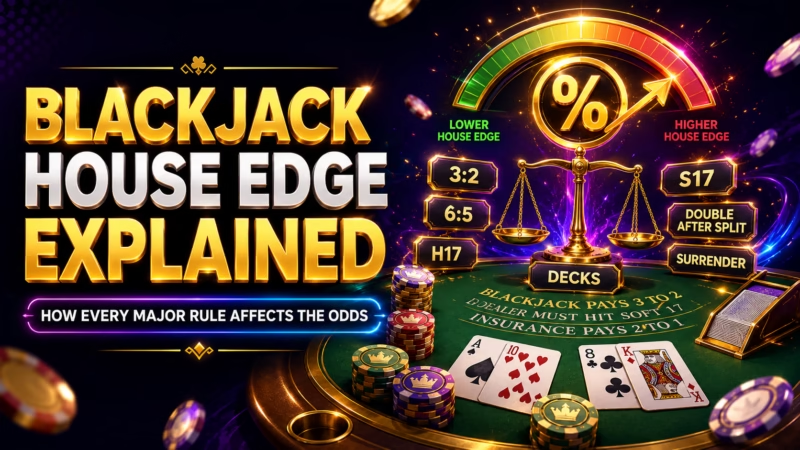
The casino house edge is the mathematical advantage a casino has over players on a particular game or bet over the long run. It is usually expressed as a percentage of the amount wagered. A house edge of 2%, for example, means the casino is mathematically expected to retain about $2 for every $100 wagered over a very large number of bets. It does not mean a player will lose exactly $2 during a $100 session.
The house edge is built into the rules, payouts, probabilities, or game design. It is one of the most useful numbers for comparing casino games because it shows how much theoretical advantage the operator has before short-term luck is considered.
- A lower house edge generally means a smaller mathematical disadvantage for the player.
- The house edge describes long-term expected results, not what will happen in one session.
- Different bets within the same casino game can have very different house edges.
- Rules and strategy can affect the house edge in games such as blackjack.
- RTP and house edge describe related concepts, but they are usually presented from opposite perspectives.
Understanding what the house edge is in casino games is particularly useful for players comparing blackjack, roulette, baccarat, craps, slots, and other games. It cannot predict whether the next bet will win or lose, but it can show which games or bets are mathematically more expensive to play over time.
What Does House Edge Mean in Casino Games?
The house edge represents the casino’s expected percentage advantage over all money wagered in the long run.
Suppose a casino game has a house edge of 5%. If players collectively wager $1,000,000 under the same mathematical conditions over a sufficiently large sample of bets, the theoretical casino advantage would correspond to about $50,000.
That calculation is an expectation, not a guarantee.
A player could wager $100 and finish $200 ahead. Another player could lose the entire $100. Individual results fluctuate because casino games contain randomness and variance. The mathematical house edge becomes more meaningful as the number of wagers increases.
This distinction matters because the house edge should not be interpreted as a prediction of a single gambling session.
How Is the Casino House Edge Calculated?
At its simplest, house edge can be expressed as:
House Edge = Expected Casino Profit / Total Amount Wagered x 100
The calculation behind an actual casino game may be more complicated because every possible outcome, probability, and payout must be considered.
For a simplified example, imagine a hypothetical game where the casino’s mathematical expectation is to keep $3 from every $100 wagered.
$3 / $100 x 100 = 3%
This means the theoretical long-term cost of wagering $100 is $3.
It does not mean every player who bets $100 will finish with $97.
House Edge Example
Consider two hypothetical casino games:
| Game | House Edge | Theoretical Cost per $100 Wagered |
| Game A | 1% | $1 |
| Game B | 5% | $5 |
| Game C | 10% | $10 |
If all other factors were equal, Game A would provide the player with better mathematical odds because less of every dollar wagered is theoretically lost to the casino advantage.
The difference becomes more significant as total wagering increases.
At $10,000 in cumulative wagers, a 1% theoretical disadvantage represents $100, while a 5% disadvantage represents $500.
Again, these numbers describe expected long-term results rather than guaranteed losses.
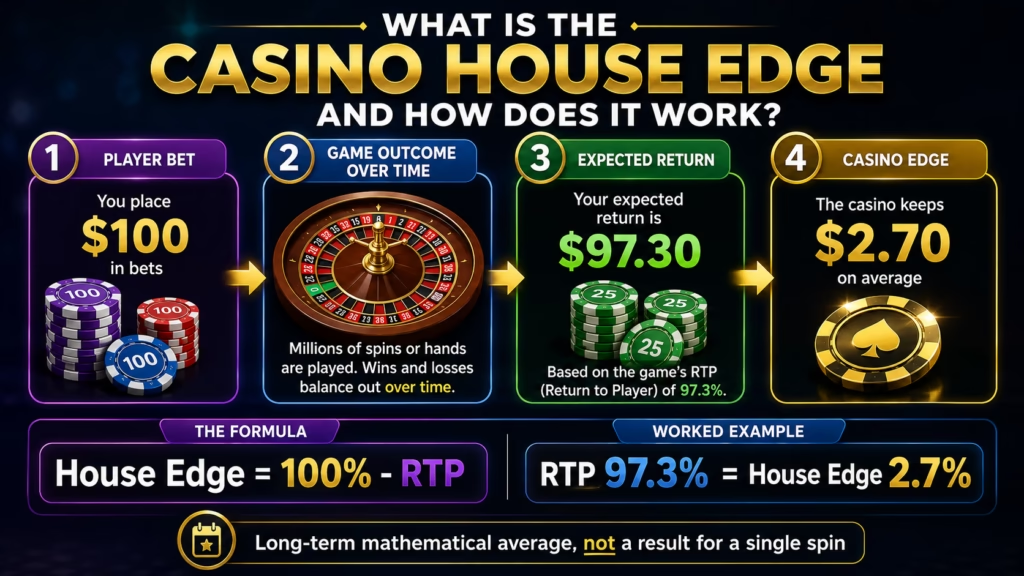
House Edge vs RTP
House edge and RTP are closely related measurements that describe the same underlying mathematical relationship from different perspectives.
RTP, or return to player, represents the theoretical percentage of wagered money returned to players over the long term. House edge represents the theoretical percentage retained by the casino.
A simplified relationship is:
House Edge = 100% – RTP
- 99% RTP corresponds to a 1% house edge.
- 97% RTP corresponds to a 3% house edge.
- 95% RTP corresponds to a 5% house edge.
If a game has a theoretical RTP of 96%, the corresponding theoretical house edge is 4%.
RTP does not mean a player who deposits or wagers $100 will receive exactly $96 back. Like house edge, RTP becomes meaningful statistically over a very large number of game rounds.
Why Do Casinos Have a House Edge?
Casinos need a mathematical advantage because gambling games would not be commercially sustainable if payouts perfectly matched the probability of every outcome.
The house edge can be created in several ways.
Payouts Can Be Lower Than the True Odds
A winning bet may pay slightly less than its mathematical probability would justify.
This difference creates an expected advantage for the casino.
Some Outcomes Favor the Casino
Certain games include outcomes that give the operator an additional advantage.
European roulette provides a simple example. Players betting on red or black are paid even money, but the wheel also contains a green zero. That zero prevents the probabilities from being exactly 50/50.
Game Rules Can Affect the Mathematics
Rules can change the house edge significantly.
This is especially important in blackjack. Deck count, dealer rules, doubling restrictions, surrender rules, blackjack payouts, and player decisions can all influence the mathematical advantage.
Players should therefore avoid assuming that every version of the same casino game has an identical house edge.
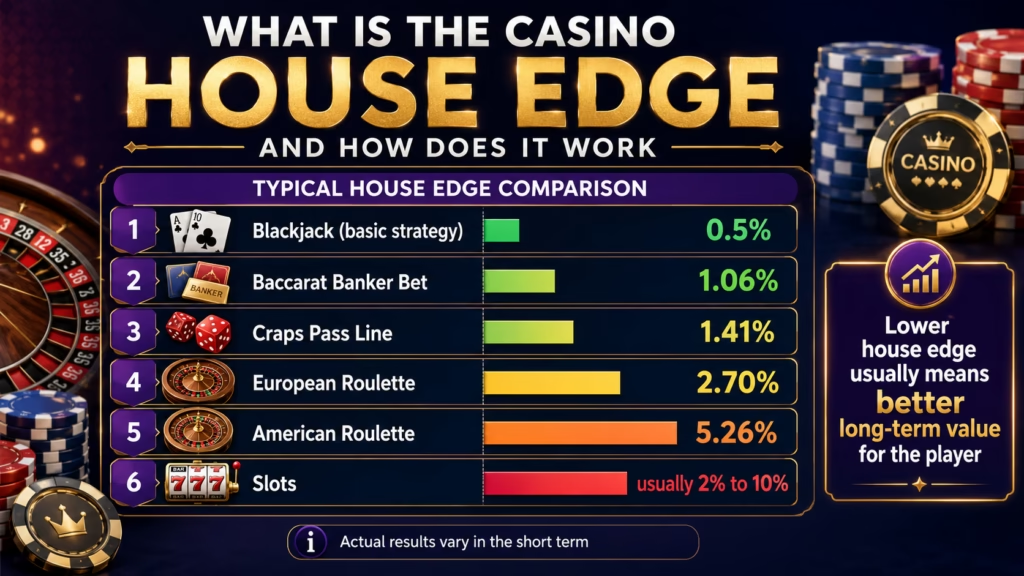
Which Casino Games Have the Lowest House Edge?
There is no single house-edge figure that applies universally to an entire game category because rules and betting choices can change the number.
Some games, however, can offer relatively low theoretical house edges under favorable conditions.
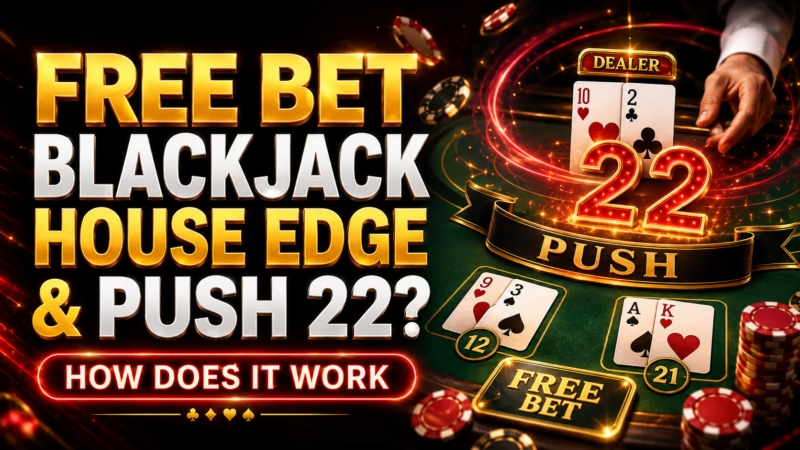
Blackjack
Blackjack can have a relatively low house edge when favorable rules are available and the player uses mathematically appropriate basic strategy.
The exact percentage depends heavily on the rules.
Playing decisions also matter. Poor decisions can increase the effective disadvantage compared with correct basic strategy.
Players should check the table rules rather than relying on a generic blackjack house-edge number.
Baccarat
The banker and player bets in standard baccarat generally have different mathematical advantages.
The banker wager is commonly associated with one of the lower house edges among traditional casino table bets, although winning banker bets commonly involve a commission or another payout adjustment depending on the baccarat format.
The tie bet normally has a substantially higher mathematical disadvantage and should be evaluated separately.
Roulette
Roulette demonstrates clearly why game format matters.
A single-zero European roulette wheel contains 37 numbers, while a traditional double-zero American wheel contains 38 numbers. The additional zero changes the probability structure and increases the house advantage on many standard bets.
Choosing between roulette variants can therefore affect the mathematical cost of playing even when the basic betting interface looks almost identical.
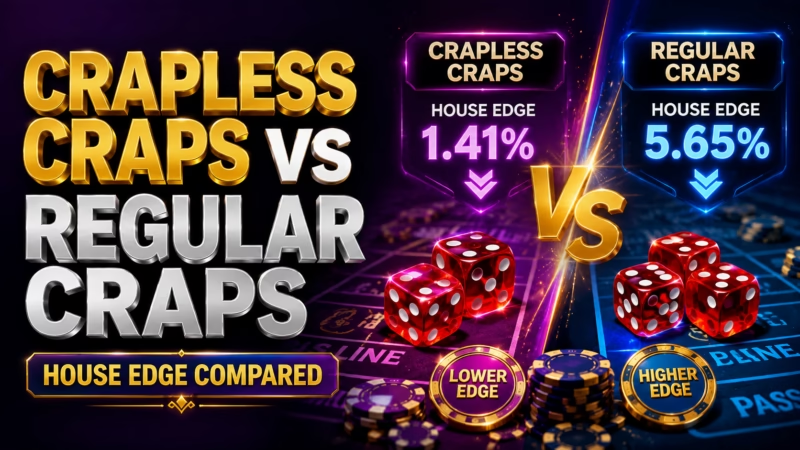
Craps
Craps contains many different bets, and their house edges vary considerably.
Some commonly used bets have relatively modest casino advantages, while certain proposition bets can carry much higher mathematical disadvantages.
For craps, asking “What is the house edge?” is less useful than asking, “What is the house edge on this specific bet?”
Slots
Slot machines usually express their mathematical return as RTP rather than directly displaying a house-edge figure.
If a slot has an RTP of 96%, its theoretical house edge is approximately 4%.
However, RTP can sometimes vary between configurations of the same slot. Players should check the game’s information screen or official paytable when an exact RTP value is important.
Can the House Edge Change?
The house edge can change when game rules, payout structures, bet types, or player decisions change.
This is particularly relevant for games with multiple betting options.
A roulette straight-up number bet and a red-or-black bet may have very different payout structures, but on the same standard wheel they can share the same underlying house advantage. In other games, choosing a different wager can dramatically change the house edge.
Blackjack is different because player decisions are part of the mathematical model. Using an inappropriate strategy can increase the casino’s effective advantage.
Slots may also be offered in different RTP configurations, so the same slot title should not automatically be assumed to have identical theoretical returns at every casino.
Does a Lower House Edge Mean You Will Win More Often?
A lower house edge does not necessarily mean you will win more individual bets.
House edge measures expected value, not hit frequency.
A game can produce frequent small wins while still having an unfavorable long-term expected return. Another game can produce fewer winning outcomes but offer larger payouts when wins occur.
This is why house edge should not be confused with volatility, hit frequency, payout frequency, or the probability of winning one specific round.
These measurements answer different questions.
House Edge vs Volatility
House edge measures theoretical long-term mathematical disadvantage, while volatility describes how unevenly results may occur.
Two games can have similar theoretical RTP values but produce completely different playing experiences.
A lower-volatility game may generate smaller wins more frequently. A higher-volatility game may have longer losing stretches combined with less frequent, potentially larger payouts.
Neither volatility nor house edge predicts the next result.
When comparing casino games, house edge helps explain expected mathematical cost, while volatility helps explain how unpredictable the path toward that long-term expectation can feel.
Why Total Amount Wagered Matters More Than Your Deposit
House edge applies to the amount wagered, not simply the amount deposited.
Suppose a player deposits $100 and repeatedly wagers the remaining balance. The total amount wagered during the session could eventually reach $500, $1,000, or considerably more even though the original deposit was only $100.
If the theoretical house edge is 3%, the expected mathematical cost is calculated against cumulative wagers.
At $1,000 in total wagering:
$1,000 x 3% = $30 theoretical expected loss
Actual results can still be positive or negative because short-term outcomes vary.
This is why playing more rounds generally increases exposure to the house edge.
Common House Edge Myths
“A 5% House Edge Means I Lose 5% Every Session”
No. A 5% house edge describes a long-term mathematical expectation across wagers. Short sessions can produce results far above or below that expectation.
“A Game Is Due to Pay Because the Casino Has Already Won Enough”
The house edge does not create a schedule of future wins. In games with independent random outcomes, previous results do not make a particular future outcome guaranteed.
“Betting Systems Can Remove the House Edge”
Changing bet sizes does not normally change the underlying mathematical expectation of an independent negative-expectation wager.
Systems such as increasing the stake after losses may change the pattern and size of risk, but they do not automatically turn an unfavorable mathematical bet into a favorable one.
“High RTP Means Low Risk”
High RTP and low risk are not the same thing.
A game can have a relatively high theoretical RTP while still having high volatility. Large short-term losses remain possible.
How to Use House Edge When Comparing Casino Games
House edge is most useful as a comparison tool rather than a prediction tool.
Before playing a casino game:
- Check the exact game or bet. Different wagers can have different mathematical advantages.
- Check the rules. Small rule changes can affect the house edge.
- Look at RTP when house edge is not shown. For many games, particularly slots, RTP is the more commonly published figure.
- Separate house edge from volatility. A low house edge does not guarantee smooth results.
- Consider wagering speed. A game that allows hundreds of bets quickly can expose a bankroll to the mathematical disadvantage faster.
- Set spending and time limits before playing. A mathematically favorable comparison does not remove gambling risk.
A lower house edge may help reduce theoretical long-term cost, but no house-edge percentage makes casino gambling a reliable way to earn money.
How This Information Was Reviewed
The casino house edge should be evaluated using the mathematical rules of the specific game, including probabilities, payouts, available bets, and any player decisions that influence expected value.
For blackjack, roulette, baccarat, craps, and similar games, players should check the exact table rules and payout conditions. For slots, the published RTP and official game information should be checked because configurations may differ between operators.
House edge, RTP, volatility, hit frequency, and bonus features describe different aspects of a casino game. None of these figures guarantees the outcome of an individual session.
Casino games should be treated as paid entertainment rather than a source of income. Players should set limits before gambling and stop if gambling begins to cause financial, emotional, or practical problems.
FAQ
What is the house edge in casino games?
The house edge is the casino’s theoretical mathematical advantage on a game or wager over the long run. A 3% house edge means the casino is expected to retain approximately 3% of total wagers across a sufficiently large sample, not that every player loses exactly 3% in each session.
Is a lower house edge better for the player?
Yes, a lower house edge generally means a smaller theoretical mathematical disadvantage for the player. It does not guarantee better results in a particular session because short-term outcomes remain random.
How do you convert RTP into house edge?
Subtract RTP from 100%. A game with 96% RTP has a theoretical house edge of approximately 4%. RTP and house edge are long-term statistical measurements and do not predict individual results.
Does house edge include casino bonuses?
Usually not. The underlying house edge is based on the game’s mathematical rules and payouts. Casino bonuses may have separate wagering requirements, restrictions, limits, and eligibility rules that need to be evaluated independently.
Can basic strategy reduce the blackjack house edge?
Correct basic strategy can reduce the mathematical disadvantage compared with making arbitrary blackjack decisions. The exact house edge still depends on table rules, including blackjack payouts, deck count, dealer actions, doubling rules, and other conditions.
Can a betting system beat the casino house edge?
A betting progression does not normally remove the mathematical disadvantage built into an independent casino wager. Changing stake sizes can change risk and bankroll fluctuations, but it does not automatically change the expected value of the underlying bet.
Is house edge the same as volatility?
No. House edge measures the theoretical long-term casino advantage, while volatility describes how dramatically results may fluctuate. Two games can have similar RTP or house-edge values while producing very different patterns of wins and losses.
Does a high house edge mean you lose quickly?
Not necessarily. House edge describes expected loss relative to total wagering, while the speed of losses also depends on bet size, number of rounds, volatility, luck, and how quickly the game is played.
Can the same casino game have different house edges?
Yes. Different rules, wagers, payout tables, and game versions can produce different house edges. Blackjack rules can vary between tables, craps bets have different mathematical advantages, and some slots may be offered with different RTP configurations.
What is the most important thing to remember about casino house edge?
House edge is a long-term mathematical measure, not a prediction of your next result. A lower house edge can help compare games, but every casino game still involves financial risk and should be treated as entertainment rather than a method of making money.
Brief Conclusion
The casino house edge shows how much mathematical advantage the casino has over a game or wager in the long run. Lower percentages generally mean a smaller theoretical disadvantage, but they do not guarantee wins or predict individual sessions. Compare the exact rules, payouts, RTP, and bet types before playing, and remember that greater total wagering increases exposure to the house edge. Casino gambling should remain entertainment with predetermined spending and time limits.