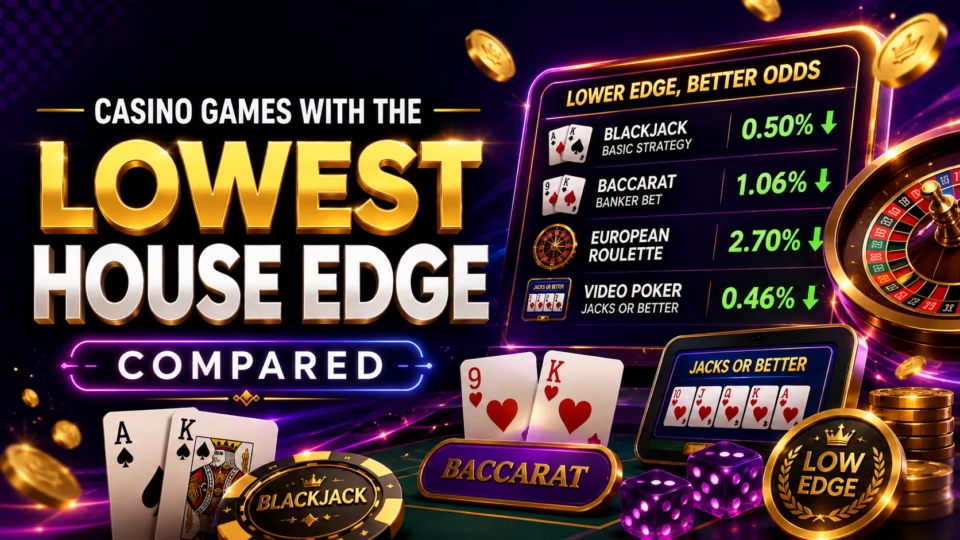
Casino games with the lowest house edge are typically blackjack under favorable rules, full-pay video poker, baccarat Banker bets, certain French roulette bets, and selected craps bets. The exact ranking depends on the rules, paytable, commission and, for strategy-based games, how accurately the player makes decisions.
Under favorable blackjack rules and correct basic strategy, the house edge can fall below 0.5%. Full-pay 9/6 Jacks or Better video poker returns about 99.54% with optimal strategy, equivalent to roughly a 0.46% house edge. Conventional baccarat has a house edge of about 1.06% on the Banker bet.
Quick takeaways
- Blackjack: often around 0.3% to 0.6% with favorable rules and accurate basic strategy.
- 9/6 Jacks or Better: about 0.46% house edge with optimal strategy.
- Baccarat Banker: about 1.06% under conventional commission rules.
- French roulette with La Partage: about 1.35% on even-money bets.
- Craps: Don’t Pass is about 1.36%, while Pass Line is about 1.41%. The separate Odds wager has 0% house edge but normally requires an underlying line bet.
A lower house edge improves the mathematical return over a very large number of bets, but it does not make a casino game profitable or predict what will happen during one session. Short-term results can differ dramatically from theoretical averages.
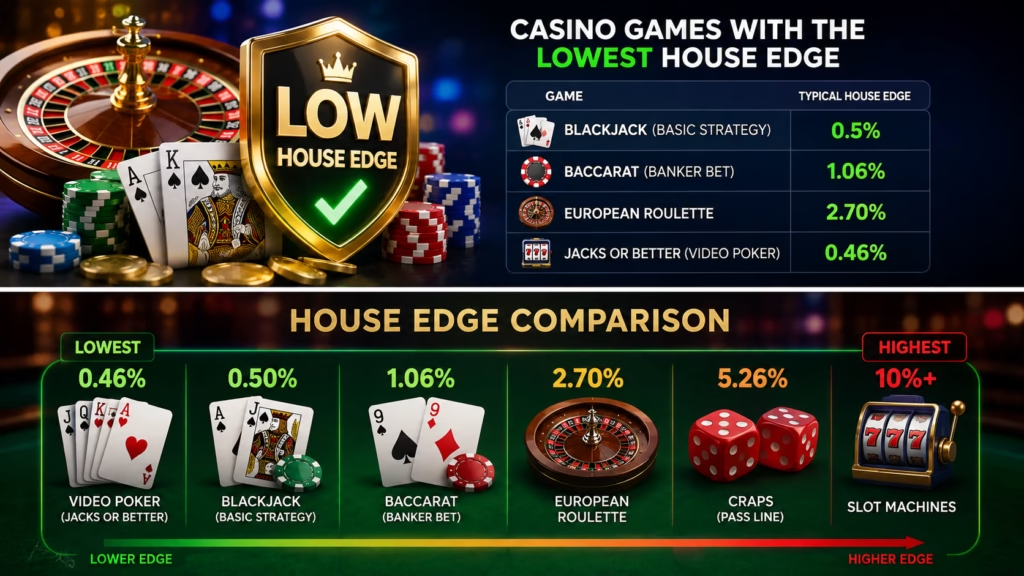
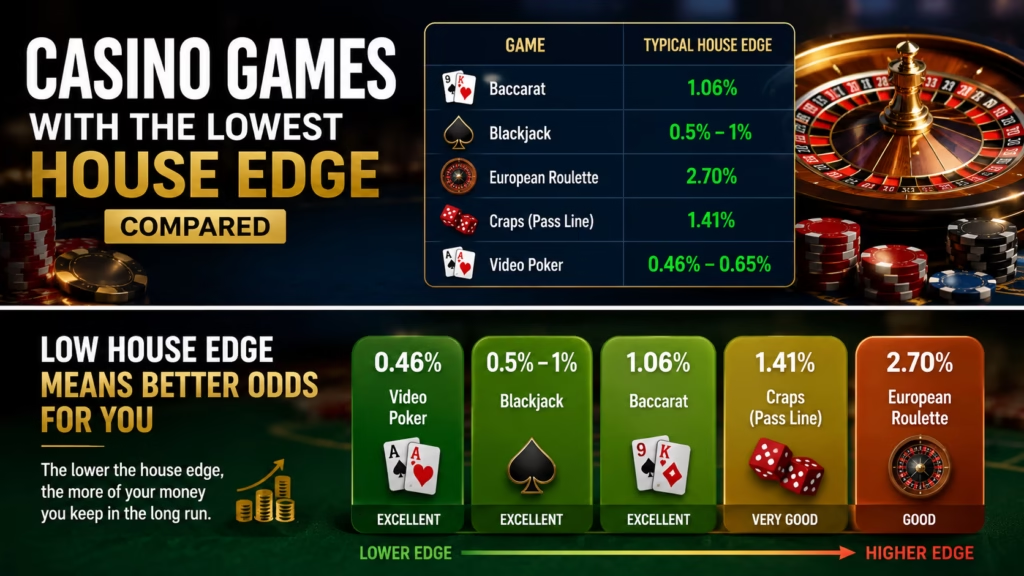
Lowest House Edge Casino Games Compared
The following comparison uses commonly cited favorable rules rather than assuming that every casino offers the same version of each game.
| Casino game or bet | Approximate house edge | Important condition |
| Blackjack | ~0.3% to 0.6% | Favorable rules and correct basic strategy |
| 9/6 Jacks or Better | ~0.46% | Full-pay table and optimal strategy |
| Baccarat Banker | ~1.06% | Conventional 5% commission format |
| French Roulette La Partage | 1.35% | Even-money bets only |
| Craps Don’t Pass / Don’t Come | 1.36% | Standard rules |
| Craps Pass / Come | 1.41% | Standard rules |
| Craps Place 6 or 8 | 1.52% | Standard payout |
| European Roulette | 2.70% | Single-zero wheel |
| American Roulette | 5.26% | Double-zero wheel |
These percentages describe long-run mathematical expectation. They are not estimates of what a particular player will lose in one visit or one online session. RTP and house edge are averages that become meaningful over large samples, while individual sessions can vary substantially.
1. Blackjack Can Have One of the Lowest House Edges
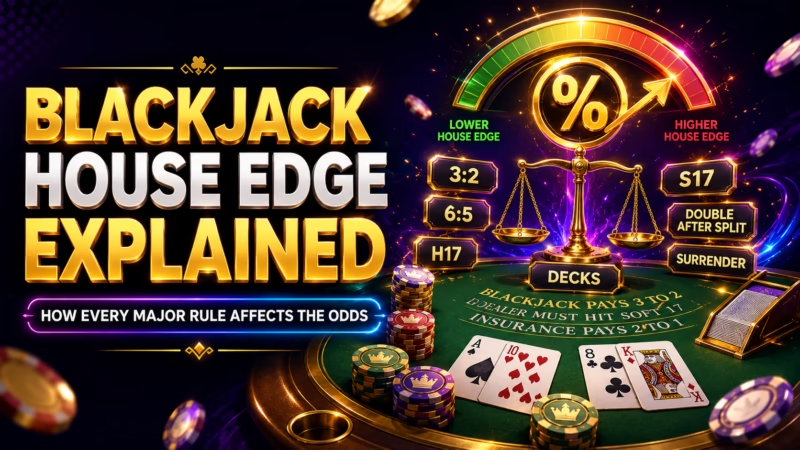
Blackjack is one of the lowest-house-edge casino games when the table has favorable rules and the player follows the correct basic strategy. The exact percentage changes with the number of decks, dealer rules, doubling options, surrender rules and the payout for a natural blackjack.
Under favorable rule sets, the house edge can be around 0.3% to 0.6% or sometimes lower. There is no single universal blackjack house edge because changing even one rule can alter the expected return.
The most important distinction is that blackjack is strategy-dependent. Hitting, standing, doubling and splitting incorrectly increases the casino advantage. A player who ignores basic strategy can give up much of the mathematical benefit that makes blackjack attractive.
Check the blackjack payout first
A natural blackjack paying 3:2 is much more favorable than a table paying 6:5. A 6:5 payout can add well over one percentage point to the house advantage compared with otherwise similar 3:2 rules.
That means a table marketed as blackjack may have significantly worse mathematics simply because of one rule.
Best suited to: players willing to learn basic strategy and check table rules before playing.
Be cautious if: the table pays 6:5 for blackjack, restricts doubling heavily or offers side bets that you have not evaluated separately.
2. Full-Pay Video Poker Can Rival Blackjack
Full-pay video poker can have a house edge below 0.5%, but the result depends heavily on both the paytable and playing strategy.
A standard example is 9/6 Jacks or Better, where a full house pays 9 units and a flush pays 6 units per unit wagered. With optimal strategy, this paytable returns approximately 99.54%, leaving an implied house edge of about 0.46%.
The same game name does not guarantee the same return. Alternative Jacks or Better paytables can have materially lower theoretical returns, so the paytable is more important than the artwork, machine name or casino lobby position.
Best suited to: players who understand poker hands and are prepared to follow a strategy chart.
Be cautious if: the paytable is reduced, particularly the full-house and flush payouts, or you are choosing cards intuitively instead of using an appropriate strategy.
3. Baccarat Banker Bet Has a Low House Edge Without Complex Strategy
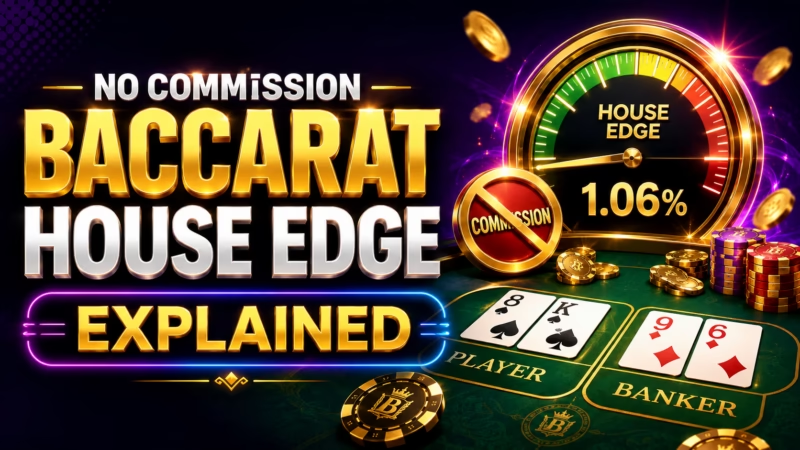
The conventional Baccarat Banker bet has a house edge of approximately 1.06%, making baccarat one of the stronger low-house-edge choices for players who do not want to memorize a detailed strategy.
In a standard eight-deck baccarat game, the Banker bet has a house edge of about 1.06%, the Player bet about 1.24%, and the Tie bet can be much higher, commonly around 14% depending on the payout structure.
The reason Banker does not simply pay even money in traditional baccarat is that winning Banker bets normally incur a 5% commission. Even after that commission, the Banker bet retains a slightly lower mathematical edge than the Player bet.
Baccarat also demonstrates why choosing the right bet matters as much as choosing the right game. Moving from Banker to Tie changes the mathematical cost dramatically even though both bets are placed at the same table.
Best suited to: players looking for simple decisions and a relatively low house edge.
Be cautious if: you move into Tie, Pair or other side bets without checking their individual house edges.
4. French Roulette With La Partage Can Beat Standard Roulette
French roulette with the La Partage rule can reduce the house edge to approximately 1.35% on even-money bets.
La Partage applies when the ball lands on zero. Instead of losing the entire even-money wager, such as red/black or odd/even, the player loses only half. That rule cuts the normal single-zero roulette edge on those specific bets from 2.70% to 1.35%.
Without La Partage, standard European single-zero roulette has a house edge of approximately 2.70% across normal bets. American double-zero roulette increases the standard edge to about 5.26%.
Choosing the wheel therefore matters more than choosing between red, black, odd, even or a single number if all bets follow the same standard single-zero rules.
Best suited to: players who prefer a simple game without strategy decisions.
Be cautious if: the wheel uses both 0 and 00 or the favorable French rules do not apply.
5. Craps Has Several Low-House-Edge Bets
Craps can offer a low house edge when players stay with specific bets instead of treating every section of the table as mathematically equal.
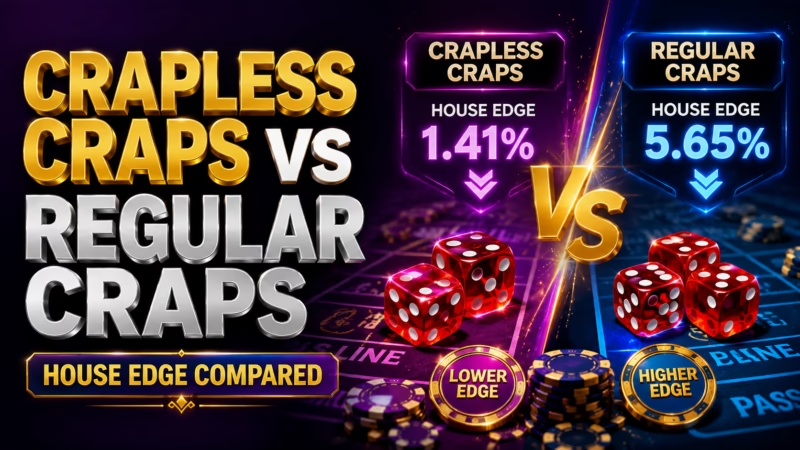
The standard Don’t Pass and Don’t Come bets carry a house edge of approximately 1.36%. Pass Line and Come bets are approximately 1.41%. Place bets on 6 or 8 are approximately 1.52%.
The special Odds wager has 0% house edge because it pays at true mathematical odds. However, this does not mean craps as a whole has no casino advantage. The Odds bet is normally available only after establishing a Pass, Come, Don’t Pass or Don’t Come position, so the overall betting combination still includes a wager with a house edge.
Craps can become much more expensive mathematically when players move into proposition bets and other high-edge options.
Best suited to: players who understand the betting layout and are disciplined enough to stay with lower-edge wagers.
Be cautious if: the excitement of the table encourages frequent side bets whose mathematics you have not checked.
6. European Roulette Is Better Than American Roulette
Single-zero European roulette has roughly half the standard house edge of double-zero American roulette.
A European wheel contains one zero and produces a house edge of approximately 2.70%. A standard American wheel contains both 0 and 00, producing approximately 5.26% on most wagers.
The difference may look small when comparing individual spins, but house edge applies repeatedly to the amount wagered. Over a large volume of bets, moving from a 5.26% game to a 2.70% game substantially changes theoretical expected loss.
If both versions are available under otherwise comparable conditions, the single-zero version has the stronger mathematical return.
What About Slots?
Slots cannot be assigned one universal house edge because RTP varies by game and sometimes by configuration.
For a straightforward casino game, a 96% theoretical RTP roughly corresponds to a 4% mathematical casino advantage, while a 98% RTP corresponds to roughly 2%. However, RTP is a long-term statistical measure rather than a prediction for an individual session.
Players comparing slots should check the actual RTP shown for that version of the game, rather than assuming every release from a particular provider has the same return.
House Edge vs RTP
House edge and RTP describe opposite sides of long-run expected return.
If a game has a theoretical RTP of 99%, the casino’s theoretical advantage is approximately 1% in a simple fixed-wager comparison. RTP describes the proportion of total wagers theoretically returned as prizes over a very large sample, while house edge describes the casino’s expected mathematical advantage.
The crucial word is theoretical. A 99% RTP does not mean that a player staking $100 should expect to leave with exactly $99. Actual returns can move substantially above or below the theoretical figure over short samples because results are random and game volatility affects short-term variation.
Does the Lowest House Edge Mean the Safest Game?
No. A low house edge reduces expected mathematical cost, but it does not remove short-term risk.
A player can lose quickly in a game with a 0.5% theoretical edge because individual outcomes fluctuate. A player can also finish ahead in a game with a much higher house edge during a short session. House edge describes long-run expectation, not the order in which wins and losses occur.
Betting speed also matters. A relatively low-edge game played hundreds of times can generate more total wagering than a higher-edge game played slowly.
For example, repeatedly recycling winnings through new bets increases total action. Expected mathematical loss is related to the amount wagered over time, not simply the amount initially deposited.
How to Choose a Low-House-Edge Casino Game
The best comparison starts with the exact rules, not simply the name of the game.
- Blackjack payout: prefer 3:2 rather than 6:5 when other rules are comparable.
- Blackjack rules: check decks, soft 17, doubling, splitting and surrender.
- Video poker paytable: distinguish full-pay versions from reduced paytables.
- Baccarat commission: confirm how winning Banker bets are paid.
- Roulette wheel: single zero is mathematically preferable to double zero, while La Partage improves qualifying even-money bets further.
- Craps bet type: Pass, Don’t Pass, Come, Don’t Come and Odds have very different mathematics from many proposition bets.
- Slot RTP: check the RTP displayed for the exact game version.
- Side bets: evaluate them separately rather than assuming they share the base game’s low edge.
A casino should make game rules, payouts and relevant return information easy to inspect before money is committed. If the mathematics are hidden or unclear, there is little reason to assume the most favorable version is being offered.
Common Mistakes When Comparing House Edge
Assuming every blackjack game has the same edge
Blackjack rules materially affect expected return. A low published blackjack figure is irrelevant if the table you are playing uses worse rules.
Comparing game names instead of individual bets
Baccarat Banker and Baccarat Tie are both baccarat wagers, yet their house edges are dramatically different.
Thinking 0% craps Odds makes the whole game house-edge free
The Odds wager itself pays at true odds, but it is tied to an underlying line bet that carries a casino advantage.
Treating RTP as a session forecast
RTP is a long-run statistical measure. It cannot tell you what the next spin, hand or session will return.
Ignoring side bets
A low-edge base game can contain optional wagers with far less favorable mathematics. Compare each wager separately.
How This Information Was Reviewed
The comparison focuses on theoretical house edge under clearly defined rules, including strategy requirements, paytables, roulette wheel configuration, baccarat commission and individual craps bets.
Blackjack and video poker percentages assume the player follows the strategy appropriate to the stated rules or paytable. Baccarat, roulette and craps percentages apply only to the specific bets described. Different casino rules or game versions can change the figures.
Before playing, verify the current rules, paytable, RTP and payout conditions inside the casino or game interface. Theoretical RTP and house edge describe long-run mathematics and cannot guarantee a particular result.
Casino games should be treated as paid entertainment, not as a method of earning income. Set limits before playing, avoid chasing losses and stop if gambling is no longer staying within the time or money limits you intended.
FAQ
Which casino game has the absolute lowest house edge?
There is no universal winner because the answer depends on the exact rules and strategy. Favorable blackjack can produce a house edge below 0.5%, while full-pay 9/6 Jacks or Better returns about 99.54% with optimal strategy, equivalent to roughly a 0.46% house edge.
Is blackjack always the casino game with the lowest house edge?
No. Blackjack can have an extremely low house edge, but poor table rules or strategy mistakes can increase it substantially. Video poker can also reach a similar theoretical return under favorable paytables and correct play.
What is the house edge on baccarat Banker?
The conventional eight-deck Baccarat Banker wager has a house edge of approximately 1.06%. The Player wager is approximately 1.24%, while the standard Tie wager is far higher, commonly around 14% depending on the payout structure.
Which roulette game has the lowest house edge?
French single-zero roulette with La Partage offers approximately a 1.35% house edge on qualifying even-money bets. Standard European single-zero roulette is approximately 2.70%, while double-zero American roulette is approximately 5.26% on most bets.
Does craps really have a 0% house edge bet?
Yes, the craps Odds wager itself has a 0% house edge because it pays at true odds. However, the Odds wager normally requires an underlying line bet, such as Pass or Don’t Pass, which does have a house edge.
Is video poker better than slots for house edge?
It can be. Full-pay 9/6 Jacks or Better offers approximately 99.54% theoretical return with optimal strategy, but other video poker paytables return less. Slots also vary by game, so the exact RTP of each version should be checked rather than comparing the categories by name alone.
Does a 1% house edge mean I will lose $1 from every $100?
No. A 1% house edge represents a long-run mathematical expectation, not a guaranteed result from a particular $100 session. Actual results can be much higher or lower over small samples because casino outcomes vary randomly.
Can a low house edge guarantee a longer playing session?
No. A lower house edge improves long-run expected value, but session length also depends on volatility, bet size, betting speed and random outcomes. A player can still experience a rapid losing streak in a low-house-edge game.
Are casino side bets usually included in the advertised house edge?
They should be evaluated separately. A base game can have a low house edge while optional wagers have very different mathematics. Baccarat provides a clear example: the standard Banker bet is about 1.06%, while the Tie bet is far higher.
Short Conclusion
The casino games with the lowest house edge are generally favorable blackjack, full-pay video poker, conventional baccarat Banker bets, French roulette with La Partage and carefully selected craps bets.
For most players, the biggest mistake is choosing a low-edge game but ignoring the rules that create that low edge. Check the blackjack payout, video poker paytable, baccarat commission, roulette wheel and exact craps wager before comparing games.
A lower house edge improves long-run mathematical value. It does not predict short-term results or guarantee winnings, so even the lowest house edge casino games should be played only within predetermined limits and treated as entertainment.