The video poker house edge is not fixed by the game name. It depends mainly on the exact paytable and how accurately the player follows the correct strategy for that version. Full-pay 9/6 Jacks or Better has a theoretical return of about 99.54% with optimal play, which corresponds to a house edge of about 0.46%. The 8/5 version returns about 97.30%, increasing the house edge to roughly 2.70%.
Quick takeaways:
- A better paytable can reduce the video poker house edge by several percentage points.
- Strategy matters because players choose which cards to hold and discard.
- A strategy designed for one video poker variant may be wrong for another.
- RTP and house edge describe long-term mathematical expectation, not what will happen during one session.
- Some rare full-pay video poker games can theoretically exceed 100% return under optimal play, but that does not guarantee a profit.
Video poker is most relevant to players who are willing to compare paytables and learn a specific playing strategy rather than simply pressing Deal and Draw. Players who do not want to study hold decisions should be especially careful with variants such as Double Bonus, Double Double Bonus and Deuces Wild, where seemingly small strategic differences can affect expected return.
What Is the House Edge in Video Poker?
The video poker house edge is the mathematical percentage of wagers that the casino expects to retain over the long run when a specified strategy is used. It is normally calculated from the game’s theoretical return:
House Edge = 100% – Theoretical Return
For example, a video poker game returning 99.54% has a theoretical house edge of approximately 0.46%. A game returning 97% has a theoretical house edge of approximately 3%.
Unlike a conventional slot, video poker includes player decisions after the initial five-card deal. The player decides which cards to hold and which to replace, so the theoretical return assumes a particular quality of strategy. The published optimal return can therefore be higher than the return an individual player actually achieves.
This distinction is important. A 99.54% theoretical return does not mean that a player will recover $99.54 from every $100 wagered. It represents a long-run mathematical expectation across a very large number of hands played according to the assumed strategy.
How the Video Poker Paytable Changes the House Edge
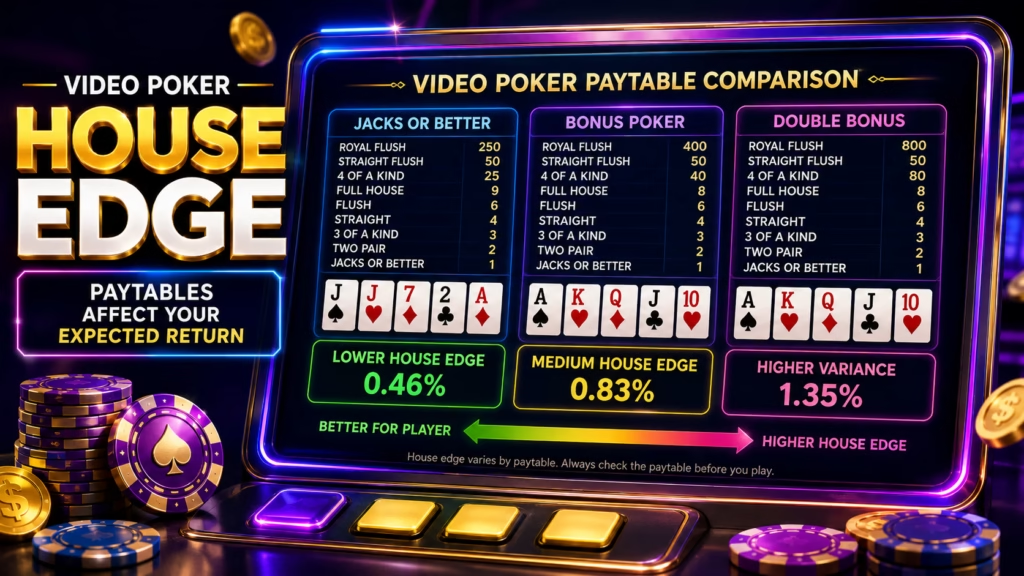
The paytable is one of the most important factors affecting video poker house edge because it determines how much each winning hand pays.
Jacks or Better provides a clear example. A description such as 9/6 Jacks or Better normally refers to a version paying 9 units for a full house and 6 units for a flush. An 8/5 version reduces those payments to 8 and 5. Those apparently small reductions substantially change the overall return because full houses and flushes occur much more frequently than royal flushes.
Jacks or Better House Edge by Paytable
| Paytable | Theoretical Return With Optimal Play | Approx. House Edge |
| 9/6 Jacks or Better | 99.5439% | 0.4561% |
| 9/5 Jacks or Better | 98.4498% | 1.5502% |
| 8/6 Jacks or Better | 98.3927% | 1.6073% |
| 8/5 Jacks or Better | 97.2984% | 2.7016% |
| 7/5 Jacks or Better | 96.1472% | 3.8528% |
| 6/5 Jacks or Better | about 94.996% | about 5.004% |
These returns are based on mathematically optimized decisions for the corresponding paytable.
The practical difference is substantial. Moving from 9/6 Jacks or Better to 8/5 Jacks or Better increases the theoretical casino advantage from about 0.46% to 2.70%. A player comparing two machines should therefore read the full house and flush payouts before assuming that both versions of Jacks or Better offer similar odds.
Why Playing Strategy Changes the Effective House Edge
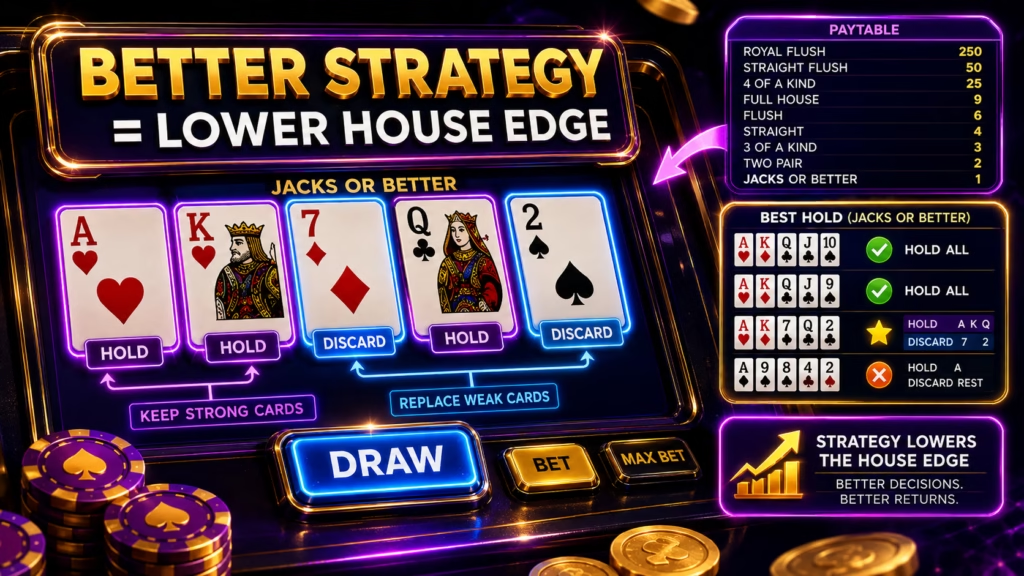
Video poker strategy affects the effective house edge because different hold decisions have different expected values. The mathematically correct choice may sometimes be less obvious than simply keeping the cards that look strongest.
For full-pay 9/6 Jacks or Better, an optimal strategy produces approximately 99.54% theoretical return. A published intermediate strategy produces roughly 99.52%, while a simplified strategy produces about 99.46%. That means simplification alone can give up around 0.08 percentage points of long-term return compared with optimal play.
That difference is relatively small because these simplified strategies are deliberately designed to remain close to optimal. Randomly guessing which cards to hold, chasing attractive-looking combinations or using a strategy from an unrelated variant can create a larger strategy penalty.
The Correct Strategy Must Match the Game
A video poker paytable strategy should match both the variant and, when relevant, the specific pay schedule. Jacks or Better, Bonus Poker, Double Bonus and Double Double Bonus may look similar on screen, but their bonus payments change the value of certain draws.
For example, using 10/7 Double Bonus strategy while playing 9/6 Jacks or Better reduces theoretical return from about 99.54% to about 98.94%. Using a 9/6 Double Double Bonus strategy on the same 9/6 Jacks or Better game produces about 98.51%. The strategy mismatch therefore costs approximately 0.61 and 1.03 percentage points respectively in these examples.
This does not mean every strategy mismatch is equally expensive. Jacks or Better and Bonus Poker strategies can be relatively close in some paytables, while other variants have more important differences. The safe approach is to identify the exact game and paytable before using a strategy chart.
House Edge Across Popular Video Poker Variants
The name of a video poker family alone does not reveal its house edge. Different pay schedules within the same family can produce very different theoretical returns.
Several well-known examples illustrate the range:
| Video Poker Version | Optimal Theoretical Return | Mathematical Position |
| 9/6 Jacks or Better | 99.54% | ~0.46% house edge |
| 8/5 Bonus Poker | 99.17% | ~0.83% house edge |
| 9/6 Double Double Bonus | 98.98% | ~1.02% house edge |
| 10/6 Double Double Bonus | 100.07% | ~0.07% theoretical player edge |
| 10/7 Double Bonus | 100.17% | ~0.17% theoretical player edge |
| Full-Pay Deuces Wild | 100.76% | ~0.76% theoretical player edge |
Published mathematical analyses place 8/5 Bonus Poker at about 99.17%, 10/7 Double Bonus at about 100.17%, 10/6 Double Double Bonus at about 100.07%, and full-pay Deuces Wild at about 100.76% under optimal strategy.
A return above 100% should not be interpreted as a guaranteed way to make money. These numbers assume the exact qualifying paytable and mathematically accurate decisions over a very large sample of hands. High-return versions can also be difficult to find, and normal short-term variance can easily outweigh a small theoretical advantage.
How to Compare Video Poker Paytables
Players comparing video poker games should evaluate more than the advertised variant name.
1. Check the Full House and Flush Payments
In Jacks or Better, the difference between 9/6 and 8/5 is particularly important. Two games labeled Jacks or Better can therefore have substantially different house edges.
2. Check Bonus Four-of-a-Kind Payments
Bonus Poker, Double Bonus and Double Double Bonus shift more of the theoretical return toward four-of-a-kind combinations. This changes both the paytable and the correct strategy.
3. Check the Royal Flush Payout
Some video poker paytables provide a disproportionately larger royal flush payout at the maximum conventional coin wager. A player comparing return percentages should make sure the quoted RTP assumes the same bet configuration actually being used. A different royal payout can materially change the overall theoretical return.
4. Match the Strategy to the Exact Variant
Do not assume that knowing Jacks or Better strategy automatically provides optimal play for Double Bonus, Deuces Wild or Triple Double Bonus. Strategy mismatch can range from almost negligible to more than one percentage point depending on the combination.
5. Compare Return, Not Only Jackpot Size
A larger payout for one rare hand can be offset by reduced payouts elsewhere. The entire paytable determines theoretical return, so one attractive number is not enough to judge the game’s house edge.
Paytable Quality vs Strategy Quality
Paytable selection and playing strategy solve two different problems.
The paytable establishes the maximum theoretical return available from the game. Strategy determines how closely the player can approach that theoretical return.
For example, optimal play cannot turn 8/5 Jacks or Better with a roughly 97.30% return into 9/6 Jacks or Better with a roughly 99.54% return. Strategy can reduce decision errors, but it cannot repair an inferior pay schedule.
The practical order is therefore:
- Identify the exact video poker variant.
- Compare available paytables.
- Select the more favorable paytable when other relevant conditions are equal.
- Use a strategy specifically designed for that game.
- Practice difficult hold decisions before wagering real money.
This sequence matters because there is little value in memorizing perfect strategy for a poor paytable if a materially better version is available nearby.
Common Video Poker House Edge Mistakes
Assuming All Jacks or Better Games Have the Same RTP
They do not. The difference between 9/6, 9/5, 8/6, 8/5 and lower-paying versions can change the house edge by several percentage points.
Looking Only at the Royal Flush
The royal flush is important, but recurring lower-value hands also contribute heavily to theoretical return. A paytable that cuts full house or flush payouts may be substantially worse even when the royal payout looks unchanged.
Using One Strategy for Every Video Poker Game
Different payout structures change which draws have the highest expected value. A strategy that is excellent for one variant can become suboptimal on another.
Treating RTP as a Session Prediction
A 99% return does not mean a session will finish close to a 1% loss. Theoretical return is a long-run average. Individual sessions may produce results far above or below that expectation.
Assuming a 100%+ Game Guarantees Profit
A theoretical return above 100% represents a mathematical expectation under specified conditions. It does not guarantee that an individual player will win, especially across a limited number of hands.
Practical Video Poker Strategy for Lowering the House Edge
A player trying to minimize the video poker house edge should focus on controllable mathematical factors rather than betting systems.
First, read the paytable before playing. If several versions of the same game are available, compare the payouts for full houses, flushes, straights, four of a kind and any variant-specific bonus hands.
Second, use a strategy chart calculated for that exact game. Strategy tools and analyzers can evaluate each possible hold according to expected value, which is more reliable than choosing cards based on intuition.
Third, practice the strategy without real-money pressure when possible. The biggest practical challenge is not understanding that strategy matters, but applying the correct decision consistently when two possible holds appear close.
Finally, set a spending and time limit before playing. Even a low-house-edge game can produce significant losses during ordinary short-term variance. Video poker should be treated as entertainment rather than as a dependable source of income.
How This Information Was Reviewed
The video poker house edge figures in this guide are based on mathematically analyzed paytables and strategy-specific expected returns. The comparison separates two variables that players can easily confuse: the theoretical return built into the paytable and the return lost through strategy errors.
Before playing any specific version, check the paytable displayed inside the game because casinos and software providers may offer different schedules under the same general video poker name. Strategy should also be matched to the actual variant rather than copied from a superficially similar game.
RTP and house edge describe long-run mathematical expectation. They do not predict the result of the next hand or guarantee the result of a session. If gambling stops being entertainment, exceeds a predetermined budget or creates pressure to recover previous losses, stopping is the safer choice.
FAQ
What is the house edge in video poker?
The video poker house edge depends on the paytable and playing strategy. Full-pay 9/6 Jacks or Better has an optimal theoretical return of about 99.54%, corresponding to a house edge of about 0.46%, while lower-paying versions can have a much larger casino advantage.
Which video poker game has the lowest house edge?
There is no single answer based only on the variant name because the exact paytable matters. Some full-pay versions of Deuces Wild, Double Bonus and Double Double Bonus have optimal returns above 100%, while many more commonly available paytables remain below 100%.
What does 9/6 mean in Jacks or Better?
In standard 9/6 Jacks or Better, the 9 generally identifies the 9-for-1 full house payment and the 6 identifies the 6-for-1 flush payment. Full-pay 9/6 Jacks or Better returns approximately 99.54% with optimal strategy.
Is 8/5 Jacks or Better much worse than 9/6?
Yes. Optimal 9/6 Jacks or Better returns approximately 99.54%, while 8/5 Jacks or Better returns approximately 97.30%. That changes the house edge from roughly 0.46% to 2.70%.
Can strategy eliminate the house edge in video poker?
Strategy can reduce decision errors, but it cannot change an inferior paytable. Optimal strategy allows the player to approach the mathematical return built into a particular pay schedule. It cannot turn a 97% paytable into a 99.5% paytable.
Can I use Jacks or Better strategy for Bonus Poker or Double Bonus?
Sometimes a related strategy performs reasonably well, but it is not automatically optimal. Some mismatches cost only a few hundredths of a percentage point while others cost much more. Using a strategy developed for the exact variant is the more accurate approach.
Does a 100% RTP video poker game guarantee that I will not lose?
No. A 100% or higher theoretical return does not guarantee a winning session. The figure applies to long-run expected value under specific paytable and strategy assumptions, while individual results remain subject to substantial short-term variation.
Is video poker RTP the same as house edge?
They describe opposite sides of the same long-run expectation. For a game with a return below 100%, house edge can generally be expressed as 100% minus theoretical RTP. A 99.5% return therefore corresponds to approximately a 0.5% house edge.
What should I check before playing video poker?
Check the exact variant, the complete paytable, the royal flush payout and whether your strategy matches that specific game. Do not rely only on the game’s title or assume that two machines labeled Jacks or Better provide the same theoretical return.
Brief Conclusion
The video poker house edge is determined by both the paytable and playing strategy. Paytable quality sets the mathematical ceiling, while correct strategy determines how closely a player approaches it.
The difference can be substantial. Optimal 9/6 Jacks or Better has about a 0.46% house edge, while 8/5 Jacks or Better is approximately 2.70%. Strategy errors can increase the disadvantage further. The practical approach is simple: compare the exact paytable first, use a strategy matched to that version and treat theoretical RTP as a long-run mathematical measure rather than a promise of what will happen during a session.