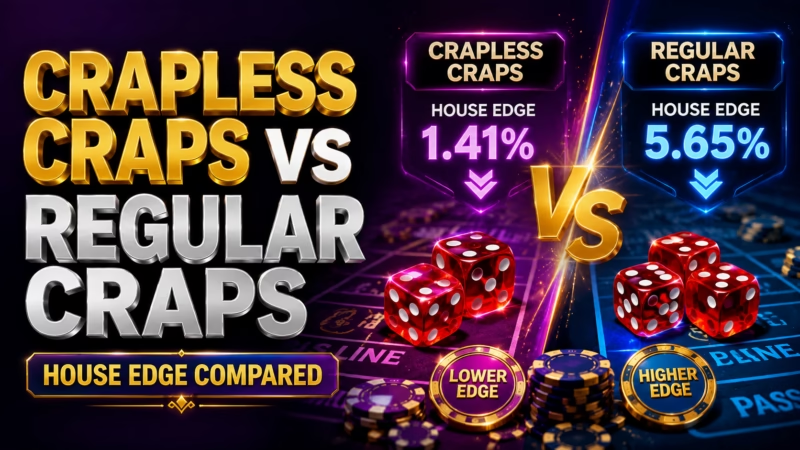
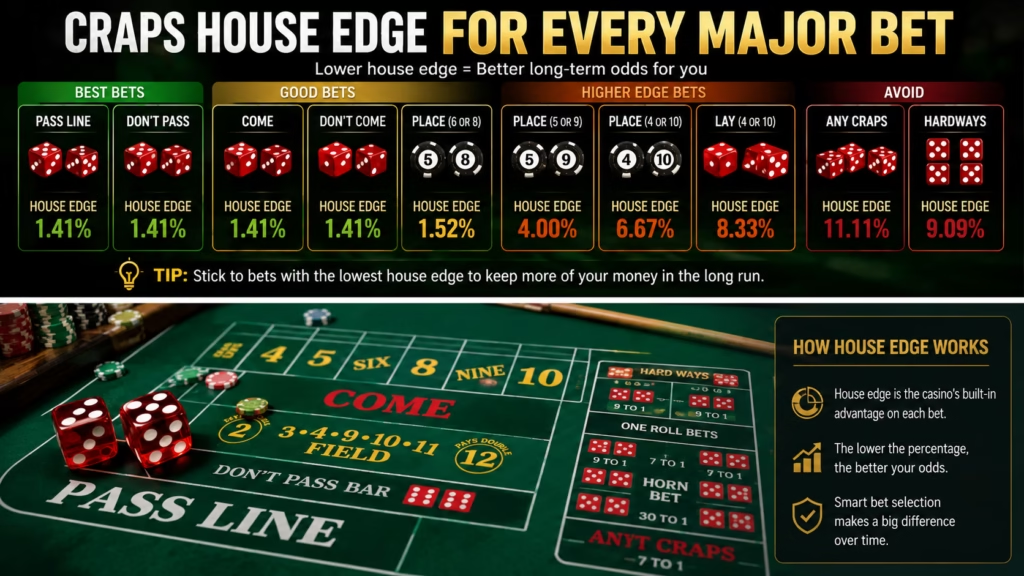
The craps house edge varies dramatically depending on the bet. Some of the strongest bets on a standard craps table have a house edge near 1.4%, while several proposition bets exceed 10%. The lowest mathematical disadvantage is generally found on Pass Line, Don’t Pass, Come, Don’t Come and properly used odds bets.
The most important numbers to know are:
- Don’t Pass / Don’t Come: about 1.36%
- Pass Line / Come: about 1.41%
- Place 6 or 8: about 1.52%
- Odds bet: 0% on the odds portion
- Place 4 or 10: about 6.67%
- Hardways: about 9.09% to 11.11%
- Any Seven: about 16.67%
Players who want simpler decisions and lower mathematical costs generally focus on line bets, Come bets and odds. Proposition bets can produce larger single-roll payouts, but their higher house edge means the casino keeps a larger theoretical percentage of the money wagered over the long run.
House edge does not predict what will happen in a particular session. Craps outcomes are random, and short sessions can differ substantially from the mathematical average.
Craps House Edge by Bet
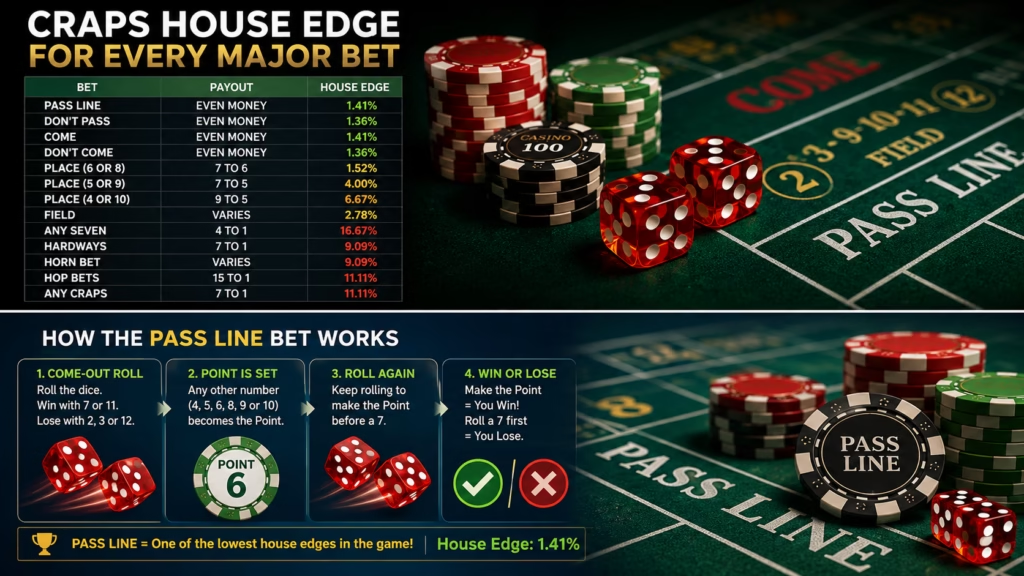
The table below compares the house edge for the major craps bets under common standard payouts.
| Craps bet | Typical house edge |
| Odds bet | 0% |
| Don’t Pass | 1.36% |
| Don’t Come | 1.36% |
| Pass Line | 1.41% |
| Come | 1.41% |
| Place 6 | 1.52% |
| Place 8 | 1.52% |
| Field with 3:1 on 12 | 2.78% |
| Place 5 | 4.00% |
| Place 9 | 4.00% |
| Field with 2:1 on 2 and 12 | 5.56% |
| Place 4 | 6.67% |
| Place 10 | 6.67% |
| Big 6 | 9.09% |
| Big 8 | 9.09% |
| Hard 6 | 9.09% |
| Hard 8 | 9.09% |
| Any Craps | 11.11% |
| Hard 4 | 11.11% |
| Hard 10 | 11.11% |
| Yo / Eleven | 11.11% |
| 2 / Aces | 13.89% |
| 12 / Boxcars | 13.89% |
| Any Seven | 16.67% |
Buy and Lay bets require extra attention. Their house edge depends on the commission, often called the vig, and whether the casino charges that commission when the bet is placed or only when it wins. For this reason, a single percentage does not accurately describe every Buy or Lay bet offered by every casino.
What Does House Edge Mean in Craps?
The craps house edge is the casino’s theoretical advantage on a particular wager over a very large number of resolved bets.
For example, a 1.41% house edge does not mean a player will lose exactly $1.41 every time $100 is wagered. It means the mathematical expected loss averages approximately $1.41 per $100 of action over a sufficiently large sample under the same rules.
Individual results can be very different. A player can win several bets in a row or lose several in a row without changing the underlying house edge.
House edge is therefore most useful for comparing bets, not predicting the result of the next dice roll.
Pass Line House Edge
The Pass Line house edge is approximately 1.41%, making it one of the lower-edge standard bets on the craps table.
On the come-out roll:
- 7 or 11 wins.
- 2, 3 or 12 loses.
- 4, 5, 6, 8, 9 or 10 establishes the point.
Once a point is established, the Pass Line wins if the point is rolled again before a 7.
The Pass Line is often suitable for beginners because the rules are relatively straightforward and the mathematical disadvantage is considerably lower than on most center-table proposition bets.
Adding an odds bet after a point is established can make the overall wager more mathematically efficient because the odds portion itself carries no house advantage.
Don’t Pass House Edge
The Don’t Pass house edge is approximately 1.36%, slightly lower than the Pass Line edge under standard rules.
The difference exists partly because a come-out roll of 12 normally pushes rather than winning for the Don’t Pass bettor.
Don’t Pass effectively bets against the shooter after the point is established. A 7 appearing before the point wins the Don’t Pass wager.
The mathematical difference between 1.36% and 1.41% is small. Players should not expect that difference to determine the outcome of a short playing session.
Come and Don’t Come House Edge
The Come bet has approximately the same 1.41% house edge as Pass Line, while the Don’t Come bet has approximately the same 1.36% edge as Don’t Pass.
The key difference is timing.
Come and Don’t Come bets are normally made after a point has already been established for the main Pass Line game. Each Come or Don’t Come wager then develops its own number if it survives its first roll.
These bets allow a player to have several numbers active while retaining a relatively low house edge compared with many one-roll proposition bets.
Why Odds Bets Have 0% House Edge
A standard craps odds bet has no built-in house edge because it pays according to the true mathematical odds of making the point before rolling a 7.
Typical true-odds payouts are:
| Point | Pass/Come odds payout |
| 4 or 10 | 2:1 |
| 5 or 9 | 3:2 |
| 6 or 8 | 6:5 |
An odds bet does not make the original Pass Line or Come bet fair. The original wager still carries its normal house edge.
Instead, adding odds increases the amount of money receiving true-odds payouts. This lowers the casino advantage when expected loss is considered relative to the total money being wagered.
Casinos may permit 1x, 2x, 3x, 5x, 10x, 20x or other odds limits. The limit is an operator rule and should be checked before playing.
Place Bet House Edge
Place bets have significantly different house edges depending on the chosen number.
Place 6 and Place 8
Place 6 and Place 8 carry a house edge of approximately 1.52% when they pay the conventional 7:6.
That makes 6 and 8 among the strongest direct number bets on a standard craps table.
Players commonly use multiples of $6 because the 7:6 payout then produces clean payouts without fractional amounts.
Place 5 and Place 9
Place 5 and Place 9 have a 4.00% house edge with the conventional 7:5 payout.
The edge is substantially higher than on Place 6 or 8.
Place 4 and Place 10
Place 4 and Place 10 have a house edge of approximately 6.67% with the conventional 9:5 payout.
Players considering 4 or 10 should also check whether the casino offers Buy bets under favorable commission rules. A Buy 4 or Buy 10 can sometimes provide better mathematical value, depending on how the vig is charged.
Buy Bet House Edge
A Buy bet pays true odds but adds a casino commission, so its house edge depends heavily on the vig rules.
A common commission is 5%, but two details matter:
- What amount the 5% commission is calculated from.
- Whether the commission is charged immediately or only after a winning bet.
For example, when a 5% Buy commission is charged on the wager only after a win, a Buy 4 or Buy 10 can have an effective house edge around 1.67% under conventional rules.
If the commission is collected regardless of whether the bet wins, the mathematical cost can be substantially higher.
Players should therefore check the exact table rules rather than assuming every Buy bet has the same house edge.
Lay Bet House Edge
A Lay bet reverses the normal number wager by betting that 7 will appear before the selected number.
Because 7 is more likely to appear before 4, 5, 6, 8, 9 or 10, the player must risk more money than the potential win.
Lay bets also normally include a commission.
Under one common structure where a 5% commission is collected upfront, approximate house edges can be around:
- Lay 4 or 10: 2.44%
- Lay 5 or 9: 3.23%
- Lay 6 or 8: 4.00%
Different commission policies change these percentages. If the casino charges commission only after a winning Lay bet, the effective edge may be lower.
Field Bet House Edge
The Field bet house edge depends on how the casino pays 2 and 12, so checking the table layout is particularly important.
The Field normally wins on:
2, 3, 4, 9, 10, 11 or 12.
It loses on:
5, 6, 7 or 8.
If both 2 and 12 pay 2:1, the house edge is approximately 5.56%.
If one of those numbers, commonly 12, pays 3:1 while the other pays 2:1, the house edge falls to approximately 2.78%.
That difference makes the exact Field rules more important than the name of the bet itself.
Hardways House Edge
Hardways are higher-edge bets that require a number to appear as a matching pair before either an easy version of the number or a 7 appears.
For example, Hard 8 wins with 4-4. It loses if 8 arrives as 2-6, 3-5, 5-3 or 6-2, or if a 7 appears first.
Typical house edges are:
- Hard 6: 9.09%
- Hard 8: 9.09%
- Hard 4: 11.11%
- Hard 10: 11.11%
Hardways can offer larger payouts than low-edge line bets, but the higher payout does not mean better mathematical value.
Proposition Bet House Edge
Many center-table proposition bets have some of the highest house edges in craps.
Any Craps
Any Craps wins when the next roll is 2, 3 or 12.
At a conventional 7:1 payout, its house edge is approximately 11.11%.
Eleven or Yo
A one-roll bet on 11 commonly pays 15:1.
Its house edge is approximately 11.11%.
Aces or Boxcars
A one-roll wager specifically on 2 or specifically on 12 commonly pays 30:1.
The house edge is approximately 13.89%.
Any Seven
Any Seven wins if the next roll totals 7.
With a conventional 4:1 payout, the house edge is approximately 16.67%, making it one of the most expensive common craps wagers mathematically.
Which Craps Bets Have the Lowest House Edge?
The lowest-edge conventional craps strategy is built around line bets and odds rather than proposition bets.
For players comparing bets strictly by mathematics, the usual order begins with:
1. Odds portion at 0%.
2. Don’t Pass or Don’t Come at about 1.36%.
3. Pass Line or Come at about 1.41%.
4. Place 6 or 8 at about 1.52%.
The 0% edge on odds should not be misunderstood. An odds bet normally cannot be placed independently and requires an underlying Pass, Don’t Pass, Come or Don’t Come wager.
A lower house edge reduces expected mathematical loss over repeated play. It does not improve the player’s ability to predict the dice or guarantee that a particular session will last longer or end profitably.
Common Mistakes When Comparing Craps House Edge
Assuming the biggest payout is the best bet
A large advertised payout does not automatically mean good value. Proposition bets often compensate for their low probability of winning with larger payouts while still retaining a high casino advantage.
Treating odds as a guaranteed advantage
Odds carry a 0% house edge, but the result remains random. Zero house edge means the payout reflects the mathematical probability, not that the bet is likely to win.
Ignoring casino-specific rules
Field payouts, Buy commissions, Lay commissions and maximum odds can change from one casino to another. A house-edge chart should therefore be matched against the actual rules of the table being played.
Using house edge to predict a short session
House edge is a long-run mathematical measurement. A 1.41% bet can lose immediately, while a 10% house-edge bet can win on its next roll.
The difference becomes meaningful through repeated wagering, not as a prediction of individual outcomes.
How to Choose Craps Bets More Carefully
Players who want to minimize the mathematical cost of craps should first compare the house edge rather than the headline payout.
A practical approach is to:
- understand Pass, Don’t Pass, Come and Don’t Come before using more complicated bets;
- check how much odds the table allows;
- prefer Place 6 or 8 over higher-edge Place numbers when the objective is lower house advantage;
- read the Field payouts before placing the bet;
- check exactly when Buy and Lay commissions are charged;
- understand that proposition bets often carry substantially higher edges;
- set a fixed gambling budget before play.
A low house edge does not make gambling profitable. It only reduces the casino’s theoretical advantage relative to higher-edge alternatives.
How This Information Was Reviewed
The percentages in this guide are based on standard two-dice craps probabilities and conventional payouts for the major bets. House edge is calculated from the probability of each relevant outcome and the amount returned when the wager wins.
Actual casino rules must still be checked before playing. Field payouts, odds limits, Buy commissions, Lay commissions and certain proposition payouts can vary between tables or operators.
House edge describes long-term mathematical expectation. It does not predict individual rolls, and no betting system can change the random outcome of properly conducted dice rolls.
Craps should be treated as entertainment rather than a way to generate income. Set spending and time limits before playing, and stop if gambling is no longer enjoyable or the losses exceed the amount you planned to spend.
FAQ
What is the house edge in craps?
The craps house edge depends on the bet and ranges from 0% on the odds portion of a qualifying wager to more than 16% on some proposition bets. Pass Line is approximately 1.41%, while Don’t Pass is approximately 1.36% under standard rules.
Which craps bet has the lowest house edge?
The odds bet has a 0% house edge because it pays at true mathematical odds. However, odds normally require an existing Pass Line, Don’t Pass, Come or Don’t Come wager, so the complete betting position still contains a casino advantage from the underlying bet.
Is Don’t Pass better than Pass Line?
Don’t Pass has a slightly lower mathematical house edge, approximately 1.36% compared with 1.41% for Pass Line. The difference is small and does not predict which side will perform better during a particular session.
What is the house edge on Place 6 and Place 8?
Place 6 and Place 8 have a house edge of approximately 1.52% when they pay 7:6. They are considerably lower-edge choices than Place 5 or 9 at 4.00% and Place 4 or 10 at approximately 6.67%.
Does taking odds reduce the craps house edge?
Taking odds reduces the effective casino advantage relative to the total amount wagered because the odds portion carries no house edge. The original Pass Line or Come wager still retains its normal house edge.
What is the house edge on a Field bet?
A Field bet commonly has a house edge of either 5.56% or 2.78%, depending on the payouts for 2 and 12. A table paying 3:1 on one of those numbers offers better mathematical value than a table paying only 2:1 on both.
Why do Buy bets have different house-edge percentages?
Buy bet house edge changes because casinos use different commission rules. The size of the vig and whether it is collected upfront or only after a win can materially change the expected cost of the wager.
What is the worst common craps bet by house edge?
Any Seven is among the highest-edge common craps bets. At a conventional 4:1 payout, its house edge is approximately 16.67%.
Can a craps betting system eliminate the house edge?
No betting progression can remove the underlying mathematical house edge of a casino wager. Changing bet size after wins or losses changes the amount at risk but does not change the probabilities or standard payouts.
Does a low house edge mean I am likely to win?
No. A low house edge means the casino’s long-run mathematical advantage is smaller. It does not predict the next roll or guarantee a profitable session. Craps outcomes remain random, so players should gamble only with money they can afford to lose.
Brief Conclusion
The craps house edge by bet ranges from 0% on odds to more than 16% on some proposition wagers. Pass Line, Don’t Pass, Come, Don’t Come and Place 6 or 8 offer substantially lower mathematical costs than most center-table bets. Odds can further improve the mathematical efficiency of a line-based strategy because the odds portion pays at true odds.
The exact rules still matter. Field payouts and Buy or Lay commissions can materially change the house edge, so always check the table rules before betting. Lower house edge reduces expected long-term loss, but it does not make craps predictable or guarantee a win.