
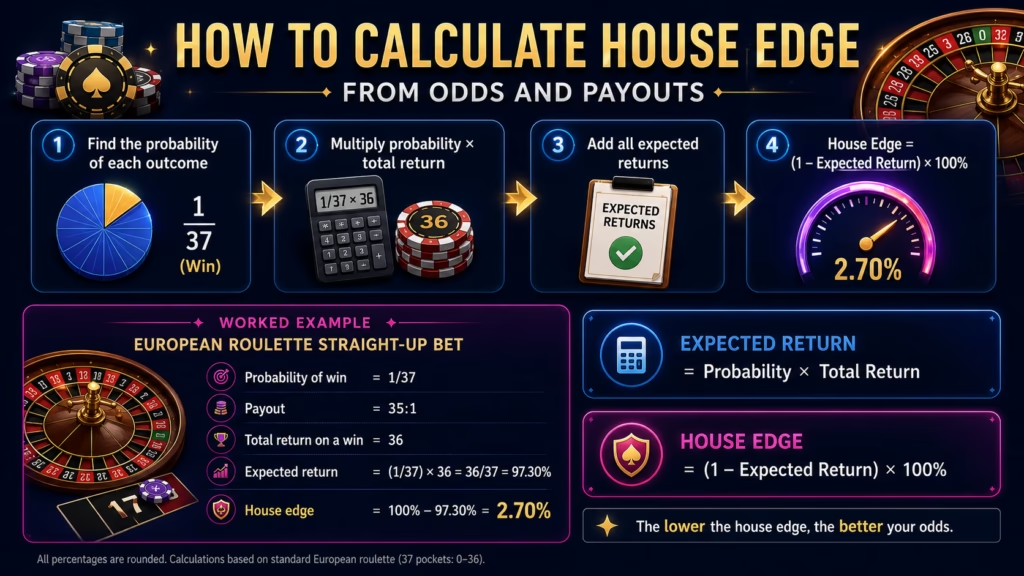
To calculate house edge, compare the true probability of each outcome with the payout offered by the game. For a simple win-or-lose bet, the core house edge formula is:
House Edge = 1 – Expected Return
Or, as a percentage:
House Edge (%) = (1 – RTP) x 100
If a bet wins with probability p and pays b to 1 in profit, the formula becomes:
House Edge = 1 – p x (b + 1)
The important point is that the payout must be compared with the mathematical probability of winning. A payout below the fair payout creates an advantage for the casino.
Quick Takeaways
- House edge measures the casino’s theoretical advantage per unit wagered over the long run.
- True probability and payout are both required to calculate house edge accurately.
- A payout written as 5:1 normally means 5 units of profit plus the original stake.
- House edge and RTP describe long-run mathematical expectations, not the result of an individual session.
- A lower house edge reduces the mathematical cost of wagering, but it does not guarantee better short-term results.
House edge calculations are most useful for players comparing table-game bets, side bets and other wagers with clearly defined probabilities. They are less straightforward when probabilities are hidden inside complex game software or when player decisions change the expected return.
What Is House Edge?
House edge is the average percentage of each wager that a casino mathematically expects to retain over a very large number of bets. A 5% house edge means an expected casino advantage of $5 for every $100 wagered in the long run, not that the player will lose exactly $5 after wagering $100.
RTP is a long-run average measured across a significant number of plays rather than an amount a player should expect back during an individual session.
House edge and RTP can therefore be expressed as two sides of the same calculation:
House Edge + RTP = 100%
For example:
- RTP = 97%
- House edge = 3%
This relationship works when RTP and house edge refer to the same wager and the same set of game rules.
House Edge Formula
For a wager with one winning outcome and one losing outcome, use:
Expected Value = (Probability of Win x Net Win) – (Probability of Loss x Stake)
Then:
House Edge = -Expected Value / Stake
For a $1 wager, the calculation becomes simpler:
House Edge = -Expected Value
If the winning payout is expressed as b to 1, you can also calculate house edge directly:
House Edge = 1 – [Probability of Win x (b + 1)]
Multiply the result by 100 to convert it into a percentage.
Why the Formula Uses b + 1
A payout of 5:1 usually means that a $1 winning bet produces:
- $5 profit
- $1 original stake returned
- $6 total return
The expected return calculation therefore uses 6, not 5.
Confusing profit with total return is one of the most common errors when calculating house edge.
How to Calculate House Edge Step by Step
1. Find the True Probability of Winning
Start with the mathematical probability of the winning outcome.
If 1 of 6 equally likely outcomes wins:
Probability = 1 / 6 = 0.1667
That is approximately 16.67%.
If 3 of 20 outcomes win:
Probability = 3 / 20 = 0.15
That is 15%.
The probability must come from the actual game rules. Advertising, recent results and previous winning sequences do not change the mathematical probability of an independent random event.
2. Identify the Payout
Next, determine how much the winning wager returns.
Suppose a bet pays 4:1.
For every $1 wagered:
Net profit = $4
Total return = $5
The total return is what matters when calculating RTP directly.
3. Calculate Expected Return
Suppose the probability of winning is 1 in 6 and the payout is 4:1.
Expected Return = 1/6 x 5
Expected Return = 0.8333
The theoretical RTP is therefore:
83.33%
4. Convert Expected Return Into House Edge
Subtract the RTP from 100%:
House Edge = 100% – 83.33%
House Edge = 16.67%
The casino’s theoretical advantage on this hypothetical wager is therefore 16.67%.
Example: Calculating House Edge From Odds and Payout
Consider a hypothetical game with three equally likely outcomes.
The player wins when one specific outcome occurs.
Probability of winning:
1 / 3 = 33.33%
The fair payout would be 2:1, because the player loses on two outcomes for every one winning outcome in the theoretical probability distribution.
Now suppose the game pays only 1.8:1.
A $1 winning bet returns:
$1.80 profit + $1 stake = $2.80
Expected return:
1/3 x $2.80 = $0.9333
RTP:
93.33%
House edge:
100% – 93.33% = 6.67%
The 6.67% house edge exists because the game pays less than the mathematically fair payout.
Fair Odds vs Actual Payout Odds
Fair odds are the payout odds that would produce a 0% house edge.
For a bet with winning probability p, the fair total return is:
Fair Total Return = 1 / p
The fair net payout is:
Fair Net Payout = (1 / p) – 1
For example, if the probability of winning is 25%:
1 / 0.25 = 4
The fair total return is 4 units, meaning fair net odds are:
3:1
If the casino pays only 2.5:1, the total return becomes 3.5 units.
RTP:
0.25 x 3.5 = 87.5%
House edge:
12.5%
The difference between fair odds and actual payout odds is where the mathematical casino advantage appears.
Roulette House Edge Example
Roulette provides a clear real-world example because the number of possible outcomes and the payout are visible.
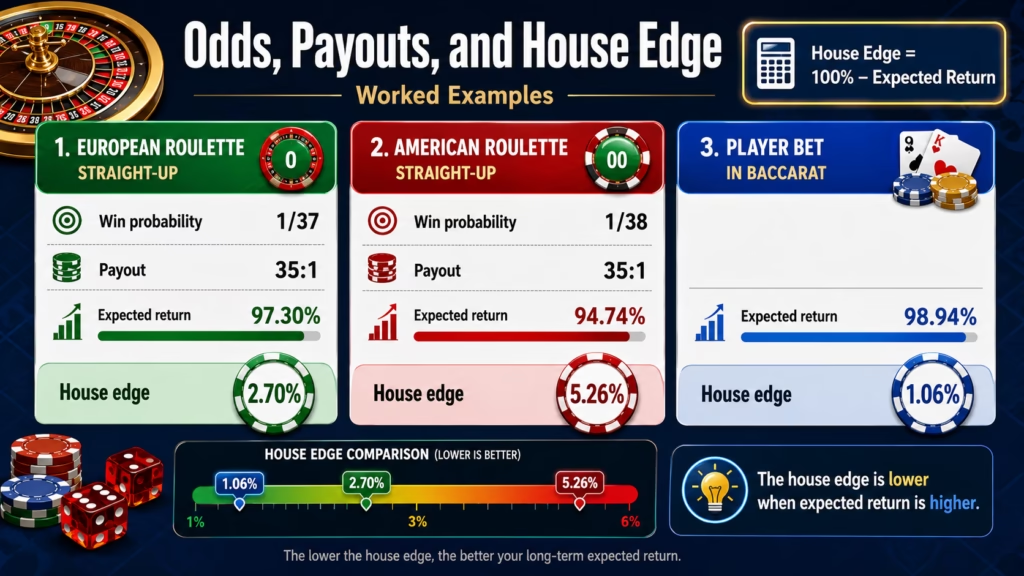
A traditional double-zero roulette wheel has 38 numbers, and a straight-up winning bet traditionally pays 35:1.
The probability of hitting one selected number is:
1 / 38
A 35:1 win produces a total return of 36 units.
RTP:
1/38 x 36 = 0.947368
RTP approximately 94.74%
House edge:
100% – 94.74% = 5.26%
Therefore, the standard straight-up wager in double-zero roulette has a theoretical house edge of approximately 5.26% under those rules.
The player could still win several bets in a short session. The 5.26% figure describes the mathematical expectation across a very large number of wagers, not the result of the next spin.
How to Calculate House Edge With Multiple Winning Outcomes
Some games have several possible payouts rather than one simple win-or-lose result.
In that case, calculate the expected value of every possible outcome:
EV = (P1 x Payoff1) + (P2 x Payoff2) + … + (Pn x Payoffn)
When using net profits, losing outcomes should be included as negative values.
For example, imagine a $1 wager with these hypothetical outcomes:
| Outcome | Probability | Net Result |
| Win A | 10% | +$5 |
| Win B | 20% | +$1 |
| Lose | 70% | -$1 |
Expected value:
EV = (0.10 x 5) + (0.20 x 1) + (0.70 x -1)
EV = 0.50 + 0.20 – 0.70
EV = 0
In this hypothetical example, the game has a 0% house edge.
If the expected value had been -$0.05 per $1 wagered, the house edge would have been 5%.
This method is especially important for wagers with several prizes because looking only at the top payout can give a misleading impression of the game’s actual mathematical return.
Payout Odds and Probability Are Not the Same Thing
A payout such as 10:1 does not mean the probability of winning is 1 in 11.
Payout odds tell you what the game pays. Probability tells you how often the underlying event is mathematically expected to occur.
If a bet pays 10:1 but wins only once every 20 outcomes, its expected return is much lower than a fair 10:1 bet.
Using a $1 stake:
Total winning return = $11
Probability = 1/20
RTP:
11 / 20 = 55%
House edge:
45%
A large advertised payout can therefore coexist with a large house edge if the winning probability is sufficiently low.
“To 1” vs “For 1” Payouts
Players should verify whether a paytable describes a payout as “to 1” or “for 1.”
A 5 to 1 payout generally means:
- wager $1
- win $5 profit
- receive $1 stake back
- total return $6
A 5 for 1 return generally means:
- wager $1
- receive $5 total
- net profit $4
That one-unit difference materially changes the expected return.
Do not calculate house edge until you know whether the listed figure represents profit or total return. The game’s official paytable or rules should clarify the payout convention.
How House Edge Relates to RTP
House edge can usually be converted directly to RTP:
RTP = 100% – House Edge
And:
House Edge = 100% – RTP
A game with 96.5% theoretical RTP therefore has:
100% – 96.5% = 3.5% house edge
RTP should not be interpreted as a promise that a player will receive exactly 96.5% of their money back. RTP is a long-run average, and normal variation can produce very different results during individual sessions.
Common House Edge Calculation Mistakes
Using the Payout Without the Probability
A 100:1 payout tells you little about value unless you also know the probability of receiving it. House edge depends on both variables.
Forgetting the Original Stake
If a payout is stated as 5:1, the total return is normally six units. Using five units in the wrong part of the formula produces an incorrect result.
Using Observed Results as True Probability
Ten, 100 or even thousands of previous outcomes may differ significantly from the mathematical expectation. For games with fixed rules, use the theoretical probabilities when they are known rather than assuming a short sequence of results represents the true odds.
Assuming Every Bet in a Game Has the Same Edge
Different wagers can have different payout structures and therefore different house edges. Side bets in particular should be calculated separately rather than assuming they have the same mathematical return as the main game.
Treating House Edge as a Session Loss Prediction
A 4% house edge does not mean a player will lose exactly $4 after wagering $100. Actual short-term results may include substantial wins or losses because individual outcomes remain uncertain.
When You Cannot Calculate House Edge From the Payout Alone
House edge cannot be calculated accurately when the probability distribution is unknown.
This limitation matters for slots and other games with complex prize structures. Knowing that a slot can pay a large maximum win does not reveal how frequently each prize occurs.
To calculate the theoretical RTP from scratch, you would need the probability and return associated with every possible outcome.
For games where these probabilities are not publicly available, the practical approach is to check the published theoretical RTP, official game rules and paytable rather than reverse-engineering house edge from the maximum payout.
How to Compare Games Using House Edge
When comparing casino wagers, use the same criteria for each option:
- Confirm the exact game variant.
- Check the mathematical probability of each relevant outcome.
- Check the actual payout table.
- Calculate expected return.
- Convert expected return to RTP.
- Subtract RTP from 100% to obtain house edge.
- Check whether special rules change the calculation.
A lower house edge means a smaller theoretical mathematical disadvantage per unit wagered over the long run. It does not make a wager profitable or remove short-term risk.
House Edge Does Not Tell You Everything About Risk
Two games can have the same house edge while producing very different playing experiences.
House edge measures expected mathematical loss relative to wagering volume. It does not directly describe:
- how frequently wins occur;
- how large individual wins can be;
- how widely results fluctuate;
- how quickly a bankroll can rise or fall;
- the probability of finishing a particular session ahead.
These characteristics are related more closely to variance and volatility.
For that reason, players comparing games should consider both house edge and volatility, rather than treating house edge as a complete measure of short-term risk.
How This Information Was Reviewed
The calculations in this guide are based on expected-value mathematics: probability is multiplied by the financial result of each possible outcome, then all outcomes are combined to determine the theoretical return.
Before applying the formula to a real casino game, check the current rules and paytable because game variants, payout conventions and special rules can change the calculation.
House edge and RTP are long-run mathematical measures. They cannot predict the next result, guarantee a particular session outcome or create a strategy that guarantees profit.
Casino games should be treated as entertainment rather than a source of income. Set spending and time limits before playing, and stop if gambling is no longer staying within those limits.
FAQ
What is the easiest formula for calculating house edge?
For a game with a known RTP, the easiest formula is House Edge = 100% – RTP. If RTP is not given, calculate the expected return from the probability and payout of every possible outcome first.
How do you calculate house edge from win probability?
For a simple win-or-lose wager paying b to 1, use House Edge = 1 – p x (b + 1), where p is the probability of winning. Multiply the answer by 100 to express it as a percentage.
What is the house edge if RTP is 96%?
An RTP of 96% corresponds to a 4% theoretical house edge, because 100% – 96% = 4%. The figure is a long-run expectation and does not mean every player will lose exactly 4% of their wagers.
How do you calculate fair payout odds?
If the probability of winning is p, fair total return equals 1 / p. Subtract one from the result to obtain fair net payout odds. For a 20% winning probability, fair total return is 5 units, which corresponds to fair net odds of 4:1.
Does a higher payout mean a lower house edge?
No. A higher payout does not automatically mean a lower house edge because the probability of winning may also be much lower. House edge can only be determined by evaluating payout and probability together.
Can you calculate slot house edge from the maximum win?
No. A maximum win does not provide enough information to calculate slot house edge. You would need the probabilities and payouts for the game’s complete outcome distribution. When those figures are unavailable, check the theoretical RTP published in the game information or paytable.
Is house edge the same as the casino’s guaranteed profit?
No. House edge is a theoretical long-run mathematical advantage, not guaranteed profit on every player or session. Short-term results can vary substantially because individual game outcomes are uncertain.
Can a betting strategy remove the house edge?
Changing bet size or following a staking pattern does not by itself change the underlying probabilities and payouts of an independent wager. A strategy cannot turn a negative mathematical expectation into a guaranteed profit without changing the actual expected value of the bet.
Why do different versions of the same game have different house edges?
Different game versions may use different rules, numbers of possible outcomes, payouts or player decisions. Even a small rules change can alter expected value, so house edge should always be calculated for the exact variant being played.
Brief Conclusion
To calculate house edge from odds and payouts, determine the true probability of every outcome, multiply each probability by its corresponding return and calculate the total expected return. The difference between 100% and that theoretical return is the house edge.
For a simple win-or-lose bet paying b to 1, use:
House Edge = [1 – p x (b + 1)] x 100%
The calculation is useful for comparing the mathematical cost of different wagers, but it does not predict short-term results or guarantee wins. Always verify the exact rules and paytable before applying the formula to a real game.