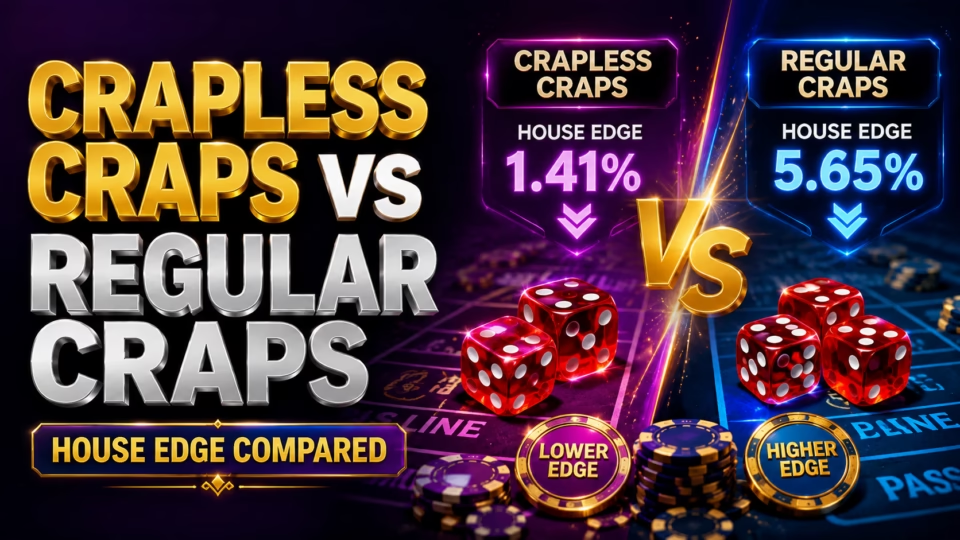
Crapless craps has a significantly higher house edge than regular craps on the basic Pass Line bet. Under standard rules, the Pass Line house edge is about 5.382% in crapless craps versus 1.414% in regular craps. The difference comes from changing 2, 3, 11, and 12 into point numbers instead of resolving them immediately on the come-out roll.
The important distinction is that crapless craps removes the frustrating experience of immediately losing a Pass Line bet on 2, 3, or 12, but this apparently player-friendly rule comes at a mathematical cost. A player also loses the automatic Pass Line win on 11, while difficult numbers such as 2 and 12 can become points that must be repeated before a 7 appears.
Quick comparison:
- Regular craps Pass Line house edge: about 1.414%.
- Crapless craps Pass Line house edge: about 5.382%.
- Regular craps allows 4, 5, 6, 8, 9, and 10 as points.
- Crapless craps allows every total except 7 to become a point.
- Odds bets themselves have 0% house edge when they pay true odds.
- Regular craps is generally the better mathematical choice for a player focused on minimizing house advantage.
Crapless craps may still appeal to players who dislike crapping out immediately or who enjoy having more possible point numbers. Anyone choosing between the two games should understand that avoiding an instant loss does not mean receiving better overall odds.
Crapless Craps vs Regular Craps at a Glance
| Feature | Regular Craps | Crapless Craps |
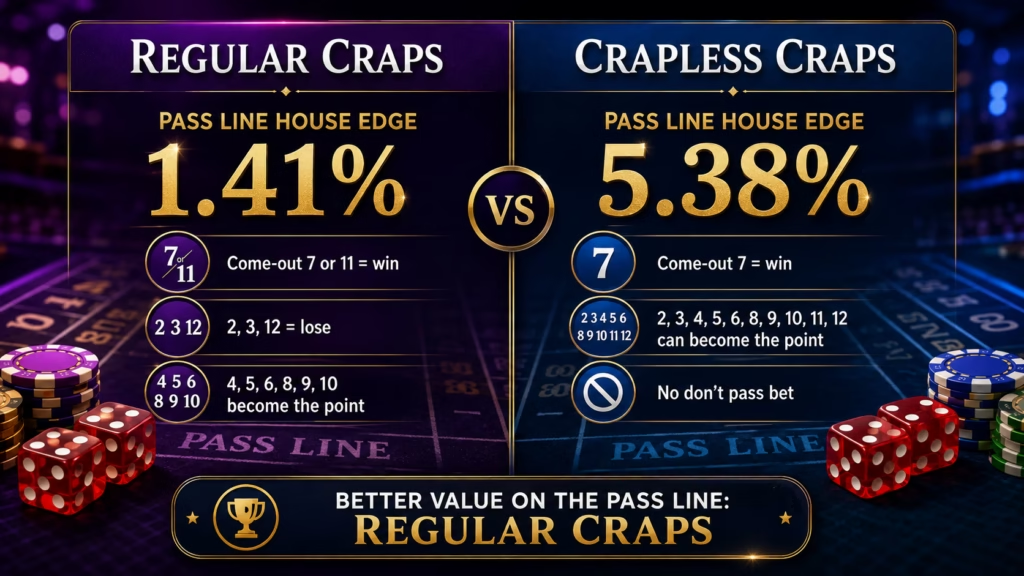
| Pass Line house edge | About 1.414% | About 5.382% |
| Come-out Pass win | 7 or 11 | 7 |
| Come-out Pass loss | 2, 3 or 12 | None |
| Standard point numbers | 4, 5, 6, 8, 9, 10 | 2, 3, 4, 5, 6, 8, 9, 10, 11, 12 |
| Odds bet house edge | 0% when paid at true odds | 0% when paid at true odds |
| Don’t Pass | Normally available | Usually unavailable |
| Better base Pass Line odds | Yes | No |
The comparison assumes conventional rules. Individual casinos can change available bets, maximum odds, commissions, and some payouts, so the table layout and published rules should always be checked before playing.
How Regular Craps Works
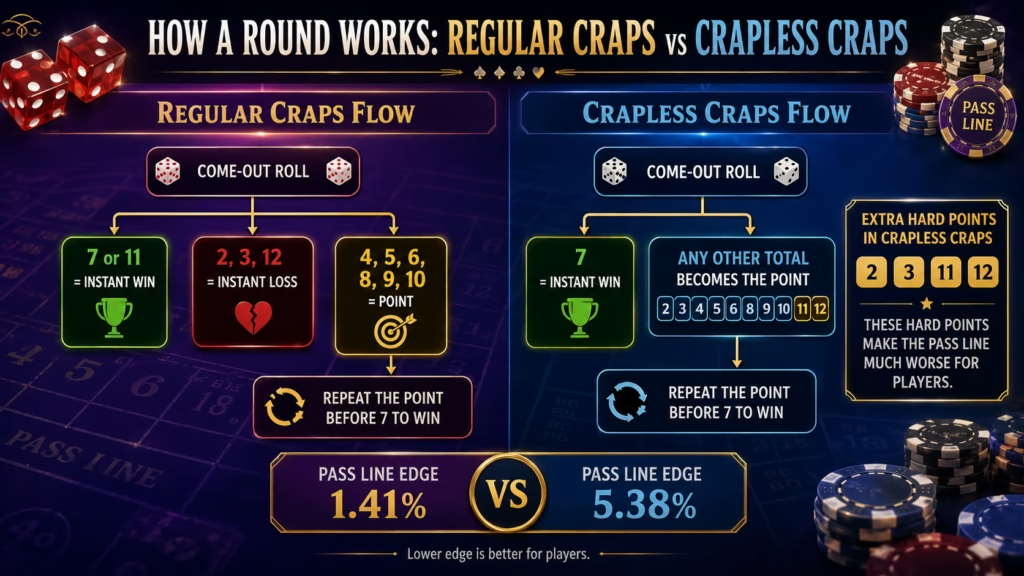
Regular craps begins with a come-out roll. A Pass Line bet wins immediately when the shooter rolls 7 or 11, loses immediately on 2, 3 or 12, and establishes a point on 4, 5, 6, 8, 9 or 10. Once a point exists, the Pass Line wins if the shooter repeats that point before rolling a 7.
These rules create a Pass Line house edge of approximately 1.41% per bet made. Regular craps also normally offers a Don’t Pass bet with a house edge around 1.36% per bet made, although the exact Don’t Pass rules can depend on whether 2 or 12 is barred.
Regular craps therefore gives players access to several comparatively low-edge wagers. The Pass Line, Don’t Pass, and true-odds bets are especially important when comparing the mathematical cost of different craps strategies.
How Crapless Craps Changes the Rules
Crapless craps removes the traditional “craps” outcomes from the Pass Line come-out roll. A 2, 3 or 12 no longer causes an immediate Pass Line loss. However, an 11 also stops being an automatic Pass Line winner. Instead, every total except 7 can establish a point.
A come-out 7 wins immediately. If any other total appears, that total becomes the point. The shooter must then repeat the point before rolling a 7 for the Pass Line bet to win.
This creates more point situations than regular craps. The additional points are 2, 3, 11 and 12, and those numbers are especially important when calculating the crapless craps house edge.
Why Is the Crapless Craps House Edge Higher?
The crapless craps house edge is higher because the rule change converts several apparently favorable come-out outcomes into difficult point situations.
With two six-sided dice, 7 is the most common total. There are six combinations that produce a 7. By comparison, there is only one combination each for 2 and 12, and two combinations each for 3 and 11.
That matters once one of those totals becomes the point. If 2 becomes the point, for example, the shooter is effectively waiting for a total that has one possible dice combination while competing against a 7 that has six combinations. The same problem applies to 12. Points of 3 and 11 are more achievable than 2 and 12 but are still substantially less likely to appear on any given roll than 7.
Regular craps avoids this situation on the Pass Line because 2, 3 and 12 immediately lose while 11 immediately wins. Crapless craps may feel more forgiving because the initial bet survives more come-out rolls, but surviving the roll is not the same as improving the bet’s expected return.
The resulting Pass Line house edge increases from approximately 1.414% to 5.382%. In other words, the base Pass Line disadvantage in crapless craps is roughly 3.8 times the conventional Pass Line percentage.
A $100 Expected-Loss Example
House edge describes the casino’s theoretical advantage over a large number of wagers. It does not predict what will happen during one session.
Using the standard Pass Line figures, $100 of initial Pass Line wagering corresponds theoretically to about $1.41 of expected loss in regular craps versus about $5.38 in crapless craps. These are long-run mathematical expectations, not guaranteed session results. A player could win, lose much more, lose less, or finish approximately even during any particular session.
This distinction matters because short-term gambling results are highly variable. House edge becomes useful primarily as a way to compare the mathematical cost of different wagers over repeated play.
Can Odds Bets Reduce the Crapless Craps House Edge?
Taking odds improves the combined percentage of money wagered because the odds portion itself carries no house edge when paid at true odds. It does not remove the disadvantage built into the original Pass Line bet.
Standard crapless craps odds commonly use true-odds payouts such as 6:1 on 2 and 12, 3:1 on 3 and 11, 2:1 on 4 and 10, and 3:2 on 5 and 9. For 6 and 8, the payout follows the true probability relationship. Exact table presentation can vary, so the casino rules should be checked.
Regular craps benefits from the same principle. A conventional odds bet pays true odds and carries no house advantage. Taking more odds lowers the house-edge percentage relative to the total amount wagered, although it also increases the amount of money at risk.
For a player comparing the two games mainly by mathematics, regular craps retains a substantial advantage.
Does Crapless Craps Have Don’t Pass?
Traditional crapless craps generally does not offer Don’t Pass or Don’t Come bets. This removes one of regular craps’ lower-house-edge options. Standard regular craps has a Don’t Pass house edge of about 1.36% per bet made under common rules.
Layouts can vary between casinos. Some less common variations may include additional wagers or different commission structures, so players should rely on the actual table rules rather than assuming every crapless craps game is identical.
What About Place Bets in Crapless Craps?
Crapless craps expands place betting because 2, 3, 11 and 12 can be treated as additional numbers. Under common rules, placing 2 or 12 at 11:2 has a house edge of about 7.14%, while placing 3 or 11 at 11:4 has a house edge of about 6.25%.
These percentages are higher than the regular Pass Line edge and show why simply having more available numbers does not necessarily create better betting opportunities.
Buy bets can produce different mathematics, particularly when a casino charges commission only after a win rather than upfront. Because commission rules materially affect expected return, the specific casino rules need to be checked before comparing buy bets.
Which Version Is Better for Low House Edge?
Regular craps is clearly better if the main goal is minimizing house edge. Its standard Pass Line carries roughly 1.414% house advantage compared with 5.382% for the crapless version, and regular craps normally also provides access to Don’t Pass at around 1.36%.
A mathematically conservative regular-craps approach generally centers on low-edge line bets and true odds rather than high-edge proposition bets. Odds do not guarantee a profit, but allocating more of the total wager to a zero-edge odds bet reduces the combined house-edge percentage applied to the total amount wagered.
Crapless craps may instead suit players who value a different game flow. Some players prefer not seeing their Pass Line disappear immediately after a 2, 3 or 12. Others enjoy having unusual points such as 2 and 12. Those preferences concern entertainment and playing style rather than mathematical advantage.
Combined House Edge With Odds in Crapless Craps
When odds are added to a crapless Pass Line bet, the combined house-edge percentage falls because the odds portion is paid at true odds. The figures below express the house edge relative to the total amount wagered.
| Odds Taken | Approximate Combined House Edge |
| No odds | 5.382% |
| 1x odds | 2.936% |
| 2x odds | 2.018% |
| 3x odds | 1.538% |
| 5x odds | 1.042% |
These percentages do not change the expected loss attached to the original Pass Line wager. They show how a zero-edge odds wager changes the combined percentage when more money is placed behind the line.
Common Crapless Craps Misconceptions
“You can’t crap out, so the odds must be better”
Removing immediate Pass Line losses does not improve the overall wager because the replacement rules create difficult point situations and remove the automatic win on 11. The final house edge reflects the full set of rules, not just what happens on the come-out roll.
“Taking odds removes the house edge”
Odds bets themselves have zero house edge when paid at true odds, but the required Pass Line bet still has negative expected value. Combining the two lowers the house-edge percentage relative to the total amount wagered, but it does not turn the overall wager into a guaranteed winning proposition.
“A difficult point means it is due to appear”
Each dice roll should be treated independently under normal fair-dice assumptions. Previous outcomes do not make a 2, 12, or any other total “due.” Betting progression systems also do not change the underlying probabilities or house edge.
How to Choose Between Crapless and Regular Craps
Choose regular craps when house edge is the primary criterion. The difference between a 1.414% Pass Line edge and a 5.382% Pass Line edge is large enough to matter over repeated wagering.
Choose crapless craps only if its rule structure is more enjoyable to you and you accept the higher base mathematical disadvantage. The game can create more point rounds and eliminates immediate Pass Line losses on 2, 3 and 12, but those features should not be interpreted as better player odds.
Before playing either version:
- Check the exact Pass Line and Come rules.
- Check how much odds the casino allows.
- Verify payouts for 2, 3, 11, and 12 in crapless craps.
- Check whether buy-bet commission is charged upfront or only on wins.
- Avoid assuming that a visually similar craps layout has identical rules.
- Set a fixed gambling budget and treat the game as entertainment.
House edge measures long-run expected value. It cannot predict whether a particular shooter, table, or session will win or lose.
How This Information Was Reviewed
This comparison focuses on the mathematical rules of conventional craps and crapless craps, particularly the Pass Line, point structure, true odds, and commonly available related wagers. The key percentages are based on standard probability calculations for two six-sided dice and conventional payout structures.
Exact casino conditions can differ. Players should verify the table’s payouts, odds limits, commissions, and available bets before wagering. A lower house edge reduces theoretical long-term expected loss relative to the amount wagered, but neither low house edge nor true odds guarantees a winning session.
Casino games should be treated as paid entertainment rather than a source of income. Set spending and time limits before playing, never chase losses, and stop if gambling is no longer enjoyable or if you cannot stay within your planned budget.
FAQ
Is crapless craps better than regular craps?
Crapless craps is not better mathematically on the Pass Line. Its standard Pass Line house edge is approximately 5.382%, compared with about 1.414% in regular craps. Crapless craps may still appeal to players who prefer its different come-out rules and expanded point numbers.
What is the house edge in crapless craps?
The standard crapless craps Pass Line house edge is approximately 5.382%. Individual side bets, place bets, and buy bets have different house edges, so 5.382% should not be applied to every wager on the table.
What is the house edge in regular craps?
The regular craps Pass Line house edge is approximately 1.414%. The Don’t Pass bet is approximately 1.36% per bet made under common rules, while true-odds bets have zero house edge.
Why does crapless craps have a worse house edge?
Crapless craps has a worse Pass Line house edge because 2, 3, 11, and 12 become points while 11 no longer wins automatically on the come-out roll. Difficult points such as 2 and 12 are much less likely to repeat before the more common 7.
Can you lose on the come-out roll in crapless craps?
A standard crapless Pass Line bet does not lose on the come-out roll. A 7 wins immediately, while other totals establish a point. The absence of an immediate loss does not mean that the bet has a lower overall house edge.
Does crapless craps pay true odds?
Crapless craps can offer true-odds bets after a point is established. Typical true-odds payouts include 6:1 on 2 and 12, 3:1 on 3 and 11, 2:1 on 4 and 10, and 3:2 on 5 and 9. The casino’s maximum permitted odds should be checked at the table.
Does taking odds make crapless craps a good bet?
Taking odds lowers the combined house-edge percentage but does not eliminate the disadvantage of the required Pass Line wager. At 5x odds, the combined percentage is approximately 1.042% under the standard structure. This does not guarantee a profit or predict any individual session.
Can you make a Don’t Pass bet in crapless craps?
Traditional crapless craps generally does not offer Don’t Pass or Don’t Come. Regular craps normally offers both. Because casino variants can differ, verify the actual layout and rules before assuming a specific wager is available.
Is crapless craps easier for beginners?
Crapless craps can feel simpler on the initial roll because 2, 3, and 12 do not immediately eliminate a Pass Line bet. However, the expanded point structure introduces additional probabilities and payouts that players still need to understand. Simpler-feeling rules do not translate into a lower house edge.
Brief Conclusion
For crapless craps vs regular craps, regular craps is the stronger choice from a house-edge perspective. The standard Pass Line costs approximately 1.414% in regular craps versus 5.382% in crapless craps. Crapless craps removes immediate come-out losses on 2, 3 and 12, but the price is making 2, 3, 11 and 12 into points and removing the automatic Pass Line win on 11.
True-odds bets can reduce the combined percentage in either game, but they cannot guarantee profits or remove the negative expectation of the underlying Pass Line bet. Players primarily concerned with mathematical efficiency should favor regular craps, while crapless craps is better viewed as an alternative ruleset chosen for entertainment rather than superior odds.