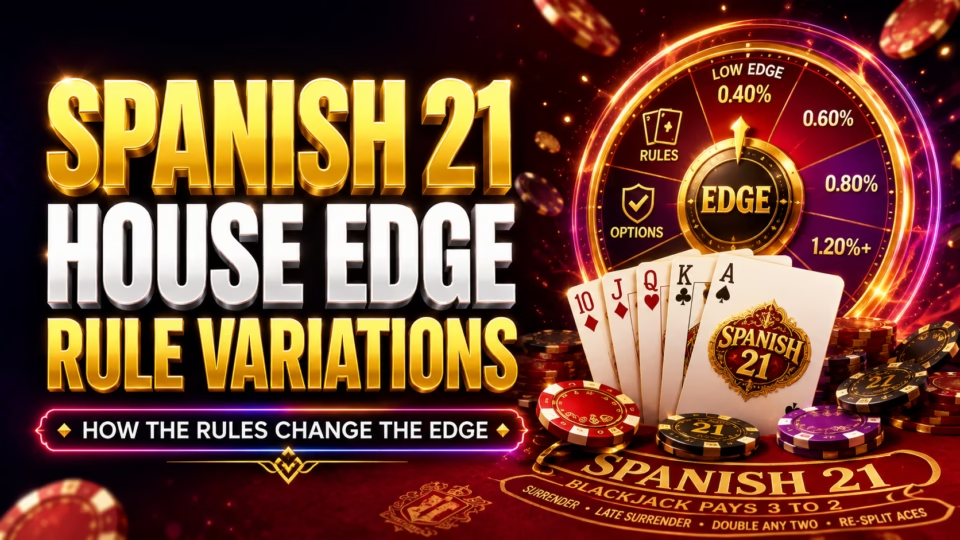
Spanish 21 can have a house edge of roughly 0.40% to 0.76% under common rule sets when the player follows the correct Spanish 21 basic strategy. The biggest variables are whether the dealer hits or stands on soft 17 and whether redoubling is allowed. A common stand-on-soft-17 game is about 0.40%, while a hit-soft-17 game without redoubling can rise to about 0.76%.
Spanish 21 looks unfavorable at first because every 10 card is removed from the deck. However, the game compensates with player-friendly rules such as a player 21 always winning, late surrender, doubling on multiple cards, double after split, bonus payouts for certain 21s and, at some tables, redoubling.
Quick takeaways:
- A Spanish 21 table where the dealer stands on soft 17 can have a house edge around 0.40%.
- Hitting soft 17 generally makes the game less favorable to the player.
- Redoubling can substantially offset the disadvantage of an H17 rule.
- Restrictions on split aces can noticeably increase the house edge.
- Side bets usually carry a much larger house edge than the main Spanish 21 wager.
- Spanish 21 requires its own basic strategy. Standard blackjack strategy does not account for the missing 10 cards and special player options.
Spanish 21 may appeal to blackjack players who want more doubling, surrender and bonus-hand options. Players who prefer very simple decision-making should be more careful because the expanded rule set creates more situations where using the wrong strategy increases the casino’s mathematical advantage.
What Is the Spanish 21 House Edge?
The Spanish 21 house edge is the casino’s theoretical long-term advantage over wagers on the main game when a particular set of rules and playing strategy is assumed. A 0.40% house edge means that the mathematical expected loss is approximately $0.40 per $100 wagered over a very large number of hands. It does not mean a player will lose exactly 0.40% during one session.
Short-term results can vary dramatically because individual hands are random. House edge describes long-run expected value, not what will happen during the next hand, hour or casino visit.
The exact Spanish 21 house edge cannot be identified from the game name alone. Two tables labeled Spanish 21 may have different expected returns because one may use S17 while another uses H17, one may permit redoubling, and another may restrict play after splitting aces.
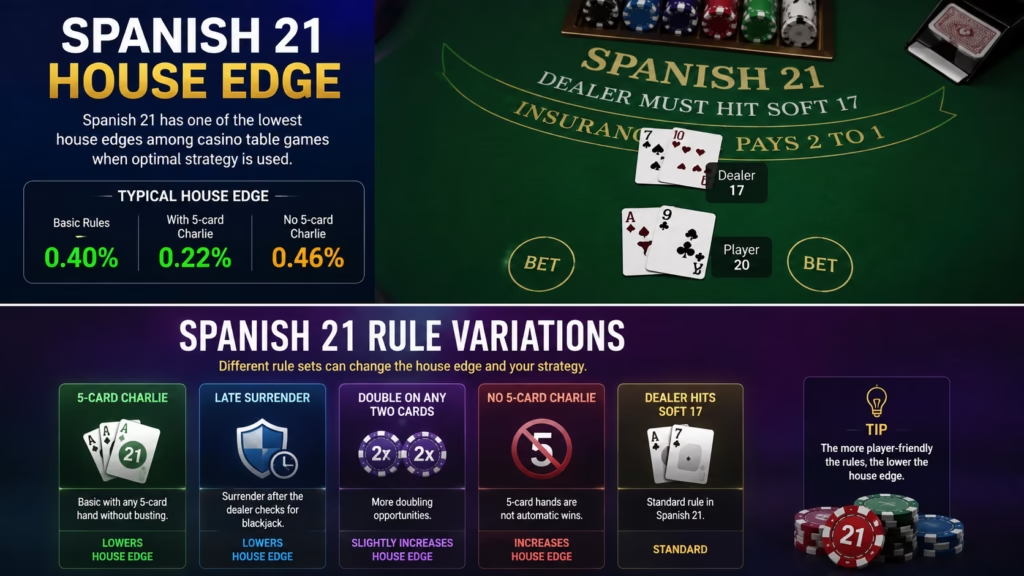
Spanish 21 House Edge by Common Rule Set
The following figures are useful benchmarks for common Spanish 21 configurations. They assume appropriate Spanish 21 basic strategy and are stated before the small effect of the Super Bonus is considered.
| Spanish 21 rules | Approximate house edge |
| Dealer stands on soft 17 | 0.40% |
| Dealer hits soft 17 and redoubling is allowed | 0.42% |
| Dealer hits soft 17 and redoubling is not allowed | 0.76% |
The difference between 0.40% and 0.76% may look small, but it is important in percentage terms. The higher figure represents almost twice the mathematical casino advantage of the lower figure.
These values also show why comparing Spanish 21 tables requires more than checking the number of decks. The interaction between dealer rules and player options can matter more than the difference between six and eight decks.
Why Removing the 10s Changes Spanish 21
Spanish 21 normally uses six or eight 48-card decks. The four numerical 10 cards are removed from each standard 52-card deck, while jacks, queens and kings remain and still count as 10-value cards.
Removing the 10s benefits the dealer because players receive fewer 10-value cards for blackjacks, strong double-down hands and completed totals of 20 or 21. Spanish 21 compensates for that mathematical disadvantage by giving the player rules that are considerably more flexible than those found at many conventional blackjack tables.
Important player-friendly rules commonly include:
- player blackjack beating dealer blackjack;
- a player total of 21 beating a dealer 21;
- late surrender;
- double after split;
- re-splitting aces;
- doubling on more than the initial two cards;
- double-down rescue;
- enhanced payouts for specific multi-card and 6-7-8 or 7-7-7 totals of 21.
The result is a game where the missing 10 cards cannot be evaluated separately from the compensation rules.
Soft 17 Is One of the Most Important Rule Variations
The dealer’s soft-17 rule is one of the first things to check when comparing Spanish 21 games.
A soft 17 is a total of 17 containing an ace that is currently counted as 11, such as Ace-6.
If the table uses S17, the dealer stands on soft 17. If it uses H17, the dealer must take another card.
Under common configurations, a stand-on-soft-17 Spanish 21 game has an approximate 0.40% house edge, compared with about 0.76% when the dealer hits soft 17 and redoubling is unavailable.
The practical lesson is simple: do not treat H17 and S17 Spanish 21 as equivalent games.
Redoubling Can Change the Mathematics Significantly
Some Spanish 21 tables allow the player to redouble after already doubling, sometimes allowing multiple successive doubles. This is a powerful player option when used in the correct situations.
The effect becomes clear when comparing H17 games:
- H17 without redoubling: approximately 0.76% house edge.
- H17 with redoubling: approximately 0.42% house edge.
Redoubling does not automatically improve an individual hand. The player still has to make the mathematically appropriate decision. Using the option at the wrong time can increase the amount at risk without improving expected value.
For this reason, a player moving from regular blackjack to Spanish 21 should use a strategy chart designed for the exact redoubling rules being offered.
Rules for Split Aces Matter More Than They May Appear
Spanish 21 commonly allows more flexibility after splitting aces than traditional blackjack. At many tables, players may draw additional cards and may be permitted to double after receiving cards on a split ace.
A rule preventing additional draws to split aces is unfavorable. Published mathematical analysis indicates that this restriction can increase the house edge by approximately 0.29 percentage points in the analyzed configuration.
That increase is large compared with a base house edge around 0.40%. Players comparing two tables should therefore check split-ace rules rather than assuming all Spanish 21 games handle aces identically.
Surrender and Double-Down Rescue
Late surrender allows the player to give up a qualifying hand after the dealer has checked for blackjack and recover part of the original wager instead of playing the hand to completion.
Spanish 21 can also offer double-down rescue. After doubling, the player may surrender the doubled hand under the applicable rules, limiting the loss rather than being forced to continue with the full doubled wager.
These options are valuable only when used in the correct situations. Surrendering simply because a hand looks uncomfortable is not a strategy. The decision should come from Spanish 21 basic strategy for the table’s exact rules.
Bonus Payouts for a Player Total of 21
Spanish 21 includes special payouts that are uncommon in standard blackjack. Common rules include:
| Player hand | Typical payout |
| Five-card 21 | 3:2 |
| Six-card 21 | 2:1 |
| Seven-or-more-card 21 | 3:1 |
| 6-7-8 or 7-7-7 mixed suits | 3:2 |
| 6-7-8 or 7-7-7 same suit | 2:1 |
| 6-7-8 or 7-7-7 all spades | 3:1 |
These payouts are part of the mechanism that compensates players for the removal of the numerical 10 cards. Bonus eligibility can be affected by actions such as doubling or splitting, so the table rules should always be checked before play.
Some versions also offer a rare Super Bonus involving suited 7-7-7 against a dealer 7. Because rules and payout amounts may vary by operator, the posted paytable should be treated as the final authority for the specific game.
Does Six-Deck or Eight-Deck Spanish 21 Have Better Odds?
Deck count matters, but it should not be evaluated independently of the other rules.
Spanish 21 is commonly offered with six or eight Spanish decks. The practical mistake is choosing a six-deck table automatically while ignoring whether the dealer hits soft 17, whether redoubling is permitted or whether drawing after split aces is restricted.
When comparing tables, check the rules in approximately this order:
- Whether the dealer hits or stands on soft 17.
- Whether redoubling is allowed.
- What happens after splitting aces.
- Whether late surrender and double-down rescue are available.
- Whether doubling after splitting is allowed.
- How bonus 21 payouts are handled.
- Number of decks.
The complete combination determines the actual mathematical value of the game.
Spanish 21 Main Game vs Match the Dealer
Match the Dealer is a common optional Spanish 21 side bet. It wins when one or both of the player’s first two cards match the rank of the dealer’s upcard, with larger payouts possible for suited matches.
The mathematical difference from the main wager is significant. Published analysis calculates a house edge of approximately 3.06% for a common six-deck Match the Dealer paytable and 2.99% for an eight-deck version.
That is several times the house edge of favorable Spanish 21 main-game rules.
A side bet may therefore make the game feel more varied, but it should not be confused with the low house edge often quoted for Spanish 21 itself. The main wager and side wager are separate bets with different probabilities and expected returns.
Spanish 21 vs Regular Blackjack House Edge
Spanish 21 is not automatically better or worse than regular blackjack.
A favorable Spanish 21 configuration can have a house edge around 0.40%, which can compete with good blackjack games. However, blackjack house edge also changes with rules such as blackjack payout, soft 17, doubling restrictions, surrender and number of decks.
The correct comparison is therefore:
specific Spanish 21 rules vs specific blackjack rules
rather than
Spanish 21 vs blackjack in general.
The strategy is also different. Applying a standard blackjack chart to Spanish 21 ignores the altered deck composition, player-21 rule, multi-card bonuses, surrender options and expanded doubling rules.
How to Choose a Spanish 21 Table
A player looking primarily for favorable mathematical rules should check the table placard or official game rules before placing a wager.
Look for:
- S17 rather than H17 when the other rules are comparable;
- redoubling when available;
- flexible rules after splitting aces;
- double after split;
- late surrender;
- double-down rescue;
- clearly stated bonus payouts;
- a main-game strategy chart matching the exact rule set.
Do not select a table because it advertises large bonus payouts while ignoring the underlying rules. Rare bonuses can be attractive, but common rules affect far more hands.
Side bets should also be evaluated separately. A Spanish 21 main game with a low house edge does not make every optional wager on the table equally favorable.
Common Spanish 21 House Edge Mistakes
Assuming Spanish 21 is bad because the 10s are removed
Removing numerical 10s favors the casino, but Spanish 21 adds compensating rules. The complete rules determine the house edge, not the deck change alone.
Using standard blackjack basic strategy
Spanish 21 has different card composition and different options. A blackjack strategy chart can therefore recommend incorrect plays in situations where Spanish 21 surrender, multi-card doubling or other rules change the expected value.
Ignoring the soft-17 rule
H17 and S17 tables can have materially different house edges. The dealer rule should be checked before comparing two games.
Treating a side bet as part of the low house edge
The frequently quoted sub-1% Spanish 21 house edge refers to the main game under specified rules and correct strategy. Match the Dealer can carry a house edge around 3% under common paytables.
Expecting the house edge to predict a session
A 0.40% theoretical edge is a long-run statistical measurement. It cannot tell a player whether the next hand or session will win or lose.
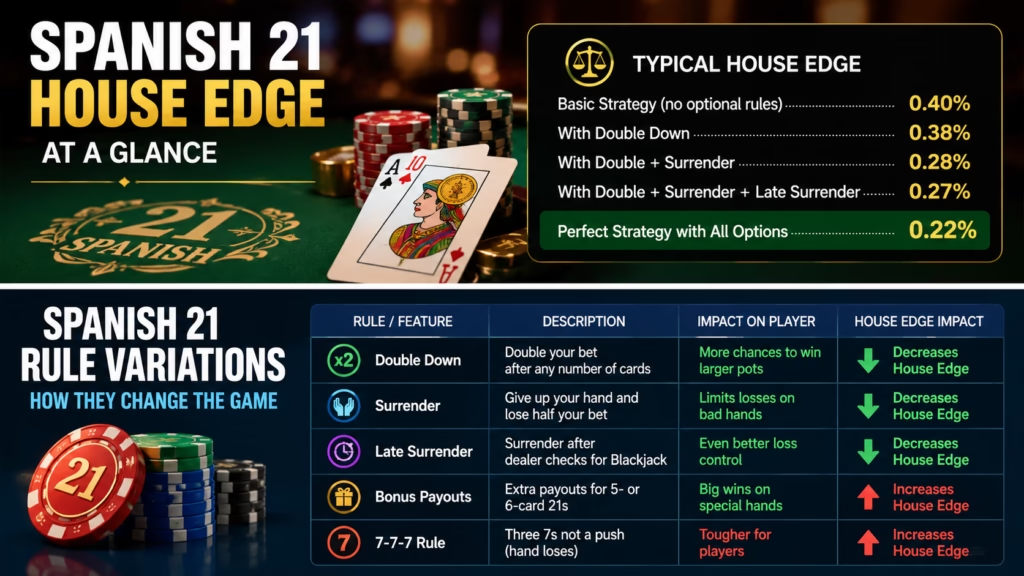
How This Information Was Reviewed
The Spanish 21 house-edge comparisons in this guide are based on published mathematical analysis of common rule configurations, with attention to dealer soft-17 rules, redoubling, split aces, bonus payouts and side bets.
Casino rules can vary, so players should verify the table placard, official rules and paytable before using any quoted house-edge figure. A percentage calculated for one ruleset should not automatically be applied to another.
House edge and basic strategy improve understanding of the mathematics but cannot guarantee a winning session. Spanish 21 is a gambling game with random short-term outcomes and should be treated as entertainment. Set spending and time limits before playing and stop if gambling is no longer recreational.
FAQ
What is the house edge in Spanish 21?
The Spanish 21 house edge is commonly around 0.40% to 0.76% for the main game under frequently analyzed rule sets when correct basic strategy is used. A dealer standing on soft 17 can produce an edge around 0.40%, while H17 without redoubling can be around 0.76%.
What Spanish 21 rules give the lowest house edge?
Player-friendly combinations generally include the dealer standing on soft 17, flexible doubling rules, favorable split-ace rules and other standard Spanish 21 options. Redoubling is particularly valuable on H17 games and can reduce the approximate analyzed edge from 0.76% to 0.42%.
Does the dealer hit soft 17 in Spanish 21?
It depends on the table. Spanish 21 can use either H17, where the dealer hits soft 17, or S17, where the dealer stands. This rule materially affects the house edge and should be checked before playing.
Is Spanish 21 better odds than blackjack?
Sometimes, but not automatically. A favorable Spanish 21 game can have a very low house edge, but blackjack also ranges widely depending on its rules. The meaningful comparison is between two specific rulesets rather than the game names alone.
Why are the 10 cards removed in Spanish 21?
Spanish 21 uses 48-card decks with the four numerical 10s removed. Jacks, queens and kings remain worth 10. The missing 10s favor the dealer mathematically, so Spanish 21 compensates with additional player options and bonus payouts.
Does redoubling improve Spanish 21 odds?
Yes, redoubling can significantly improve the theoretical return when it is allowed and used according to correct strategy. In common H17 examples, the house edge is about 0.42% with redoubling compared with about 0.76% without it.
Is Match the Dealer a good Spanish 21 bet?
Match the Dealer generally has a higher house edge than the Spanish 21 main wager. Common six-deck and eight-deck paytables have been analyzed at about 3.06% and 2.99%, respectively.
Can I use normal blackjack strategy for Spanish 21?
No. Spanish 21 requires a strategy adapted to its 48-card decks and special rules. Missing 10s, player 21 always winning, expanded doubling, surrender options and bonus hands change the optimal decisions.
Does a 0.40% house edge mean I will lose 40 cents for every $100?
No. A 0.40% house edge describes long-term mathematical expectation across a very large amount of wagering. A short session can finish far above or below that expectation because individual outcomes remain random.
Can Spanish 21 strategy guarantee a profit?
No. Basic strategy can reduce avoidable mathematical disadvantage, but it cannot guarantee a winning hand or profitable session. Gambling outcomes remain uncertain, so Spanish 21 should be played only with money set aside for entertainment.
In short
The Spanish 21 house edge is determined by the complete ruleset, not simply by the removal of the 10 cards. Common analyzed games range from about 0.40% with S17 to about 0.76% with H17 and no redoubling, while H17 with redoubling can be around 0.42%.
The most important Spanish 21 rule variations to check are soft 17, redoubling, play after splitting aces, surrender, doubling rules and bonus payouts. Optional side bets should be evaluated separately because their house edge can be much higher than the main game.
Use a Spanish 21 basic strategy that matches the exact table rules, verify the current paytable before playing and remember that a low theoretical house edge does not predict or guarantee the result of an individual session.