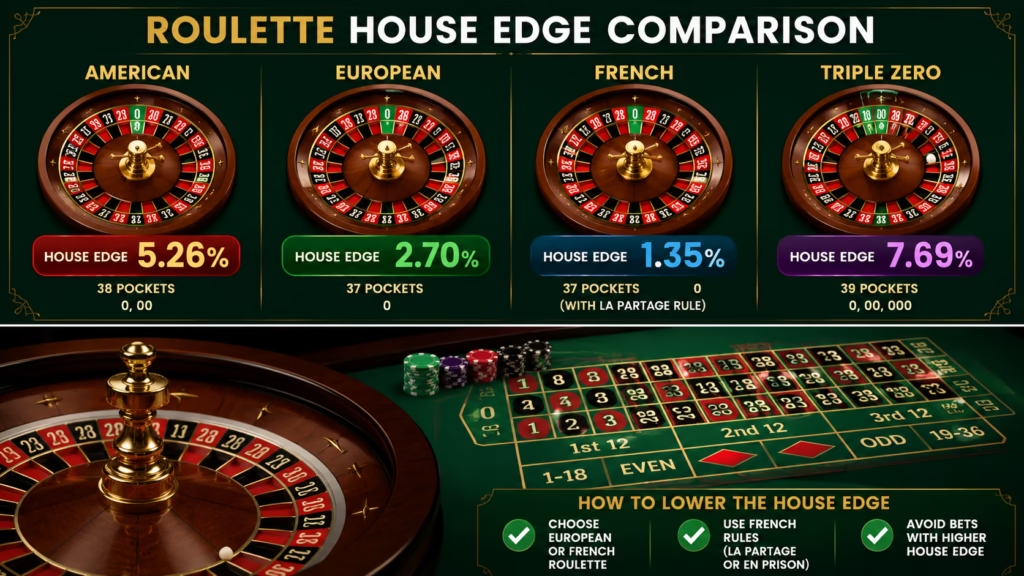
The roulette house edge depends mainly on the wheel type and the number of zero pockets. European roulette has a standard house edge of 2.70%, American double zero roulette is usually 5.26%, and triple zero roulette increases the standard edge to about 7.69%. French roulette can be even more favorable on qualifying even money bets, with La Partage reducing the house edge to about 1.35%.
Quick takeaways
- French roulette with La Partage: about 1.35% house edge on qualifying even money bets.
- European roulette: 2.70% house edge on standard bets.
- American roulette: 5.26% on most standard bets.
- Triple zero roulette: about 7.69% with standard roulette payouts.
- More zeros increase the casino’s mathematical advantage without increasing the normal payout for a winning number.
For players who simply want the mathematically better roulette format, a single zero European wheel is preferable to double zero or triple zero roulette. French roulette can provide an even lower edge when La Partage or favorable En Prison rules apply. Players should be especially cautious with triple zero tables because the extra zero significantly increases the expected cost of play.
What Is the House Edge in Roulette?
The roulette house edge is the casino’s theoretical advantage over the total amount wagered over a very large number of spins. A 2.70% house edge means that the mathematical expected loss is $2.70 for every $100 wagered over the long run. It does not mean a player will lose exactly $2.70 after betting $100 in one session.
Short term roulette results can be dramatically different from the theoretical expectation because individual spins are random. A player may win, lose, or finish close to even over a limited number of spins. The house edge describes the underlying mathematics of the game, not the result of a specific session.
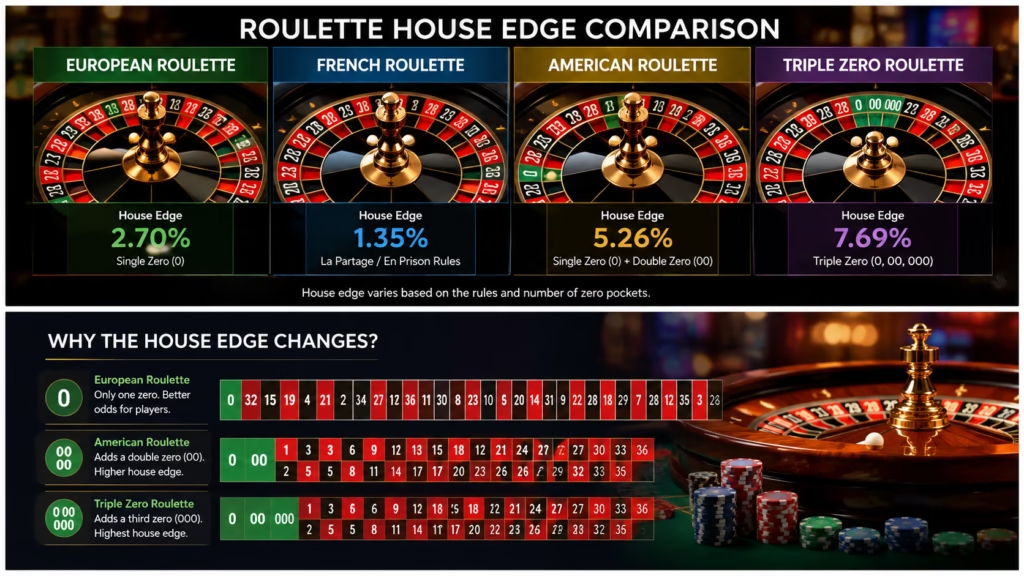
The zeros create the casino advantage. A standard red bet, for example, pays 1:1 even though zero is neither red nor black. Adding 00 or 000 creates additional losing outcomes without improving the standard payout, which is why the house edge increases.
Roulette House Edge by Wheel Type
The difference between roulette variants becomes clear when their wheel structures are compared.
| Roulette Type | Total Pockets | Zero Pockets | Typical House Edge |
| French with La Partage | 37 | 0 | About 1.35% on eligible even money bets |
| European | 37 | 0 | 2.70% |
| American | 38 | 0 and 00 | 5.26% on most bets |
| Triple Zero | 39 | 0, 00 and 000 | About 7.69% on standard bets |
European roulette uses 37 pockets consisting of numbers 1 through 36 plus a single zero. American roulette adds 00 for 38 total outcomes. Triple zero roulette adds another house pocket, usually displayed as 000, producing 39 outcomes.
The comparison shows why checking the wheel before placing a bet matters. The underlying roulette experience can look almost identical while the mathematical cost differs substantially.
European Roulette House Edge
European roulette has a 2.70% house edge on standard bets because its wheel contains 37 pockets with only one zero. Standard payouts remain based around the 36 numbered pockets, so the additional zero produces a casino advantage of 1/37, or approximately 2.70%.
For example, a straight up number pays 35:1. There are 37 possible outcomes, but only one wins. The payout would need to be 36:1 to represent true mathematical odds, so the difference creates the house advantage.
European roulette is generally the better choice when comparing otherwise equivalent single zero and double zero tables. The player does not need to use a special betting strategy to receive the lower edge because the difference comes directly from the wheel structure.
At a theoretical 2.70% edge:
- $100 in cumulative wagers corresponds to an expected loss of about $2.70.
- $1,000 in cumulative wagers corresponds to about $27.
- $10,000 in cumulative wagers corresponds to about $270.
These figures are long term mathematical expectations rather than predictions of an individual session.
American Roulette House Edge
American roulette normally has a 5.26% house edge on standard bets because its wheel contains both 0 and 00. The wheel therefore has 38 possible outcomes instead of the 37 found in European roulette.
The additional 00 nearly doubles the standard house advantage from 2.70% to 5.26%. That difference applies even though common payouts such as 35:1 for a straight up number and 1:1 for red or black remain unchanged.
For every $1,000 wagered over a sufficiently large number of bets, the theoretical expected loss is approximately:
$1,000 × 5.26% = $52.60
European roulette would theoretically cost about $27 per $1,000 wagered under the same standard assumptions. The difference is therefore approximately $25.60 for every $1,000 of total betting volume.
The American Five Number Bet Is Even Worse
American roulette has an important exception to the normal 5.26% edge. The five number bet covering 0, 00, 1, 2 and 3 traditionally pays 6:1 and carries a house edge of about 7.89%, making it less favorable than most other conventional bets on the wheel.
Players comparing bets should therefore distinguish between the general American roulette edge and the special five number combination.
Triple Zero Roulette House Edge
Triple zero roulette has a house edge of approximately 7.69% on standard bets when the wheel contains 39 pockets and normal roulette payouts are used. The third zero increases the number of house favorable outcomes while standard winning payouts generally remain unchanged.
The effect is substantial:
- European roulette: 2.70%
- American double zero roulette: 5.26%
- Triple zero roulette: 7.69%
For every $1,000 of cumulative wagers, a 7.69% edge corresponds to a theoretical expected loss of about $76.90.
That does not mean a player automatically loses $76.90 after wagering $1,000. Actual short term results can move far above or below the expected value. The figure shows why triple zero roulette becomes increasingly expensive as betting volume grows.
Triple zero roulette may use layouts or side bets that vary by casino, so players should check the table rules before assuming every wager carries exactly the same edge.
French Roulette House Edge
French roulette normally uses the same single zero wheel as European roulette, but special zero rules can reduce the house edge on even money bets. The most important rules are La Partage and En Prison.
La Partage
La Partage usually applies to even money bets such as:
- Red or black
- Odd or even
- 1 to 18 or 19 to 36
If zero appears, the player receives half of the qualifying stake back instead of losing the entire wager. This reduces the house edge on those bets from 2.70% to approximately 1.35%.
A French roulette table offering La Partage is therefore mathematically more favorable for these bets than a normal European table.
The reduced 1.35% edge does not automatically apply to straight up numbers, splits, streets, corners and other inside bets. Those bets generally retain the normal single zero mathematics.
En Prison
En Prison is another rule that may protect an even money wager when zero appears. Instead of immediately settling the full bet as a loss, the stake is held for another spin. If the qualifying bet wins according to the table’s En Prison rules, the original stake may be returned without an additional profit.
Exact En Prison procedures can vary, particularly when zero appears again while a wager is imprisoned. Players should therefore check the table rules rather than assume every French roulette game handles the situation identically.
American vs European vs French vs Triple Zero Roulette
For standard roulette play, the number of zeros is one of the most important factors to check.
French vs European Roulette
French and European roulette normally use a 37 pocket single zero wheel. Standard European roulette has a 2.70% edge, while French rules such as La Partage can reduce the edge on qualifying even money bets to approximately 1.35%.
If the special French rule is unavailable or does not apply to the chosen bet, the underlying single zero advantage remains approximately 2.70%.
European vs American Roulette
European roulette is mathematically preferable when the choice is between equivalent single zero and double zero tables. The house edge rises from 2.70% to 5.26% when 00 is added.
Changing from American to European roulette therefore reduces the standard house edge by almost half without requiring a change in betting system.
American vs Triple Zero Roulette
American double zero roulette has a 5.26% edge on most standard bets, while a conventional triple zero format increases that figure to approximately 7.69%.
If both tables offer comparable betting limits and rules, double zero roulette has the lower mathematical cost.
Does the Type of Roulette Bet Change the House Edge?
On a standard single zero European wheel, conventional bets generally share the same 2.70% house edge, even though their hit frequencies and payouts are very different. A straight up number is less likely to win than red or black, but it compensates with a larger payout.
The same principle generally applies to conventional double zero bets, although special wagers can be exceptions. The American five number bet is the best known example because its approximately 7.89% edge is higher than the normal 5.26% American roulette edge.
This distinction matters because a bet with a higher hit frequency is not automatically a better mathematical bet. Hit frequency determines how often a wager may win, while house edge describes its expected cost over repeated play.
Can a Roulette Betting System Reduce the House Edge?
A staking system does not remove the mathematical house edge created by the roulette wheel and payout table. Changing bet sizes after wins or losses affects the pattern and size of potential results, but it does not remove the zero pockets or improve the standard payouts.
Systems such as Martingale, Fibonacci or D’Alembert can change bankroll exposure and the probability of reaching specific short term outcomes. They cannot turn a negative expected value roulette game into a positive expected value game under normal independent play.
Table limits and finite bankrolls also prevent unlimited progression after losses. Players should therefore evaluate a roulette system based on risk and bet sizing rather than treating it as a method for overcoming the casino advantage.
How to Choose a Roulette Table With a Lower House Edge
The simplest way to reduce the mathematical cost of roulette is to compare the actual table rules before playing.
- Look for a single zero wheel. European roulette at 2.70% is substantially preferable to standard double zero or triple zero roulette.
- Check for La Partage. On qualifying French roulette even money bets, it can reduce the house edge to about 1.35%.
- Check En Prison rules carefully. The treatment of a second zero can vary between games.
- Avoid assuming every bet has the headline edge. Special bets and side bets may have different mathematics.
- Compare betting limits as well as house edge. A lower edge does not help bankroll control if the table requires wagers that are too large for the player’s planned budget.
- Set a spending and time limit before starting. A lower house edge reduces theoretical expected loss but does not make roulette profitable or eliminate short term risk.
Common Roulette House Edge Myths
“Red or black has almost a 50% chance, so the house edge is almost zero”
Red and black each cover 18 numbers, but zero does not belong to either group. On American and triple zero wheels, additional zero pockets increase the gap further. The even money payout therefore remains less favorable than true mathematical odds.
“A number that has not appeared recently is more likely to appear next”
Previous results do not change the probabilities of the next independent spin in a normally functioning roulette game. A long absence does not make a number mathematically due.
“A betting progression can recover every loss”
Bet progressions can require rapidly increasing stakes and remain exposed to losing sequences, table limits and bankroll limits. They do not change the underlying house edge.
“Low house edge means low risk”
House edge and short term variance are different concepts. Even a French roulette bet with a relatively low theoretical edge can lose several times in succession. A lower house edge improves long term mathematical conditions, but it does not guarantee a favorable session.
How This Information Was Reviewed
The roulette house edge comparison is based on wheel structure, standard roulette payouts and the treatment of zero on European, American and French rules. The core mathematical comparison is 2.70% for standard single zero roulette, 5.26% for most conventional double zero wagers, about 7.69% for standard triple zero roulette, and approximately 1.35% for qualifying French roulette bets when favorable zero rules apply.
Players should still verify the rules displayed at the specific casino or game because side bets, special layouts, En Prison procedures and other variations may change the expected return.
House edge represents a long term mathematical expectation. It cannot predict an individual spin or guarantee the outcome of a session. Roulette should be treated as paid entertainment rather than a source of income, and players should set limits before wagering.
FAQ
Which roulette has the lowest house edge?
French roulette with La Partage can offer a house edge of approximately 1.35% on qualifying even money bets. Standard European roulette is normally 2.70%, American roulette is 5.26% on most conventional bets, and triple zero roulette is about 7.69%.
What is the house edge on European roulette?
European single zero roulette has a 2.70% house edge on standard bets. The wheel contains 37 pockets, numbers 1 through 36 and one zero.
What is the house edge on American roulette?
American double zero roulette has a 5.26% house edge on most standard bets. The special five number bet covering 0, 00, 1, 2 and 3 is worse at approximately 7.89%.
What is the house edge on triple zero roulette?
Standard triple zero roulette has a house edge of about 7.69% when a 39 pocket wheel uses conventional roulette payouts. Specific side bets can have different returns, so the individual game rules should be checked.
Why does adding another zero increase the house edge?
Adding another zero creates an additional losing outcome for most player bets without increasing standard payouts. A single zero wheel has 37 outcomes, double zero has 38, and triple zero typically has 39, so the casino advantage increases as extra house pockets are added.
Does betting red or black have a lower house edge?
Red or black normally has the same standard house edge as other conventional bets on the same wheel. The important exception is French roulette with La Partage or certain favorable En Prison rules, where qualifying even money bets can receive a reduced edge.
Is European roulette better than American roulette?
European roulette has better mathematical conditions because its standard 2.70% house edge is substantially lower than the 5.26% edge on most American roulette bets. This difference comes from European roulette having one zero instead of both 0 and 00.
Can roulette have a 0% house edge?
Standard casino roulette does not normally provide a 0% house edge because the payouts are structured to give the casino a mathematical advantage. Promotional or unusual rule variations would need to be evaluated separately rather than assumed to follow standard roulette mathematics.
Does the house edge tell me how much I will lose?
No. The house edge describes expected loss over a very large amount of wagering, not the guaranteed result of a particular session. Short term results can differ substantially because roulette outcomes are random.
Brief Conclusion
The roulette house edge by wheel type is one of the simplest ways to compare roulette games. Standard European roulette offers 2.70%, American roulette about 5.26%, and triple zero roulette about 7.69%. French roulette can lower the edge to approximately 1.35% on qualifying even money bets when La Partage or favorable equivalent rules apply.
When several tables are available, choosing a single zero wheel and checking for La Partage provides better mathematical conditions than trying to compensate for a high house edge with a betting system. A lower edge does not guarantee winnings, so roulette should remain entertainment played with predefined limits.