
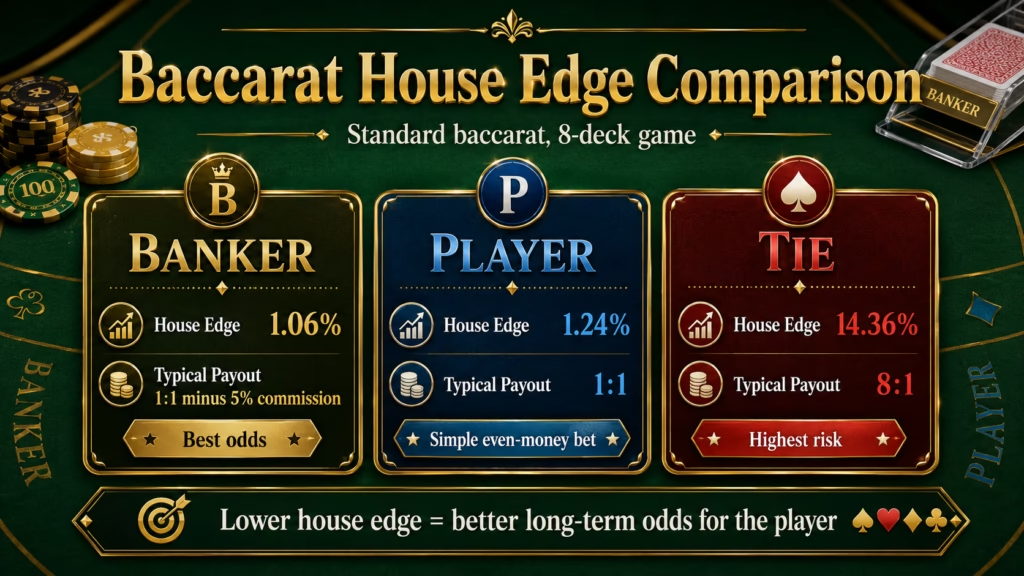
The baccarat house edge depends heavily on which bet you make. Under standard commission baccarat rules, the Banker bet normally has a house edge of about 1.06%, the Player bet about 1.24%, and a Tie bet paying 8:1 about 14.36%. This makes Banker and Player mathematically much closer to each other than either is to the Tie bet.
The important point is that house edge describes the casino’s expected advantage over a very large number of wagers. It does not predict whether a particular Banker, Player, or Tie bet will win.
Quick takeaways:
- Banker usually has the lowest house edge in standard baccarat.
- Player is slightly less favorable mathematically but normally pays even money without commission.
- Tie has a much higher house edge when it pays 8:1.
- A 5% commission on winning Banker bets is already included in the usual 1.06% Banker house edge.
- Baccarat variants can use different payouts and rules, so always check the table rules before comparing percentages.
This information is most useful for players deciding between the three main baccarat wagers. Players looking for short-term predictions or a guaranteed winning strategy should be cautious because baccarat outcomes remain random and house edge only describes long-term mathematical expectation.
What Is the House Edge in Baccarat?
The baccarat house edge is the casino’s theoretical average advantage on a particular wager over a very large number of completed bets. A 1.06% house edge does not mean the casino takes 1.06% from every wager. It means that, mathematically, the casino expects to retain about $1.06 for every $100 wagered over a sufficiently large sample under the specified rules.
House edge can be expressed as:
House Edge = Expected Casino Profit / Total Amount Wagered x 100
For example, if a particular baccarat bet has a theoretical house edge of 1.24%, every $100 wagered represents an expected long-term player loss of approximately $1.24. Individual sessions can produce completely different results because wins and losses occur randomly.
House edge should therefore be used to compare bets, not to predict the next hand.
Baccarat House Edge Comparison
Under commonly used standard baccarat rules with an eight-deck shoe and a 5% commission on winning Banker bets, the three main wagers have approximately the following house edges:
| Baccarat Bet | Typical Payout | Approximate House Edge |
| Banker | 0.95:1 after 5% commission | 1.06% |
| Player | 1:1 | 1.24% |
| Tie | 8:1 | 14.36% |
The difference between Banker and Player is small, but the difference between either of those wagers and Tie is substantial.
A player wagering $100 repeatedly under these conditions would have an approximate theoretical long-term loss of:
- $1.06 per $100 wagered on Banker
- $1.24 per $100 wagered on Player
- $14.36 per $100 wagered on an 8:1 Tie
These figures are mathematical averages rather than expected results from a single $100 bet.
Banker Bet House Edge
The Banker bet has a house edge of approximately 1.06% in standard commission baccarat, making it mathematically the strongest of the three traditional wagers.
Banker does not have a lower house edge because the casino controls the Banker hand. “Banker” is simply one of the two positions dealt according to baccarat’s fixed drawing rules.
In standard eight-deck baccarat, the Banker hand wins slightly more often than the Player hand before ties are removed. This small probability advantage exists because Banker drawing decisions can depend on both the Banker’s total and, in certain situations, the value of the Player’s third card.
Casinos normally compensate for this mathematical advantage by charging a commission on winning Banker wagers.
Why Does the Casino Charge 5% Commission on Banker?
A typical winning Banker wager pays 0.95 units of profit for every 1 unit wagered because the casino deducts a 5% commission.
For example:
- Bet: $100 on Banker
- Banker wins
- Gross even-money profit would be: $100
- 5% commission: $5
- Actual profit: $95
- Original $100 stake is also returned
The commission reduces the player’s return enough to give the casino its approximately 1.06% long-term advantage.
Commission handling differs between casinos. Some deduct it immediately, while traditional baccarat tables may record commissions and collect them later.
Player Bet House Edge
The Player bet has a house edge of approximately 1.24% under standard baccarat rules. Player wins normally pay 1:1, so a $100 winning Player wager produces $100 in profit plus the return of the original stake.
Player does not normally carry the commission associated with Banker bets, but this does not make it mathematically superior.
The fixed baccarat drawing rules give Banker a slightly stronger underlying probability of winning. As a result, Player retains a slightly higher house edge even though its winning payout is a full 1:1.
The difference between approximately 1.06% and 1.24% is relatively small. Players who dislike calculating Banker commission may find Player simpler, but simplicity does not change the underlying expected value.
Tie Bet House Edge
The Tie bet usually has a much higher house edge than Banker or Player. When a standard Tie wager pays 8:1, its house edge is approximately 14.36% under common eight-deck baccarat rules.
A Tie wager wins when the final Banker and Player totals are equal.
For example, if you wager $10 on Tie at 8:1 and a tie occurs:
- Profit: $80
- Original stake returned: $10
- Total returned: $90
The large payout can make Tie visually attractive, but the payout must be evaluated against how infrequently ties occur.
Under standard eight-deck baccarat mathematics, ties occur roughly 9.5% of hands. An 8:1 payout is not sufficient to compensate fully for the probability of losing the wager, which creates the relatively high casino advantage.
What If the Tie Pays 9:1?
A 9:1 Tie payout is substantially better mathematically than an 8:1 payout, although Tie still normally has a higher house edge than Banker or Player.
Under common standard eight-deck rules, a 9:1 Tie payout produces a house edge of roughly 4.84% rather than approximately 14.36%.
That difference shows why checking the paytable matters. Two baccarat tables can offer the same basic Tie wager while providing very different expected returns.
What Happens to Banker and Player Bets When the Hand Ties?
A Tie normally results in a push for standard Banker and Player wagers. The Banker or Player stake is returned rather than lost.
This distinction matters when interpreting baccarat probabilities. Banker may win approximately 45.86% of all resolved hands including ties in the denominator, while Player wins approximately 44.62% and ties account for roughly 9.52% under common eight-deck rules.
Those percentages do not mean a Banker bet loses every time Banker fails to win. When the result is a tie, the standard Banker wager normally pushes.
Why Banker Has a Lower House Edge Than Player
Banker has a lower house edge because baccarat’s third-card rules create a small mathematical advantage for the Banker hand.
The Player hand follows relatively simple drawing rules. Banker drawing rules are more complex because the Banker decision can depend partly on whether Player drew a third card and what that card was.
These rules are automatic. Neither the player nor the dealer chooses strategically whether to draw.
The resulting probability difference is small, but over many hands it is enough to make Banker slightly more likely to win than Player. The standard Banker commission reduces that advantage but does not completely eliminate Banker’s position as the lowest-house-edge traditional wager.
Banker vs Player vs Tie
For players comparing only mathematical house edge, the usual ranking is straightforward:
1. Banker
Banker generally offers the lowest house edge at approximately 1.06% under standard commission baccarat rules.
The disadvantage is that winning Banker bets usually incur a commission.
2. Player
Player has a slightly higher house edge at approximately 1.24%.
Its advantage from a practical perspective is simpler 1:1 settlement without the traditional Banker commission.
3. Tie
Tie can offer an attractive headline payout, but its mathematical cost is considerably higher when the payout is only 8:1.
A player primarily concerned with minimizing house edge would normally have little mathematical reason to prefer an 8:1 Tie wager over Banker or Player.
Does the Lowest House Edge Mean Banker Will Win More During Your Session?
No. A lower baccarat house edge does not guarantee that Banker will produce better results during an individual session.
House edge becomes meaningful across a large number of wagers. Over ten, twenty, or even hundreds of hands, random variation can dominate the theoretical difference between Banker and Player.
For example, Player could win repeatedly during one session even though its long-term house edge is slightly higher. Tie could also appear several times within a short period despite being statistically uncommon.
Past hands do not change the predetermined drawing rules or guarantee the outcome of upcoming hands.
Does Baccarat Pattern Tracking Reduce the House Edge?
Recording previous Banker, Player, and Tie results does not by itself change the mathematical house edge of the next standard baccarat wager.
Baccarat scoreboards frequently display patterns such as Banker streaks, Player streaks and alternating results. These displays describe previous hands. They do not establish that the same pattern must continue or reverse.
Systems based on statements such as “Banker has won five times, so Player is due” confuse historical outcomes with future probability.
The same problem applies to the opposite assumption that a winning streak must continue.
Pattern tracking may be part of how some players experience the game, but it should not be treated as a reliable method of eliminating the casino’s mathematical advantage.
Does Bet Progression Beat the Baccarat House Edge?
Increasing or decreasing wager sizes after wins or losses does not remove the underlying house edge.
Systems such as doubling after a loss can change the distribution of session outcomes, but they cannot change the probability and payout structure of the wager itself.
A progression system can also increase financial exposure quickly. A sequence of losing hands may require progressively larger bets, eventually reaching either the player’s bankroll limit or the casino’s maximum wager.
House edge should therefore be evaluated independently of staking systems.
How No-Commission Baccarat Changes the Calculation
No-commission baccarat should not automatically be treated as equivalent to standard baccarat with the commission removed.
Many no-commission variants modify the payout when Banker wins with a particular total, commonly a Banker 6. Depending on the rules, that Banker result may pay less than even money rather than incurring a standard 5% commission on every Banker win.
These rule changes affect expected value.
Before comparing a no-commission table with standard baccarat, check:
- the payout for a normal Banker win;
- the payout when Banker wins with 6;
- whether any other Banker result has a special settlement;
- Tie payout;
- number of decks;
- applicable side bets.
The standard 1.06% Banker figure should not automatically be applied to every baccarat variation.
Does the Number of Decks Affect Baccarat House Edge?
The number of decks can slightly change baccarat probabilities and house edge because card composition changes the mathematical distribution of possible hands.
The effect on Banker and Player is generally much smaller than the difference between those wagers and a poorly paying Tie bet, but exact percentages should still be matched to the specific rules being played.
If precise expected value matters, check whether the game uses six decks, eight decks, or another configuration rather than assuming every baccarat table has identical mathematics.
How to Compare Baccarat Bets Properly
A useful baccarat comparison should focus on rules rather than simply choosing the bet with the biggest potential payout.
Before playing, check:
- Banker commission: Determine whether winning Banker bets pay 0.95:1 or use another settlement system.
- Player payout: Standard Player bets normally pay 1:1.
- Tie payout: Distinguish between 8:1, 9:1, or another advertised return.
- No-commission rules: Check whether specific Banker totals receive reduced payouts.
- Deck count: Exact mathematical values can differ slightly between game configurations.
- Side-bet rules: Side bets have separate probabilities and house edges and should not be assumed to match the main wagers.
This approach makes it possible to compare the actual game rules instead of relying only on the word “baccarat” in the table name.
Common Baccarat House Edge Mistakes
One common mistake is assuming Banker represents the casino and therefore must always win more. Banker is simply a hand governed by fixed rules.
Another mistake is comparing payouts without considering probability. An 8:1 Tie payout looks much larger than the 1:1 Player payout, but its significantly higher house edge explains why payout size alone is not a useful measure of value.
Players also sometimes interpret a 1.06% house edge as a guaranteed 1.06% loss during every session. House edge is a long-term expected value, not a prediction of short-term results.
Finally, standard baccarat percentages should not be copied directly to every no-commission or modified baccarat game. Changes in payouts can materially change the casino advantage.
Practical Approach to Baccarat House Edge
If the goal is simply to minimize theoretical casino advantage, standard Banker is generally the strongest of the three main baccarat bets, followed closely by Player.
Tie requires more caution because the house edge can be several times higher, particularly when the payout is 8:1.
A practical approach is to:
- verify the Banker payout before wagering;
- check whether Banker wins involve commission;
- check the exact Tie payout;
- avoid assuming side bets have the same low house edge as Banker or Player;
- set a fixed spending limit before playing;
- avoid increasing stakes purely to recover previous losses.
Choosing a lower-house-edge bet reduces theoretical cost. It does not turn baccarat into a positive-expectation game or guarantee a favorable session.

How This Information Was Reviewed
The baccarat house edge comparisons in this guide are based on standard baccarat probability and expected-value calculations, including the effect of the usual 5% commission on winning Banker bets.
The commonly quoted Banker, Player and Tie percentages apply to specific standard rule sets. Exact values can change when a casino modifies deck count, Banker commission, Tie payout, no-commission rules or other settlement conditions.
Players should therefore verify the game’s rules and paytable before applying a house-edge percentage to a particular table.
House edge describes long-term mathematical expectation and cannot predict an individual hand or session. Baccarat should be treated as paid entertainment rather than a method of earning money. Set spending and time limits in advance, and stop if gambling is no longer within those limits.
FAQ
What is the house edge in baccarat?
The baccarat house edge depends on the wager. Under common standard commission rules, Banker has an approximately 1.06% house edge, Player approximately 1.24%, and an 8:1 Tie bet approximately 14.36%. Different baccarat variants can produce different percentages.
Is Banker or Player better in baccarat?
Banker is mathematically slightly better under standard baccarat rules because its house edge is approximately 1.06% compared with roughly 1.24% for Player. The difference does not guarantee Banker will perform better during a particular session.
Why does Banker have the lowest house edge?
Banker has the lowest house edge because baccarat’s fixed drawing rules give the Banker hand a small probability advantage over Player. Casinos normally offset part of this advantage by charging a commission on Banker wins.
What is the house edge on a Tie bet in baccarat?
A Tie bet paying 8:1 has an approximately 14.36% house edge under common eight-deck baccarat rules. A 9:1 Tie payout is considerably better, with an edge of roughly 4.84% under the same standard assumptions.
Is a Tie bet worth playing in baccarat?
An 8:1 Tie bet has a substantially higher theoretical cost than Banker or Player. Players comparing wagers by expected value would generally find Banker or Player mathematically more favorable. A Tie can still occur on any hand, but its large payout does not eliminate its higher house edge.
Does the 5% Banker commission cause the 1.06% house edge?
The approximately 1.06% Banker house edge already accounts for the standard 5% commission on winning Banker bets. Without considering the commission and exact game rules, the usual Banker percentage should not be applied.
Can baccarat patterns predict Banker or Player?
Previous Banker and Player results do not provide a guaranteed prediction of the next hand. Baccarat scoreboards record historical results, but standard drawing rules and random card order determine future outcomes.
Can a betting system overcome the baccarat house edge?
Changing bet sizes does not remove the mathematical house edge. Progression systems can change short-term risk and may require rapidly increasing wagers, but they do not alter the probability or payout of Banker, Player or Tie.
Is no-commission baccarat better than regular baccarat?
Not necessarily. No-commission baccarat often changes the payout for certain Banker wins, so removing the visible commission does not automatically improve expected value. Check the exact variant rules before comparing house edges.
Does baccarat house edge guarantee how much I will lose?
No. House edge represents a long-term mathematical expectation rather than a guaranteed session result. A player may win or lose much more than the theoretical percentage over a short period because individual baccarat outcomes are random.
Brief Conclusion
Standard baccarat gives the casino a relatively small mathematical advantage on its two main wagers. Banker normally has the lowest house edge at about 1.06%, followed by Player at about 1.24%. An 8:1 Tie bet is much more expensive mathematically at about 14.36%.
For accurate comparison, always check the specific table’s Banker commission, Tie payout, deck count and no-commission rules. Lower house edge reduces theoretical long-term cost, but no baccarat wager guarantees a win or predicts the outcome of the next hand.