
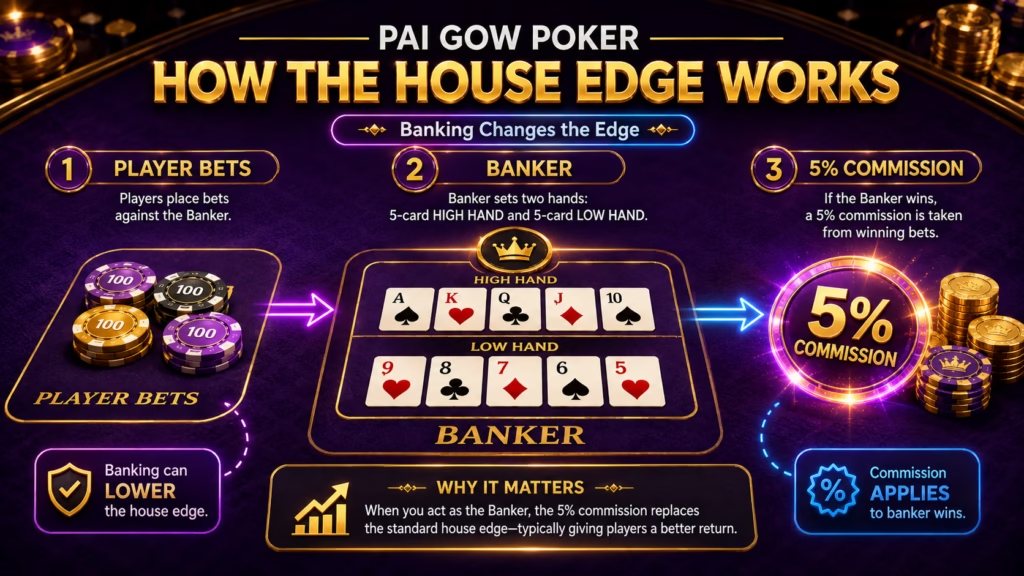
The Pai Gow Poker house edge is usually around 2.5% to 2.8% in traditional play when the casino dealer acts as banker, but the exact figure depends on the hand-setting strategy, banking rules and commission structure. Banking can reduce the player’s mathematical disadvantage substantially because ties favor the banker. In detailed mathematical analysis, the house edge can fall from about 2.72% when the dealer banks to about 0.25% when the player banks, assuming both sides use the casino’s house-way strategy and the traditional 5% commission applies.
Quick takeaways
- Traditional Pai Gow Poker commonly charges a 5% commission on winning main bets.
- The banker wins exact ties, often called copies, which gives the banking position a mathematical advantage.
- Banking can dramatically reduce the effective house edge, but the exact result depends on how often the player is allowed to bank and how hands are set.
- Commission and house edge are not the same thing. A 5% commission does not mean the house edge is 5%.
- Commission-free versions use different rules to restore a casino advantage, so no commission does not mean no house edge.
Pai Gow Poker generally appeals to players who prefer a slower table game, frequent pushes and decisions about how to divide seven cards into two hands. Banking is more relevant to experienced players who understand the rules and have enough bankroll to accept the extra financial responsibility of acting as the bank. The game remains gambling, and neither banking nor optimal hand setting guarantees a profit.
What Is the Pai Gow Poker House Edge?
The Pai Gow Poker house edge is the casino’s expected long-term advantage on the main wager, expressed as a percentage of the amount initially bet. It does not predict what will happen during one hand, one hour or one casino session.
In traditional Pai Gow Poker, each player receives seven cards and divides them into a five-card high hand and a two-card low hand. The dealer does the same, normally according to a predetermined house way. The player’s two hands are then compared separately with the banker’s two hands. Winning both normally wins the wager, splitting the comparisons creates a push, and losing both loses the wager. Exact ties favor the banker.
A commonly cited benchmark for standard Pai Gow Poker is around 2.8%. More detailed mathematical modelling can produce slightly different numbers because it accounts for the exact hand-setting strategy and who acts as banker. This is why players may see Pai Gow Poker house-edge figures ranging from roughly 2.5% to 2.8% for conventional dealer-banked play.
Pai Gow Poker House Edge With Banking
Pai Gow Poker house edge with banking can be much lower because the banker receives the benefit of tied comparisons. Traditional rules may allow a player to take a turn acting as banker rather than always competing against the casino dealer.
| Situation | Approximate house edge against the player |
| Dealer banks, player uses house way | 2.72% |
| Dealer banks, player uses theoretical optimal strategy | 2.51% |
| Player banks, player uses house way | 0.25% |
| Player banks, player uses theoretical optimal strategy | 0.04% |
These figures are based on a specific mathematical ruleset and should not be treated as universal values for every casino. They demonstrate the size of the banking effect rather than guaranteeing the same percentage at every table. In this model, changing from dealer banking to player banking improves expected value by roughly 2.47 percentage points.
The theoretical 0.04% figure also assumes optimal hand setting. It should not be interpreted as a realistic promise that every player can reproduce that result. Actual casino rules, mistakes when arranging hands, commission procedures and banking availability can all change expected return.

Why Does Banking Reduce the House Edge?
Banking reduces the disadvantage primarily because ties belong to the banker.
Suppose the player’s low hand and the banker’s low hand have exactly the same value. The banker wins that comparison rather than treating it as an ordinary tie. The same principle applies when equivalent hands are compared in the high hand. This tie-breaking rule contributes significantly to the banker’s advantage.
When the casino dealer banks, that structural advantage belongs to the house. When a player is permitted to bank, the advantage temporarily moves to that player.
This does not mean the player suddenly receives a guaranteed positive expectation. Traditional commission still reduces the banker’s winning results, and the player must set the banking hand correctly.
How the 5% Pai Gow Poker Commission Works
Traditional Pai Gow Poker commonly pays a winning main wager at even money minus a 5% commission.
- Main wager: $100
- Player wins both hands
- Gross profit at even money: $100
- 5% commission: $5
- Net profit: $95
The original $100 wager is also returned. The commission matters because the player receives slightly less than even money when winning but still loses the entire wager when losing.
However, 5% commission does not equal a 5% house edge. The commission is charged only on qualifying wins. Pai Gow Poker also produces many pushes, and the banker advantage on copies affects the expected value. All of these outcomes must be combined to calculate the actual house edge.
Commission vs House Edge
Confusing commission with house edge is one of the most common mistakes when evaluating Pai Gow Poker.
A commission is a direct deduction from a payout. A house edge is the average mathematical loss expected from the entire wager over a very large number of hands.
Consider a hypothetical $100 bet. Paying $5 commission after one winning hand does not mean the casino expects to earn $5 from every $100 wager. Some hands lose, some win and many push. The long-term calculation weights every possible outcome by its probability.
That is why traditional Pai Gow Poker can charge a 5% commission while its dealer-banked house edge remains closer to the 2.5% to 2.8% range under commonly analysed rules.
Does Banking Every Other Hand Cut the House Edge in Half?
Banking more often generally improves expected return, but there is no universal rule that banking automatically cuts the house edge exactly in half.
The result depends on the house edge while the dealer banks, the expected value while the player banks, how frequently banking is offered and the casino’s commission rules.
Published figures can therefore differ. A simplified standard benchmark may place the dealer-banked edge around 2.8%, while detailed strategy models can calculate about 2.72% when the dealer banks and about 0.25% when a player banks using the house way.
The practical lesson is more useful than chasing one universal percentage: check how often the casino allows player banking and what rules apply during those hands.
What Does the Player Take On When Banking?
Player banking changes more than the mathematics. The player may also need sufficient chips to cover the wagers being played against the bank.
Rules vary between casinos, but banking can expose a player to considerably more money than a normal single main wager. Depending on the table rules, the banking player may need enough chips to cover opposing action, buy additional chips or give up the banking opportunity.
Before agreeing to bank, check:
- whether player banking is permitted;
- how often the banking position rotates;
- whether co-banking is available;
- how commission is calculated;
- how much opposing action must be covered;
- whether the banker must follow the house way;
- whether table limits change when banking.
A lower theoretical house edge is not useful if taking the banking position requires financial exposure outside the player’s predetermined gambling budget.
Does Better Hand Setting Lower the Pai Gow Poker House Edge?
Correct hand setting can reduce the house edge because the player chooses how to divide seven cards into the two-card and five-card hands.
The effect is meaningful but smaller than the effect of banking. In one commonly analysed model, moving from the house-way strategy to theoretical optimal strategy improves expected return by roughly 0.21 percentage points, while changing who banks produces an improvement of about 2.47 percentage points.
For most casual players, learning a sound Pai Gow Poker strategy is therefore useful, but it should not create unrealistic expectations. Correct strategy reduces mathematical mistakes. It does not influence which cards are dealt.
When unsure how to arrange a hand, many casinos allow players to request that the hand be set according to the house way. Availability and procedures should be confirmed at the table.
What About Commission-Free Pai Gow Poker?
Commission-free Pai Gow Poker does not remove the casino advantage. Instead, the game normally changes another rule to compensate for eliminating the traditional 5% deduction.
For example, Face Up Pai Gow Poker is commonly commission-free. The dealer’s hand is exposed before players arrange their hands, but specific dealer outcomes can cause a push rather than an ordinary player win. Other commission-free formats may use a dealer queen-high push rule.
Depending on the exact rules, commission-free Pai Gow Poker variants can still carry a house edge around the mid-2% range on the primary wager.
For that reason, choosing between traditional and commission-free Pai Gow should be based on the complete ruleset, not the commission label alone.
Traditional Pai Gow vs Commission-Free Pai Gow
| Feature | Traditional Pai Gow Poker | Commission-Free Variant |
| Winning main bet | Usually even money minus commission | Usually even money |
| Typical commission | Often 5% | None |
| Compensating special rule | Usually not required | Usually yes |
| Player banking | May be available | Depends on variant |
| House edge | Depends on strategy and banking | Depends on special rules |
| What to check | Commission and banking policy | Exact push rules and paytable |
A commission-free table can be easier to understand because payouts do not require calculating a 5% deduction, but it is not automatically the mathematically superior game.
Common Pai Gow Poker House Edge Mistakes
Assuming a 5% commission means a 5% house edge
The commission affects winning payouts only. House edge incorporates wins, losses, pushes and banking rules.
Assuming player banking guarantees an advantage
Banking substantially improves expected value under traditional rules, but commission, strategy and casino procedures still matter. A near-zero theoretical edge under one mathematical model is not a guaranteed result.
Comparing variants by commission alone
A no-commission game normally compensates through another rule. Compare the entire ruleset rather than simply choosing the table with no commission.
Ignoring side bets
The house edge of the main Pai Gow Poker wager does not tell you the expected return of optional side bets. Every side bet has its own paytable and mathematical edge, so it should be evaluated separately.
Treating house edge as a session forecast
A 2.7% house edge does not mean a player will lose exactly $2.70 for every $100 bet during a short session. House edge describes long-term expected value across a very large number of wagers.
How to Evaluate a Pai Gow Poker Table
When comparing Pai Gow Poker games, start with the rules rather than the casino’s marketing description.
Check the commission, banking policy, tie rules, house way, special push conditions and side-bet paytables. These factors determine whether a quoted house-edge figure actually applies to the game in front of you.
For traditional Pai Gow Poker, the ability to bank is particularly important. For commission-free Pai Gow, the replacement rule is usually more important than the absence of commission.
Players should also decide on a fixed gambling budget before playing. A mathematically favorable rule does not eliminate short-term variance, and gambling should be treated as entertainment rather than a source of income.
How This Information Was Reviewed
The house-edge figures in this guide are based on established Pai Gow Poker expected-value calculations and standard game rules that model dealer banking, player banking, house-way strategy and theoretical optimal strategy separately.
Exact numbers should still be checked against the rules of the specific casino or game variant. Commission procedures, banking availability, house-way rules and special push conditions can change the expected return.
No house-edge figure predicts an individual session. Banking and correct hand setting can improve expected value, but neither can control the cards or guarantee winnings.
FAQ
What is the standard Pai Gow Poker house edge?
The standard Pai Gow Poker house edge is commonly quoted at roughly 2.5% to 2.8% when the casino dealer banks. Detailed mathematical models can vary slightly depending on whether the player follows the house way or uses a more optimized hand-setting strategy.
What is the Pai Gow Poker house edge with banking?
The Pai Gow Poker house edge with player banking can be much lower than when the dealer banks. In one detailed traditional-rules model, the player’s disadvantage is approximately 0.25% when banking with house-way strategy and about 0.04% with theoretical optimal strategy. These figures depend on the exact rules and should not be treated as universal.
Why does the banker have an advantage in Pai Gow Poker?
The banker has an advantage because equal-ranking comparisons go to the banker. When the casino banks, this rule benefits the house. When a player banks, the same tie advantage temporarily moves to the player.
Is Pai Gow Poker commission always 5%?
A 5% commission is traditional but not universal. Some casinos and variants use different commission procedures, while commission-free versions replace the commission with other rules. Always check the table rules before playing.
Does 5% commission mean Pai Gow Poker has a 5% house edge?
No. A 5% commission is a deduction from qualifying winning payouts, while house edge measures expected loss across all possible wins, losses and pushes. Traditional Pai Gow Poker can therefore charge 5% commission while maintaining a main-game house edge below 3% under commonly analysed rules.
Is commission-free Pai Gow Poker better?
Not necessarily. Commission-free Pai Gow Poker generally changes another rule to preserve a casino advantage. The correct comparison is the complete ruleset and calculated house edge, not simply whether the game charges commission.
Can optimal strategy eliminate the Pai Gow Poker house edge?
No strategy reliably eliminates the house edge under all Pai Gow Poker rules. Optimal hand setting can reduce expected losses, and banking can improve the mathematics substantially, but the cards remain random and casino rules differ.
Is banking always worth doing?
Banking can improve expected value, but it also changes the player’s financial exposure. A banker may need enough chips to cover opposing wagers, and casino procedures differ. Players should understand the banking rules and stay within a predetermined gambling budget.
Do Pai Gow Poker side bets have the same house edge?
No. Optional Pai Gow Poker side bets use separate paytables and therefore have their own house edges. The main game’s roughly 2% to 3% range should never be assumed to apply to a Fortune, progressive or other bonus wager.
Short Conclusion
The Pai Gow Poker house edge is mainly shaped by three factors: who banks, how the hands are set and how commission is charged. Traditional dealer-banked Pai Gow Poker generally carries a house edge around 2.5% to 2.8%, while player banking can reduce the mathematical disadvantage dramatically under suitable rules.
The important distinction is that a 5% commission is not a 5% house edge. Banking shifts the valuable tie advantage to the player, while commission-free variants replace the commission with other casino-favorable rules. Check the specific table rules before comparing percentages, set firm spending limits and treat Pai Gow Poker as entertainment rather than a way to earn money.