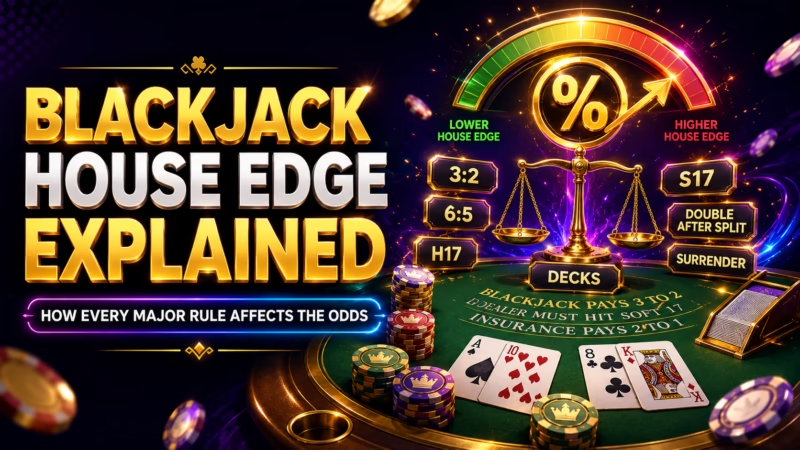
The Blackjack Switch house edge is about 0.58% under the standard six-deck Las Vegas-style rules when optimal strategy is used. The figure assumes the dealer hits soft 17 and a blackjack created by switching cards is treated as a regular 21 rather than a natural blackjack. Rule changes can move the house edge higher or lower, so the exact game rules matter.
Blackjack Switch differs from regular blackjack because the player receives two hands, makes two equal wagers, and may exchange the second card dealt to each hand. That powerful switching option is balanced by less favorable rules, most importantly the dealer’s Push 22 rule and even-money payouts on natural blackjacks.
Quick takeaways:
- Standard six-deck Blackjack Switch has an estimated 0.58% house edge with optimal play.
- You must play two blackjack hands with equal initial bets.
- You may switch the second card between the two hands before playing them.
- A dealer total of 22 normally pushes against non-busted ordinary hands, instead of losing as it would in standard blackjack.
- Natural blackjacks generally pay 1:1 rather than 3:2.
- Blackjack Switch strategy requires both a switching strategy and a modified blackjack basic strategy.
Blackjack Switch may appeal to players who already understand ordinary blackjack and want an additional strategic decision before hitting, standing, splitting, or doubling. Beginners can learn it, but using a normal blackjack strategy chart without accounting for Push 22 can produce incorrect decisions.
What Is Blackjack Switch?
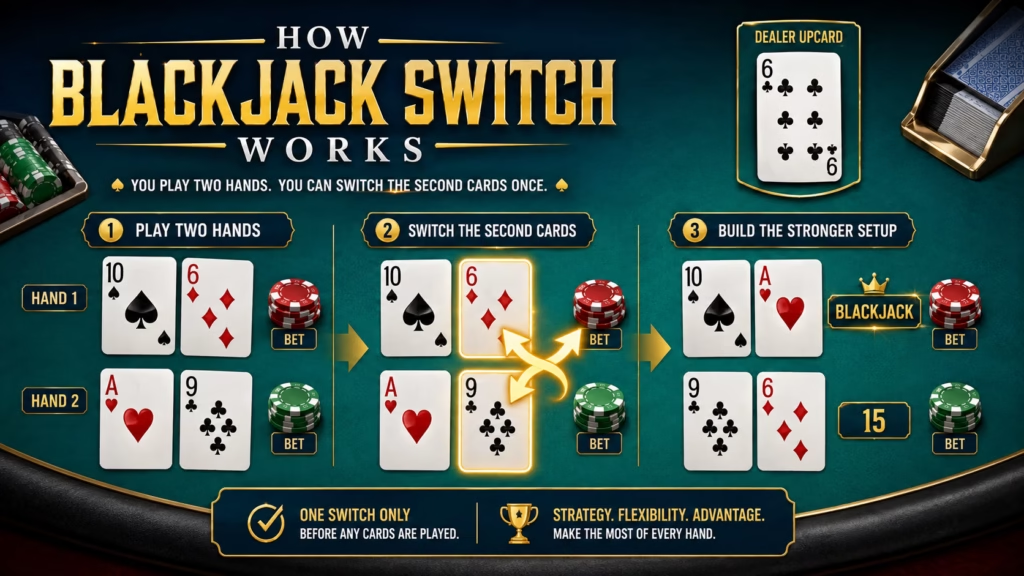
Blackjack Switch is a blackjack variant in which each player starts with two separate hands and two equal wagers. After the initial deal, the player can leave the hands unchanged or exchange the second card of one hand with the second card of the other.
For example, imagine the two starting hands are:
- Hand 1: 5 + 10
- Hand 2: 10 + 6
Keeping the cards produces totals of 15 and 16. Switching the second cards creates:
- Hand 1: 5 + 6 = 11
- Hand 2: 10 + 10 = 20
The ability to transform two weak hands into an 11 and a 20 is extremely valuable. The casino compensates for that advantage through several rule changes.
Typical Blackjack Switch rules use six or eight decks. The player may normally double on any first two cards, double after splitting, and resplit under the applicable table rules. Exact conditions should always be checked before playing because casinos and jurisdictions can use different versions.
What Is the Blackjack Switch House Edge?
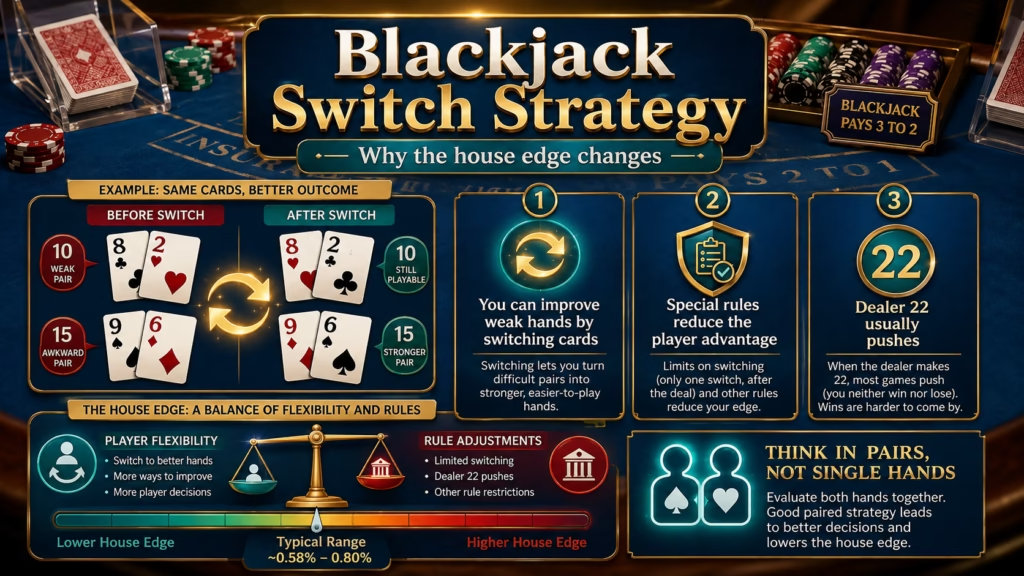
Under a commonly analyzed six-deck Las Vegas ruleset, Blackjack Switch has a house edge of approximately 0.58% when the player follows optimal strategy. The calculation assumes that the dealer hits soft 17 and that a blackjack created through switching is treated as an ordinary 21.
A 0.58% house edge means that the theoretical casino advantage equals about $0.58 for every $100 wagered over a very large number of bets. It does not mean that a player will lose exactly $0.58 during a $100 session. Short-term results can vary dramatically because individual blackjack hands are random.
The house edge also assumes correct decisions. Strategy mistakes can increase the casino advantage.
How Rule Changes Affect the House Edge
Blackjack Switch house edge is not one universal percentage. Deck count, dealer rules, blackjack treatment, surrender rules, and other variations can change the mathematical return.
For the analyzed Las Vegas version, moving from six decks to eight decks adds roughly 0.02 percentage points to the house advantage. Having the dealer stand instead of hit on soft 17 improves the player’s theoretical return by about 0.30 percentage points.
This is why players comparing Blackjack Switch tables should check the actual rules rather than relying only on a published RTP or house-edge figure.
Why Does the Casino Still Have an Edge If You Can Switch Cards?
The switching mechanic gives the player substantial control over the composition of the two starting hands, so Blackjack Switch introduces rules that compensate for that advantage.
The two most important are Push 22 and the reduced blackjack payout.
Dealer 22 Pushes Instead of Busting
In ordinary blackjack, a dealer total above 21 normally busts and surviving player hands win.
Blackjack Switch changes that outcome. Under the standard version, when the dealer reaches exactly 22, ordinary non-busted player hands push instead of winning.
For example:
- Player: 20
- Dealer: 22
In conventional blackjack, the player’s 20 wins because the dealer busted.
In Blackjack Switch, the 20 normally pushes and the original wager is returned.
This rule removes a significant number of outcomes that would otherwise be player wins.
A true player blackjack is treated differently under the commonly analyzed rules and can still defeat dealer 22. A blackjack created by switching cards is generally classified only as a total of 21, not as a natural blackjack.
Blackjack Usually Pays Even Money
Another important difference is the payout for a natural blackjack.
Traditional favorable blackjack commonly pays 3:2. Blackjack Switch typically pays 1:1 on a winning natural blackjack.
A $10 blackjack therefore earns $10 rather than the $15 profit associated with a 3:2 table.
The reduced payout is part of the mathematical cost of receiving the switching option.
How Blackjack Switch Strategy Works
A proper Blackjack Switch strategy has two stages:
- Decide whether the second cards should be switched.
- Play each resulting hand using basic strategy designed for Blackjack Switch.
The second step matters because the Push 22 rule changes some hit, stand, split, and double decisions from conventional blackjack. Simply using a standard blackjack strategy chart is therefore not optimal.
Blackjack Switch Switching Strategy
The central strategic question is not simply whether switching improves one hand. The player must evaluate the combined value of both hands.
A switch that creates a 20 might look attractive, but it can still be a poor decision if the other hand becomes extremely weak. Conversely, sacrificing some strength in the better hand can occasionally improve the combined expected value of the two wagers.
A practical simplified switching system ranks desirable hands roughly in this order:
1. 21
2. 20
3. 19
4. A,A
5. 11
6. 10
7. 9
8. 18 or 8
The dealer’s upcard then affects whether the player should prioritize one strong hand or create two more balanced hands.
Against Dealer 7 or 8
Against a dealer 7 or 8, the simplified switching approach generally favors balancing the two hands and making the weaker hand as strong as reasonably possible.
The reason is that dealer 7 and 8 are relatively competitive upcards. Creating one excellent hand while leaving the second hand severely disadvantaged may produce a worse combined expectation than keeping two playable totals.
Against Other Dealer Upcards
Against most other dealer cards, the simplified approach generally prioritizes maximizing the stronger hand according to the switching hierarchy.
This rule is only a shortcut. Exact switching decisions depend on all four player cards and the dealer’s visible card.
How Accurate Is a Simple Blackjack Switch Strategy?
A simplified switching strategy is easier to memorize, but it is not mathematically perfect.
Detailed mathematical analysis of Blackjack Switch estimates that one well-known simple switching strategy costs approximately 0.17 percentage points compared with optimal switching decisions. Under that model, an incorrect switching decision occurs roughly once every 18.6 hands.
If the underlying optimal house edge is around 0.58%, a strategy error cost of 0.17 percentage points illustrates why learning the switching decision matters. The exact resulting edge still depends on whether the player also makes correct decisions after the switch.
An advanced switching system can reduce the estimated strategy-error cost to about 0.08 percentage points compared with optimal play.
For casual players, the simpler system may be easier to use consistently. Players concerned primarily with mathematical efficiency would need a more detailed switching chart or calculator.
Blackjack Switch Strategy vs Regular Blackjack Strategy
Blackjack Switch strategy should not be treated as ordinary blackjack basic strategy with one extra decision.
| Feature | Blackjack Switch | Traditional Blackjack |
| Starting hands | Two | Usually one |
| Initial wagers | Two equal bets | One bet |
| Card switching | Yes | No |
| Dealer 22 | Usually pushes ordinary active hands | Dealer bust |
| Natural blackjack payout | Typically 1:1 | Often 3:2, depending on table |
| Strategy | Switching + modified basic strategy | Basic strategy |
The biggest strategic difference comes from Push 22. Because dealer 22 no longer produces an automatic win for most surviving player hands, the expected values of hitting, standing, doubling, and splitting change.
Example of a Blackjack Switch Decision
Suppose your hands are:
- 8 + 4
- A + 8
Against a dealer 6, keeping the cards produces a hard 12 and soft 19.
Switching the second cards creates:
- 8 + 8
- A + 4
The decision is not obvious because soft 19 looks significantly stronger than soft 15. However, mathematical analysis gives the switched combination of 8-8 plus soft 15 a slightly higher combined expected value in this particular situation.
This example shows why intuition alone is unreliable in Blackjack Switch. The correct decision depends on the total expected value of both hands together, not on which arrangement looks safer.
Common Blackjack Switch Strategy Mistakes
Using a Regular Blackjack Chart
Standard blackjack strategy assumes that dealer 22 is a bust. Blackjack Switch does not. Some conventional blackjack decisions are therefore mathematically incorrect in the Switch version.
Use a strategy chart specifically calculated for the Blackjack Switch rules being played.
Automatically Creating the Highest Possible Hand
A switch that produces a 20 or 21 is attractive, but the second hand must also be considered.
The objective is to maximize the combined expected value of both wagers, not simply create the strongest individual hand.
Treating a Switched 21 as a Natural Blackjack
A two-card 21 created by switching is generally treated as an ordinary 21 rather than a natural blackjack. Under the commonly analyzed rules, that distinction affects both payouts and dealer-22 outcomes.
Ignoring Table Rules
A published 0.58% house-edge figure applies to a specific configuration. Six versus eight decks, soft-17 rules, blackjack treatment, and other conditions can change the return.
Check the game rules or paytable before assuming a particular house edge.
What About the Super Match Side Bet?
Some Blackjack Switch tables offer a Super Match side bet based on the player’s first four cards. Possible winning combinations can include a pair, three of a kind, two pair, and four of a kind. Paytables can vary.
For one analyzed six-deck paytable paying 1:1 for a pair, 5:1 for three of a kind, 8:1 for two pair, and 40:1 for four of a kind, the calculated house edge is approximately 2.55%.
That is substantially higher than the approximately 0.58% edge calculated for the main Blackjack Switch game under optimal strategy. Players focused on minimizing mathematical disadvantage should evaluate the side bet separately rather than assuming it shares the main game’s low house edge.
How to Choose a Blackjack Switch Game
Before playing Blackjack Switch, check:
- whether the game uses six or eight decks;
- whether the dealer hits or stands on soft 17;
- how natural and switched blackjacks are treated;
- whether double after split is allowed;
- how many times pairs can be resplit;
- the exact dealer-22 rule;
- whether surrender is available;
- the paytable and house edge of optional side bets.
The published RTP or house-edge percentage is useful only when it matches the actual rules being offered.
How This Information Was Reviewed
The Blackjack Switch house-edge figures and strategy principles in this guide are based on mathematical analysis of the game’s rules, expected values, switching decisions, and common rule variations. The core playing rules were also considered when describing the requirements for two equal wagers and the treatment of switched hands.
Players should still verify the rules displayed by the specific casino or game provider because deck count, dealer behavior, side-bet paytables, surrender availability, and other conditions can differ.
House edge represents a long-run mathematical expectation. It cannot predict whether a particular hand or session will win or lose. Blackjack Switch should be treated as entertainment rather than a source of income, and players should decide their spending and time limits before gambling.
FAQ
What is the house edge in Blackjack Switch?
The Blackjack Switch house edge is approximately 0.58% under a commonly analyzed six-deck Las Vegas ruleset with optimal strategy. The dealer hits soft 17 in that configuration, and switched blackjack is treated as 21. Different table rules can change the percentage.
Is Blackjack Switch better odds than regular blackjack?
Not necessarily. Both games can have relatively low house edges under favorable rules and correct strategy, but the exact comparison depends on the specific table conditions. Blackjack Switch gives the player the valuable ability to exchange cards but compensates with rules such as Push 22 and even-money blackjack payouts.
What is the Push 22 rule in Blackjack Switch?
The Push 22 rule means that when the dealer finishes with exactly 22, ordinary non-busted player hands generally push instead of winning. A natural blackjack can receive different treatment, while a switched two-card 21 is normally considered an ordinary 21.
Should you always switch cards in Blackjack Switch?
No. Switching is optional, and many starting combinations are better left unchanged. The correct decision depends on all four player cards, the dealer’s upcard, and the combined expected value of the two resulting hands.
Does Blackjack Switch require a different basic strategy?
Yes. Blackjack Switch requires a modified basic strategy because dealer 22 pushes instead of busting against most active player hands. Standard blackjack charts therefore produce some incorrect decisions.
Does a blackjack created by switching count as a natural blackjack?
Generally no. Under commonly used rules, a blackjack formed by exchanging the second cards is treated as an ordinary total of 21 rather than a natural blackjack.
How many hands do you play in Blackjack Switch?
You play two hands at the same time and must normally place equal initial wagers on both hands. After the cards are dealt, you can exchange the second card between those two hands before normal blackjack decisions begin.
Is Blackjack Switch strategy guaranteed to win?
No. Blackjack Switch strategy can reduce mathematical mistakes and bring the player’s expected return closer to the theoretical optimum, but it cannot guarantee winning hands or profitable sessions. Individual outcomes remain random.
Is the Super Match bet worth playing?
The Super Match bet can have a higher mathematical house edge than the main game. One analyzed six-deck 40-8-5-1 paytable has an estimated house edge of about 2.55%, compared with roughly 0.58% for the main game under optimal standard rules.
Brief Conclusion
Blackjack Switch combines a powerful card-switching mechanic with compensating rules such as Push 22 and even-money blackjack payouts. Under standard six-deck Las Vegas-style conditions, optimal play produces an estimated 0.58% house edge. The key to Blackjack Switch strategy is evaluating both hands together, making the correct switch decision, and then using basic strategy specifically designed for the Push 22 rules. No strategy removes the casino advantage or guarantees a winning session.