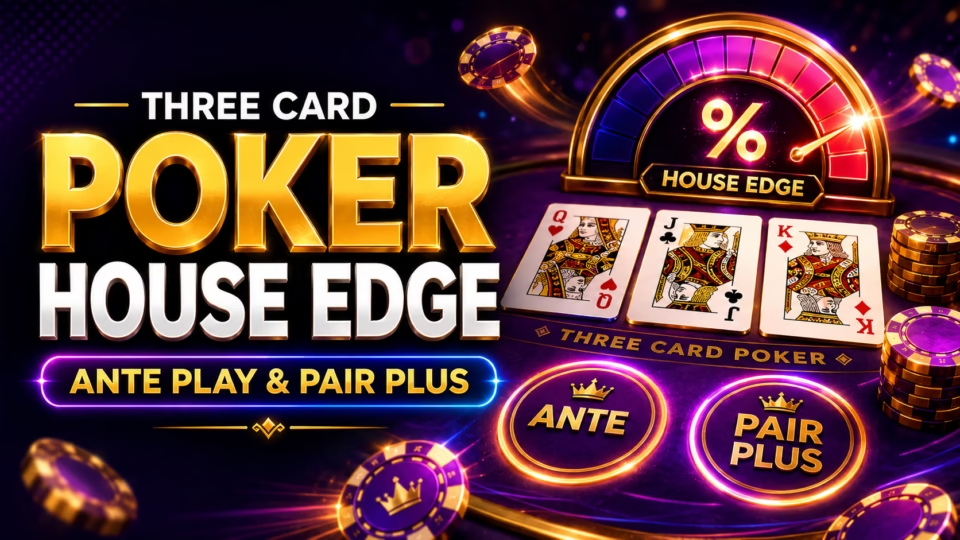
The Three Card Poker house edge depends heavily on which wager you make. Under the standard Ante Bonus pay table and optimal Q-6-4 strategy, Ante and Play has a 3.37% house edge measured against the initial Ante wager. Its element of risk, which measures expected loss against the average total amount actually wagered after conditional Play bets, is lower at about 2.01%.
Pair Plus can range from about 2.32% to 7.28% or more depending on the pay table. The older full-pay 1-4-6-30-40 schedule has a 2.32% house edge, while the 1-3-6-30-40 schedule produces a much higher 7.28% edge. This makes checking the Pair Plus payout table more important than simply seeing that the bet is available.
Quick takeaways:
- Standard Ante and Play house edge: 3.37% with correct strategy.
- Ante and Play element of risk: approximately 2.01%.
- Optimal basic strategy: Play Q-6-4 or better and fold lower hands.
- Pair Plus house edge varies substantially with its payout schedule.
- A 2.32% Pair Plus table is mathematically very different from a 7.28% table, even though the wager works the same way.
Three Card Poker may appeal to players who want a fast table game with only one meaningful strategy decision. Players looking primarily for large bonus payouts may find Pair Plus more entertaining, but higher payouts do not automatically mean better mathematical value. Gambling outcomes remain random, and house edge describes long-run mathematical expectation rather than what will happen during one session.
What Is the House Edge in Three Card Poker?
The house edge in Three Card Poker is the casino’s theoretical advantage over repeated play under a specific set of rules and payouts. It does not mean the casino will win that percentage from every individual player or every session.
For the common Ante Bonus schedule paying 5:1 for a straight flush, 4:1 for three of a kind and 1:1 for a straight, the Ante and Play game has a calculated house edge of approximately 3.37% when the player follows optimal strategy.
That percentage is measured relative to the initial Ante. Because a player who continues must make an additional Play wager equal to the Ante, another statistic called the element of risk can give a more useful comparison based on the average total money put into action. For standard Ante and Play, that figure is approximately 2.01%.
This distinction explains why statements such as “Three Card Poker has a 2.01% house edge” can be misleading. The commonly quoted 3.37% is the conventional house-edge figure, while 2.01% is the element of risk for the standard Ante and Play game.
How Ante and Play Work
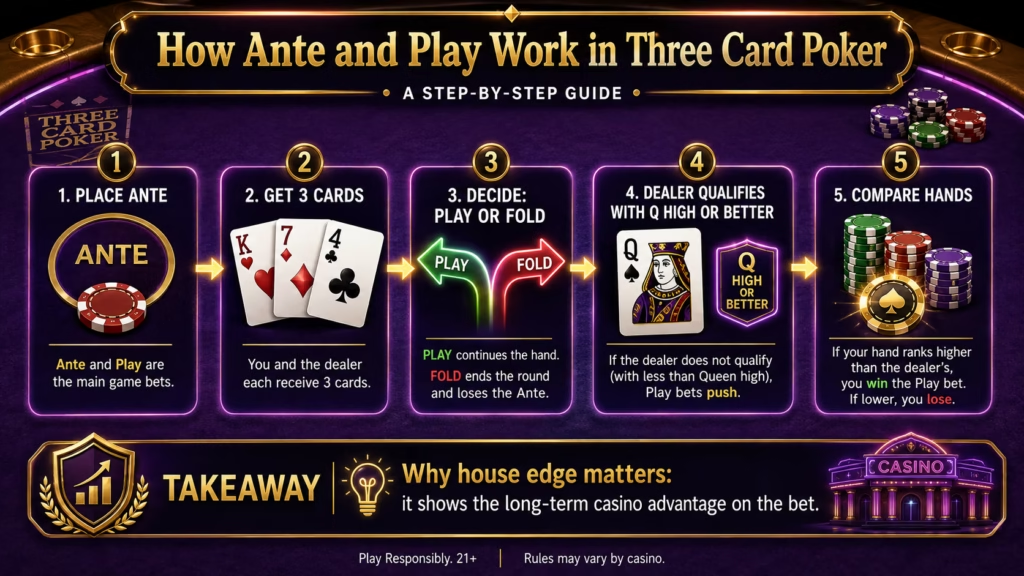
The Ante wager starts the dealer-versus-player portion of Three Card Poker. After receiving three cards, the player chooses either to fold or make a Play wager equal to the original Ante. The dealer then reveals three cards and normally needs at least queen-high to qualify.
- Place the Ante before the cards are dealt.
- Receive three cards.
- Fold and lose the Ante, or make a Play bet equal to the Ante.
- The dealer reveals the dealer hand.
- The dealer normally qualifies with queen-high or better.
- If the dealer qualifies, the player’s hand is compared with the dealer’s.
- Standard Ante Bonus payouts may apply to qualifying strong player hands regardless of whether the dealer ultimately beats the player.
Three-card poker hand rankings also differ slightly from conventional five-card poker because a straight ranks above a flush. A three-card straight is mathematically less common than a three-card flush.
The Q-6-4 Strategy and the 3.37% House Edge
The optimal basic strategy for standard Ante and Play is simple: make the Play wager with Q-6-4 or better and fold anything lower.
“Q-6-4 or better” does not mean the hand must contain exactly those three cards. Hands are compared from the highest card downward. For example, Q-7-3 is better than Q-6-4 because the sevens decide the comparison after the queens tie.
The Q-6-4 threshold matters because it minimizes the mathematical disadvantage of the Ante and Play decision. Raising Q-6-4 has a smaller expected loss than folding it, while raising Q-6-3 has a slightly greater expected loss than surrendering the Ante.
Playing more aggressively does not improve the odds. Raising every hand increases the house edge substantially, to approximately 7.65% under the analyzed standard rules. Even simply copying the dealer’s queen-high qualification rule instead of using Q-6-4 raises the house edge slightly to around 3.45%.
The practical lesson is straightforward: bet size systems cannot replace the correct Play-or-fold decision. The Q-6-4 rule changes the mathematical expectation of the game because it affects which hands receive an additional wager.
What Is the Pair Plus Bet?
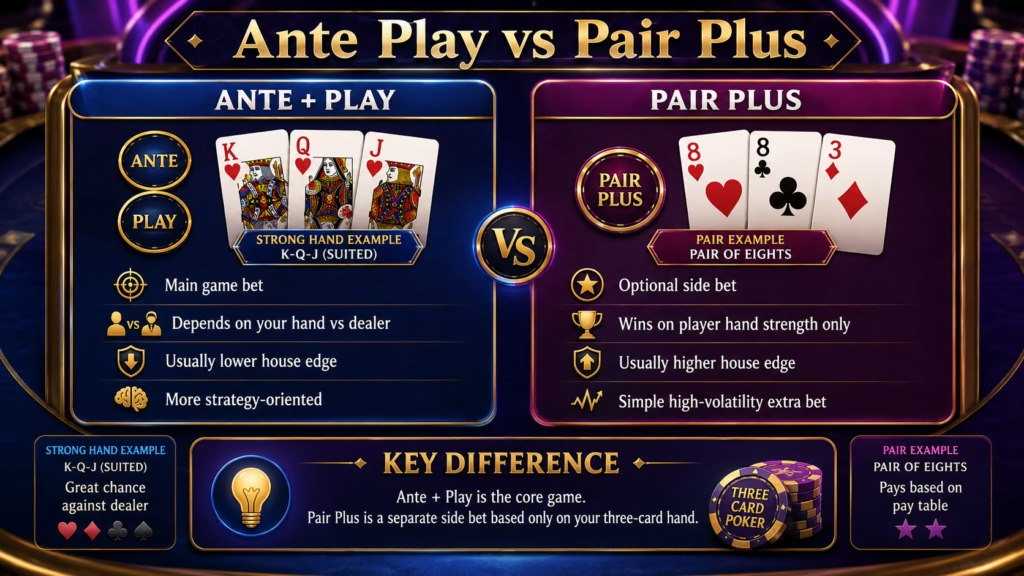
Pair Plus is a separate wager based only on the player’s three-card hand. It normally wins when the player receives at least a pair, with larger payouts for a flush, straight, three of a kind or straight flush. The dealer’s hand does not determine the strength of the player’s Pair Plus result.
There is no Q-6-4 decision for Pair Plus. Once the wager has been placed and the cards are dealt, its mathematical result is determined by the player’s hand and the applicable payout table.
The probability distribution also shows why most Pair Plus hands lose. Approximately 74.39% of three-card hands are below a pair, while a pair occurs about 16.94%, a flush about 4.96%, a straight about 3.26%, three of a kind about 0.24% and a straight flush about 0.22%.
Pair Plus therefore produces relatively infrequent winning combinations compared with the number of losing hands, with the larger payouts compensating for some of that frequency.
Pair Plus House Edge Depends on the Pay Table
The biggest mistake when evaluating Pair Plus is quoting one universal house-edge percentage. Pair Plus house edge changes when the casino changes even one payout.
Consider several analyzed payout schedules without a Mini Royal:
| Pair Plus payouts, Pair / Flush / Straight / Trips / Straight Flush | House Edge |
| 1 / 4 / 6 / 30 / 40 | 2.32% |
| 1 / 4 / 6 / 33 / 35 | 2.70% |
| 1 / 4 / 6 / 25 / 40 | 3.49% |
| 1 / 4 / 6 / 25 / 35 | 4.58% |
| 1 / 4 / 5 / 30 / 40 | 5.57% |
| 1 / 4 / 5 / 25 / 40 | 6.75% |
| 1 / 3 / 6 / 30 / 40 | 7.28% |
The difference between the first and last examples is substantial. Reducing the flush payout from 4:1 to 3:1 changes a 2.32% game into a 7.28% game when the remaining listed payouts are unchanged.
For that reason, players comparing Three Card Poker tables should read the posted Pair Plus payouts before deciding whether the side bet is worth including.
Three Card Poker Ante Play vs Pair Plus
Ante and Play is generally the better mathematical choice when comparing standard modern rules using expected loss relative to total money wagered. The reason is that Ante and Play has an element of risk of about 2.01%, while Pair Plus has no conditional second wager, so its element of risk is the same as its house edge.
| Feature | Ante and Play | Pair Plus |
| Main purpose | Beat the dealer | Make a pair or better |
| Player decision | Play or fold | None after betting |
| Basic strategy | Play Q-6-4 or better | No strategy decision |
| Standard quoted house edge | About 3.37% | Pay-table dependent |
| Element of risk | About 2.01% | Same as Pair Plus house edge |
| Payout sensitivity | Ante Bonus rules matter | Extremely sensitive to pay table |
| Variance | Moderate | Typically more payout-driven |
A full-pay Pair Plus game at 2.32% is relatively close to the 2.01% element of risk for Ante and Play. However, a Pair Plus table with a 6% or 7% house edge is considerably more expensive mathematically over repeated wagering.
Players who prefer simple dealer competition and want to minimize mathematical disadvantage should focus first on Ante and Play with correct strategy. Players who choose Pair Plus primarily for the chance of a larger payout should understand that they are often accepting more variance and, depending on the table, a substantially larger house advantage.
A Simple House Edge Example
Suppose a player makes 100 separate $10 Pair Plus wagers, creating $1,000 of total Pair Plus action.
With the full-pay 2.32% schedule, the theoretical long-run expected loss associated with that amount of action is approximately $23.20.
With a 7.28% Pair Plus schedule, the theoretical expected loss on the same $1,000 of wagering rises to approximately $72.80. The individual session could finish far above or below either figure because house edge is a long-run expectation, not a prediction for 100 hands.
For Ante and Play, a 3.37% house edge should be interpreted against the initial Ante amount, not as 3.37% of every dollar eventually placed on both Ante and Play. This is why the 2.01% element-of-risk figure is useful when comparing total betting exposure.
Common Three Card Poker House Edge Mistakes
Treating 2.01% and 3.37% as contradictory numbers
They measure different things. The 3.37% house edge measures expected loss against the original Ante, while the approximately 2.01% element of risk compares expected loss with average total wagering after conditional Play bets.
Assuming every Pair Plus table has a 2.32% edge
The 2.32% figure applies to the favorable 1-4-6-30-40 schedule. Other documented Pair Plus schedules range considerably higher, including 7.28% for a 1-3-6-30-40 table.
Playing every Ante hand
Always raising removes the benefit of the game’s one strategic decision. Under the standard analysis, playing blind increases the house edge to approximately 7.65%.
Increasing Pair Plus because it has bigger payouts
A 30:1 or 40:1 payout does not by itself indicate a favorable wager. The complete payout schedule and the probability of every possible hand determine the house edge.
Changing bets after wins or losses
Previous cards do not alter the mathematical house edge of the next properly randomized hand. Increasing wagers after losing hands can increase money at risk but does not eliminate the casino’s underlying advantage.
How to Choose a Better Three Card Poker Table
When comparing Three Card Poker games, check the rules and payout tables before placing money on the table.
For Ante and Play, confirm the dealer qualification rule and Ante Bonus schedule. The widely analyzed standard schedule pays 5:1 for a straight flush, 4:1 for three of a kind and 1:1 for a straight, producing the commonly quoted 3.37% house edge with optimal strategy. Alternative Ante Bonus schedules can change the figure.
For Pair Plus, examine all five important payouts rather than focusing only on the straight flush or three-of-a-kind prize. A reduction in a relatively frequent category such as the flush or straight can materially increase the house advantage.
If the rules differ from the standard version, the published house-edge figures should not automatically be assumed to apply. Regional variants, Mini Royal bonuses and alternative payout schedules can change the mathematics.
How This Information Was Reviewed
The comparison above uses established Three Card Poker rules, hand probabilities, payout schedules and mathematical analysis rather than short-term winning or losing results. The standard 3.37% Ante and Play figure assumes the common Ante Bonus schedule and correct Q-6-4 strategy, while Pair Plus figures must be matched to the exact pay table being offered.
Before playing, check the table rules or game information screen because casinos and online operators may offer different payouts or variants. House edge and RTP-style statistics describe theoretical long-run performance and cannot predict the result of a particular hand or session.
Three Card Poker should be treated as paid entertainment rather than a method of earning money. Set a spending and time limit before playing, never increase stakes to recover losses, and stop if gambling is no longer within the limits you intended.
FAQ
What is the house edge in Three Card Poker?
The standard Three Card Poker house edge for Ante and Play is approximately 3.37% when the common 5-4-1 Ante Bonus schedule is used and the player follows Q-6-4 basic strategy. The corresponding element of risk is approximately 2.01% because the Play wager is made only on hands the player continues.
Is 2.01% or 3.37% the correct Three Card Poker house edge?
Both figures can be correct, but they describe different measurements. The 3.37% house edge measures expected loss against the initial Ante wager. The 2.01% element of risk measures expected loss against the average total amount wagered, including conditional Play bets.
What is the house edge on Pair Plus?
Pair Plus house edge depends on the payout table. The 1-4-6-30-40 schedule has an edge of approximately 2.32%, while a 1-3-6-30-40 schedule has an edge of approximately 7.28%. Other documented schedules can produce different values.
Is Ante Play better than Pair Plus?
Ante and Play is usually the stronger mathematical choice when the comparison is based on total money at risk. Its standard element of risk is about 2.01%, whereas Pair Plus may carry an edge from roughly 2.32% to more than 7% depending on payouts.
What is the best strategy for Three Card Poker Ante Play?
The standard optimal strategy is to make the Play bet with Q-6-4 or better and fold lower hands. Using a looser or tighter decision rule changes the game’s expected return and generally increases the house advantage compared with optimal play.
Does Pair Plus require a strategy?
Pair Plus has no decision-based strategy after the cards are dealt. Its result depends on the player’s three-card hand and the posted payout schedule. The useful decision is therefore made before the deal by comparing the Pair Plus pay table with alternatives.
How often does Pair Plus produce a pair or better?
A player receives a pair or better on roughly 25.61% of three-card hands based on standard 52-card combination probabilities. About 74.39% of three-card hands are below a pair, which explains why Pair Plus needs elevated payouts for stronger hands.
Can a betting system reduce the Three Card Poker house edge?
Changing bet sizes after wins or losses does not remove the mathematical house edge. The main controllable factors are using the correct Q-6-4 decision on Ante and Play and selecting better payout schedules where alternatives are available. Individual hands remain random.
Does Three Card Poker house edge predict how much I will lose?
No. House edge is a long-run theoretical average, not a forecast for one session. A player can win or lose substantially more than the mathematical expectation over a short period because card outcomes vary. Gambling should therefore be played only with money set aside for entertainment.
Brief Conclusion
For standard Three Card Poker Ante Play, the key numbers are 3.37% house edge and approximately 2.01% element of risk when Q-6-4 basic strategy is used. Pair Plus is much more dependent on the pay table: a strong 1-4-6-30-40 schedule has a 2.32% edge, while the 1-3-6-30-40 version reaches about 7.28%.
For players focused on minimizing mathematical disadvantage, Ante and Play with correct strategy is generally the more defensible choice. Pair Plus should be evaluated separately by checking every posted payout before betting. Neither wager offers guaranteed wins, and Three Card Poker should be treated as entertainment rather than a source of income.