The Ultimate Texas Hold’em house edge is approximately 2.185% of the Ante bet when standard rules and mathematically optimal strategy are used. However, that percentage does not mean the casino keeps 2.185% of every dollar placed on the table. Because Ultimate Texas Hold’em requires an equal Blind bet and allows additional Play bets of up to four times the Ante, the more useful measure for comparing the game with other casino games is often its Element of Risk, approximately 0.526% of the average total amount wagered.
Quick facts
- House edge: about 2.185% relative to the Ante.
- Element of Risk: about 0.526% relative to all main-game money wagered on average.
- Average total wager: about 4.152 times the Ante under optimal play.
- Strategy matters: incorrect raise, check and fold decisions increase the mathematical disadvantage.
- Side bets are separate: Trips and progressive wagers have their own paytables and house edges.
Ultimate Texas Hold’em is most relevant to players who want a casino table game with meaningful decisions rather than a purely fixed betting sequence. The low Element of Risk can look attractive mathematically, but the game can still produce substantial short-term swings because individual hands may involve several units of betting.
What Is the Ultimate Texas Hold’em House Edge?
The Ultimate Texas Hold’em house edge is about 2.185% under optimal strategy, expressed relative to the initial Ante wager. The standard mathematical analysis assumes the usual structure in which the player makes equal Ante and Blind bets and can later make one Play bet.
This definition is important because Ultimate Texas Hold’em does not use a flat one-unit wager on every hand. Under standard rules, the player starts with one unit on the Ante and one unit on the Blind. Depending on the cards and previous decisions, the Play wager may later be 1x, 2x, 3x or 4x the Ante.
A 2.185% house edge therefore means that, over a very large number of hands played with optimal decisions, the theoretical expected loss is approximately 0.02185 units for every one unit of Ante. It does not mean that exactly 2.185% of the player’s total action is lost.
Example with a $10 Ante
Suppose the Ante is $10.
The theoretical expected loss is: $10 × 2.185% = $0.2185 per hand.
That is about 22 cents in long-run mathematical expectation, even though the player initially places $20 on the table because the $10 Ante must be accompanied by a $10 Blind.
Actual results over a session can be dramatically different. A player can win or lose many times the theoretical expectation because house edge describes a long-term average, not what should happen during the next hand or session.
What Is the Element of Risk in Ultimate Texas Hold’em?
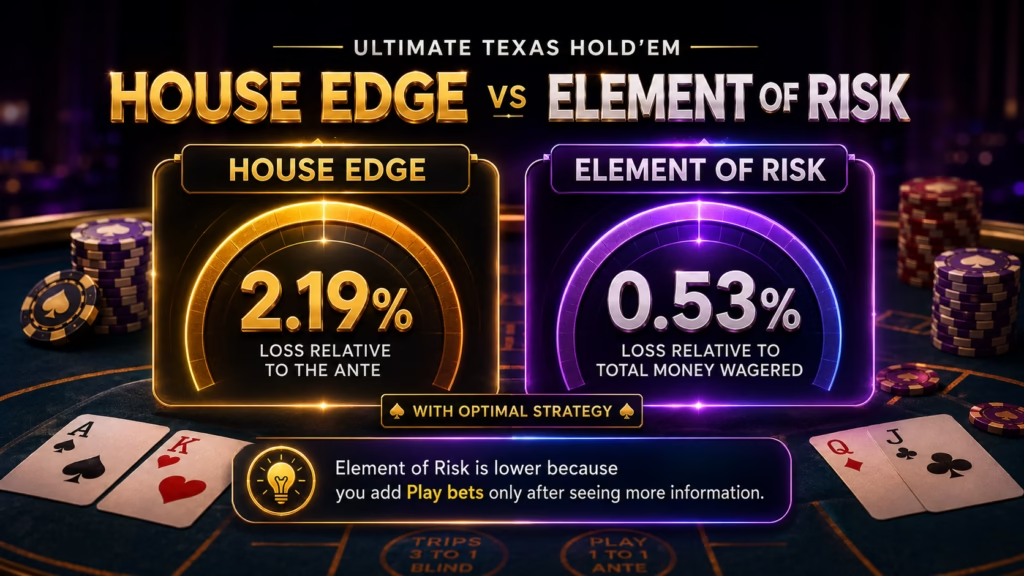
The Ultimate Texas Hold’em Element of Risk is approximately 0.526% under optimal strategy. Element of Risk measures expected loss against the average total amount of money actually wagered rather than only against the Ante.
This distinction makes Element of Risk particularly useful in Ultimate Texas Hold’em because the amount at risk changes from hand to hand.
Mathematical analysis gives an average total wager of approximately 4.152252 Ante units per completed hand. Dividing the 2.185% expected loss per Ante by 4.152252 gives an Element of Risk of approximately 0.526%.
The calculation is: 2.185% ÷ 4.152252 ≈ 0.526%.
Element of Risk answers a different question from conventional house edge. Instead of asking how much the casino theoretically earns relative to the Ante, it asks how much is theoretically lost relative to the total amount put into action.
House Edge vs Element of Risk
| Measure | Approximate value | Based on |
| House edge | 2.185% | Ante bet |
| Element of Risk | 0.526% | Average total main-game wagers |
| Average total wager | 4.152252 units | Ante + Blind + average Play action |
The 2.185% figure is not contradictory to the 0.526% figure. Both can be correct because they divide the expected loss by different amounts.
For example, with a $10 Ante, the average total amount placed into action is approximately: $10 × 4.152252 = $41.52.
The theoretical loss remains about $0.2185. Measured against the Ante, $0.2185 ÷ $10 = 2.185%. Measured against approximately $41.52 of total action, $0.2185 ÷ $41.52 ≈ 0.526%.
This is why comparing Ultimate Texas Hold’em with another casino game using only the headline 2.185% number can be misleading.
Why Ultimate Texas Hold’em Has So Much Average Action
Ultimate Texas Hold’em creates more betting action because the player begins with two mandatory wagers and can make a larger Play wager after seeing information about the hand.
Under standard rules, the player places equal Ante and Blind bets before the cards are dealt. After seeing the two hole cards, the player can check or raise 3x or 4x the Ante. If no Play wager has been made, a 2x raise becomes available after the flop. After all five community cards are exposed, a player who has not raised must either make a 1x Play bet or fold.
This structure is central to the mathematics of the game. Strong hands are often committed earlier with larger wagers, while weaker situations can be delayed until more information becomes available.
How the Dealer Qualification Rule Affects the Game
The standard dealer qualification rule requires the dealer to have at least a pair to open. Dealer qualification affects the Ante settlement, but it does not automatically determine whether the player wins the entire hand.
When the dealer does not qualify, the Ante pushes. The Play wager and Blind wager are still resolved according to the applicable rules and final hand result. Winning Ante and Play wagers normally pay even money, while the Blind uses a separate paytable for qualifying winning poker hands.
This is another reason Ultimate Texas Hold’em mathematics cannot be understood by treating it like ordinary player-versus-player Texas Hold’em.
The Blind Bet and Its Paytable
The Blind is a mandatory wager equal to the Ante, but winning Blind bets do not always pay even money.
Under a common standard paytable, a winning Blind starts paying at a straight and offers progressively larger payouts for stronger poker hands. A winning hand below a straight causes the Blind to push rather than generate an additional payout.
| Player hand | Blind payout |
| Royal flush | 500 to 1 |
| Straight flush | 50 to 1 |
| Four of a kind | 10 to 1 |
| Full house | 3 to 1 |
| Flush | 3 to 2 |
| Straight | 1 to 1 |
| Lower winning hand | Push |
Players should check the actual table rules before wagering because alternative rules, payout limits or game variants can change the mathematics.
How Strategy Changes the Ultimate Texas Hold’em House Edge
The quoted 2.185% Ultimate Texas Hold’em house edge assumes optimal decisions. The casino advantage increases when a player consistently raises, checks or folds at mathematically inferior points.
Ultimate Texas Hold’em differs from games such as baccarat because the player’s choices influence expected return. The player cannot control which cards appear, but can influence how much money is exposed after seeing available information.
A simplified strategy can come reasonably close to theoretical optimal play, but it still carries a higher disadvantage. One widely cited simplified strategy produces an estimated house edge of approximately 2.43%, compared with 2.185% for optimal play.
The practical lesson is not that strategy can turn Ultimate Texas Hold’em into a guaranteed winning game. Strategy reduces avoidable mathematical mistakes. Random cards and normal variance still determine individual outcomes.
Why the 4x Raise Is Important
The ability to make a 4x Play wager before the flop is one of the most important strategic features of standard Ultimate Texas Hold’em.
A common beginner mistake is assuming that betting four times the Ante must always be more dangerous than waiting for additional community cards. That logic ignores expected value. When the player’s starting cards are sufficiently strong, committing more money while the hand has favorable equity can be mathematically better than waiting and losing the opportunity to make the larger raise.
The opposite mistake is raising 4x too frequently because the larger wager appears to create more winning potential. Betting more does not improve the cards. The raise should be determined by hand strength and strategy rather than by a desire to recover losses or increase excitement.
Does a Low Element of Risk Make Ultimate Texas Hold’em a Good Bet?
A 0.526% Element of Risk indicates a relatively small theoretical loss compared with the average amount wagered under optimal play, but it does not make Ultimate Texas Hold’em low-risk in the everyday sense of the word.
Individual hands can require several Ante units, and poker-hand payouts create significant variance. A player betting a $25 Ante is not simply exposing $25 per hand. The mandatory Blind adds another $25, and a pre-flop 4x Play wager adds $100 more.
That means a single decision can place $150 of total action on the table from a $25 Ante.
Players choosing their stake should therefore base bankroll limits on the potential total hand exposure, not only on the printed Ante minimum.
House Edge Does Not Predict Session Results
The Ultimate Texas Hold’em house edge cannot predict whether a player will win or lose during a particular visit.
House edge is an expectation derived from a huge number of mathematically possible outcomes. Short sessions are dominated by variance. A player can run substantially above or below the theoretical expectation for dozens or hundreds of hands.
A lower house edge improves long-term mathematical conditions, but it does not produce smoother results, guarantee longer sessions or make a winning session more likely on demand.
This distinction is especially important when someone interprets a 0.526% Element of Risk as meaning that only about half a percent of a bankroll can be lost. That is incorrect. The percentage describes theoretical average loss relative to betting action over the long run, not the maximum or likely loss during one session.
What About the Trips Side Bet?
The Trips wager should be evaluated separately from the 2.185% main-game house edge and 0.526% Element of Risk.
Trips is an optional side bet based primarily on the poker value of the player’s final hand. Different Trips paytables are available, so the exact expected return depends on the version offered by the casino.
A player comparing Ultimate Texas Hold’em tables should therefore check at least three things:
- The Blind paytable.
- The Trips paytable, if the side bet will be used.
- Any maximum payout or special table rules.
Adding a side wager with a different house edge changes the overall economics of the money actually being bet, even though the mathematical edge of the main Ante, Blind and Play structure remains a separate calculation.
Common Misunderstandings About Ultimate Texas Hold’em Odds
“The casino takes 2.185% of every dollar I wager”
No. The 2.185% figure is calculated relative to the Ante. The Element of Risk, about 0.526%, expresses theoretical loss relative to average total main-game action.
“A 0.526% Element of Risk means I cannot lose much”
No. Element of Risk describes long-term expected loss, not short-term volatility or maximum exposure. Several Ante units may be placed on a single hand.
“Waiting for more cards is always safer”
Not mathematically. Strong starting hands can justify the larger early Play wager. Waiting may sacrifice a profitable 4x betting opportunity.
“Following strategy means I should eventually win”
No. Correct strategy minimizes the casino’s mathematical advantage under the analyzed rules. It does not eliminate the house edge or guarantee profitable results.
“Trips is included in the 0.526% figure”
No. Optional side wagers have separate payout schedules and expected returns and should be evaluated independently.
How to Evaluate an Ultimate Texas Hold’em Table
Before playing Ultimate Texas Hold’em, check the actual rules rather than assuming every table uses identical conditions. Approved versions of the game can be offered with permitted variations, so the displayed paytables and table rules matter.
Focus on:
- whether the standard 3x or 4x pre-flop Play option is available;
- the Blind paytable;
- the dealer qualification requirement;
- the available Trips paytable;
- table minimums and maximums;
- maximum payout restrictions;
- any additional progressive or side wagers.
The mathematical figures in this article apply to the commonly analyzed standard version. A materially different rule or payout schedule can change the expected return.

How This Information Was Reviewed
The Ultimate Texas Hold’em house-edge figures in this guide are based on mathematical analysis of the standard Ante, Blind and Play structure using optimal strategy. Standard rules include equal Ante and Blind wagers, one Play decision of up to 4x the Ante, a dealer qualification requirement of at least a pair and a separate Blind paytable.
Players should verify the rules and paytables displayed by the specific casino before playing because table variations and side bets can change the expected return.
House edge and Element of Risk are long-run mathematical statistics. Neither predicts the outcome of the next hand, and neither creates a guaranteed strategy for making money. Ultimate Texas Hold’em should be treated as entertainment, with stakes and session limits set before play.
FAQ
What is the house edge in Ultimate Texas Hold’em?
The Ultimate Texas Hold’em house edge is approximately 2.185% of the Ante under standard rules and optimal strategy. The figure uses the Ante as its denominator rather than the player’s complete betting action.
What is the Ultimate Texas Hold’em Element of Risk?
The Element of Risk is approximately 0.526% when optimal strategy is used. It compares theoretical expected loss with the average total amount wagered across the Ante, Blind and Play bets.
Why are the house edge and Element of Risk different?
The percentages use different denominators. The 2.185% house edge is measured against one Ante unit, while the 0.526% Element of Risk is measured against approximately 4.152252 units of average total wagering action.
What is the average amount wagered per hand?
Under optimal strategy, the average total main-game wager is approximately 4.152252 times the Ante. A $10 Ante therefore corresponds to about $41.52 of average total betting action per hand.
Does optimal strategy remove the casino advantage?
No. Optimal Ultimate Texas Hold’em strategy reduces the house edge to its analyzed minimum under the applicable rules, but the standard game still retains a mathematical casino advantage. Individual results remain random.
Does the Trips bet have the same house edge?
No. Trips is a separate optional wager with its own paytable and expected return. Players should check the Trips payout table offered at the specific casino before deciding whether to make the wager.
Is the 4x raise always better than waiting for the flop?
No. A 4x raise is mathematically appropriate only with qualifying starting hands under the strategy being used. Raising every hand increases unnecessary exposure, while failing to raise sufficiently strong hands can also reduce expected return.
Can Ultimate Texas Hold’em be profitable in the long run?
The standard casino game has a mathematical house advantage under normal rules, so optimal strategy does not create an expectation of guaranteed long-term profit. Winning sessions are possible because of normal variance, but gambling should not be treated as a reliable source of income.
Does a low Element of Risk mean Ultimate Texas Hold’em is safe?
No. A low Element of Risk describes expected loss relative to total wagering volume, not the amount that can be lost during a session. Because a single hand can involve several Ante units, players should choose stakes based on total potential exposure and set firm spending limits.
Brief Conclusion
Ultimate Texas Hold’em has an approximately 2.185% house edge relative to the Ante and a 0.526% Element of Risk relative to average total wagering under optimal play.
The 0.526% figure is usually more useful when comparing the game’s cost with other casino games because Ultimate Texas Hold’em generates about 4.152 times the Ante in average total action. Neither figure predicts short-term results. Strategy can reduce avoidable errors, but it cannot remove randomness or guarantee winnings.