
The keno house edge is not a single fixed percentage. It depends mainly on the game’s payout table, the number of spots selected, and the specific keno format. Two games can use the same classic 80-number board and draw 20 numbers, yet return very different percentages to players because they pay different amounts for the same catches.
Standard spot keno usually uses 80 numbers, with 20 numbers drawn, while the player selects a certain number of spots. Payouts then depend on how many selected numbers are caught.
Quick takeaways:
- Traditional live casino keno has historically carried a much larger house edge than many common table games.
- Video keno can offer substantially better mathematical returns than traditional live keno, but the exact paytable matters.
- The keno payout table is more important than the size of the jackpot alone.
- Choosing more numbers does not automatically improve or worsen the house edge.
- RTP and house edge describe long-term mathematical expectations, not what will happen during one session.
Keno is most likely to appeal to players who prefer simple number-selection games and do not want strategy-heavy decisions after a wager is placed. Players primarily concerned with maximizing theoretical return should examine the paytable carefully because some keno versions carry a substantial mathematical disadvantage.
What Is the House Edge in Keno?
The keno house edge is the percentage of all money wagered that the game is mathematically designed to retain over the long run.
House edge and Return to Player are complementary:
House Edge = 100% – RTP
For example, a keno game with an 88% theoretical RTP has a 12% house edge.
That does not mean a player who wagers $100 will necessarily lose exactly $12. RTP is measured across a very large number of plays. A short session may finish far above or below the theoretical return because individual draws remain random.
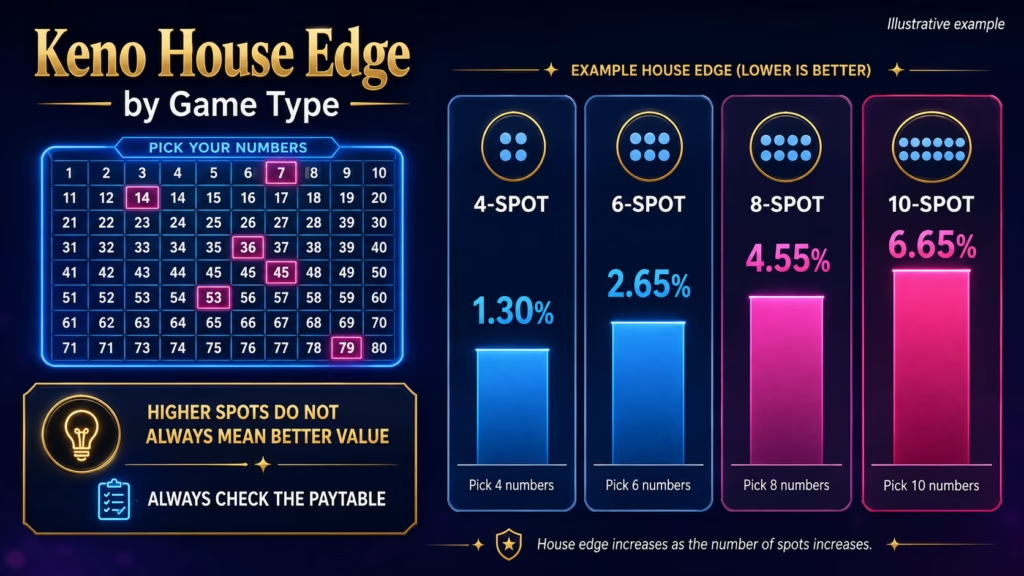
Keno House Edge by Game Type
Different keno formats can have dramatically different mathematical returns.
| Keno type | House edge tendency | What matters most |
| Traditional live casino keno | Often high | Casino paytable and number of spots |
| Video keno | Often lower than live keno | Machine paytable and selected game |
| Online RNG keno | Highly variable | Published RTP and paytable |
| Lottery-style keno | Can be very high | Official prize schedule |
| Special or bonus keno variants | Variable | Base payouts, multipliers, jackpots and extra wager cost |
Historical casino surveys illustrate how large the differences can be. Live-keno examples have produced returns between roughly 65% and 80%, equivalent to house edges between about 20% and 35%. Video-keno examples have produced returns from roughly 84% to 95%, equivalent to house edges from about 5% to 16%. These figures are examples from analyzed games, not a guaranteed range for every current keno game worldwide.
Traditional Live Keno
Traditional casino keno typically involves selecting numbers on a ticket and waiting for a centralized drawing. Its mathematical return has historically been relatively low compared with many electronic versions.
The important point is that live keno itself does not automatically have a particular house edge. The payout schedule determines how much value the casino returns for each possible result.
Historical live-keno examples have produced returns as low as about 65%, meaning a theoretical house edge near 35%.
For a player comparing live keno games, the correct question is therefore not simply “How many numbers can I pick?” It is “What does this game pay for each possible number of catches?”
Video Keno
Video keno uses similar underlying probabilities but displays the game electronically and can use a different payout structure.
Historical video-keno examples have offered considerably better returns than traditional live keno, with analyzed returns ranging from roughly 84% to 95% in some game sets. That corresponds to house edges of approximately 16% to 5%.
However, faster electronic play creates another practical consideration. A lower house edge per wager does not necessarily mean a lower total expected loss over an hour if substantially more wagers are placed.
Online Keno
Online keno should not be treated as one standardized game. Providers can use different spot limits, payout structures, jackpots and special mechanics.
Some online versions use the familiar 80-number board and 20-number draw but allow a wider range of selections than traditional spot keno. The practical rule is simple: check the published RTP or calculate the return from the actual keno payout table instead of assuming that all online keno has the same house edge.
Lottery-Style Keno
Lottery-operated keno can use the same recognizable 80-number and 20-number structure while offering a substantially different return.
A current lottery-style paytable can, for example, produce an implied RTP of around 50% on a 1-spot wager and around 60% on certain larger spot counts, meaning house edges near 50% or 40%. The exact figure depends on the official prize schedule in force.
The example demonstrates why the paytable must be examined before comparing one keno game with another.
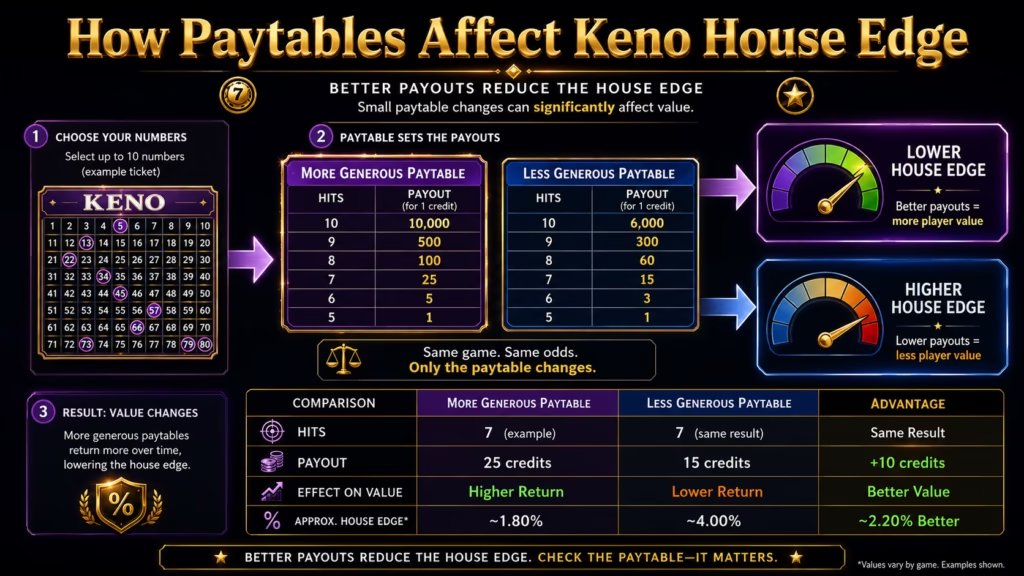
How the Keno Payout Table Changes the House Edge
The keno payout table determines how much each possible result contributes to expected return.
Consider two otherwise identical 5-spot games. Both use the same 80 numbers, both draw 20 numbers and both give the player exactly the same probability of catching five numbers. If one game pays 750 units for five catches while another pays 810, their RTPs will differ even though their winning probabilities are unchanged.
Real paytable comparisons show the effect clearly. One standard spot-keno paytable can produce returns around 84% to 86% across several spot selections, corresponding to house edges of roughly 14% to 16%. A more generous paytable can produce returns around 90% to 93%, corresponding to house edges of roughly 7% to 10%.
The probability model has not changed. The payouts changed, and the house edge changed with them.
Does Picking More Numbers Reduce the Keno House Edge?
Picking more spots does not automatically reduce the keno house edge.
Each spot count effectively has its own payout schedule. A casino may provide its most favorable return on 6 spots, while another paytable may favor 4 spots or 10 spots.
For example, an analyzed paytable can return about 90.2% on a 2-spot selection, about 90.9% on 7 spots and about 89.8% on 10 spots. Another paytable can reach about 92.7% on 6 spots while producing about 92.0% on 9 spots.
This means players should compare expected return by spot count, rather than assuming that selecting more or fewer numbers is mathematically superior.
How to Calculate House Edge From a Keno Paytable
For standard 80-number keno where 20 numbers are drawn, the probability of catching exactly c numbers after selecting p spots can be calculated with the hypergeometric distribution:
P(c catches) = C(20,c) × C(60,p-c) / C(80,p)
Once each outcome probability is known, multiply the probability by its payout:
Expected Return = Σ [Probability of Result × Payout for Result]
Then divide by the amount wagered if the payout figures are not already expressed per unit bet.
House Edge = 1 – Expected Return
If the expected return equals 0.925, the RTP is 92.5% and the house edge is 7.5%.
How to Compare Two Keno Paytables
A large jackpot should not be the only comparison point.
- RTP or calculated expected return. A higher theoretical return means a lower mathematical house edge.
- Payouts for common catches. Frequent smaller payouts can materially affect RTP.
- Payouts for zero catches. Some games pay for missing every selected number on larger spot tickets.
- Top-prize contribution. An enormous jackpot may account for only a small part of expected return because the required result is extremely rare.
- Spot-specific return. Compare the exact number of spots you intend to select.
- Extra wager cost. Multipliers, jackpots and bonus features may require another stake and therefore need their own expected-value calculation.
Optional features can alter either the wager, possible prizes or both. That means a bonus option should be evaluated as part of the full paytable rather than judged only by its advertised top prize.
Common Keno House Edge Myths
“Certain numbers improve the RTP”
Choosing one group of numbers instead of another does not change the mathematical probability of those numbers being drawn in a standard fair keno game.
The payout table and number of spots matter. The visual pattern of the selected numbers does not. Standard keno gives each number the same underlying chance of appearing in a draw.
“A higher jackpot means a better keno game”
A bigger maximum prize does not necessarily mean a higher RTP.
A paytable can advertise a very large jackpot while reducing payouts for more common results. Expected return depends on the value of every payout multiplied by its probability, not only the largest prize.
“A higher RTP means I should win more often”
RTP and hit frequency measure different things.
A game could return a higher percentage through relatively rare large prizes while another game pays smaller prizes more frequently. RTP describes long-term value, not how often an individual ticket wins.
“Keno becomes due after a losing streak”
Previous draws do not make specific numbers due in a properly operated independent game.
A losing sequence can continue, and a recent winning number can appear again. Mathematical house edge describes the long-run relationship between probabilities and payouts, not a mechanism that forces short sessions to move toward the theoretical average.
Practical Ways to Evaluate a Keno Game
The most useful decision a player can make before playing is to inspect the exact rules and paytable.
Where the RTP is displayed, compare it directly. Where only a paytable is available, calculate expected return or use a reliable keno calculator. Game information should clearly show the rules, available spot counts, wager requirements and prizes.
A lower house edge improves long-term mathematical value, but it does not create a profitable system or guarantee a winning session. Set a fixed spending limit before playing and treat keno as entertainment rather than an income source.
How This Information Was Reviewed
The keno house-edge comparisons in this guide are based on the underlying 80-number probability model, published payout structures, calculated expected returns and standard relationships between RTP and house edge.
Historical casino ranges are identified as examples rather than presented as universal current figures. Specific paytable examples are treated as examples because casinos, lotteries and online providers can use different payouts.
Before wagering, check the actual game’s current rules, RTP, stake requirements and prize table. RTP and house edge apply over large numbers of plays and cannot predict the result of an individual draw or session.
FAQ
What is the average house edge in keno?
There is no reliable single average house edge for all keno games. Historical live casino examples have produced house edges above 20%, while some video-keno paytables have produced much lower figures. The exact percentage should be calculated from the individual game’s payout table.
Why does keno usually have a high house edge?
Keno can have a high house edge because the payouts offered for successful catches are substantially below mathematically fair payouts. The probability of each result is fixed by the drawing rules, but the operator determines how much qualifying results pay.
What is a good keno house edge?
A lower house edge is mathematically preferable to a higher one. For example, an 8% house edge has better long-term expected value than a 15% house edge. That comparison does not imply that either game will produce a profit during a particular session.
Is video keno better than live keno?
Video keno can offer a lower house edge than traditional live keno, but this depends on the specific machine and paytable. Historical comparisons have found significantly higher returns on some video games than on analyzed live games.
Does choosing fewer keno numbers improve the odds?
Choosing fewer numbers changes the probability distribution but does not automatically improve the overall expected return. Each spot count can have a different house edge because each uses a different payout column.
Can the keno payout table tell me the RTP?
Yes. The RTP can be calculated by multiplying every possible payout by the probability of that result and adding the values together. House edge is then 100% minus the resulting RTP.
Does choosing lucky numbers reduce the house edge?
No. In standard fair keno, choosing birthdays, patterns, consecutive numbers or randomly generated numbers does not alter the game’s mathematical house edge. The paytable and spot count determine expected return.
Can a low-house-edge keno strategy guarantee a win?
No. Selecting a more favorable paytable can reduce the mathematical disadvantage, but it cannot guarantee a winning draw or profitable session. Keno outcomes remain random, and gambling should be treated as entertainment.
Brief Conclusion
The keno house edge is determined primarily by the payout table, not by the name “keno” itself. Traditional live keno, video keno, online games and lottery-style versions can produce very different theoretical returns even when they use similar 80-number rules.
Compare RTP whenever it is published. If it is not, examine the complete keno payout table and calculate expected return for the exact number of spots being played. A lower house edge gives better long-term mathematical value, but it does not predict or guarantee the result of any individual session.