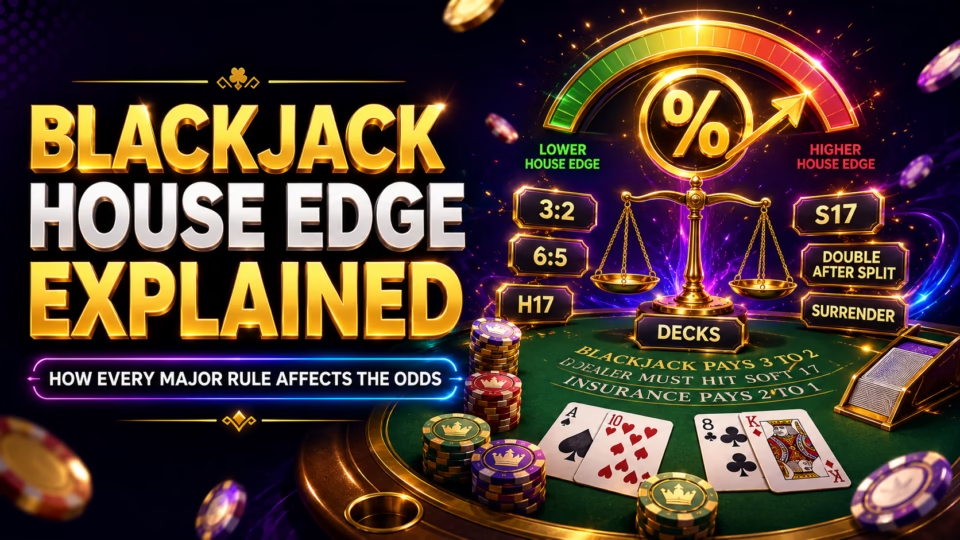
The blackjack house edge is the casino’s long-term mathematical advantage over the player, but unlike roulette or baccarat, blackjack does not have one fixed house edge. The percentage changes according to the table rules and the strategy used by the player.
A blackjack game with favorable rules and correct basic strategy can have a relatively low house edge, while seemingly small rule changes can make the same game significantly worse. Blackjack payout, dealer soft 17 rules, doubling restrictions, splitting rules, surrender, deck count, and the dealer’s hole-card procedure all affect the odds.
Quick takeaways
- 3:2 blackjack is substantially better than 6:5 blackjack.
- A dealer who stands on soft 17, or S17, is better for the player than a dealer who hits soft 17.
- Double after split, surrender, and resplitting options generally reduce the house edge.
- Fewer decks can improve the player’s theoretical return, but favorable deck count cannot compensate for a poor rule such as 6:5 blackjack.
- The advertised rules matter only if the player follows an appropriate basic strategy. Different rule combinations can require different decisions.
Players comparing blackjack tables should therefore examine the complete rules rather than choosing a game simply because it uses one or two decks.
What Is the House Edge in Blackjack?
The blackjack house edge measures the average expected loss relative to the player’s original wager over a very large number of hands. It is a long-term mathematical expectation, not a prediction of what will happen during one session.
For example, suppose a particular blackjack game has a theoretical house edge of 0.50% under correct basic strategy. Across $1,000 of initial wagers, the mathematical expectation would be a $5 loss. That does not mean a player will lose exactly $5. Actual short-term results can be much higher or lower because blackjack outcomes vary from hand to hand.
Blackjack is unusual because the player can increase the initial wager through doubling and splitting. Standard house-edge calculations normally use the original wager as the denominator rather than the final amount placed into action.
How Blackjack Rules Change the House Edge
Blackjack rules can move the mathematical advantage by fractions of a percentage point or, in the case of poor blackjack payouts, by more than one percentage point.
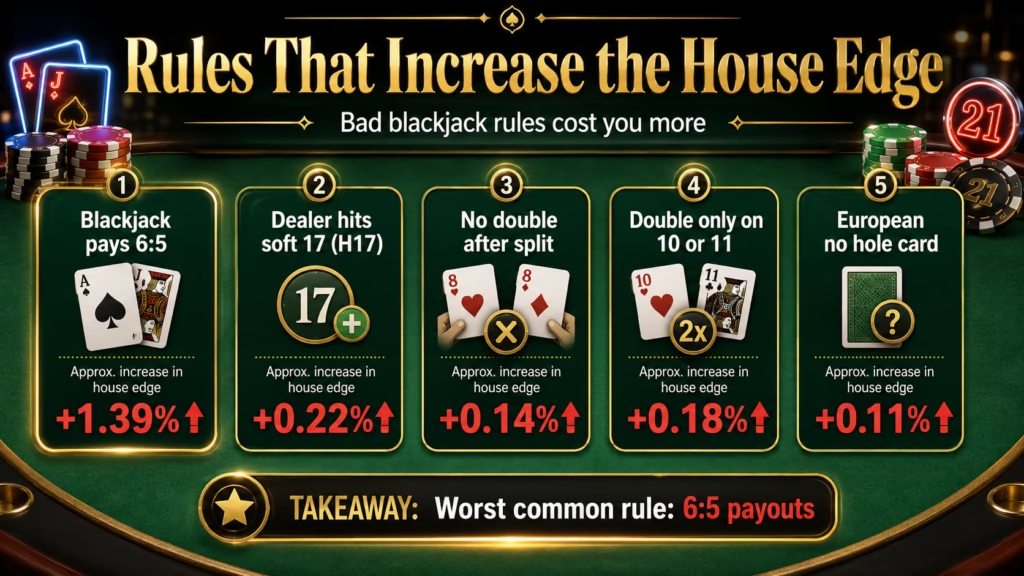
The approximate effects below show how common changes affect player expectation relative to a standard reference rule set. Exact results depend on the complete combination of rules and the strategy used.
| Rule change | Approximate effect on house edge |
| Blackjack pays 6:5 instead of 3:2 | +1.39 percentage points |
| Dealer hits soft 17 instead of standing | +0.22 |
| No double after split | +0.14 |
| Double only on 10 and 11 | +0.18 |
| European no-hole-card rule | About +0.11 |
| No resplitting | About +0.10 |
| Single deck instead of eight decks | About -0.48 |
| Double deck instead of eight decks | About -0.19 |
| Player may resplit aces | About -0.08 |
| Late surrender | Roughly -0.08 |
| Player may draw to split aces | About -0.19 |
These percentages should not simply be added to every blackjack game without qualification. Rule interactions can change basic strategy and expected value, which is why a full rule-set calculation produces a more accurate result than adding isolated adjustments.
3:2 vs 6:5 Blackjack Payout
Blackjack payout is one of the most important rules to check before sitting down at a table.
A traditional 3:2 payout returns $15 in winnings for a $10 natural blackjack. A 6:5 payout returns only $12.
Changing blackjack from 3:2 to 6:5 reduces player expectation by approximately 1.39 percentage points under a standard mathematical comparison. That difference is much larger than most other common blackjack rule variations.
A single-deck table may therefore look attractive, but if it pays only 6:5 for blackjack, the worse payout can more than eliminate the mathematical benefit associated with using fewer decks.
Practical rule: check the blackjack payout first. A 3:2 game is generally preferable to an otherwise similar 6:5 game.
Dealer Stands or Hits on Soft 17
A soft 17 is a hand totaling 17 with an ace counted as 11, such as Ace-6.
Blackjack tables normally describe the rule as:
- S17: dealer stands on all 17s.
- H17: dealer hits soft 17.
H17 is worse for the player. Compared with S17 under a standard reference rule set, allowing the dealer to hit soft 17 reduces player expectation by about 0.22 percentage points.
The difference looks small compared with 6:5 blackjack, but it matters when comparing two otherwise similar games. If two blackjack tables have the same payout and similar rules, S17 is generally the better choice.
How the Number of Decks Affects Blackjack House Edge
Fewer decks generally improve player expectation when the other rules remain identical.
Compared with an eight-deck reference game, the approximate improvement in player expectation is:
- 0.48 percentage points for single deck
- 0.19 for double deck
- 0.06 for four decks
- 0.02 for six decks
The problem is that casinos can pair a favorable deck count with unfavorable blackjack rules. For example, choosing a single-deck game solely because it uses one deck can be a mistake if that game pays 6:5 while a nearby six-deck game pays 3:2.
Compare the complete blackjack rules, not the number of decks alone.
Double Down Rules
Doubling allows the player to increase the wager when certain hands have favorable expected value, so restrictions on doubling generally benefit the casino.
A liberal blackjack game may allow doubling on any first two cards. More restrictive games might allow doubles only on:
- 9, 10, or 11
- 10 or 11
Restricting doubles to 9 through 11 costs roughly 0.09 percentage points of player expectation relative to unrestricted doubling in a standard comparison. Restricting doubles to only 10 and 11 costs roughly 0.18 percentage points.
The effect comes from removing profitable doubling opportunities that basic strategy would otherwise use.
Double After Split
Double after split, commonly abbreviated DAS, is a favorable blackjack rule.
Without DAS, the player cannot double a hand created after splitting a pair. Removing double after split reduces player expectation by approximately 0.14 percentage points under a standard comparison.
DAS is especially relevant because splitting can produce hands such as 10 or 11 where doubling may otherwise be mathematically attractive. When comparing similar tables, look for DAS allowed.
Resplitting and Resplitting Aces
Casinos also determine how many times a pair may be split. More flexible resplitting rules generally favor the player. Restricting the player from resplitting at all reduces expected return by roughly 0.10 percentage points in a standard reference analysis.
A separate rule concerns aces. Many blackjack games allow players to split aces but give only one additional card to each hand. A game that allows resplitting aces, RSA, is slightly more favorable. The approximate value of resplitting aces is about 0.08 percentage points under common reference rules.
Allowing players to continue drawing cards after splitting aces is even more favorable, although this rule is less common.
Surrender Rules
Surrender lets the player give up a poor starting hand and lose only half of the original wager rather than playing the hand to completion.
Late surrender
Late surrender occurs after the dealer has checked for blackjack where applicable. It provides a modest improvement in player expectation when used according to the correct strategy.
Early surrender
Early surrender occurs before the dealer checks for blackjack. It can be considerably more valuable because the player may surrender against powerful dealer upcards without first losing to a dealer blackjack.
Early surrender is much less common. Mathematical rule analysis shows that early surrender against a dealer ace or ten can provide substantially more player value than standard late surrender.
Surrender is useful only when applied correctly. Surrendering too many hands can erase the advantage provided by the rule.
Hole Card and European No-Hole-Card Rules
The way the dealer handles blackjack can affect what happens to additional wagers from doubles and splits.
Under many American-style blackjack rules, the dealer takes a hole card and checks for blackjack when showing an ace or ten-value card. If the dealer already has blackjack, the hand normally ends before the player can double or split.
Under European no-hole-card, ENHC, blackjack may not be determined until after players have completed their hands. Depending on the specific rules, additional wagers from doubles and splits can therefore be exposed to a dealer blackjack.
The standard ENHC variation reduces player expectation by about 0.11 percentage points in a common reference comparison. However, some games use alternatives such as Original Bets Only or related procedures that limit which additional wagers are lost. The exact dealer-blackjack rule should therefore be checked rather than assuming every no-hole-card game works identically.
Insurance and Even Money
Insurance does not improve the underlying blackjack rules. It is a separate wager offered when the dealer shows an ace.
For a player following conventional basic strategy without information from card counting, insurance is generally declined. Even money on a player blackjack is mathematically equivalent to taking insurance against the dealer having blackjack.
Players should also distinguish the house edge of the main blackjack wager from side bets offered at the same table. Side bets have their own probabilities and house edges and should not be treated as part of the base game’s advertised mathematical advantage.
Which Blackjack Rules Should You Look For?
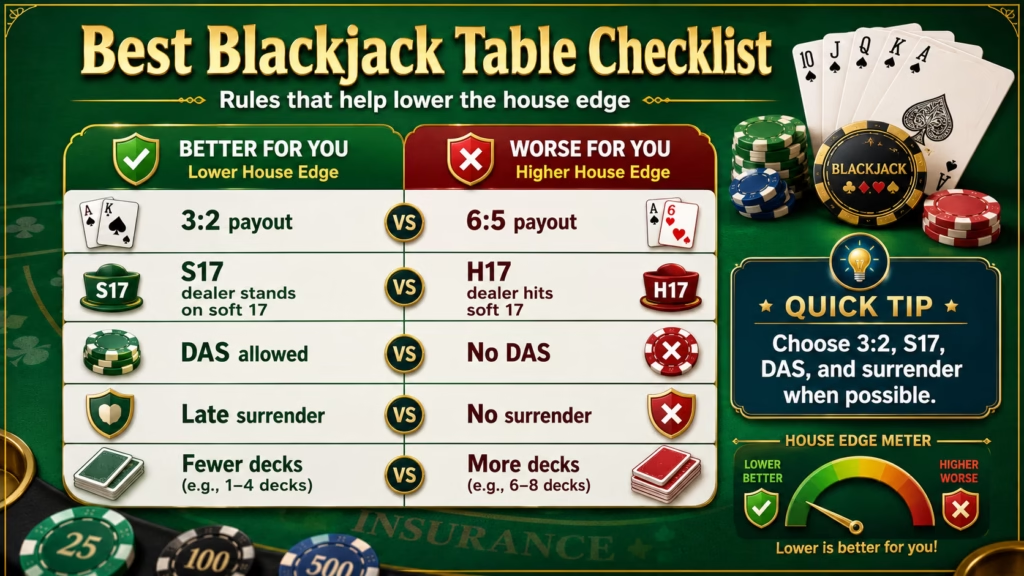
When comparing blackjack games, prioritize the rules in roughly this order:
- Choose 3:2 blackjack rather than 6:5.
- Prefer dealer stands on soft 17.
- Look for double on any first two cards.
- Prefer double after split allowed.
- Look for late surrender when available.
- Prefer generous splitting and resplitting ace rules.
- Compare deck count only after checking the more important rules.
- Check what happens to doubled and split wagers if the dealer has blackjack.
The payout rule deserves particular attention because the mathematical penalty from 6:5 blackjack is much larger than the difference created by most other common rules.
Good Rules vs Poor Rules
A player choosing between blackjack tables should evaluate the package rather than one attractive feature.
More player-friendly rule set
- Blackjack pays 3:2
- Dealer stands on soft 17
- Double on any first two cards
- Double after split
- Resplitting permitted
- Late surrender
- Favorable protection against losing additional bets to dealer blackjack
Less player-friendly rule set
- Blackjack pays 6:5
- Dealer hits soft 17
- Restricted doubling
- No double after split
- Limited splitting
- No surrender
- Rules that expose additional split or double wagers to dealer blackjack
The actual blackjack house edge still requires calculating the complete rule combination and using the corresponding basic strategy.
Does Basic Strategy Change the House Edge?
Yes. Blackjack house-edge figures normally assume optimal or near-optimal decisions.
Basic strategy determines whether the player should hit, stand, double, split, or surrender based on the player’s hand, the dealer’s upcard, and the applicable table rules. House-edge calculations based on correct strategy therefore do not represent a player who regularly makes mathematically poor decisions.
Strategy can also change when the rules change. An H17 game is not always played exactly like an S17 game, and deck count, surrender availability, doubling restrictions, and other rules can alter specific decisions. A basic-strategy chart should therefore match the blackjack game being played.
Common Blackjack House Edge Mistakes
Assuming every blackjack table has the same odds
Blackjack house edge varies by rule set. Two tables in the same casino can theoretically offer different expected returns.
Choosing single deck without checking the payout
Fewer decks can help, but 6:5 blackjack can make a single-deck game substantially less attractive.
Ignoring the soft 17 rule
H17 gives the dealer an additional opportunity to improve certain soft hands and increases the house edge compared with S17.
Looking only at the advertised house edge
An advertised low house edge normally assumes appropriate strategy. Player decisions still matter.
Treating house edge as a session prediction
A 0.5% house edge does not mean a player will lose 0.5% in every session. Short-term blackjack results can vary substantially around the long-term expectation.
How This Information Was Reviewed
The blackjack rules in this guide are evaluated by their effect on expected player return under appropriate basic strategy. The comparison considers deck count, payout, soft 17, doubling, splitting, surrender, and dealer-blackjack procedures.
Exact house edge should always be calculated from the complete rule set because individual rule effects are not guaranteed to combine perfectly in every game. Players should check the table rules or official game information before playing, particularly the blackjack payout, H17/S17 rule, doubling restrictions, surrender availability, and treatment of split or double bets against dealer blackjack.
House edge describes long-term expectation. It cannot predict the next hand or guarantee the outcome of a playing session. Blackjack should be treated as paid entertainment rather than a source of income, and players should decide their spending and time limits before gambling.
FAQ
What is the typical blackjack house edge?
Blackjack does not have one universal house edge. The percentage depends on the rules and the player’s decisions. Favorable rules combined with correct basic strategy can produce a comparatively low casino advantage, while poor payouts and restrictive rules can increase it substantially. A complete rule-set calculation is needed for an exact figure.
How much does 6:5 blackjack increase the house edge?
Changing the natural-blackjack payout from 3:2 to 6:5 increases the house advantage by about 1.39 percentage points under a standard reference comparison. This makes the payout one of the most important rules to check.
Is 3:2 blackjack always better than 6:5?
A 3:2 payout is more favorable than 6:5 when comparing that rule directly because a winning natural blackjack pays more. The complete game should still be evaluated because other rules also affect the final house edge.
Is S17 or H17 better for the player?
S17 is better for the player. When the dealer hits soft 17 instead of standing, the player’s expected return falls by approximately 0.22 percentage points under a standard reference rule set.
Does single-deck blackjack have a lower house edge?
Single-deck blackjack can have a lower house edge when all other rules remain equal. In a standard rule comparison, single deck improves player expectation by about 0.48 percentage points compared with eight decks. However, a 6:5 payout or other restrictive rules can easily outweigh that advantage.
Does basic strategy eliminate the blackjack house edge?
No. Basic strategy is designed to make mathematically efficient decisions under a particular rule set, but it does not guarantee profit or remove normal variance. Most house-edge figures already assume correct or near-correct strategy.
Does double after split matter?
Yes. Allowing double after split improves player expectation because it preserves profitable doubling opportunities after a pair has been separated. Removing DAS increases the house advantage by roughly 0.14 percentage points in a standard comparison.
Is surrender a good blackjack rule?
Surrender is generally favorable when used according to the correct strategy because it allows the player to abandon selected poor hands for half the original wager. Late surrender provides a modest benefit, while early surrender can be considerably more valuable but is less commonly offered.
Can the blackjack house edge predict how much I will lose?
No. House edge is a long-term statistical expectation, not a prediction for an individual session. A player may win or lose much more than the theoretical percentage over a small number of hands. Outcomes remain uncertain, so bankroll and time limits should be set before playing.
Brief Conclusion
The blackjack house edge depends heavily on the rules. The most important rule to check is usually the blackjack payout, with 3:2 substantially preferable to 6:5. S17, double after split, flexible doubling, surrender, generous splitting rules, and fewer decks can also improve player expectation.
Do not judge a blackjack table by one rule alone. Compare the complete rule set, use a matching basic strategy, and remember that even a mathematically favorable blackjack game still involves random outcomes and a long-term casino advantage under most standard conditions.