No KYC casinos can be reasonably safe to use, but the absence of identity verification does not make a casino trustworthy. The main safety factors are the operator behind the site, its regulatory status, withdrawal rules, account security, payment handling, game integrity and responsible gambling protections.
A casino advertised as “No KYC” also does not necessarily mean that identification will never be requested. Some operators allow registration, deposits or limited play without documents but reserve the right to request identity, source-of-funds or payment verification when certain conditions are triggered.
Quick answer:
- No KYC does not automatically mean unsafe.
- “No verification” does not always mean verification will never occur.
- A verifiable gaming licence is a much stronger safety signal than a No KYC claim.
- Withdrawal rules deserve particular attention because verification may be triggered before funds are released.
- Crypto payments can increase privacy, but blockchain transactions are generally irreversible.
- Provably fair games can help verify individual game results, but they do not prove that the casino itself is trustworthy.
No KYC casinos are usually most appealing to players who prioritize faster registration, privacy or cryptocurrency payments. Players who want stronger regulatory protection, conventional payment methods or clearly defined dispute procedures may prefer casinos operating under stricter identity-verification frameworks.
What Is a No KYC Casino?
A No KYC casino is an online casino that requires little or no identity verification during at least part of the customer journey. KYC stands for “Know Your Customer,” the process businesses use to establish a customer’s identity and, in some situations, obtain additional information about payment sources or financial activity.
The term is used inconsistently across the casino industry. One operator may require only an email address and crypto wallet, while another may allow deposits without documents but require verification before a large withdrawal.
For that reason, players should distinguish between no upfront KYC and no KYC under any circumstances. The second claim deserves much more scrutiny.
In strongly regulated markets, identity verification may be mandatory. For example, operators licensed for remote gambling in Great Britain must obtain and verify customer identity information before permitting gambling.
A casino serving players worldwide may operate under a different regulatory framework, so verification requirements depend partly on the licence, jurisdiction and operator policies.
Are No KYC Casinos Safe?
Some No KYC casinos may offer legitimate gambling services, but safety must be evaluated independently of their verification policy.
A safer operator should provide enough information for a player to determine who runs the casino, where it is licensed, what withdrawal restrictions apply, how disputes are handled and which responsible gambling tools are available.
A site becomes significantly harder to trust when the operator is anonymous, the claimed licence cannot be verified, withdrawal conditions are vague or the casino can request documents under undefined circumstances.
The most useful question is therefore not simply “Are No KYC casinos safe?” It is: “What protections still exist when traditional identity verification is reduced?”
1. Verify the Casino Licence Independently
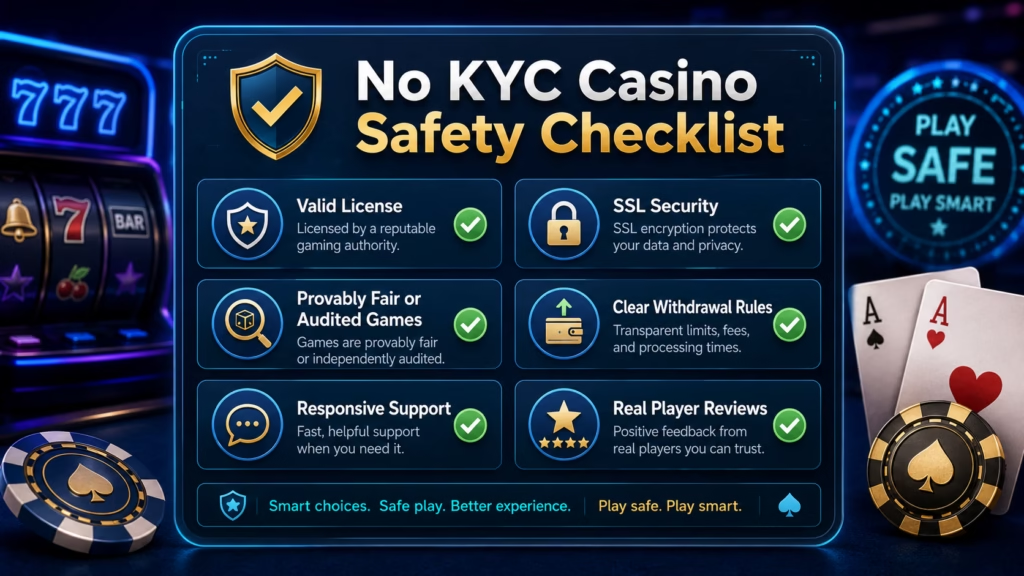
A gaming licence is one of the strongest checks available, but a licence logo displayed in a website footer is not enough.
Players should verify the operator or domain directly through the regulator’s own register whenever possible.
Some established regulators provide searchable public registers where users can check licensees, authorization status and approved website domains. This matters because fake licensing claims and copied regulator branding can occur.
Curaçao has also changed its online-gambling regulatory framework, with the Curaçao Gaming Authority responsible for online-gaming licensing and supervision under the newer framework.
For regulated sites, players should confirm not only the operator’s licence but also whether the specific player-facing domain is properly authorized when the regulator provides domain-level information.
Important safety check
Never assume a casino is regulated because its footer contains a regulator’s logo, licence number or certification seal. Open the regulator’s official website independently and confirm that the casino domain matches the authorized operator.
2. Read the Withdrawal and Verification Rules Before Depositing
Withdrawal conditions are particularly important at No KYC casinos because some sites provide simplified registration but retain broad rights to verify players later.
Check the terms for phrases such as:
- identity verification;
- enhanced due diligence;
- source of funds;
- proof of address;
- payment ownership verification;
- suspicious activity;
- cumulative withdrawal thresholds;
- bonus verification;
- additional security checks.
A legitimate risk-based verification process is not necessarily a red flag. Casinos may have legal or anti-money-laundering obligations that require additional checks.
The concern is unexpected or undefined verification. If a casino markets itself as completely anonymous while its terms allow unrestricted document demands whenever a withdrawal is requested, the marketing claim does not accurately describe the real customer experience.
A useful rule is simple: assume the written terms control the account, not the advertising headline.
3. Check Who Actually Operates the Casino
A trustworthy casino should make the legal operator reasonably easy to identify.
Look for:
- company name;
- licensing jurisdiction;
- licence or authorization number;
- registered business information where provided;
- terms and conditions;
- privacy policy;
- complaints or dispute procedure;
- responsible gambling information.
An anonymous casino with an unverifiable company, no licensing information and no meaningful dispute process provides much less recourse if something goes wrong.
No KYC should mean reduced customer identification, not reduced operator transparency.
4. Examine Withdrawal Limits and Processing Conditions
A casino can offer instant registration and still create problems at withdrawal.
Before depositing, check:
| Safety check | Better sign | Warning sign |
| Withdrawal limits | Clearly stated limits | Limits hidden or difficult to find |
| Verification | Specific circumstances explained | “Documents may be requested at any time” with no context |
| Fees | Published fee rules | Undisclosed withdrawal charges |
| Processing | Defined procedure | No meaningful withdrawal information |
| Account closure | Rules explain what happens to funds | Casino claims broad rights to confiscate balances |
| Bonus withdrawals | Wagering and restrictions are explicit | Key restrictions appear only after claiming a bonus |
Terms may differ considerably between operators, currencies and payment methods, so these conditions should be checked on the casino itself before money is deposited.
5. Understand the Risks of Crypto Payments
Many No KYC casinos use Bitcoin, Ethereum, stablecoins or other cryptocurrencies because crypto transfers can work without sharing conventional banking information directly with the casino.
Crypto does not make a casino safe by itself.
Blockchain payments are generally difficult or impossible to reverse after confirmation. If funds are sent to the wrong address or to an unreliable operator, a card-style chargeback mechanism usually does not exist.
Players should therefore verify:
- the correct blockchain network;
- minimum deposit requirements;
- required confirmations;
- deposit and withdrawal fees;
- supported currencies;
- minimum withdrawal amount;
- whether withdrawals must return through a particular method.
Privacy should also not be confused with complete anonymity. Public blockchains can preserve transaction histories even when personal identity is not directly attached to every wallet address.
6. Look at Game Integrity Separately From Casino Safety
Game fairness and operator reliability are related but separate issues.
Established game-provider software, independent testing arrangements where applicable and transparent game rules can improve confidence in game integrity.
Some crypto casinos also offer provably fair games. A provably fair system can allow players to verify cryptographic information connected with a game outcome.
However, provably fair technology does not prove that:
- withdrawals will always be processed;
- the operator is financially stable;
- bonuses are fair;
- customer support will resolve disputes;
- personal information will be protected;
- the casino is properly licensed.
Provably fair technology verifies a narrow part of the gambling process. It should never replace the broader casino safety checks.
7. Check Account and Website Security
Even a casino with limited KYC may still hold valuable information such as email addresses, wallet addresses, account balances and transaction histories.
Basic security features therefore remain important.
Prefer casinos that offer:
- HTTPS encryption;
- strong password requirements;
- two-factor authentication where available;
- withdrawal confirmation or address security;
- login alerts or session controls;
- clear privacy and account-security information.
HTTPS alone is not proof that a casino is legitimate. Almost any website can obtain an encryption certificate. It protects the connection rather than certifying the business behind the website.
8. Look for Responsible Gambling Protections
Reduced identity verification should not mean reduced gambling controls.
Useful protections can include deposit limits, loss limits, session controls, cooling-off periods and self-exclusion options.
Established regulatory frameworks may require licensed operators to provide responsible gambling information and safer gambling tools. Gambling should be treated as entertainment rather than a way of generating income.
A No KYC casino that makes deposits exceptionally easy while providing almost no way to limit or stop gambling deserves greater caution.
No KYC Casino Red Flags
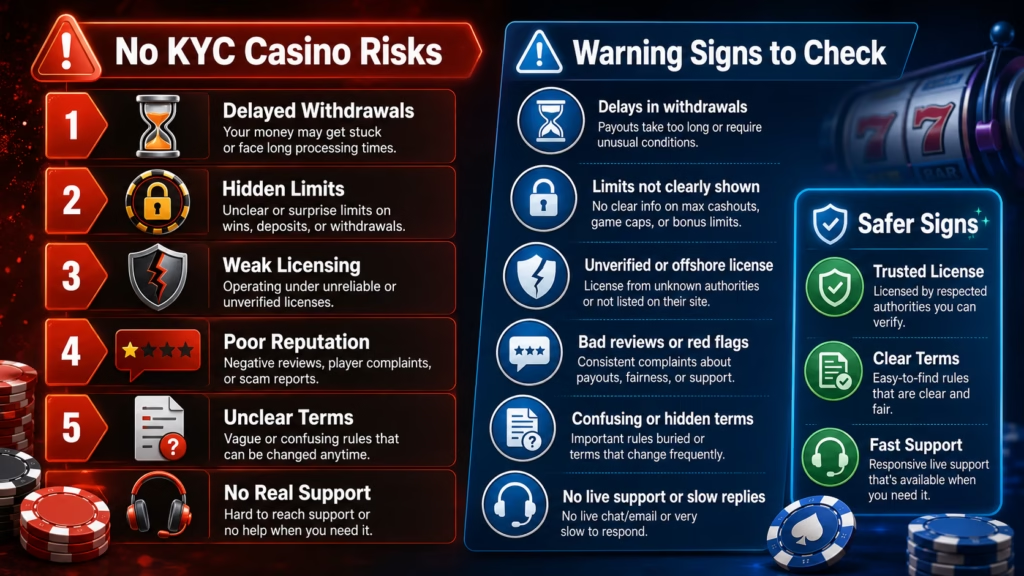
Several warning signs become particularly important when considering a no-verification casino:
- The claimed licence cannot be found on the regulator’s website.
- The casino hides the legal company operating the site.
- Withdrawal rules are missing or unusually vague.
- The site claims “zero KYC forever” while its terms contain broad verification powers.
- Bonus conditions make withdrawals difficult to understand.
- The casino gives no meaningful information about complaints or disputes.
- Support avoids answering basic questions about withdrawals or verification.
- The operator promises guaranteed profits, guaranteed wins or risk-free gambling.
- Responsible gambling tools are absent or difficult to find.
- The casino pressures players to make larger or repeated deposits.
One warning sign does not automatically prove fraud, but multiple unresolved red flags are a strong reason not to deposit.
No KYC Casinos vs Regular KYC Casinos
The biggest difference is usually the balance between privacy, convenience and regulatory oversight.
| Feature | No KYC Casino | Traditional KYC Casino |
| Registration | Often faster | Usually more identity information |
| Documents | May not be required initially | Commonly required |
| Privacy | Potentially greater | More personal information collected |
| Crypto support | Often common | Varies |
| Later verification | Still possible | Expected |
| Regulatory protection | Varies significantly | Depends on jurisdiction and licence |
| Dispute options | May be limited | Often clearer under stricter regulators |
Neither format is automatically superior in every situation. A traditional KYC casino can still have poor terms, and a reduced-KYC casino can still operate transparently.
The real difference is that players considering a No KYC casino should perform more of the trust assessment themselves.
How to Choose a Safer No KYC Casino
Before depositing, perform the following checks in order:
1. Verify the licence
Use the regulator’s website rather than trusting the casino footer.
2. Match the domain
Confirm that the exact website being used is connected to the licensed operator where the regulator provides domain-level information.
3. Read the KYC policy
Determine when documents can be requested and whether verification may affect withdrawals.
4. Read withdrawal terms
Check limits, fees, processing rules and restrictions before depositing.
5. Review bonus conditions separately
Bonuses can introduce wagering requirements, game restrictions, maximum bets and withdrawal rules that do not apply to ordinary cash balances.
6. Check security controls
Two-factor authentication and withdrawal protection are useful, especially for crypto balances.
7. Confirm responsible gambling tools
Set limits before playing rather than after losses occur.
8. Start cautiously
Using a smaller amount can reduce exposure while you learn how the operator handles deposits, account controls and withdrawals. It does not remove gambling risk or guarantee that future withdrawals will be processed identically.
Are No Verification Casinos Safer for Privacy?
No verification casinos may collect less identity documentation at registration, which can reduce the amount of sensitive personal data initially provided to the operator.
That privacy advantage has limits.
A casino may still collect an email address, IP information, device data, wallet addresses, transaction histories and other account information. It may also request identity documents later if required by its terms or regulatory obligations.
Players looking primarily for privacy should therefore read both the KYC policy and privacy policy rather than assuming “No KYC” means no personal information is collected.
Does No KYC Mean a Casino Is Unregulated?
No. Reduced KYC and regulation are separate concepts.
Some operators may work under jurisdictions that permit different risk-based verification procedures, while others may operate without meaningful regulatory oversight.
The opposite is also true. In jurisdictions with strict identity requirements, a legitimately licensed operator may be unable to offer genuine no-verification gambling. Great Britain, for example, requires remote licensees to verify customer identity before gambling.
This is why a No KYC claim should always be considered together with the casino’s jurisdiction.
The Biggest Misconception About No KYC Casinos
The biggest misconception is that No KYC means both anonymity and instant unrestricted withdrawals.
Those are separate issues.
A casino may allow quick registration but apply transaction limits. It may accept crypto without documents but later trigger enhanced checks. It may permit anonymous-style account creation while recording blockchain, device or network information.
A better way to evaluate a casino is to ask exactly what information is required, when it can be requested and what happens if verification cannot be completed.
How This Information Was Reviewed
The safety assessment in this guide is based on practical criteria that can be checked before depositing: regulatory status, operator identity, verification rules, withdrawal conditions, payment risks, account security, game transparency and responsible gambling protections.
Licensing claims should always be checked directly with the relevant regulator because licences, domains and regulatory statuses can change. Casino terms, withdrawal limits, KYC triggers, cryptocurrency support and bonus conditions can also change and should be checked on the operator’s current website.
No licensing system, security feature or verification policy can remove the financial risk of gambling. Casino games should be treated as entertainment rather than a source of income, and individual game results remain uncertain. Set spending limits before playing and avoid gambling with money needed for essential expenses.
FAQ
Are No KYC casinos safe to use?
No KYC casinos can be reasonably safe when the operator is transparent, properly regulated where applicable, has clear withdrawal rules and provides adequate security and player-protection measures. The No KYC label itself is not evidence of safety.
Are no verification casinos safe with cryptocurrency?
A no-verification crypto casino can have legitimate security controls, but cryptocurrency adds specific risks because transactions are generally irreversible. Verify the operator, wallet address, blockchain network, withdrawal terms and account-security options before transferring funds.
Can a No KYC casino ask for ID later?
Yes. Some No KYC casinos can request identity or financial information later when specific risk, withdrawal, regulatory or anti-money-laundering conditions arise. Read the verification policy before depositing rather than assuming documents can never be requested.
Why would a No KYC casino require verification for a withdrawal?
A casino may need additional information because of legal obligations, security concerns, payment ownership checks or unusual transaction activity. The exact circumstances depend on the operator and jurisdiction. What matters is whether those circumstances are clearly explained in the terms rather than introduced unexpectedly.
Is a licensed No KYC casino automatically safe?
No. Licensing can provide meaningful regulatory oversight, but it is not an absolute guarantee against disputes, technical problems or poor customer experience. Confirm the licence directly with the regulator and examine withdrawal, verification and responsible gambling rules separately.
Are No KYC casinos anonymous?
Not necessarily. A casino may avoid requesting conventional identity documents while still recording wallet addresses, IP information, device information, account activity and transaction data. Its privacy policy should explain what information is collected.
Are provably fair casinos safe?
Provably fair technology can help verify whether certain game outcomes were generated according to the disclosed cryptographic process, but it does not verify the operator’s financial reliability, licensing, withdrawal practices or customer support. Casino safety requires broader checks.
What is the safest way to check a No KYC casino?
Start by verifying the operator and exact domain through the regulator’s official register. Then review KYC triggers, withdrawal terms, security controls, bonus conditions and responsible gambling tools before depositing.
Should I choose No KYC or a regular casino?
Choose based on the protections you value. No KYC casinos may appeal to players who prioritize privacy and faster registration, while conventional regulated casinos may provide clearer identity controls and dispute procedures. Neither model removes gambling risk.
Short Conclusion
No KYC casinos are not automatically safe or unsafe. The strongest safety signals are a verifiable operator and licence, transparent withdrawal and verification rules, secure payment and account controls, clear game information and meaningful responsible gambling protections.
Treat “No KYC” as a description of the verification process, not as proof of trustworthiness. Check the operator before depositing, understand when verification can still occur and gamble only with money you can afford to lose.