Blockchain analytics at No KYC casinos allows an operator to assess the risk of cryptocurrency deposits and withdrawals without necessarily asking every player for identity documents. Instead of starting with a passport or proof of address, the casino can analyze the blockchain history of a wallet, its connections to known entities, and the path that funds followed before reaching the casino.
This distinction matters because No KYC does not automatically mean no AML checks or no blockchain screening. A casino may allow registration and routine play without traditional identity verification while still using crypto casino blockchain screening to detect sanctions exposure, stolen funds, scams, darknet activity, or other risk indicators.
Key points:
- Blockchain analytics examines wallet addresses and transaction history rather than only personal identity.
- A No KYC casino may screen a wallet before accepting a deposit or processing a withdrawal.
- Risk scoring can consider both direct and indirect connections to high-risk addresses.
- A flagged transaction can trigger manual review, additional questions, or identity verification.
- Blockchain analytics cannot automatically identify every wallet owner by legal name.
For crypto players, the practical issue is simple: a casino that advertises “No KYC” may still know considerably more about the history of deposited cryptocurrency than the registration process suggests.
What Is Blockchain Analytics at a No KYC Casino?
Blockchain analytics is the process of examining public blockchain data to identify transaction relationships, wallet activity, and potential financial crime risks.
Public blockchains such as Bitcoin and Ethereum maintain transaction records that can be analyzed. Specialized blockchain intelligence platforms combine this on-chain information with databases that label addresses associated with exchanges, payment processors, scams, hacks, sanctions, darknet markets, mixers, and other entities.
Wallet screening tools can then produce a risk assessment for an address. Chainalysis describes wallet screening as checking an address against blockchain risk data and evaluating direct and indirect exposure to potentially illicit activity.
This means blockchain analytics and KYC are not the same process.
Traditional KYC asks:
- Who are you?
- What is your legal name?
- Where do you live?
- Can you provide identification?
Blockchain analytics asks:
- Where did these crypto assets come from?
- Which wallets have interacted with this address?
- Are there known high-risk entities in the transaction history?
- Does the transaction meet the casino’s risk rules?
A casino can therefore perform blockchain screening even when it has not collected a player’s passport.
How Crypto Casino Blockchain Screening Works
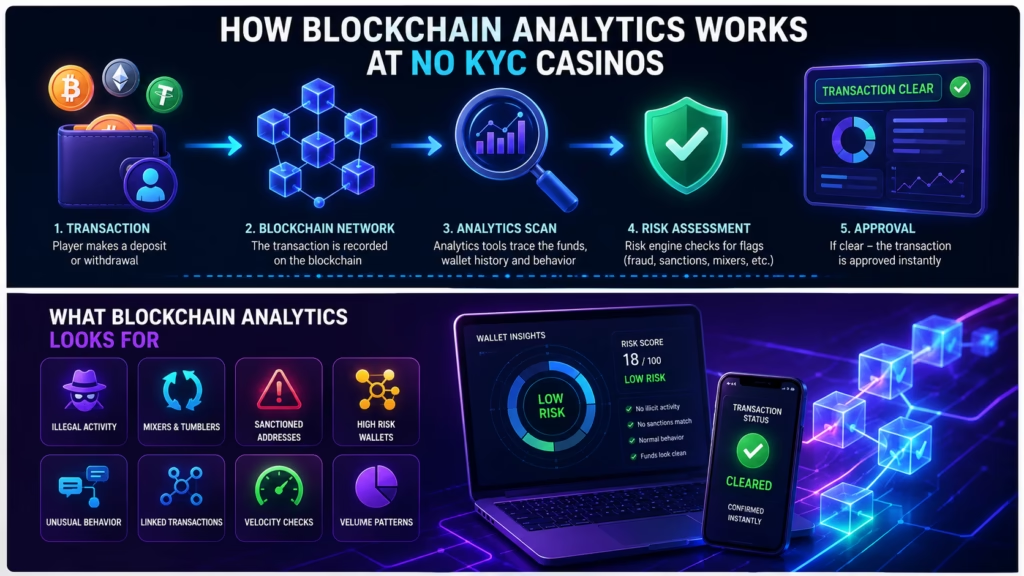
A typical crypto casino blockchain screening process can be divided into several stages.
1. The Casino Receives a Wallet Address or Transaction
When cryptocurrency is deposited, the operator can see the sending transaction and associated blockchain addresses.
The casino does not need the player’s identity to analyze this information because transaction data on most public blockchains is visible on-chain.
The same principle can apply when a player requests a withdrawal. A casino may evaluate the destination address before releasing cryptocurrency.

2. Blockchain Analytics Identifies Known Address Relationships
Blockchain intelligence platforms maintain large databases of addresses and address clusters associated with known entities.
An address might be associated with:
- cryptocurrency exchanges;
- payment processors;
- gambling services;
- sanctioned entities;
- scams;
- stolen funds;
- darknet markets;
- ransomware;
- mixers or other obfuscation services.
Attribution is not perfect. Some addresses can be confidently linked to known services, while others remain unidentified or are classified only according to transaction behavior.
3. Direct and Indirect Exposure Is Analyzed
Blockchain analytics does not necessarily stop at the wallet that directly sent cryptocurrency to the casino.
Screening systems may analyze previous transaction connections.
For example, consider this simplified flow:
High-risk address → Wallet A → Wallet B → Casino
Wallet B did not transact directly with the original high-risk address, but blockchain analytics can potentially detect the earlier connection.
Chainalysis specifically describes wallet screening as considering both direct and indirect exposure when calculating address risk.
The significance of indirect exposure depends on factors such as transaction distance, value, type of risk, and the operator’s own compliance rules.
4. The Wallet Receives a Risk Assessment
The screening platform can assign categories, alerts, or a risk score to the wallet.
A risk score should not be interpreted as a universal blockchain reputation number. Different analytics providers and casino operators can use different data sources, thresholds, classifications, and risk policies.
TRM Labs, for example, describes wallet screening as evaluating ownership, counterparty, and indirect exposure while allowing businesses to configure their own risk tolerance.
Therefore, a wallet accepted by one operator is not guaranteed to receive the same assessment elsewhere.
5. The Casino Decides What to Do
Blockchain analytics usually supports a decision rather than making every decision automatically.
Depending on the casino’s policies, a transaction might be:
- accepted normally;
- sent for manual review;
- delayed while additional checks are completed;
- rejected;
- subject to enhanced due diligence;
- followed by a request for identity or source-of-funds information.
The exact thresholds are normally operator-specific and may not be publicly disclosed.
Blockchain Analytics vs KYC
Blockchain analytics and KYC solve different compliance problems.
| Control | Main Question | Identity Documents Required? |
| Wallet screening | Is this blockchain address associated with elevated risk? | Usually not for the initial address check |
| Transaction monitoring | Does the movement of funds show suspicious patterns? | Not necessarily |
| KYC | Who is the customer? | Yes |
| Source-of-funds review | Where did the money originate? | Documentation may be required |
| Sanctions screening | Is the transaction connected to sanctioned persons, entities, or addresses? | Can begin with blockchain data, but further checks may follow |
A No KYC casino can therefore use wallet screening and transaction monitoring while avoiding routine identity checks for ordinary customers.
However, “No KYC” should never be interpreted as a guarantee that verification will be impossible under all circumstances.
Why No KYC Casinos Use Blockchain Analytics
Blockchain analytics gives crypto operators a way to manage transaction risk while preserving a relatively lightweight registration process.
There is also a wider regulatory reason for blockchain screening. FATF states that virtual asset service providers covered by its standards should apply risk-based AML/CFT controls, including customer due diligence, record keeping, and reporting suspicious transactions.
Sanctions authorities also recognize blockchain analytics as a compliance tool. OFAC guidance for the virtual currency industry recommends risk-based controls and discusses transaction screening and blockchain analytics for detecting potential sanctions exposure.
Whether those particular obligations apply to an individual casino depends on its jurisdiction, corporate structure, activities, and regulatory status. There is no single worldwide compliance model that applies identically to every No KYC casino.
What Can Trigger Extra Verification?
Blockchain analytics can become one reason a nominally No KYC casino asks a customer for more information.
Potential triggers can include:
- connections with sanctioned addresses;
- exposure to cryptocurrency linked with hacks or stolen funds;
- transactions associated with fraud or scams;
- exposure to darknet services;
- interaction with services categorized as high risk by the operator;
- unusual transaction patterns;
- a withdrawal destination that generates a compliance alert;
- transaction activity that exceeds the casino’s internal risk threshold.
A trigger does not automatically prove wrongdoing. Blockchain analysis involves attribution, transaction relationships, and risk assessment, so a flagged wallet may require human review before the operator reaches a conclusion.
Players should also understand that casinos can have additional verification triggers unrelated to blockchain analytics, including payment disputes, account security checks, bonus abuse investigations, regulatory requirements, or unusually large withdrawals.
Can Blockchain Analytics Identify You?
Blockchain analytics can sometimes connect cryptocurrency activity with known entities, but a wallet address alone does not automatically reveal the legal identity of its owner.
The distinction between pseudonymity and anonymity is important.
A Bitcoin or Ethereum transaction publicly exposes blockchain addresses and transaction history, but those addresses do not normally contain a person’s name. Identity can become easier to associate with blockchain activity when additional information exists.
For example, an analytics provider may identify that an address belongs to a particular exchange. If that exchange has verified its customer, the exchange may possess off-chain identity information even though the blockchain itself does not contain a passport or residential address.
Blockchain analytics is therefore better understood as transaction intelligence rather than an automatic identity database.
Does Using a Self-Custody Wallet Prevent Screening?
A self-custody wallet does not prevent blockchain analytics.
Self-custody means the user controls the wallet’s private keys. It does not remove the wallet’s public transaction history from the blockchain.
A casino can still potentially analyze:
- incoming transactions;
- outgoing transactions;
- historical counterparties;
- connected addresses;
- known entity exposure.
Self-custody can improve control over funds, but it should not be confused with making blockchain transactions invisible.
Wallet Screening vs Continuous Transaction Monitoring
Wallet screening usually evaluates the risk associated with a particular blockchain address at a specific moment.
Transaction monitoring goes further by evaluating activity over time.
A wallet that produces no significant alert today could theoretically receive a different assessment later if new intelligence becomes available or its future transaction activity changes.
For this reason, some blockchain compliance systems support continuous re-screening rather than checking an address only once. TRM Labs describes ongoing monitoring and re-screening as part of modern wallet-screening workflows.
This is another reason why passing an initial crypto deposit check should not be interpreted as permanent approval of every future transaction.
How to Evaluate a No KYC Casino Before Depositing
Players interested in No KYC casinos should evaluate verification policies rather than relying only on the words “No KYC.”
Before sending cryptocurrency, check:
- Verification terms. Look for circumstances in which the casino reserves the right to request KYC.
- AML policy. Check whether blockchain analytics, transaction monitoring, enhanced due diligence, or source-of-funds checks are mentioned.
- Withdrawal rules. Verification restrictions often matter more when withdrawing than when depositing.
- Supported cryptocurrencies and networks. Sending assets using the wrong network can create a separate payment problem.
- Source-of-funds provisions. Larger or unusual transactions may receive additional review depending on the operator.
- Restricted jurisdictions. No KYC does not mean unrestricted worldwide access.
- Bonus conditions. Wagering requirements, maximum bets, withdrawal limits, and excluded games can still apply even when identification is not requested.
A useful distinction is between a casino offering no routine KYC and a casino claiming no verification under any circumstances. The first model is more realistic because an operator can maintain a low-friction signup process while retaining risk-based verification rights.
Common Myths About Blockchain Analytics at No KYC Casinos
“No KYC Means the Casino Cannot Track My Crypto”
Incorrect. A casino can analyze public blockchain transactions without knowing the player’s legal identity.
“A New Wallet Has No Blockchain History”
The address itself may be new, but the cryptocurrency entering it still has an observable transaction path on transparent blockchains.
“Blockchain Risk Scores Prove a Wallet Is Criminal”
Not necessarily. Risk scores are analytical tools based on attribution, transaction relationships, categories, and thresholds. A risk alert can justify investigation, but it should not automatically be interpreted as proof of illegal activity.
“If a Deposit Was Accepted, a Withdrawal Cannot Be Checked”
Deposit acceptance does not guarantee that no additional screening will occur later. Operators may perform checks at different stages of the customer relationship.
“No KYC Guarantees Complete Anonymity”
No. A No KYC registration process primarily describes the amount of identity information collected by the casino. It does not eliminate blockchain visibility, IP information, payment records, cookies, device information, or other data that an operator may process according to its policies.
Practical Advice for Crypto Casino Players
The safest approach is not to search for ways around blockchain screening. Instead, use funds you can legitimately account for and understand the casino’s verification rules before depositing.
Keep transaction records if cryptocurrency moved through multiple wallets or exchanges. Records can be useful if an operator later asks about the origin of a transaction.
Avoid accepting casino funds or deposits from unknown third parties on your behalf. Apart from security concerns, third-party transactions can complicate ownership and source-of-funds questions.
Most importantly, blockchain analytics does not change the mathematics of casino games. Screening technology affects payments and compliance, not whether a slot spin, roulette result, or other random casino outcome wins. Casino gambling should be treated as entertainment rather than a source of income, and players should establish deposit and loss limits before playing.
How This Information Was Reviewed
This guide separates three concepts that are often incorrectly combined: traditional KYC, blockchain wallet screening, and transaction monitoring. The explanation is based on publicly documented blockchain analytics practices and guidance from blockchain intelligence providers, FATF, and OFAC.
Individual casino policies can differ substantially. Players should therefore verify the operator’s current AML policy, KYC triggers, withdrawal rules, restricted jurisdictions, and source-of-funds requirements before depositing.
Blockchain screening cannot guarantee that a transaction will be approved, and passing a wallet check does not guarantee successful withdrawals. Casino outcomes also remain random and should never be treated as a predictable way to generate income.
FAQ
Do No KYC casinos use blockchain analytics?
Some No KYC casinos use blockchain analytics to evaluate cryptocurrency deposits and withdrawals even when they do not routinely request identity documents. The operator may screen wallet addresses, transaction history, and exposure to known high-risk entities.
Can a No KYC casino ask for KYC after I deposit?
Yes. “No KYC” often means that routine identity verification is not required at registration, not that verification can never occur. A casino may request KYC because of compliance alerts, security issues, withdrawal reviews, regulatory requirements, or other conditions stated in its terms.
What does crypto casino blockchain screening check?
Crypto casino blockchain screening can examine wallet attribution, transaction history, direct and indirect exposure to known entities, sanctions risk, scams, stolen cryptocurrency, darknet activity, and other categories configured by the operator.
Can a casino see where my Bitcoin came from?
A casino using blockchain analytics may be able to trace previous transaction relationships and identify some known counterparties. It cannot necessarily determine the identity of every person involved because blockchain addresses are not automatically linked to legal names.
Can blockchain analytics see through multiple wallets?
Blockchain analytics can follow transaction paths across multiple addresses when those movements are visible on a supported blockchain. However, attribution quality and confidence vary, and transaction relationships do not automatically prove that the same person controlled every address.
Does using a private wallet stop casino blockchain screening?
No. A self-custody wallet gives you control of the private keys, but transactions remain visible on transparent public blockchains. A casino can still screen the wallet and analyze its transaction relationships.
Why was my crypto deposit flagged?
A crypto deposit can be flagged because the sending wallet or its transaction history meets a casino’s internal risk rules. Possible reasons include sanctions exposure, stolen-fund attribution, fraud indicators, high-risk counterparties, or unusual transaction behavior. Only the operator can provide the exact reason for a particular review.
Can two casinos give the same wallet different risk ratings?
Yes. Blockchain analytics providers and casino operators can use different databases, thresholds, risk categories, and compliance policies. There is no universal risk score that every casino must apply in exactly the same way.
Does blockchain screening affect casino game results?
No. Blockchain screening concerns cryptocurrency payments and compliance. It does not alter RTP, volatility, RNG outcomes, or the probability of a particular casino result. Gambling outcomes remain uncertain, and players should never assume blockchain technology provides a method for predicting wins.
Is a No KYC casino completely anonymous?
Not necessarily. No KYC normally refers to reduced or absent routine identity verification. Blockchain transactions can still be analyzed, and operators may process other information according to their privacy, security, AML, and payment policies.
Brief Conclusion
Blockchain analytics allows No KYC casinos to screen cryptocurrency without automatically identifying every player first. Wallet addresses can be evaluated for transaction history, known counterparties, sanctions exposure, illicit-fund indicators, and other risks, with higher-risk activity potentially triggering additional review or KYC.
For players, the important distinction is that No KYC does not mean no monitoring. Before depositing, check the casino’s verification triggers, AML rules, withdrawal conditions, and source-of-funds policy. Use cryptocurrency that you can legitimately account for, keep control of your bankroll, and treat casino gambling as entertainment rather than a way to make money.