A non-custodial wallet for No KYC casino payments gives the wallet owner direct control over the private keys used to authorize cryptocurrency transactions. The wallet itself normally does not require a casino account, bank account, or centralized exchange to approve each transfer. However, using a non-custodial wallet does not guarantee anonymous gambling or guarantee that a casino will never request identity verification.
For casino payments, the main advantage is control. Cryptocurrency can usually be sent directly from the player’s wallet to the deposit address supplied by the casino, then withdrawn back to an address controlled by the player.
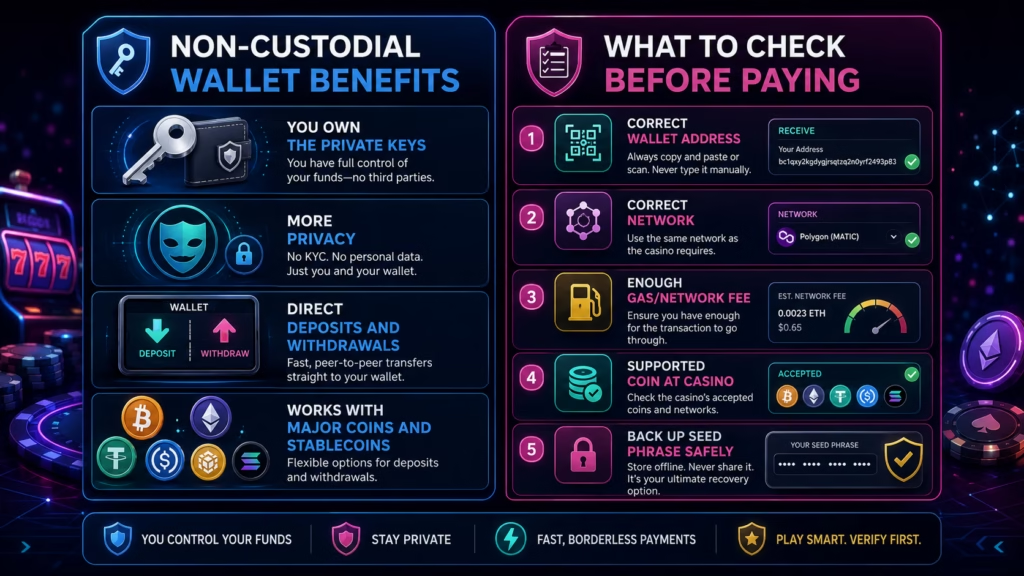
- A non-custodial wallet gives the user control of the private keys or recovery phrase.
- The wallet may not require KYC, but a casino can still impose KYC or source-of-funds checks.
- Deposits and withdrawals require the correct cryptocurrency and blockchain network.
- Blockchain transactions are generally irreversible once confirmed.
- Security depends heavily on protecting the recovery phrase and verifying addresses before sending funds.
A non-custodial crypto wallet may suit players who already use cryptocurrency and want more direct control over deposits and withdrawals. Beginners should be more cautious because a wrong network, incorrect address, lost recovery phrase, or malicious wallet approval can result in funds that may be difficult or impossible to recover.
What Is a Non-Custodial Wallet?
A non-custodial cryptocurrency wallet is a wallet where the user controls the cryptographic credentials required to move the assets. Instead of asking an exchange or other custodian to authorize a withdrawal, the user signs transactions using keys associated with the wallet.
The practical difference is ownership of access.
With a custodial wallet, an exchange or service normally controls the underlying private keys and allows the account holder to access funds through its platform. With a non-custodial wallet, control is tied directly to the wallet credentials.
This distinction matters for casino payments because withdrawals can potentially move directly between a casino and an address controlled by the player instead of passing through a centralized exchange.
How Non-Custodial Wallets Work With No KYC Casinos
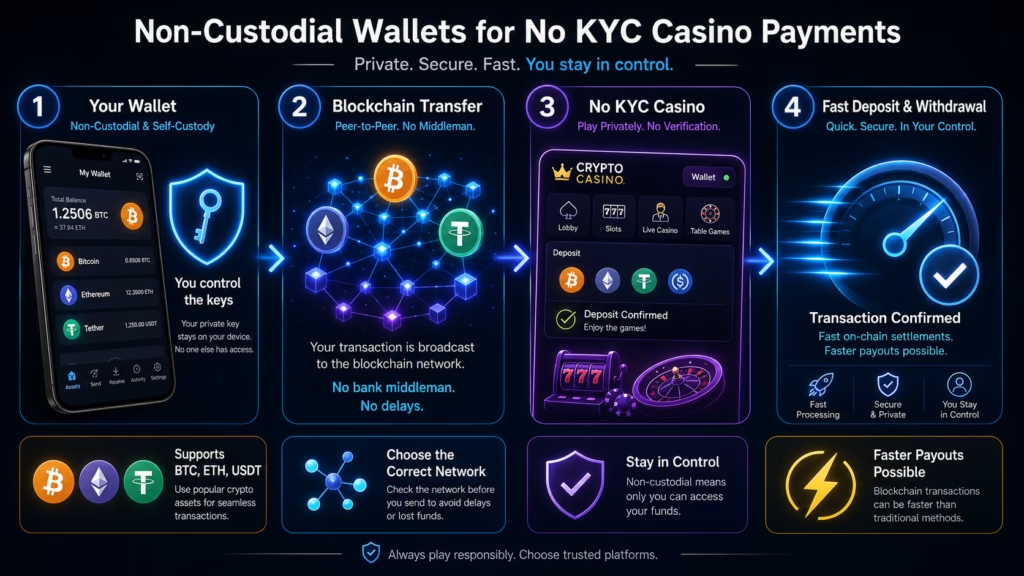
A non custodial wallet No KYC casino payment normally involves a direct blockchain transfer between the player’s wallet and an address generated by the casino.
A typical deposit works like this:
1. Select cryptocurrency as the casino deposit method.
2. Choose the cryptocurrency and blockchain network.
3. Copy the casino’s deposit address.
4. Verify that the wallet and casino are using the same network.
5. Send the desired amount.
6. Wait for the blockchain confirmations required by the operator.
7. Check the casino balance after the transaction is credited.
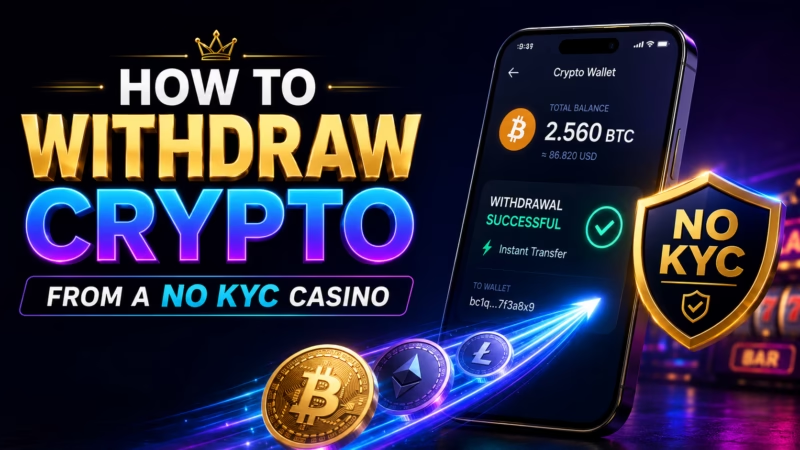
Withdrawals generally reverse the process. The player provides a receiving address from the non-custodial wallet, chooses the supported network, and submits the withdrawal request.
The blockchain transfer may be fast, but casino processing is separate. An operator can review a withdrawal before broadcasting the cryptocurrency transaction, so using crypto does not automatically mean an instant withdrawal.
Does a Non-Custodial Wallet Mean No KYC?
No. A non-custodial wallet and a No KYC casino are separate things.
A wallet can allow cryptocurrency transactions without collecting conventional identity documents while the casino using that wallet address can still have its own verification requirements.
- account security checks;
- regulatory requirements;
- anti-money laundering procedures;
- payment disputes;
- unusual account activity;
- withdrawal reviews;
- source-of-funds or source-of-wealth requirements;
- restrictions applying to particular jurisdictions.
Some operators allow registration and ordinary crypto payments with limited information but reserve the right to request verification later.
For that reason, players looking for a non custodial crypto wallet casino should read the casino’s verification policy before depositing rather than assuming that a crypto-only registration process means identification can never be requested.
Non-Custodial vs Custodial Wallets for Casino Payments
| Feature | Non-Custodial Wallet | Custodial Wallet |
| Private-key control | User | Service provider |
| Transaction authorization | User signs transaction | Provider processes withdrawal |
| Account verification | Wallet itself may not require traditional KYC | Common on centralized services |
| Recovery responsibility | Mostly user | Provider may offer account recovery |
| Withdrawal restrictions | Primarily blockchain and wallet restrictions | Provider policies may also apply |
| Risk if credentials are lost | Potentially severe | Account recovery may be possible |
| Best suited to | Users comfortable managing crypto | Users wanting simpler account management |
A non-custodial wallet provides more control, but that control also creates more responsibility. There may be no customer-support department capable of restoring a wallet if the recovery phrase is permanently lost.
Why Players Use Non-Custodial Wallets for Casino Deposits
Direct control over cryptocurrency
Non-custodial wallets allow the wallet holder to decide when and where cryptocurrency is sent without requesting an exchange withdrawal first.
This can simplify the payment route for someone who already holds cryptocurrency in self-custody.
Fewer intermediaries
A direct wallet-to-casino transfer removes one payment intermediary from the transaction path.
That does not remove the casino’s own controls, but it can reduce dependence on a centralized exchange for every deposit or withdrawal.
Wider blockchain access
Multi-chain wallets can support numerous cryptocurrencies, tokens, and networks from one interface.
This flexibility can be useful when casinos offer multiple crypto deposit options, although network compatibility must always be checked individually.
Greater control over receiving addresses
A withdrawal sent to a non-custodial address is controlled by the holder of that wallet’s keys once the transaction is completed.
This differs from depositing to an exchange address where the exchange ultimately controls the underlying wallet infrastructure.
The Biggest Risks of Non-Custodial Casino Payments
Sending crypto on the wrong network
Network mismatch is one of the most important payment risks.
For example, the same token may exist on several blockchain networks. A casino deposit page may support only one of them. Sending a supported token through an unsupported network can prevent automatic crediting and may make recovery difficult.
Always match both cryptocurrency and blockchain network before sending.
Using the wrong deposit address
Cryptocurrency transactions generally cannot simply be reversed like a card payment.
Copy the casino address directly from the payment page and compare the beginning and end of the address before confirming the transaction.
For a larger transfer, a small test transaction may reduce operational risk when fees make this practical.
Losing the recovery phrase
The recovery phrase is effectively the master backup for many non-custodial wallets.
Anyone who obtains it may be able to control the wallet. Anyone who permanently loses it may lose the ability to restore the wallet after device failure or loss.
A legitimate support agent should not need the recovery phrase to troubleshoot an ordinary payment problem.
Malicious wallet connections
Some cryptocurrency wallets interact with decentralized applications and smart contracts. Approving an unknown contract can create risks beyond simply sending one transaction.
Casino deposits normally require a destination address or a supported wallet connection. Players should understand exactly what permissions are being requested before approving anything.
How to Choose a Non-Custodial Wallet for Casino Payments
A good casino payment wallet should be evaluated on practical criteria rather than marketing claims.
Check blockchain compatibility
The wallet needs to support both the cryptocurrency and the exact network offered by the casino.
Supporting USDT, for example, is not enough by itself because USDT exists on multiple networks.
Check transaction-fee controls
Some wallets allow users to choose or adjust network fees. Others simplify fee selection automatically.
The lowest fee is not always the best choice because insufficient fees can sometimes result in slower confirmation.
Check backup and recovery options
Understand how the wallet is restored before depositing significant funds.
A wallet is unsuitable for serious use if the owner does not understand how its recovery mechanism works.
Check address visibility
A casino payment wallet should make receiving addresses, networks, transaction hashes, and transaction history easy to verify.
These details are useful if a deposit or withdrawal needs to be investigated.
Consider separating gambling funds
Using a separate wallet for casino activity can simplify transaction tracking and limit how much cryptocurrency is exposed through a single wallet.
The casino wallet does not need to contain an entire long-term crypto portfolio.
Hot Wallet or Hardware Wallet for Casino Payments?
A hot wallet runs on an internet-connected device and is generally more convenient for frequent casino deposits and withdrawals.
A hardware wallet keeps sensitive signing operations isolated in dedicated hardware and may be preferable for longer-term storage.
For frequent casino transactions, some crypto users keep a smaller spending balance in a hot wallet while storing larger holdings separately. This reduces the amount exposed if the everyday wallet or device is compromised.
Convenience should not be confused with security. A wallet that is frequently connected to websites naturally has a different risk profile from cryptocurrency stored offline for long periods.
Which Cryptocurrencies Work With Non-Custodial Casino Wallets?
Compatibility depends on both the casino and the wallet.
- Bitcoin;
- Ethereum;
- stablecoins;
- Litecoin;
- Dogecoin;
- Solana-based assets;
- other supported coins or tokens.
The crucial factor is not simply whether the casino lists a coin. The wallet must support the same network implementation used for the casino deposit and withdrawal.
Stablecoins require particular attention because the same ticker can operate across several chains.
Can Non-Custodial Wallets Make Casino Withdrawals Faster?
A non-custodial wallet can remove delays associated with withdrawing from a centralized exchange, but it cannot control the casino’s internal withdrawal process.
- internal approval;
- pending withdrawal periods;
- account verification;
- bonus conditions;
- withdrawal limits;
- blockchain congestion;
- network confirmation requirements.
After the casino sends the transaction, blockchain confirmation speed depends mainly on the selected network and transaction conditions.
Claims of “instant crypto withdrawals” should therefore be checked against the operator’s actual withdrawal rules.
Common Mistakes to Avoid
The most expensive mistakes with non-custodial casino wallets are usually operational rather than strategic.
- sending before checking the network;
- assuming every token with the same ticker uses the same blockchain;
- depositing from a wallet you cannot properly restore;
- keeping the recovery phrase in screenshots or ordinary cloud notes;
- sharing a seed phrase with casino support;
- assuming “No KYC” means verification can never occur;
- ignoring minimum deposit or withdrawal amounts;
- overlooking blockchain withdrawal fees;
- using an address from an old payment session without confirming it remains valid;
- keeping more gambling funds in a payment wallet than necessary.
A successful blockchain transaction also does not prove that a casino is trustworthy. Wallet security and operator reliability need to be evaluated separately.
No KYC Does Not Mean Anonymous
Cryptocurrency payments can reduce the amount of conventional payment information shared during a transaction, but public blockchains normally create permanent transaction records.
Wallet addresses, transaction amounts, timestamps, and fund movements can often be viewed through blockchain explorers.
A non-custodial wallet therefore provides self-custody, not automatic anonymity.
Users should also understand the laws and gambling rules applying where they live. Casino availability, cryptocurrency regulation, taxation, and identity-verification obligations vary between jurisdictions.
Practical Checklist Before Depositing
1. The casino accepts your cryptocurrency.
2. The casino supports your exact blockchain network.
3. The deposit address has been copied correctly.
4. The minimum deposit amount has been checked.
5. Network fees are reasonable.
6. Withdrawal rules have been reviewed.
7. KYC conditions are understood.
8. Bonus wagering conditions have been checked if a promotion is used.
9. The wallet backup has been secured.
10. The amount being deposited fits a predetermined gambling budget.
If several casinos satisfy these requirements, compare their withdrawal rules, supported networks, account restrictions, responsible gambling controls, and verification policies before choosing where to play.
How This Information Was Reviewed
The suitability of a non-custodial wallet for No KYC casino payments should be assessed through wallet custody, blockchain compatibility, transaction control, withdrawal conditions, verification requirements, security procedures, and user responsibility.
Exact deposit networks, minimum amounts, fees, KYC policies, withdrawal limits, bonus conditions, and geographic availability can change, so these details should be confirmed directly in the casino’s current payment and account terms before depositing.
Crypto payments do not change the randomness of casino games and do not improve the mathematical probability of winning. Gambling should be treated as paid entertainment, not as an investment or income strategy. Set financial limits before playing and stop if gambling begins to create financial or personal problems.
FAQ
Can I use a non-custodial wallet at a No KYC casino?
Yes, some crypto casinos accept deposits from non-custodial wallets. Compatibility depends on the cryptocurrency and blockchain network supported by the operator. Check the casino payment page before transferring funds.
Does MetaMask or another non-custodial wallet require KYC?
A self-custody wallet application may allow wallet creation without traditional identity verification, but integrated third-party services such as fiat purchases can have separate KYC requirements. Requirements depend on the wallet feature and service provider being used.
Can a casino ask for KYC after I deposit with a non-custodial wallet?
Yes. Using a non-custodial wallet does not prevent a casino from requesting identity, account-security, or source-of-funds information when its policies or regulatory obligations require it.
Is a non-custodial wallet anonymous?
No. Self-custody and anonymity are different concepts. Public blockchain transactions can expose wallet addresses, transaction values, timestamps, and transaction history even when the wallet itself does not contain a public name.
What is the safest way to send crypto to a casino?
Verify the cryptocurrency, network, receiving address, deposit minimum, and casino terms before sending. Protect the recovery phrase and consider a small test transfer for larger payments when transaction fees make that practical. No cryptocurrency transaction method is completely risk-free.
Can I withdraw casino winnings directly to a non-custodial wallet?
Many crypto casinos allow withdrawals to a user-provided cryptocurrency address, but withdrawal rules vary. The selected currency, blockchain network, minimum withdrawal, fees, account verification, and operator restrictions should be checked first.
Should I use a separate crypto wallet for gambling?
A separate payment wallet can be useful because it separates gambling transactions from long-term cryptocurrency holdings and limits the amount stored in a frequently used wallet. It does not remove blockchain, casino, or gambling risks.
What happens if I send casino funds through the wrong network?
The deposit may not be credited automatically, and recovery may be difficult or impossible. Contact the operator if a network mistake occurs, but do not assume the casino can recover the funds.
Are non-custodial wallets better than exchange wallets for casinos?
Non-custodial wallets provide greater direct control, while exchange wallets may be simpler for users who prefer account recovery and centralized management. Neither option is universally better. The appropriate choice depends on technical experience, security practices, network compatibility, and how often cryptocurrency is moved.
Does using a crypto wallet improve my chances of winning?
No. The payment method has no effect on the mathematical outcome of casino games. Crypto deposits, non-custodial wallets, RTP, bonuses, or faster withdrawals do not guarantee a profit or improve the result of a random game.
Brief Conclusion
A non custodial wallet No KYC casino setup can provide direct control over cryptocurrency deposits and withdrawals, fewer payment intermediaries, and flexible blockchain access. The trade-off is greater personal responsibility for private keys, recovery phrases, addresses, and network selection.
The most important distinction is that non-custodial does not automatically mean anonymous, and No KYC does not guarantee that verification will never be requested. Before depositing, check the casino’s supported networks, withdrawal policy, KYC terms, fees, limits, and jurisdictional availability. Use cryptocurrency carefully, keep gambling funds limited, and treat casino play as entertainment rather than a way to generate income.