A No KYC casino license should always be verified directly with the regulator, not from a badge, logo, certificate image, or licensing claim displayed by the casino itself. The safest verification method is to identify the casino’s legal operator, claimed regulator, licence or authorization number, and website domain, then confirm that the same information appears in the regulator’s official register.
The most important checks are simple:
- Find the legal company name in the casino’s Terms and Conditions or footer.
- Identify the regulator and licence or authorization number.
- Search the regulator’s official register independently.
- Confirm that the exact casino domain is covered by the authorization.
- Check whether the licence is active, provisional, suspended, expired, or otherwise restricted.
- Look for regulatory actions, warnings, or unauthorized-domain notices.
- Do not assume that ‘No KYC’ means identity verification can never be requested.
A valid gaming licence is an important trust signal, but it does not make every licensed casino equally suitable for every player. Licensing standards, complaint procedures, AML requirements, geographic restrictions, and player-protection rules differ between jurisdictions.
What Does a No KYC Casino License Actually Mean?
A No KYC casino license is not a special category of gaming licence that exempts an operator from identity checks. ‘No KYC’ is normally a marketing description used by casinos that allow some customers to register, deposit, or play without immediately uploading identity documents.
A licensed operator may still have legal obligations involving customer due diligence, anti-money laundering controls, sanctions screening, age verification, source-of-funds checks, suspicious transaction monitoring, or payment ownership verification.
This distinction matters because a casino advertising ‘No KYC’ may still request verification after certain triggers. These can include unusual transactions, regulatory requirements, payment disputes, account-security concerns, AML alerts, withdrawal reviews, or other circumstances defined in its terms.
For example, UK Gambling Commission rules require applicable remote operators to establish a customer’s identity before permitting that customer to gamble. A casino claiming both literal ‘no identity verification’ and UKGC authorization should therefore be examined very carefully.
Malta-licensed gaming businesses also operate under AML/CFT and customer due diligence requirements, including a risk-based compliance framework. A claim such as ‘No KYC casino’ should therefore not be interpreted as a guarantee that an MGA-licensed operator will never request identification.
How to Verify a No KYC Casino License Step by Step
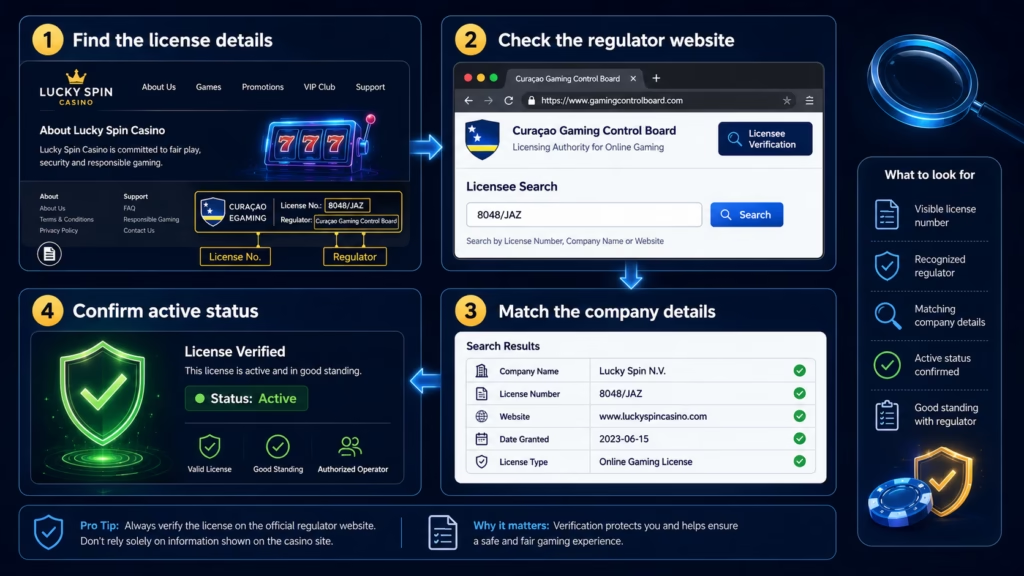
1. Find the Legal Operator Behind the Casino
Start with the casino’s footer, Terms and Conditions, Privacy Policy, AML Policy, or licensing page.
Look for information such as:
- legal company name;
- company registration number;
- registered jurisdiction;
- regulator;
- licence or authorization number;
- registered address;
- trading names;
- domains operated by the company.
The casino brand and the licensed company are often different names. A website called Example Casino might legally be operated by Example Entertainment B.V. or another corporate entity.
The legal entity is more important than the brand name because regulators normally authorize companies, specific gaming services, domains, or combinations of these.
If a casino provides no identifiable operator, no licence information, and no meaningful corporate details, there may be nothing independently verifiable. Treat that as a major warning sign.
2. Identify the Actual Regulator
A legitimate licensing statement should identify a real gambling regulator rather than using vague expressions such as:
- internationally licensed;
- globally regulated;
- fully authorized;
- certified gaming company;
- legally registered casino.
Company registration is not automatically a gambling licence.
Similarly, software certificates, game-testing reports, payment-provider relationships, SSL certificates, and business registrations do not replace an operator gaming licence.
You need to determine which authority supposedly permits the operator to provide gambling services.
3. Go to the Regulator Independently
Do not rely only on a link supplied by the casino.
Fake casinos can copy regulator logos, reproduce licence seals, create imitation certificate pages, or link users to domains designed to resemble regulatory websites.
This risk is not theoretical. In July 2026, the Malta Gaming Authority warned about websites impersonating MGA-licensed operators and specifically advised consumers to verify authorization through the MGA’s official Licensee Register.
The Kahnawa:ke Gaming Commission also issued a June 2026 warning concerning a website falsely implying an affiliation with the Commission and advised users to obtain licensing information directly through its official channels.
The practical rule is straightforward: locate the regulator independently and perform the check there.
4. Search by More Than the Licence Number
A licence number alone is not enough.
Fraudulent operators can copy a real licence number belonging to another company. A successful search therefore proves very little unless the other details match.
Check all available fields:
| Detail | What should match |
| Legal operator | Company named in casino terms |
| Casino brand | Trading name where listed |
| Domain | Exact website you are visiting |
| Licence number | Number displayed by the casino |
| Licence status | Active or otherwise currently valid |
| Gaming activity | Online casino or relevant gambling service |
| Jurisdiction | Same authority the casino claims |
| Restrictions | Any limitations affecting authorization |
A genuine licence belonging to Company A does not authorize an unrelated Company B simply because Company B copied its number.
5. Verify the Exact Casino Domain
Domain verification is one of the most important steps when you check a No KYC casino license.
A criminal or unauthorized operator can copy the branding, legal text, company name, and licence details of a legitimate casino while operating from a different domain.
Where the regulator publishes authorized URLs, compare them character by character.
Pay attention to:
- different top-level domains;
- added hyphens;
- extra words;
- alternative spellings;
- additional subdomains;
- substituted characters;
- mirror sites.
For example, examplecasino.com and example-casino.io should not automatically be treated as the same licensed website.
The Malta Gaming Authority allows users to search its Licensee Register by licensee name, authorization status, URL, and gaming service.
The UK Gambling Commission’s business register can also be searched using information including business name, trading name, domain name, or account number.
6. Check the Current Licence Status
Finding the operator in a regulator’s database is only half of the verification.
You also need to check its current status.
A licence may have been:
- suspended;
- surrendered;
- terminated;
- expired;
- forfeited;
- converted to another status;
- restricted;
- subject to enforcement action.
Historical licensing information should not be presented as evidence that a casino is currently authorized.
The UK Gambling Commission, for example, distinguishes statuses such as active, expired, and forfeited in its public business register.
If the regulator provides an enforcement register or regulatory notices, check those as well.
How to Check Major Casino Licensing Authorities
Malta Gaming Authority
The Malta Gaming Authority provides an official Licensee Register where users can search by licensee name, authorization status, URL, or gaming service. The MGA also operates an Enforcement Register.
For an MGA claim, verify:
1. the legal company;
2. the casino URL;
3. authorization status;
4. authorized gaming services;
5. any relevant enforcement information.
An MGA logo displayed on a casino website is not sufficient proof.
UK Gambling Commission
The UK Gambling Commission maintains a public register of gambling businesses. Its register includes the legal business name, licence status, account information, and other licensing details, and it supports searches that include domain names.
The UKGC is particularly relevant when a casino claims to accept customers in Great Britain under a UK licence.
A literal No KYC model is incompatible with the UKGC requirement for applicable remote operators to verify customer identity before allowing gambling. A casino can potentially offer a low-friction verification process, but that is different from operating without identity verification requirements.
Curacao Gaming Authority
Curacao’s licensing framework changed significantly when the National Ordinance on Games of Chance, known as the LOK, came into effect on December 24, 2024. The Curacao Gaming Authority states that online gaming in or from Curacao requires an online gaming licence under the new framework, while existing licences from the previous system entered transitional arrangements.
This makes old screenshots and claims about Curacao licences particularly poor evidence of current authorization.
When checking a Curacao casino, use current Curacao Gaming Authority information and verify the operator’s present licensing position rather than assuming that an old master-licence or sub-licence statement remains sufficient.
Kahnawa:ke Gaming Commission
The Kahnawa:ke Gaming Commission publishes information about its interactive gaming permit holders and associated URLs. Its Client Provider Authorization framework can authorize approved entities to provide interactive gaming services under the Commission’s regulatory system.
Check both the operator and URL because a legitimate company name appearing elsewhere does not automatically validate the domain you are visiting.
The Commission also publishes regulatory notices involving suspensions, terminations, unauthorized operators, and other licensing developments.
Isle of Man Gambling Supervision Commission
The Isle of Man Gambling Supervision Commission regulates online gambling operators under the jurisdiction’s online gambling framework. Isle of Man legislation requires the Commission to maintain a register of current and former licence holders and make licensing information available for public inspection.
An Isle of Man licence should therefore be checked against current licence-holder information rather than accepted solely from a casino footer.
Isle of Man gambling businesses are also subject to AML/CFT obligations, which is another reason not to interpret ‘No KYC’ as a permanent exemption from customer due diligence.
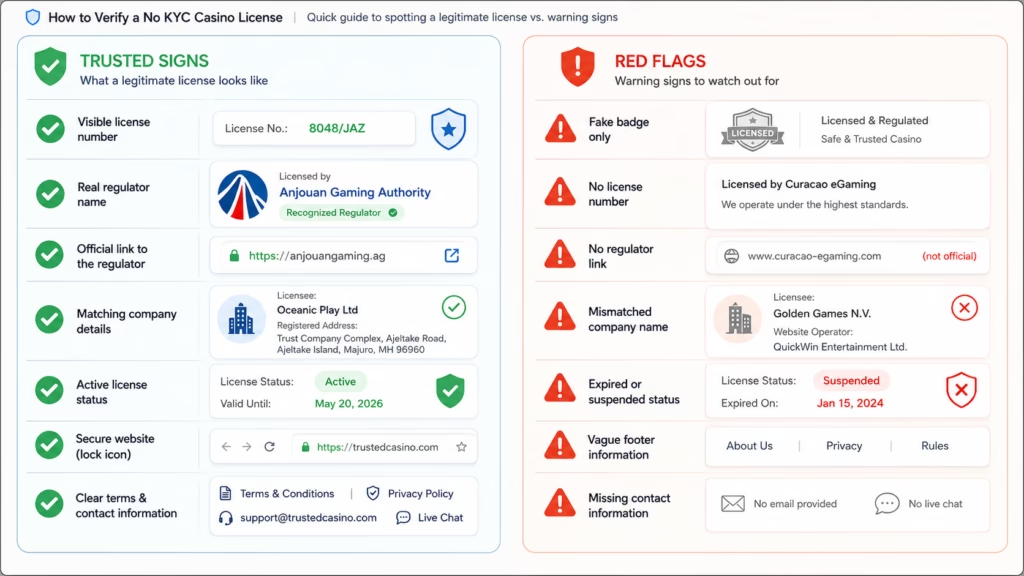
Red Flags That a Casino Licence May Be Fake or Misleading
A licensing claim deserves additional scrutiny when you see one or more of these signs:
1. The regulator’s logo is displayed but cannot be clicked or independently verified.
2. The casino gives a licence number but no legal company name.
3. The licence belongs to another operator.
4. The casino domain does not appear among authorized URLs where the regulator publishes them.
5. The licence is expired, suspended, terminated, or otherwise inactive.
6. The supposed regulator does not appear to operate a recognizable gambling licensing system.
7. A certificate is hosted entirely on the casino’s own website.
8. The site describes ordinary business incorporation as a gaming licence.
9. The casino uses vague wording such as ‘internationally licensed’ without identifying an authority.
10. The operator promises that verification can never occur under any circumstances.
The final point is particularly important for No KYC casinos. Legitimate regulated gambling businesses can still have AML, sanctions, fraud-prevention, payment verification, and customer due diligence responsibilities.
Does a Valid Licence Mean a No KYC Casino Is Safe?
A valid licence reduces one important category of uncertainty, but it does not prove that a casino is completely safe or suitable.
Licensing should be treated as the beginning of due diligence, not the end.
Before depositing, also review:
- withdrawal rules;
- maximum withdrawal limits;
- account verification clauses;
- cryptocurrency wallet requirements;
- restricted countries;
- bonus wagering requirements;
- dormant account rules;
- complaint procedures;
- responsible gambling controls;
- terms allowing funds or accounts to be frozen;
- policies covering duplicate or multiple accounts.
The most important practical question is not simply ‘Is there a licence?’ It is ‘Does the regulator confirm that this exact legal operator and domain currently hold the authorization being claimed?’
Common Mistakes When Checking a No KYC Casino License
Trusting a Licence Badge
A badge is an image. It can be copied.
Always confirm the licensing information through the regulator.
Checking Only the Company Name
A legitimate licensed company can operate several brands and URLs. A scam website can also copy that company’s identity.
Where possible, verify the exact domain.
Assuming Crypto Means No Regulation
Accepting Bitcoin, USDT, Ethereum, or another cryptocurrency does not determine whether a casino is licensed.
Payment method and regulatory status are separate questions.
Believing No KYC Means No Verification Forever
‘No KYC’ commonly describes the initial customer journey rather than an unconditional legal promise.
Read the casino’s AML, verification, withdrawal, and Terms and Conditions pages to understand when documentation may be requested.
Ignoring Your Own Country’s Rules
An offshore licence does not automatically authorize a casino to target players everywhere.
Gambling laws and market-access rules depend on jurisdiction. A licence from one country or territory should not be interpreted as worldwide authorization.
A 60-Second No KYC Casino Licence Checklist
Before depositing, confirm these seven points:
- Operator: Who legally owns the casino?
- Regulator: Which gambling authority supposedly licenses it?
- Licence: Is there a verifiable licence or authorization?
- Domain: Is the exact website included?
- Status: Is the authorization currently active?
- Enforcement: Are there warnings, suspensions, or regulatory actions?
- KYC terms: Under what circumstances can identity or source-of-funds verification be required?
If the casino fails the first four checks, depositing funds means accepting significantly more uncertainty about who operates the website and what regulatory recourse may exist.
How This Information Was Reviewed
Casino licensing should be evaluated using primary regulatory information wherever possible. The key criteria are the legal operator, exact domain, regulator, authorization status, permitted gambling activity, enforcement history, and the casino’s own verification and withdrawal terms.
Licensing systems can change, as demonstrated by Curacao’s transition to the LOK framework, so current regulator records should take priority over old casino reviews, screenshots, forum posts, or cached licence badges.
A licence also does not guarantee winnings, fast withdrawals, or the absence of disputes. Casino games involve financial risk and random outcomes. Gambling should be treated as entertainment, limits should be set before playing, and players should stop when gambling is no longer affordable or enjoyable.
FAQ
How do I verify a No KYC casino license?
Verify a No KYC casino license by finding the operator’s legal company name, regulator, licence number, and domain, then matching those details against the regulator’s official register. Do not rely solely on the casino’s licensing badge or certificate.
How can I tell whether a casino licence is fake?
A casino licence may be fake or misleading if the regulator cannot confirm the operator, the licence number belongs to another company, the website domain is not authorized, or the claimed licence is inactive. A copied regulator logo is not proof of licensing.
Can a licensed casino really have no KYC?
A licensed casino may offer registration or gambling with little or no initial document submission in some jurisdictions, but ‘No KYC’ does not necessarily mean verification can never occur. AML, sanctions, security, payment, or regulatory requirements may trigger additional checks.
Can a UK-licensed casino be No KYC?
A UKGC-licensed remote casino cannot operate on the basis that customer identity never needs to be verified. UK Gambling Commission rules require applicable remote licensees to establish customer identity before permitting gambling.
How do I check a Curacao casino licence?
Check current licensing information through the Curacao Gaming Authority and match the operator to its claimed authorization. Curacao’s regulatory framework changed under the LOK from December 24, 2024, so old master-licence or sub-licence information should not automatically be treated as evidence of current status.
Is a licence number enough to verify an online casino?
No. A licence number can be copied from a legitimate operator. Verify the legal company, licence status, casino brand, and exact domain wherever those fields are provided by the regulator.
Is a company registration the same as a casino licence?
No. Incorporating a company generally establishes a legal business entity, while a gambling licence authorizes specified gambling activities under a particular regulatory framework. A casino should not use ordinary corporate registration as a substitute for a gaming authorization.
Should I trust a casino if the licence badge links to a certificate?
Only after confirming that the certificate is hosted or validated through the genuine regulator and refers to the correct operator and domain. Fake websites can reproduce badges and create imitation verification pages.
Does a valid licence guarantee that withdrawals will be paid?
No. A valid licence provides regulatory oversight but does not guarantee that every withdrawal will be immediate or dispute-free. Withdrawal conditions, verification requirements, bonus rules, payment methods, and account restrictions should be checked before depositing.
Short Conclusion
To verify a No KYC casino license, check the legal operator, regulator, licence or authorization, exact domain, current status, and enforcement history directly through the regulator. Never treat a logo or copied licence number as sufficient evidence. Most importantly, remember that ‘No KYC’ usually describes a reduced-friction verification process, not a guarantee that identity checks can never be required.