No KYC casinos are not necessarily anonymous. A casino described as “No KYC” usually means that players can create an account, deposit, play, or sometimes withdraw without submitting the standard identity documents required by traditional casinos. It does not mean the operator has no information that could be connected to the player.
A No KYC casino may still see or store a cryptocurrency wallet address, email address, IP address, device information, transaction history, country information, account activity, and payment details. The casino may also request identity verification later if an account triggers anti-money-laundering, fraud, security, payment, or regulatory checks.
- No KYC is not the same as anonymous.
- Crypto payments are often pseudonymous rather than anonymous.
- A casino may allow gambling without document verification but still collect technical data.
- KYC can sometimes be requested after registration or before certain transactions.
- Privacy rules and verification requirements depend heavily on the operator, payment method, licence, and jurisdiction.
Who this topic is most relevant to: adult players who value faster registration, reduced document sharing, cryptocurrency payments, or greater financial privacy. Players looking for complete anonymity should be more cautious because a casino that asks for no passport or proof of address can still leave multiple ways of linking activity to an individual.
What Does “No KYC Casino” Actually Mean?
A No KYC casino generally allows players to use the service without completing the traditional Know Your Customer process at the beginning of the account relationship.
Traditional casino KYC can involve information such as:
- full name;
- date of birth;
- residential address;
- passport or national ID;
- driving licence;
- proof of address;
- payment ownership verification;
- source-of-funds information in some circumstances.
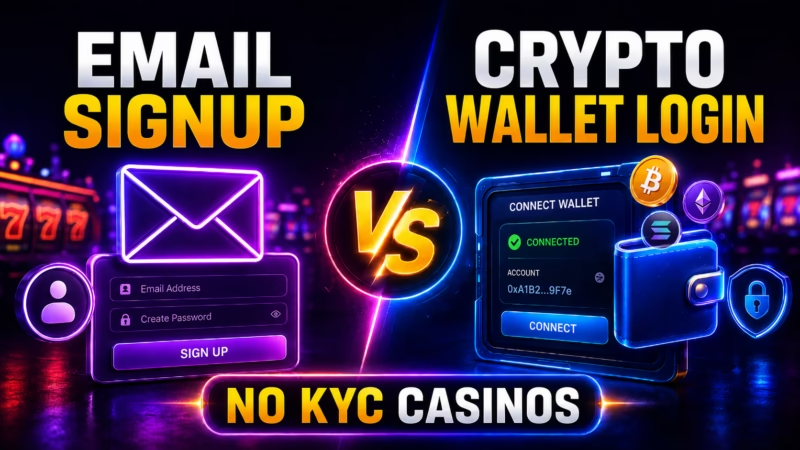
A No KYC model may remove some or all of these requirements from normal registration. Some crypto casinos, for example, allow an account to be created with only an email address or through a cryptocurrency wallet.
The important distinction is that “No KYC” describes the verification process, not necessarily the amount of information collected about the player.
A casino can therefore have no routine document verification while still keeping records of logins, wallet transactions, deposits, withdrawals, device activity, or communications.
Are No KYC Casinos Anonymous?
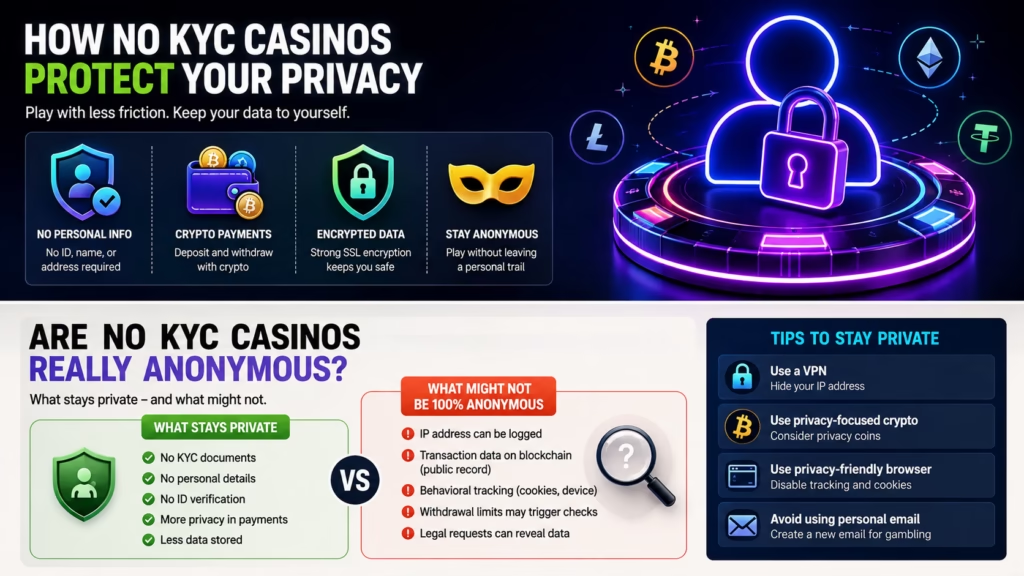
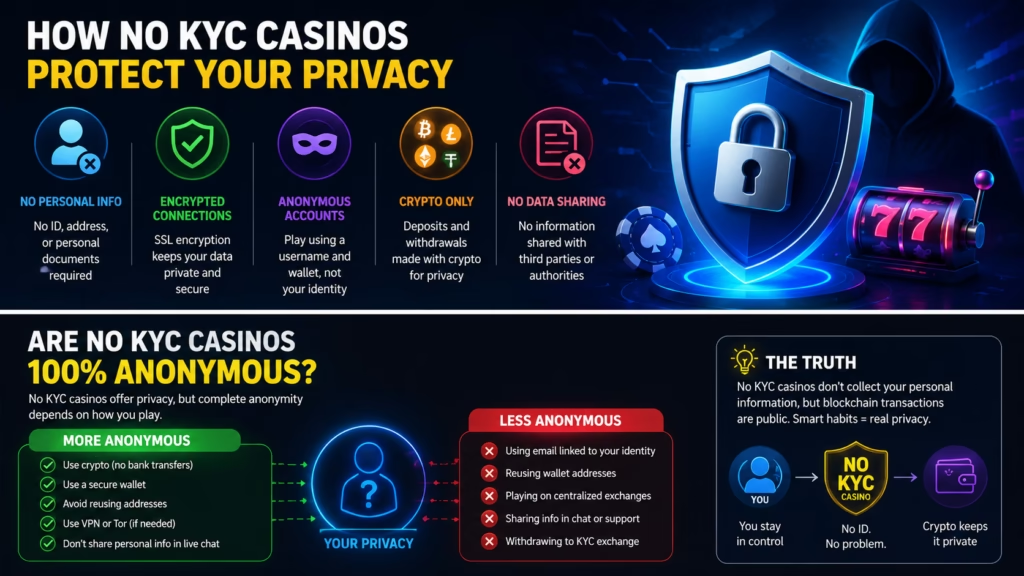
No KYC casinos can provide more privacy than conventional casinos, but describing them as completely anonymous is usually inaccurate.
True anonymity would mean that the casino cannot reasonably connect gambling activity with the identity of the person behind it. That standard is difficult to achieve online because several data points can potentially create a link between an account and its user.
Consider a player who registers without providing a name or passport but deposits Bitcoin from a wallet previously used with a regulated cryptocurrency exchange. The casino may not know that player’s legal identity directly, but the payment trail is not necessarily anonymous.
Bitcoin transactions are recorded on a public blockchain, which is why Bitcoin is commonly described as pseudonymous rather than inherently anonymous.
A more accurate description of many No KYC casinos is privacy-focused or pseudonymous gambling, rather than anonymous gambling.
No KYC vs Anonymous vs Private Casinos
These terms are often treated as interchangeable, but they describe different things.
| Term | What It Usually Means |
| No KYC casino | Standard identity documents may not be required during normal registration or play. |
| No verification casino | Often another marketing term for reduced or delayed identity checks. |
| Private casino account | The operator may collect less personal information than a conventional casino. |
| Pseudonymous gambling | Activity is linked to an account or wallet address rather than directly to a real name. |
| Anonymous gambling | Activity cannot reasonably be connected to the player’s real-world identity. |
Most services marketed as anonymous casinos fit somewhere between No KYC and pseudonymous, rather than providing absolute anonymity.
What Information Can a No KYC Casino Still See?
A No KYC casino may know considerably more about a player than the registration page suggests.
Cryptocurrency Wallet Address
When cryptocurrency is deposited, the receiving system can identify the sending transaction and associated blockchain address.
On transparent blockchains such as Bitcoin, transaction history is publicly visible. A wallet address does not automatically reveal a person’s name, but privacy can decrease when the address becomes associated with an identifiable service or individual.
IP Address
An online casino may receive the IP address used to connect to its website. An IP address does not necessarily identify a specific person by itself, but it can provide information about the connection and approximate geographical location.
Whether an operator stores this information, and for how long, depends on its systems and privacy policy.
Device and Browser Information
Web services can collect technical information such as operating system, browser type, screen characteristics, language, cookies, session identifiers, and other device-related signals.
Casinos may use some of this information for account security, fraud detection, authentication, abuse prevention, or compliance.
Email Address
A casino requiring only an email address may still have a direct identifier if the player uses an email account connected to their real identity elsewhere. Registration without identity documents therefore does not automatically create an anonymous account.
Transaction History
Deposits, wagers, withdrawals, bonuses, and account transfers create a financial and behavioural history. Even when that history is attached only to an account number or wallet address, it can reduce anonymity if other information later connects the account with a particular person.
Are Crypto No KYC Casinos Anonymous?
Crypto No KYC casinos are usually pseudonymous rather than fully anonymous.
Cryptocurrency removes the need to give the casino conventional card or bank-account details in many cases. That can significantly reduce the amount of financial information shared directly with the operator.
However, using cryptocurrency does not automatically hide transaction history. Public blockchain networks can reveal:
- sending addresses;
- receiving addresses;
- transaction amounts;
- transaction times;
- previous and subsequent transactions associated with addresses.
Anti-money-laundering standards can also apply to virtual asset service providers, including customer due diligence, record keeping, and information requirements for certain transfers. This matters particularly when cryptocurrency moves between a casino and an exchange or other regulated service that already knows the customer’s identity.
For that reason, crypto payment and anonymous payment should not be treated as synonyms.
Can a No KYC Casino Ask for Verification Later?
Yes. A casino advertised as No KYC may still request verification under specific circumstances.
Possible triggers can include:
- suspected fraud;
- unusual transaction activity;
- account security concerns;
- payment disputes;
- anti-money-laundering checks;
- sanctions or compliance screening;
- questions about account ownership;
- jurisdiction or age concerns;
- unusually large transactions;
- requirements imposed by the operator’s payment partners.
The exact triggers depend on the casino’s rules and regulatory environment.
This is why players should read the casino’s Terms and Conditions, AML Policy, KYC Policy, Withdrawal Policy, and Privacy Policy rather than relying only on a “No KYC” label on a landing page.
If the terms explicitly reserve the right to request identification, the casino should be treated as a conditional No KYC casino, not as a guaranteed verification-free service.
Regulation Makes a Major Difference
Verification requirements vary significantly between gambling jurisdictions.
In tightly regulated markets, remote gambling operators may be required to verify customer identity before gambling is permitted. Other jurisdictions can apply different rules, which means the “No KYC” concept cannot be interpreted identically worldwide.
An offshore crypto casino, a casino operating under another jurisdiction, and a gambling site targeting a tightly regulated domestic market can have very different obligations.
Players should therefore check which legal entity operates the casino, which jurisdiction applies, where the operator accepts customers, and what its actual verification policy says.
Does “No Verification Casino” Mean the Same Thing?
“No verification casino” and “No KYC casino” are commonly used for similar services, but neither term guarantees that verification can never occur.
The phrase may mean:
- no document verification during registration;
- automated verification instead of document uploads;
- no routine KYC for smaller transactions;
- crypto-only registration;
- verification only when certain risk conditions occur.
Two casinos using the same “No KYC” marketing language can therefore have completely different procedures.
The strongest indicator is not the headline claim. It is what the casino’s actual terms say about identity checks, withdrawals, account limits, suspicious activity, and AML procedures.
How to Evaluate the Privacy of a No KYC Casino
Players interested in No KYC casinos should evaluate privacy as a combination of policies rather than looking for a single “anonymous” label.
Check these points before depositing:
1. Registration Requirements
Determine exactly what information is required to open an account. A casino requiring only a wallet connection has a different registration model from one requiring a name, phone number, residential country, and verified email.
2. KYC Triggers
Look for language explaining when identification can be requested. Pay particular attention to vague clauses allowing unrestricted verification “at any time.” Such clauses can make the practical No KYC benefit much weaker than the marketing implies.
3. Withdrawal Rules
Check whether withdrawals have separate verification conditions, limits, processing rules, or account-ownership checks. Verification policies should be reviewed before depositing, not after a significant balance has accumulated.
4. Privacy Policy
A useful privacy policy should explain which categories of data are collected, why they are collected, and how they may be shared. No passport requirement does not compensate for a privacy policy that allows extensive collection of technical or behavioural information.
5. Payment Method
Consider what information the payment method exposes. Bank cards and regulated payment accounts normally create a clearer identity connection than a standalone cryptocurrency address, while cryptocurrency still does not automatically provide anonymity.
6. Operator and Jurisdiction
Check who operates the site and what legal or regulatory framework applies. A casino with unclear ownership, vague terms, and no meaningful dispute process may offer fewer verification checks, but that does not make it a better choice. Less identification can sometimes mean less consumer protection as well.
Common Myths About No KYC Casino Anonymity
“The casino does not have my passport, so I am anonymous.”
Not necessarily. A passport is only one possible identity signal. Wallet history, email information, payment records, IP addresses, and account data may still create links to the user.
“Bitcoin makes casino gambling anonymous.”
Bitcoin is not inherently anonymous. Its blockchain records transactions publicly, which makes Bitcoin better described as pseudonymous.
“No KYC means the casino can never request ID.”
Not necessarily. Many operators reserve the right to conduct additional checks when legal, payment, security, fraud, or AML concerns arise.
“A VPN makes a casino account anonymous.”
A VPN changes the network connection presented to a website, but it does not remove blockchain history, account records, payment information, cookies, or other identifiers. It also does not change a casino’s eligibility rules. Players should not use technical measures to bypass country restrictions or operator terms.
“Less regulation always means better privacy.”
Less regulation may reduce mandatory identity collection, but it can also reduce consumer protections, complaint mechanisms, oversight, or clarity around withdrawals. Privacy and player protection should therefore be evaluated separately.
When Does a No KYC Casino Make Sense?
A No KYC casino may appeal to an adult player who wants to minimize unnecessary document sharing and prefers cryptocurrency payments or faster account creation.
The strongest use case is privacy reduction rather than absolute anonymity. A player may prefer giving an operator a wallet address instead of sending passport scans, bank statements, and proof-of-address documents.
A No KYC casino is less suitable for someone who expects guaranteed anonymity, guaranteed verification-free withdrawals, or the same consumer protections available through every locally regulated gambling market.
The safest approach is to assume that verification may become possible whenever the casino’s terms allow it.
How This Information Was Reviewed
The distinction between No KYC gambling and anonymity is based on four practical criteria: what information the casino requests, what technical information may exist, how the payment method works, and what regulatory or AML obligations can apply.
Players should check the individual casino’s current terms because verification rules, withdrawal limits, accepted countries, payment methods, and compliance procedures can change.
Casino gambling should be treated as entertainment rather than a source of income. Set spending and time limits before playing, never gamble with money needed for essential expenses, and stop if gambling is becoming difficult to control.
FAQ
Are No KYC casinos completely anonymous?
No. No KYC casinos may require less personal information than conventional casinos, but they are not automatically anonymous. Wallet addresses, IP information, emails, transaction histories, device data, or later verification can potentially connect an account to a person.
Are no verification casinos anonymous?
No verification casinos can offer increased privacy, but “no verification” does not guarantee anonymity. The phrase often means that standard identity documents are not required during normal registration. Players should check whether verification can still be requested for withdrawals, security, fraud, or AML reasons.
Can a No KYC casino suddenly ask for ID?
Yes. Some No KYC casinos reserve the right to request identity documents when certain conditions are triggered. The exact circumstances should be stated in the casino’s KYC, AML, withdrawal, or general account terms.
Is Bitcoin anonymous when used at an online casino?
No. Bitcoin is generally considered pseudonymous rather than anonymous because transactions and wallet addresses are recorded publicly on the blockchain. A wallet may become connected to a real identity when it interacts with an identifiable person or regulated service.
Can a crypto casino identify my wallet?
A crypto casino can normally see blockchain information relevant to transactions sent to or from its addresses. Whether the operator can associate that wallet with a legal identity depends on other information and circumstances.
Do all No KYC casinos allow withdrawals without verification?
No. Withdrawal policies differ between operators. Some casinos may process ordinary withdrawals without document verification, while others can request additional information under conditions defined in their terms. Check these rules before depositing.
Are No KYC casinos legal worldwide?
No single worldwide rule applies. Gambling laws, licensing requirements, age restrictions, cryptocurrency regulations, and identity-verification obligations differ between countries and jurisdictions. Players should check whether online gambling and the specific operator are permitted where they live.
Does using a VPN make a No KYC casino anonymous?
No. A VPN alone does not create anonymity because it does not remove wallet history, payment information, cookies, account records, or other potential identifiers. Using a VPN to bypass an operator’s geographical restrictions can also violate its terms.
What should I check before choosing a No KYC casino?
Check the casino’s registration requirements, KYC triggers, withdrawal conditions, privacy policy, payment methods, operator information, jurisdiction, geographic restrictions, and responsible gambling tools. The actual terms are more important than the phrase “No KYC” in promotional material.
Brief Conclusion
No KYC casinos are more accurately described as privacy-focused or pseudonymous than truly anonymous. Avoiding passport uploads can reduce the amount of personal information shared with a casino, but wallet transactions, account data, IP information, payment records, and conditional verification can still create links to the player.
Before using a No KYC casino, check exactly what information is collected and under what circumstances KYC can be requested. Treat “No KYC” as a description of the normal verification process, not as a promise of permanent anonymity.