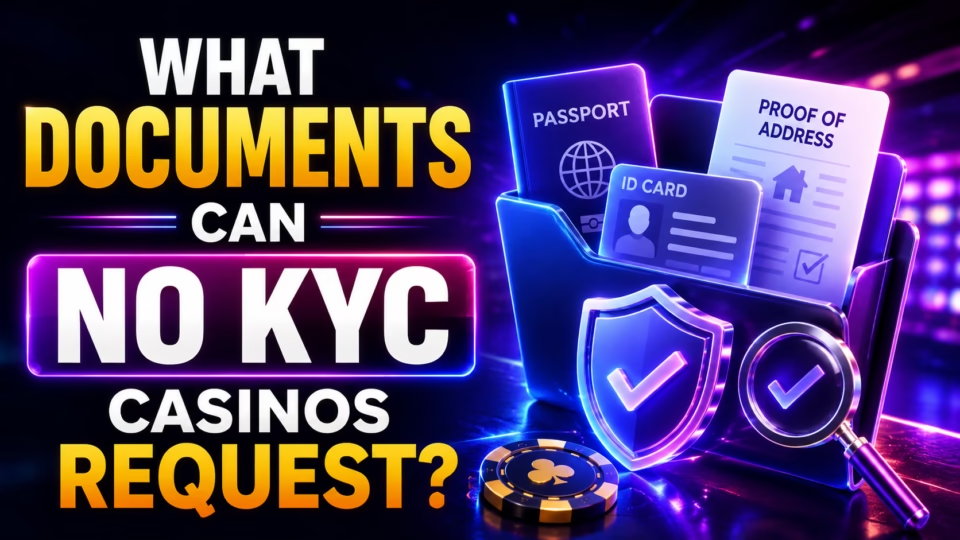
A no KYC casino can still request verification documents. “No KYC” usually means that full identity verification is not automatically required from every player at registration, not that the casino can never perform KYC, customer due diligence, anti-money laundering checks, or fraud reviews.
Depending on the casino, licence, payment method and risk profile, requested documents may include a passport or ID card, proof of address, bank statement, proof of payment ownership, selfie or liveness check, and evidence showing the source of funds. Regulated operators may also be required to perform additional checks when transactions or account activity trigger AML concerns.
Quick takeaways:
- No KYC does not necessarily mean “no documents ever.”
- Basic play may be possible without uploading identification at some casinos, while withdrawals or unusual activity can trigger verification.
- Passport, national ID, proof of address and financial records are among the most common documents that may be requested.
- Crypto deposits do not automatically remove AML or source-of-funds requirements.
- Players should check the casino’s verification and withdrawal terms before depositing, rather than assuming that a no KYC label guarantees anonymous withdrawals.
No KYC casinos are generally most appealing to players who value faster registration and reduced routine document submission. They are less suitable for anyone who expects complete anonymity under every circumstance, because an operator may still be legally or contractually required to investigate an account.
What Does “No KYC Casino” Actually Mean?
A no KYC casino normally reduces or postpones traditional identity verification rather than eliminating verification entirely. Some operators allow an account to be opened with an email address, cryptocurrency wallet or limited personal information and only request additional information when a specific condition occurs.
The exact meaning depends heavily on the operator. One casino may conduct electronic identity checks in the background without requiring documents from the player. Another may allow deposits and gameplay without verification but reserve the right to request documents before certain withdrawals. A third may request KYC only after detecting activity that creates an AML, fraud, sanctions or account-ownership concern.
This distinction matters because “no KYC” is a commercial description, not a universal regulatory category. Players should therefore judge a casino by its actual verification policy rather than the label alone.
Electronic verification can also explain why some players never upload documents. Regulated operators may use reliable electronic systems to verify identity without requiring the customer to manually provide physical documents in every case.
What Verification Documents Can No KYC Casinos Request?
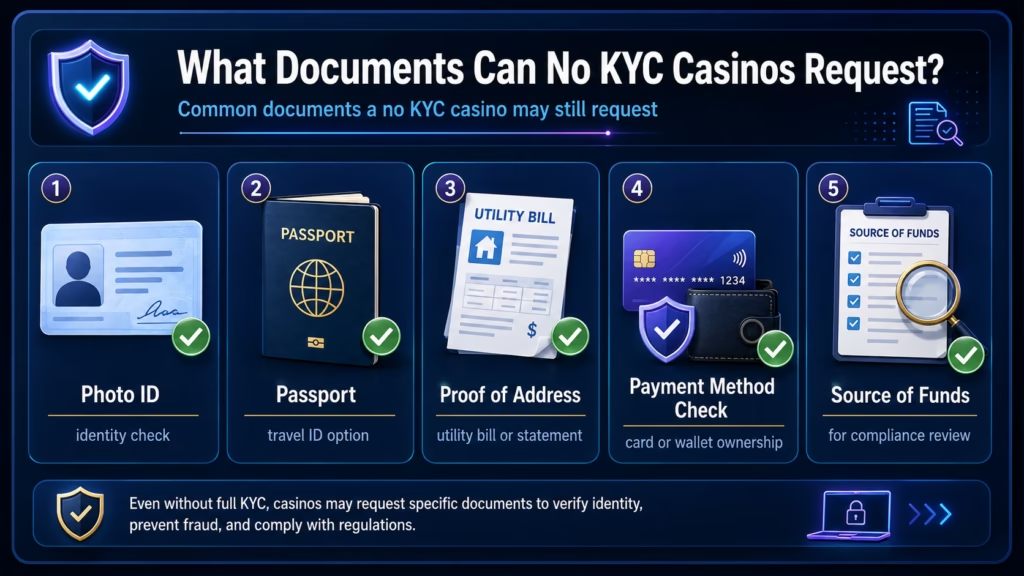
The documents required by no KYC casinos depend on what information the operator needs to verify. Identity, residential address, payment ownership and source of funds are separate questions, so one document may not satisfy every check.
| Verification purpose | Documents that may be requested |
| Identity | Passport, national identity card, government-issued photo ID, driving licence where accepted |
| Residential address | Utility bill, bank statement, government correspondence, rental agreement where accepted |
| Account ownership | Selfie, liveness verification, photo matching the identity document |
| Payment verification | Bank or payment account statement, transaction information or other evidence connecting the payment method to the player |
| Source of funds | Bank statements, income records, investment statements, sale documents or other evidence explaining where specific funds originated |
| Enhanced due diligence | Additional identity, financial or supporting documentation depending on the reason for the review |
The exact document list varies between operators and jurisdictions. A casino may also reject documents that are expired, illegible, incomplete or too old for the purpose of verifying a current address.
Government-Issued Photo ID
A passport or national identity document is one of the strongest forms of identity evidence a casino can request because it allows the operator to compare the player’s name, date of birth, photograph and identifying information against an authoritative source.
Regulated AML frameworks commonly expect identity verification to rely on reliable, independent information and may accept an unexpired government-issued document containing photographic evidence, such as a passport or identity card.
A no KYC casino may therefore advertise document-free registration while still requesting government ID if the account later requires formal customer due diligence.
Proof of Address
A proof-of-address document may be requested when a casino needs to confirm where the player actually lives. Common examples include bank statements, utility bills and certain government-issued correspondence.
Address checks can be important for determining whether the player is located in a permitted jurisdiction, whether account information is consistent and whether additional regulatory restrictions apply.
Depending on the operator and jurisdiction, documents such as bank statements, utility bills, letters from public authorities and rental agreements may be accepted as address evidence when an identity document does not verify residential address.
Selfie or Liveness Verification
A no KYC casino may request a selfie or biometric liveness check to determine whether the person controlling the account matches the identity document being submitted.
This type of check can be triggered by suspected account takeover, identity theft, duplicate accounts or other fraud indicators. It should not automatically be interpreted as proof that the casino is acting improperly.
A liveness check is different from traditional document KYC because its main purpose is usually to establish that a real person is present and controls the identity being presented.
Can a No KYC Casino Ask for Bank Statements?
Yes. A no KYC casino can potentially request bank statements when financial activity requires additional verification, especially for source-of-funds, affordability, payment or AML purposes.
A bank statement may help establish several facts at once, including the player’s address, ownership of a bank account and the origin or movement of money. The operator should still have a legitimate compliance or account-related reason for requesting financial information.
Bank statements may be used during source-of-funds and anti-money laundering checks. Regulated casino operators can also be required to monitor customer activity on an ongoing basis and obtain additional source-of-funds information when necessary.
Players should distinguish source of funds from source of wealth. Source of funds concerns the origin of money used for a particular transaction or gambling activity. Source of wealth concerns how the person’s overall wealth was accumulated.
Can Crypto Casinos Request Source-of-Funds Evidence?
Yes. Using Bitcoin, Ethereum, USDT or another cryptocurrency does not automatically exempt a casino account from source-of-funds checks.
A crypto casino may need to understand whether gambling funds are consistent with the player’s risk profile and whether transactions create money laundering, sanctions or financial crime concerns. The exact evidence requested can differ substantially between operators.
Regulated AML frameworks can require ongoing scrutiny of transactions and, where necessary, consideration of a player’s source of funds. These obligations may also apply when cryptocurrency is used as a funding method.
This means the practical distinction between a crypto casino and a traditional casino is usually the payment technology, not the disappearance of AML obligations.
When Can a No KYC Casino Trigger Verification?
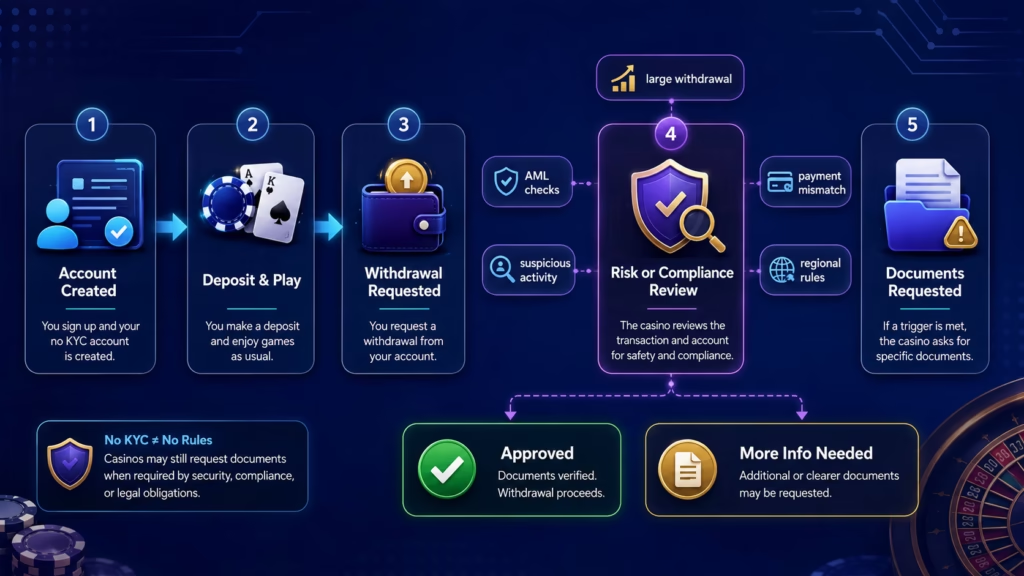
A no KYC casino can trigger additional verification when the player’s account moves outside the operator’s normal low-risk profile. There is no single worldwide trigger that applies to every casino.
Potential triggers include unusually large or changing transaction patterns, discrepancies in personal information, suspicious account activity, sanctions screening issues, fraud indicators or doubts about information previously supplied.
Regulated casino AML frameworks may require customer due diligence when money laundering or terrorist-financing activity is suspected or when the operator doubts the accuracy or adequacy of previously obtained verification information. Ongoing monitoring can also require updated information when customer circumstances change.
Verification therefore does not always happen because a specific withdrawal amount has been reached. Risk-based systems can respond to the pattern and context of activity rather than one fixed number.
Can Verification Be Requested During a Withdrawal?
Yes. A casino may sometimes require additional information during a withdrawal if a legitimate compliance issue only becomes relevant at that stage, although regulated operators in some jurisdictions are restricted from deliberately delaying verification until withdrawal when the information could reasonably have been requested earlier.
Some regulatory frameworks state that operators should not make proof of age or identity a withdrawal condition when those checks could have been performed previously. However, additional information may still be required at withdrawal to fulfil legal obligations such as AML checks.
For players, the practical lesson is simple: read the withdrawal and verification policy before depositing. A casino that says “no KYC registration” may have substantially different rules for withdrawals.
No KYC vs Anonymous Casino: They Are Not the Same Thing
A no KYC casino should not automatically be treated as an anonymous casino. An operator can collect less information at registration while still recording IP information, transaction records, payment data, device information or other account information permitted under its policies and applicable law.
Regulated casinos may cross-reference player information against geolocation, IP-address and funding-method data when verifying customer information.
Players whose main priority is privacy should therefore examine exactly what information is collected rather than focusing only on whether a passport upload is required.
How to Evaluate Verification Rules Before Choosing a No KYC Casino
The best way to assess a no KYC casino is to examine what happens before and after registration, not simply whether the homepage advertises instant or document-free signup.
Start with the casino’s terms, KYC or AML policy, withdrawal rules and restricted-country policy. Check whether the operator explains circumstances in which additional verification may be requested and whether there are withdrawal limits or enhanced checks connected to larger transactions.
Pay particular attention to vague statements allowing the casino to demand “any documents” without explaining the purpose. Flexible compliance language is normal because AML checks are risk based, but legitimate operators should still provide understandable terms describing verification procedures and account restrictions.
If minimizing routine verification is important, look for an operator that clearly explains which checks are automatic, when manual documents become necessary and whether electronic verification is used.
Common Misconceptions About No KYC Casino Verification
“No KYC means the casino cannot ask for my passport.” This is incorrect. A casino may reserve the right or have a regulatory obligation to verify identity under particular circumstances.
“Crypto deposits make KYC impossible.” Crypto transactions can still be reviewed as part of AML and source-of-funds procedures.
“If I deposited without documents, the casino cannot request them later.” Registration requirements and ongoing customer due diligence are separate processes. Risk can be reassessed after the account has been opened.
“Every document request means the casino is trying to avoid paying.” Verification can be legitimate, particularly when AML or fraud checks are required. However, unreasonable or unexplained document requests, repeated requests for the same evidence or prolonged withdrawal delays deserve closer scrutiny under the operator’s complaints and licensing procedures.
How This Information Was Reviewed
The information in this guide is based on the distinction between simplified registration, identity verification, customer due diligence and enhanced AML checks. Current gambling-regulation frameworks show that regulated casino operators can be required to identify customers, verify information using reliable sources and monitor transactions over time.
Verification requirements vary by licence, country, operator and individual risk assessment. Players should therefore check the casino’s current terms and licensing information before depositing.
Casino gambling should be treated as entertainment rather than a way to generate income. Set spending limits before playing, never gamble with money needed for essential expenses and stop if gambling is becoming difficult to control.
FAQ
Do no KYC casinos require documents?
No KYC casinos may require documents even when verification is not required during ordinary registration. A document request can be triggered by AML requirements, suspicious activity, account-security concerns, withdrawal checks or inconsistencies in customer information.
What are the most common no KYC casino verification documents?
The most common documents can include a passport or government-issued ID, proof of address, bank statements and identity confirmation such as a selfie. The exact requirements depend on the operator and reason for verification.
Can a no KYC casino request my passport before paying a withdrawal?
Yes, it can be possible if identity verification becomes legitimately necessary. However, some regulated jurisdictions restrict casinos from postponing routine identity checks until withdrawal when those checks could reasonably have been completed earlier.
Can a crypto casino ask where my money came from?
Yes. Crypto casinos can perform source-of-funds checks where AML rules or the operator’s risk assessment require them. Cryptocurrency does not automatically remove customer due diligence obligations.
Can a casino ask for a selfie with my ID?
Yes. A selfie or liveness check may be used to confirm that the person controlling the casino account matches the identity document, particularly when fraud or identity theft is suspected.
Is proof of address always required at a no KYC casino?
No. Proof of address is not necessarily required from every no KYC casino player. It may be requested when the casino cannot verify the player’s residence electronically or when jurisdiction, fraud or AML checks make residential verification necessary.
Why does a casino suddenly ask for KYC after I have already played?
A casino can request KYC later because customer due diligence may continue throughout the account relationship. Changing transaction patterns, updated risk information or doubts about previously supplied information can trigger additional checks.
Does no KYC mean completely anonymous gambling?
No. No KYC and anonymous gambling are not equivalent. An operator may avoid routine passport uploads while still processing transaction information, IP data, geolocation signals and other account information according to its terms and applicable regulations.
Should I avoid a no KYC casino that reserves the right to request documents?
Not automatically. The ability to request documents can be a normal part of AML and fraud controls. What matters is whether the casino clearly explains its verification policy, operates under identifiable rules and handles withdrawals and document requests consistently.
In short
A no KYC casino can still request verification documents, including identification, proof of address, financial information, selfies and source-of-funds evidence. “No KYC” usually refers to reduced or delayed routine verification, not a guarantee that documents will never be required.
Before depositing, check the casino’s KYC, AML and withdrawal terms and assume that verification may become necessary if account activity triggers additional checks. Gambling outcomes remain uncertain, so play within fixed limits and treat casino games as entertainment rather than a source of income.