
Real-money online casinos are not legally permitted to be offered in India under the current nationwide framework. As of September 2026, the Promotion and Regulation of Online Gaming Act, 2025, together with the Promotion and Regulation of Online Gaming Rules, 2026, prohibits the offering of “online money games”. The Rules came into force on May 1, 2026. The definition covers online games based on skill, chance, or both when users pay money or other stakes with an expectation of monetary or similar enrichment.
For casino players, the most important points are:
- Real-money slots, roulette, blackjack and similar online casino games normally fit the federal definition of an online money game.
- The prohibition applies across India, not only in states that previously banned online gambling.
- The law also applies when an online money gaming service is operated outside India but offered within India.
- Advertising online money games and facilitating payments for them are separately prohibited.
- State gambling laws still matter because they can impose additional restrictions and offences alongside the federal framework.
The practical result is that older explanations of India online casino laws based mainly on whether a player lives in Goa, Sikkim, Telangana or another state are now incomplete. The federal rules introduced in 2026 changed the legal starting point for the whole country.
Are Online Casinos Legal in India?
Real-money online casino services fall within India’s nationwide prohibition on online money games when players stake money or other value in expectation of winning money or another form of monetary enrichment. Section 2 of the Promotion and Regulation of Online Gaming Act defines an online money game broadly and explicitly says that the classification applies regardless of whether the game is based on skill, chance, or a combination of both.
That makes traditional casino games relatively straightforward. A real-money slot, roulette table, baccarat game or casino blackjack game involves staking value for the possibility of receiving more value in return. These games therefore normally satisfy the core elements of an online money game.
Section 5 prohibits offering or facilitating online money gaming services. Section 6 prohibits advertising that directly or indirectly promotes online money games, while Section 7 prohibits banks, financial institutions and other payment facilitators from facilitating payments for online money gaming services.
This is an important distinction for players. The central Act is particularly focused on operators, advertisers and payment facilitation. Whether a player’s own conduct creates separate liability can also depend on the applicable state gambling law and the circumstances. Anyone facing an actual investigation, payment dispute or enforcement issue should obtain advice from an Indian lawyer rather than relying on a general casino guide.
What Changed Under the Promotion and Regulation of Online Gaming Act?
India previously had a fragmented gambling framework. State legislation and court decisions were especially important because different states treated gambling and games of skill differently.
The Promotion and Regulation of Online Gaming Act, 2025 created a nationwide framework. The final Promotion and Regulation of Online Gaming Rules, 2026 were notified on April 22, 2026 and came into force on May 1, 2026. The government also constituted the Online Gaming Authority of India to administer the framework.
The law divides online gaming into several broad categories.
Online money games
An online money game involves a user paying fees, depositing money or staking other value with the expectation of receiving monetary or similar enrichment. It does not matter whether the game is predominantly skill-based or chance-based.
Real-money online casino games normally belong in this category.
Online social games
An online social game does not involve wagering money or other stakes for monetary gain. The Act allows a subscription or one-time access fee when that payment is genuinely an access fee rather than a stake or wager.
A casino-style game using purely recreational credits that cannot be converted into money or something of monetary value may therefore be fundamentally different from a real-money online casino.
E-sports
Recognized e-sports can involve legitimate participation or registration fees and performance-based prizes, but they cannot involve betting or wagering. The Act specifically excludes qualifying e-sports from its definition of online money games.
Do State Online Casino Laws Still Matter?
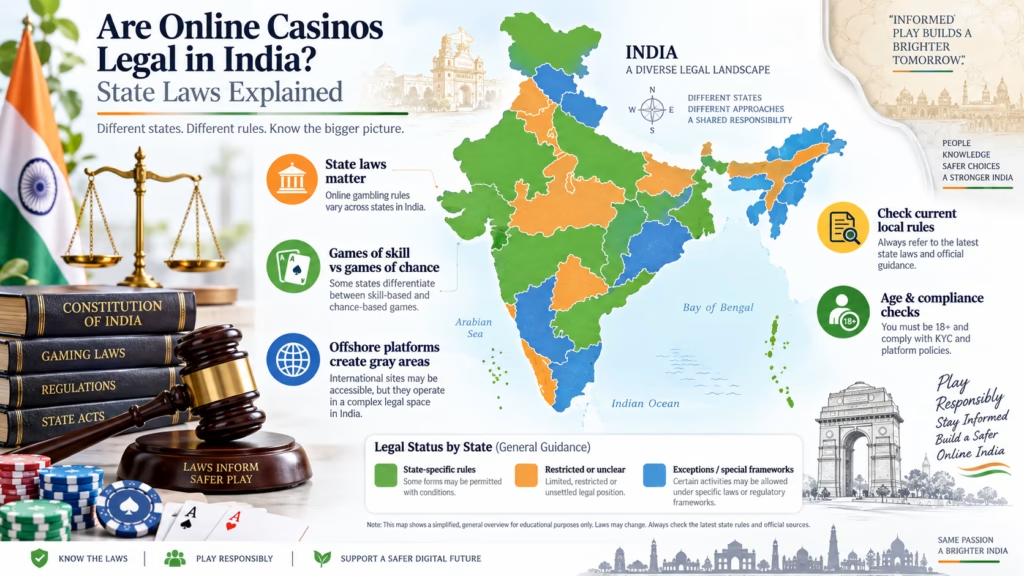
Yes. Indian state gambling laws remain relevant even though online money games are now subject to a nationwide federal prohibition. Section 18 of the Promotion and Regulation of Online Gaming Act states that its provisions operate in addition to other laws. Where another Act is inconsistent with the federal Act, the federal provisions override the inconsistency to that extent.
This means a state law cannot simply turn a federally prohibited online money game into a permissible nationwide real-money casino service. State legislation can still impose additional restrictions, penalties or regulatory obligations.
| State or jurisdiction | Why its gambling law matters in 2026 |
| Tamil Nadu | Tamil Nadu has a dedicated Prohibition of Online Gambling and Regulation of Online Games Act and its own Online Gaming Authority. The state framework remains active alongside the federal regime. |
| Telangana | Telangana amended its Gaming Act to expressly cover online gaming for money or other stakes and even included risking money on the result of a game of skill within its wagering provisions. |
| Andhra Pradesh | The 2020 amendment brought cyberspace and playing online games for money or other stakes into the state’s Gaming Act. |
| Sikkim | Sikkim historically created a licensed gaming framework, but its regulated online gaming model was restricted to intranet gaming terminals that could not operate outside Sikkim’s geographical boundaries. |
| Nagaland | Nagaland’s licensing regime was designed for online games of skill, not a general authorization for chance-based online casinos. The federal prohibition on money games now applies regardless of the traditional skill versus chance distinction. |
| Goa | Goa allows specified casino gaming in authorized physical locations and offshore vessels. That does not create a general exemption for internet casinos serving players throughout India. |
| Karnataka | Karnataka’s 2021 attempt to broadly prohibit online games involving stakes was struck down by the High Court in 2022. That older judgment should not be interpreted as making real-money online casinos legal in Karnataka under the nationwide 2026 framework. |
This table highlights important examples rather than every gambling statute in every Indian state and union territory.
Are Offshore Online Casinos Legal for Indian Players?
An offshore casino licence does not override Indian online gaming law. The Promotion and Regulation of Online Gaming Act expressly extends to online money gaming services offered within India, including services operated from outside Indian territory.
A casino being licensed in another jurisdiction therefore answers a different question. A foreign licence may show that the operator is regulated somewhere, but it does not automatically give that operator permission to offer real-money online casino services to users in India.
This also means that statements such as “the casino accepts Indian players” or “the website is accessible from India” should not be treated as evidence of legality. Technical accessibility and legal authorization are separate issues.
Does Using Cryptocurrency Make an Online Casino Legal?
Cryptocurrency does not create a general exemption from India’s online money gaming rules. The Act’s definition of “other stakes” includes credits, coins, tokens, objects and similar items that are equivalent or convertible to money and are purchased directly or indirectly with money.
A crypto casino in which a user deposits cryptocurrency, wagers it and can receive cryptocurrency or other convertible value in return can therefore still satisfy the basic characteristics of an online money game.
Changing the payment method from INR to Bitcoin, USDT or another digital asset does not by itself change the underlying nature of the game.
What About VPNs and Geo-Blocking?
A VPN does not change whether an online money gaming service is prohibited under Indian law. Geographic blocking is a technical access restriction, not a legal exemption.
If a casino does not accept users from India, bypassing that restriction may also conflict with the operator’s terms and create additional problems with account verification or withdrawals. Players should not interpret the ability to open a website through a VPN as evidence that the service can legally be offered in India.
Are Free Casino Games Legal?
Casino-style games without real-money wagering can fall into a different category from online money games.
An online social game under the federal Act must not involve staking money or other stakes or participation with an expectation of monetary gain. It may charge a genuine subscription or access fee provided that the payment is not actually a wager.
For example, a blackjack simulator using non-purchasable, non-convertible virtual chips purely for entertainment is legally different from a blackjack table where a player deposits ₹1,000 and can withdraw winnings.
Players should pay particular attention to purchased virtual currencies. Calling something “coins”, “credits” or “tokens” does not necessarily make it play money if those assets are bought with money or can be converted into monetary value.
Does the Skill vs Chance Distinction Still Matter?
The skill versus chance distinction is much less useful for determining whether a real-money online game is permitted under the 2025 federal Act. The definition of an online money game expressly covers games based on skill, chance or both.
Historically, this distinction was extremely important. Indian courts and state legislation often treated games of skill differently from gambling. For example, earlier litigation in Tamil Nadu and Karnataka focused heavily on whether rummy, poker and similar activities were predominantly games of skill.
For a traditional online casino player, however, that debate does little to change the present conclusion. Slots, roulette and similar games already involve substantial chance, while the federal money-game definition now reaches real-money games even where skill is involved.
Is Online Casino Advertising Legal in India?
Advertising an online money game is prohibited under the federal Act. Section 6 covers advertisements in media, including electronic communication, that directly or indirectly promote or induce people to play online money games.
This matters not only to casino operators but also to publishers, influencers and other parties involved in promotional activity. Promotional casino content, bonus advertising or affiliate activity intended to induce Indian users to play real-money games may create legal issues under the broad wording of the prohibition. The application of the law to a specific website, advertisement or commercial arrangement should be assessed by qualified Indian counsel.
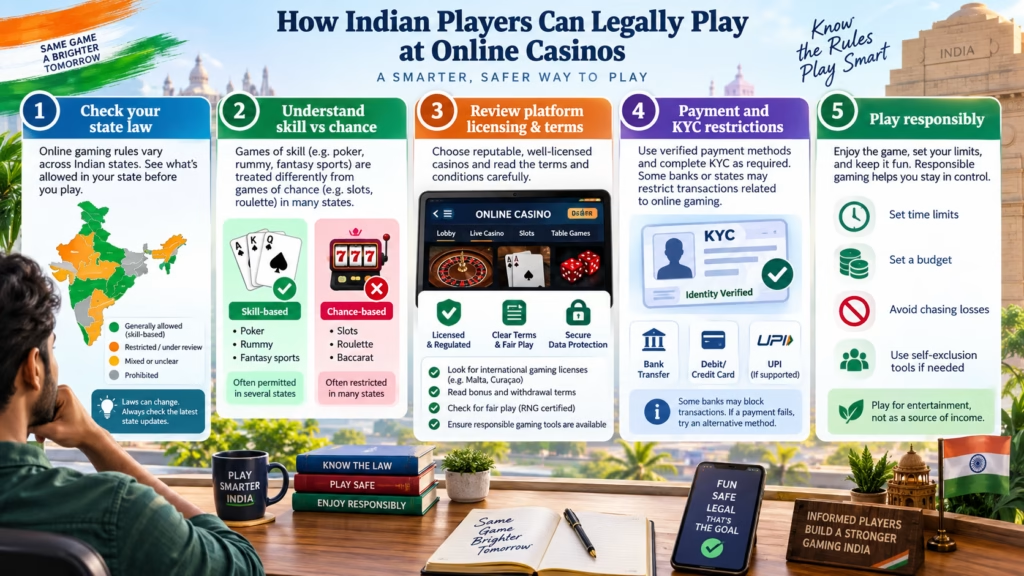
How to Check Whether an Online Game Is Permitted in India
Do not rely only on a casino’s homepage, foreign licence or claim that Indian players are accepted.
- Determine whether money or another stake is involved. If users deposit or stake value to obtain monetary enrichment, the game may fall within the online money game definition.
- Check whether virtual coins or tokens have monetary value. Purchased or convertible tokens can count as other stakes.
- Check the Online Gaming Authority of India framework. The 2026 Rules allow games to be formally determined and require the Authority to publish information about online money games.
- Check applicable state legislation. State laws can add restrictions and penalties.
- Do not confuse a foreign licence with Indian authorization. A casino regulated abroad can still be prohibited from offering an online money gaming service in India.
- Obtain legal advice for borderline cases. This is particularly important for new game formats involving tokens, competitions, entry fees or hybrid reward systems.
Common Myths About India Online Casino Laws
“Online casinos are legal because India has no national gambling law”
That description is outdated. India now has the Promotion and Regulation of Online Gaming Act, 2025 and the operational Rules that came into force on May 1, 2026.
“Online casinos are legal if the company is offshore”
The Act also applies to online money gaming services operated outside India when they are offered within India.
“Sikkim licences make online casinos legal across India”
Sikkim’s legacy system is geographically restricted. The state’s own framework does not provide a nationwide authorization for online casino services.
“Goa has casinos, so online casinos must be legal”
Goa’s casino regime concerns authorized gaming in specified locations, including qualifying hotels and offshore vessels. It is not a nationwide internet casino licence.
“Skill games are automatically legal for money”
That is no longer a reliable rule for online gaming under the federal Act. Its online money game definition expressly applies irrespective of whether a game depends on skill, chance or both.
How This Information Was Reviewed
This overview is based primarily on the Promotion and Regulation of Online Gaming Act, 2025, the Promotion and Regulation of Online Gaming Rules, 2026, official government information, state legislation and relevant court decisions.
The central Rules came into force on May 1, 2026, so older casino-law articles may no longer accurately describe the current position. State legislation should still be checked because Section 18 preserves other applicable laws except where they conflict with the federal Act.
This article provides general information, not individualized legal advice. Gambling laws, regulatory classifications and enforcement practices can change. Casino gambling should also be treated as entertainment rather than a way to make money, and no casino game offers guaranteed winnings.
FAQ
Are online casinos legal in India?
Real-money online casinos are generally caught by India’s prohibition on online money games when players stake money or other value with an expectation of monetary gain. The federal framework has applied nationwide since May 1, 2026.
Is online gambling banned throughout India?
Online money games are subject to a nationwide federal prohibition. State gambling laws also remain applicable and can impose additional restrictions or penalties.
Can Indian players legally use foreign online casinos?
A casino being located or licensed abroad does not exempt it from Indian law. The federal Act expressly covers online money gaming services operated outside India when offered within India.
Are online slots legal in India?
Real-money online slots normally meet the characteristics of an online money game because players stake value for the possibility of receiving monetary winnings. Free-play slots without monetary or convertible stakes may fall into a different category.
Are crypto casinos legal in India?
Using cryptocurrency does not create a general exemption. Purchased or convertible coins and tokens can qualify as other stakes, so a casino using crypto can still fall within the online money game prohibition.
Are online casinos legal in Goa?
Goa permits certain casino gaming in specifically authorized physical locations and offshore vessels, but that framework should not be interpreted as general permission to operate or play real-money internet casinos under the nationwide online gaming regime.
Are online casinos legal in Sikkim?
Sikkim has historically regulated certain gaming activities, but its online gaming model was restricted to intranet terminals operating within the state’s geographical boundaries. It does not provide a nationwide exemption from the federal prohibition on online money games.
Are games of skill legal for real money in India?
The traditional skill versus chance distinction no longer determines the answer under the federal online money game definition. The 2025 Act covers qualifying money games whether they are based on skill, chance or both, although recognized e-sports meeting the statutory requirements are treated separately.
Is it legal to advertise an online casino in India?
Advertising online money games is prohibited by Section 6 of the Promotion and Regulation of Online Gaming Act. The provision covers advertising that directly or indirectly promotes or induces participation in online money games.
Brief Conclusion
As of September 2026, real-money online casinos cannot lawfully be offered in India under the current federal online gaming framework. The law covers money games based on chance, skill or both, applies to offshore services offered into India, and also restricts advertising and payment facilitation. State laws remain relevant, but historical exceptions in places such as Goa, Sikkim or Nagaland should not be treated as a general route around the nationwide rules. Players should verify current official regulations before participating and treat casino gaming as entertainment, never as a source of income.