Casino loyalty points for high rollers are rewards earned through eligible casino activity, usually based on wagering volume, game type, theoretical casino advantage, deposits, or a combination of these factors. High-volume players may receive faster point accumulation, VIP tier multipliers, cashback, free play, personalized promotions, withdrawal benefits, or non-cash perks, but the actual value varies significantly between casino programs.
Quick takeaways:
- Loyalty points are not automatically worth the same amount at every casino.
- High rollers should compare the effective reward rate, not simply the number of points awarded.
- Slots, table games and live casino games may earn points at different rates.
- VIP tiers can increase rewards, but higher status may require substantial wagering.
- Point expiration, redemption limits and wagering requirements can reduce real value.
- Loyalty rewards should be treated as a benefit on gambling you already intended to do, not a reason to increase spending.
Casino loyalty programs are most relevant to players who already generate substantial eligible wagering and want to understand how much value they receive in return. A program becomes less attractive when earning rules are unclear, rewards expire quickly, redemption is restrictive, or maintaining VIP status encourages more gambling than the player originally planned.
What Are Casino Loyalty Points for High Rollers?
Casino loyalty points are a form of reward currency credited to a player’s account for qualifying casino activity. Players can usually exchange accumulated points for rewards such as bonus funds, free spins, free play, cashback, tournament entries, merchandise or other benefits defined by the operator.
For high rollers, loyalty programs can work differently from standard player programs. A casino may offer accelerated point earning, higher conversion rates, dedicated VIP promotions or separate reward structures for players who reach upper loyalty tiers.
The important distinction is that points earned and points value are not the same thing. One casino might award 1,000 points for a certain level of activity while another awards 100,000. Those numbers mean little until the redemption value and earning requirements are considered.
A high roller should therefore ask two questions:
- How much eligible wagering is required to earn the points?
- What monetary or practical value can those points actually provide?
That calculation gives a much better picture of a loyalty program than the advertised point balance alone.
How Casino Loyalty Points Are Usually Earned
Casino loyalty points may be awarded according to eligible wagering, although the exact formula depends on the operator.
A simple system might award a fixed number of points for every unit wagered. A more sophisticated program may consider the type of game, theoretical house advantage, player tier or promotional multiplier.
For example, imagine a casino awards 1 loyalty point for every $10 of eligible slot wagering.
A player wagering $20,000 would earn: $20,000 ÷ $10 = 2,000 points.
This does not mean the player has earned $2,000. The next step is determining the casino’s point conversion rate.
Different games can also contribute differently. Slots may generate points faster than blackjack, baccarat or roulette because operators often calculate rewards partly around expected casino margin.
Some casinos may exclude certain games entirely from loyalty calculations.
High rollers should check whether the program specifies:
- eligible games;
- wagering-to-point ratios;
- different rates for slots and table games;
- live casino contribution;
- promotional point multipliers;
- VIP tier multipliers;
- maximum points per period;
- excluded games or bets.
Without these details, comparing two programs accurately is difficult.
VIP Casino Points Value: How to Calculate the Real Reward
The VIP casino points value is best measured by converting points into their actual redeemable value and comparing that value with the wagering required to earn them.
Suppose a casino requires 1,000 points to redeem $10 in rewards.
Each point is therefore worth: $10 ÷ 1,000 = $0.01 per point.
If a player earns one point for every $10 wagered, generating 1,000 points requires $10,000 in eligible wagering.
The effective loyalty return would therefore be: $10 ÷ $10,000 × 100 = 0.10%.
This percentage is more informative than the number of points displayed in the account.
Example of Different Loyalty Programs
| Program | Wagering | Points Earned | Redemption Value | Effective Reward |
| Program A | $10,000 | 1,000 | $10 | 0.10% |
| Program B | $10,000 | 5,000 | $15 | 0.15% |
| Program C | $10,000 | 20,000 | $10 | 0.10% |
Program C appears more generous because it awards 20,000 points, but its actual value is identical to Program A in this example.
High rollers should therefore avoid judging loyalty programs by large point numbers. The meaningful metric is the value received relative to qualifying activity.
Loyalty Points vs Cashback vs Free Play
Loyalty points, cashback and free play can all appear in VIP programs, but they should not automatically be treated as equivalent.
Loyalty points are usually accumulated and later exchanged for available rewards. Their usefulness depends on the redemption catalogue and conversion rate.
Cashback generally returns a defined portion of qualifying losses or activity under specific conditions. Casinos may apply caps, eligibility requirements or calculation periods.
Free play or bonus funds provide additional casino wagering value but may not be withdrawable as cash immediately. Wagering requirements, eligible games, maximum conversions and other restrictions may apply.
For a high roller, flexible rewards are generally easier to evaluate than complicated rewards with several restrictions.
A $100 reward that can be converted straightforwardly may provide more practical value than a nominal $200 bonus with restrictive wagering or withdrawal conditions.
Always check the applicable terms before assigning cash value to a casino reward.
How VIP Tiers Affect Loyalty Points
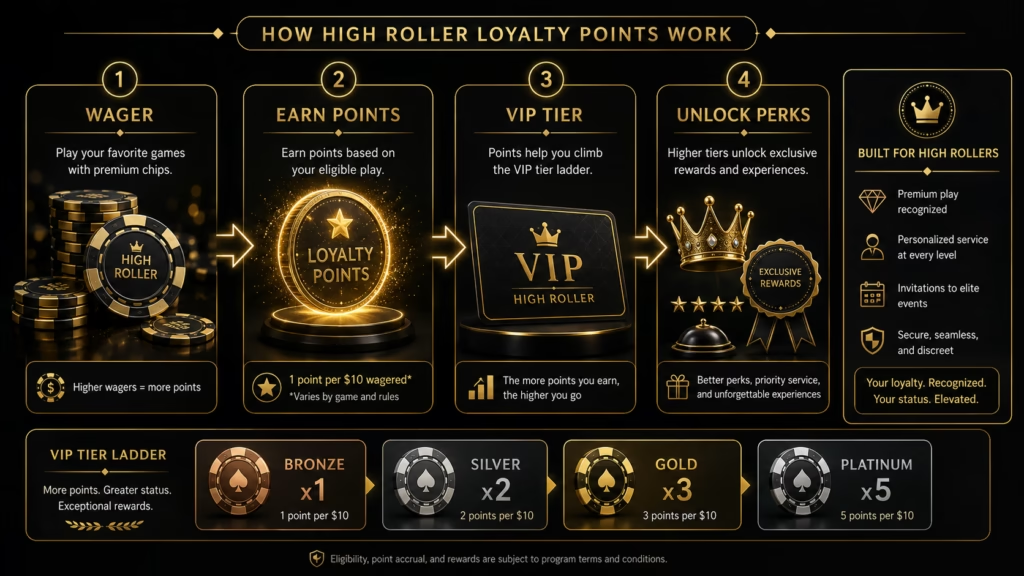
VIP tiers can increase casino loyalty value by providing better point multipliers or additional benefits as players progress through the program.
A hypothetical structure could look like this:
- Entry tier: 1× points
- Intermediate tier: 1.25× points
- Advanced tier: 1.5× points
- Premium tier: 2× points
If the base earning rate produces 1,000 points, a 2× multiplier could increase the award to 2,000 points.
However, the multiplier should not be evaluated separately from the requirements for maintaining the tier.
A premium VIP level may require substantially more qualifying activity. Increasing gambling solely to obtain a higher multiplier can easily cost more than the additional rewards are worth.
High rollers should calculate the benefits based on their normal activity rather than treating the next VIP tier as a target that must be reached.
What High Rollers Should Compare Between Loyalty Programs
A strong casino loyalty program should be understandable enough for a player to estimate its value before committing significant activity.
1. Earning Rate
Check how much qualifying wagering generates one point. A program with a transparent ratio is easier to evaluate than one using an unclear proprietary formula.
2. Point Conversion Rate
Determine what accumulated points can actually buy. If 10,000 points equal $10 in rewards, that conversion should be compared with how much wagering was needed to generate the 10,000 points.
3. Game Contribution
Casino games may earn loyalty points at different rates. A player who primarily uses blackjack, baccarat or live dealer games should not assume a program advertised heavily around slots will provide the same reward rate.
4. Tier Multipliers
Higher tiers may provide stronger earning rates. Calculate whether the multiplier materially changes the effective reward percentage rather than focusing only on the multiplier advertised.
5. Point Expiration
Some programs may remove inactive or older points after a specified period. Expiration matters especially for players who gamble heavily for short periods but then take long breaks.
6. Redemption Restrictions
Check whether points can be exchanged for cash-equivalent rewards, free play, bonuses, merchandise or only selected benefits. The more restricted the redemption system, the harder it is to treat the advertised balance as real monetary value.
7. Bonus Wagering Requirements
A loyalty reward credited as bonus funds may be subject to wagering conditions. For example, $100 in loyalty bonus funds should not automatically be valued as $100 in withdrawable cash.
8. Limits and Caps
Programs can impose daily, weekly or monthly earning limits. Caps matter more to high rollers because a player may exceed standard reward thresholds quickly.
Are High Roller Loyalty Programs Better Than Standard Programs?
High roller loyalty programs can offer more valuable benefits, but they are not automatically better on an effective-return basis.
A premium program may include accelerated point earning, dedicated support, exclusive promotions, withdrawal advantages, event invitations or personalized rewards. These benefits can have genuine practical value for players who would naturally qualify.
However, some VIP features are difficult to compare financially. Priority customer support, account management or event access may be valuable to one player and irrelevant to another.
For this reason, high rollers should separate rewards into two categories:
Measurable value: cashback, point conversion, bonus value and free play.
Personal value: support, events, hospitality, gifts and convenience features.
This prevents attractive VIP branding from obscuring the actual financial structure of the loyalty program.
Common Mistakes High Rollers Make With Loyalty Points
Chasing the Next VIP Level
The most important mistake is increasing wagering specifically to maintain or reach a VIP tier. If another $20,000 of wagering is needed to unlock $100 of additional rewards, the reward should not be treated as a reason to generate that extra activity.
Looking Only at Point Multipliers
A 5× points promotion sounds significant, but its real value depends on the base earning rate and redemption value. Five times a very small base reward may still represent a relatively small benefit.
Assuming Every Game Earns Equally
Table games and live casino titles may earn points more slowly than slots, or certain bets may not qualify. Players should verify contribution rules for the games they actually use.
Ignoring Expiration
A large balance has limited value if points expire before the player expects to redeem them.
Treating Bonus Value as Cash
Bonus funds can have conditions that ordinary cash does not. Always check wagering requirements, game restrictions, maximum conversions and withdrawal rules.
A Practical Way to Compare Casino Loyalty Programs
High rollers can compare loyalty programs using a simple four-step method.
Step 1: Estimate normal wagering. Use the amount of gambling activity you would realistically generate without trying to reach a loyalty target.
Step 2: Calculate expected points. Apply the casino’s published earning ratio and relevant game contribution.
Step 3: Convert points into reward value. Use the redemption rate applicable to the reward you would actually choose.
Step 4: Calculate effective reward percentage. Use: Reward value ÷ qualifying wagering × 100.
For example, $50 of usable rewards generated from $25,000 of eligible wagering equals: $50 ÷ $25,000 × 100 = 0.20%.
The calculation does not predict gambling results or make wagering profitable. It simply measures one component of the loyalty program.
When Casino Loyalty Points Are Most Useful
Casino loyalty points are most useful when they reward activity a player already planned rather than influencing the player to gamble more.
A program may be particularly relevant for a high roller who:
- consistently generates substantial eligible wagering;
- plays games that receive reasonable loyalty contribution;
- can redeem points for rewards they actually value;
- understands expiration and redemption rules;
- qualifies for VIP multipliers without changing normal spending;
- compares loyalty value as part of the overall casino offering.
Loyalty points become less useful when earning rules are difficult to verify or when status targets begin influencing wagering decisions.

How This Information Was Reviewed
The value of casino loyalty points should be evaluated through earning requirements, point conversion, game contribution, VIP multipliers, redemption restrictions, expiration and reward conditions.
Exact rules depend on the casino, jurisdiction and loyalty program. Players should therefore check the operator’s current VIP terms, loyalty rules and bonus conditions before relying on any advertised reward value.
Loyalty points, cashback and VIP benefits do not change the random nature of casino games or guarantee profitable play. Gambling should be treated as entertainment, and players should set spending and time limits independently of loyalty status.
FAQ
How do casino loyalty points work for high rollers?
Casino loyalty points for high rollers are usually earned through qualifying wagering or other eligible casino activity. Higher VIP tiers may provide faster earning rates or point multipliers, but the exact rules differ between operators. Always check game contribution, conversion rates and redemption conditions.
How much are VIP casino points worth?
The value of VIP casino points depends on the casino’s conversion rate. Divide the redeemable reward value by the number of points required to obtain it. For example, if 5,000 points can be exchanged for $25 in usable rewards, each point has a nominal value of $0.005 before considering any additional restrictions.
Do high rollers earn casino points faster?
High rollers may earn points faster when a casino provides VIP tier multipliers or enhanced earning rates. This is not universal, and some programs use the same base earning system for all players while offering VIP benefits separately.
Do all casino games earn the same number of loyalty points?
No. Casinos may assign different loyalty contribution rates to slots, table games, live dealer games and other products. Some games or individual bets may generate reduced points or no points at all.
Can casino loyalty points be withdrawn as cash?
Some casino programs allow points to be converted into cash-equivalent rewards, while others restrict redemption to bonus funds, free play, spins, merchandise or other benefits. The applicable loyalty terms should state exactly how points can be redeemed.
Do casino loyalty points expire?
Casino loyalty points can expire depending on the operator’s rules. Expiration may be based on a fixed period or account inactivity, so high rollers who play intermittently should check this condition carefully.
Is cashback better than loyalty points?
Cashback can be easier to value because it may be expressed as a percentage, while loyalty points require conversion calculations. However, cashback conditions, limits and eligibility rules can also vary. The more valuable option depends on the effective reward and applicable restrictions.
Is it worth wagering more to reach the next VIP tier?
Increasing wagering solely to reach a higher VIP level is generally a poor way to evaluate a loyalty program. Additional gambling exposure can substantially exceed the value of the extra rewards. VIP status is better treated as a consequence of normal activity rather than a wagering target.
Do loyalty points improve my chances of winning?
No. Loyalty points do not change the mathematical outcome of casino games. They are a reward mechanism attached to qualifying activity, while individual game outcomes remain governed by the rules and randomness of the game.
What should high rollers check before choosing a VIP loyalty program?
High rollers should compare the earning rate, effective reward percentage, game contribution, point conversion, tier multipliers, expiration rules, redemption restrictions, wagering requirements and reward limits. These factors provide a more useful comparison than the advertised number of points alone.
Brief Conclusion
Casino loyalty points for high rollers can add measurable value to existing casino activity, but point totals alone are misleading. The useful comparison is the effective reward earned from normal qualifying wagering after considering conversion rates, game contribution, VIP multipliers, expiration and redemption restrictions.
A strong VIP program should reward activity the player already intended to make. Loyalty status should never become a reason to increase wagering, chase losses or exceed predetermined spending limits.