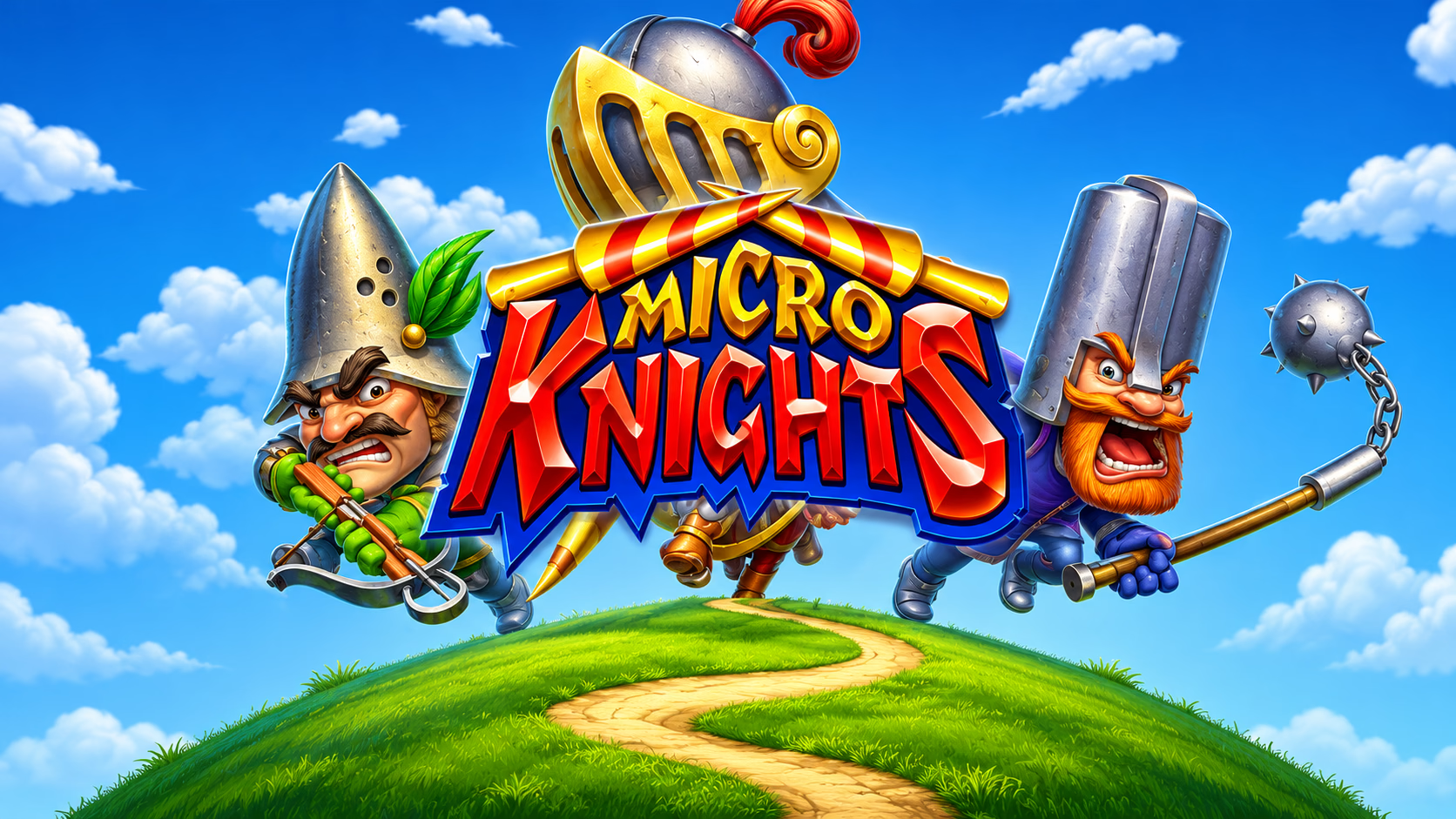
The Micro Knights slot by ELK Studios is a medieval-fantasy game built around a 7×7 grid, winning clusters of five or more matching symbols, and a queue that can turn symbols pushed off the board into further wins. Its defining feature is not the castle setting but the way three miniature knights interact with cascading symbols. The game also offers six flag features and a Free Drops round triggered by three crown scatters.
The commonly reported return to player (RTP) is 96%, with a maximum payout of 2,500 times the stake. Those figures describe theoretical game settings and an upper prize limit, not what any particular session will return. Players looking for a conventional five-reel slot should expect a markedly different rhythm here.
Micro Knights at a Glance
| Detail | What to know |
| Developer | ELK Studios |
| Theme | Medieval fantasy with three cartoon knights |
| Game layout | 7×7 grid, 49 symbol positions |
| Winning rule | Five or more matching symbols connected horizontally or vertically |
| Main mechanics | Avalanches, symbol queue, three knight abilities, six flag features |
| Reported RTP | 96% reference figure; check the version at the operator |
| Maximum win | 2,500× the total stake |
| Stake range | €0.20 to €100 in a published euro-denominated ruleset; local limits can differ |
| Bonus round | Five Free Drops from three crown scatters, with a possible retrigger |
| Demo | Free-play options are offered by the developer and some casino sites |
The volatility rating deserves a qualification. One data service cites a medium rating of 6/10 based on ELK game data, while an operator lists the game as high volatility at 7/10. These descriptions are not a dependable substitute for the rules and information panel of the particular game version you open.
How a Medieval Battle Becomes a Winning Cluster
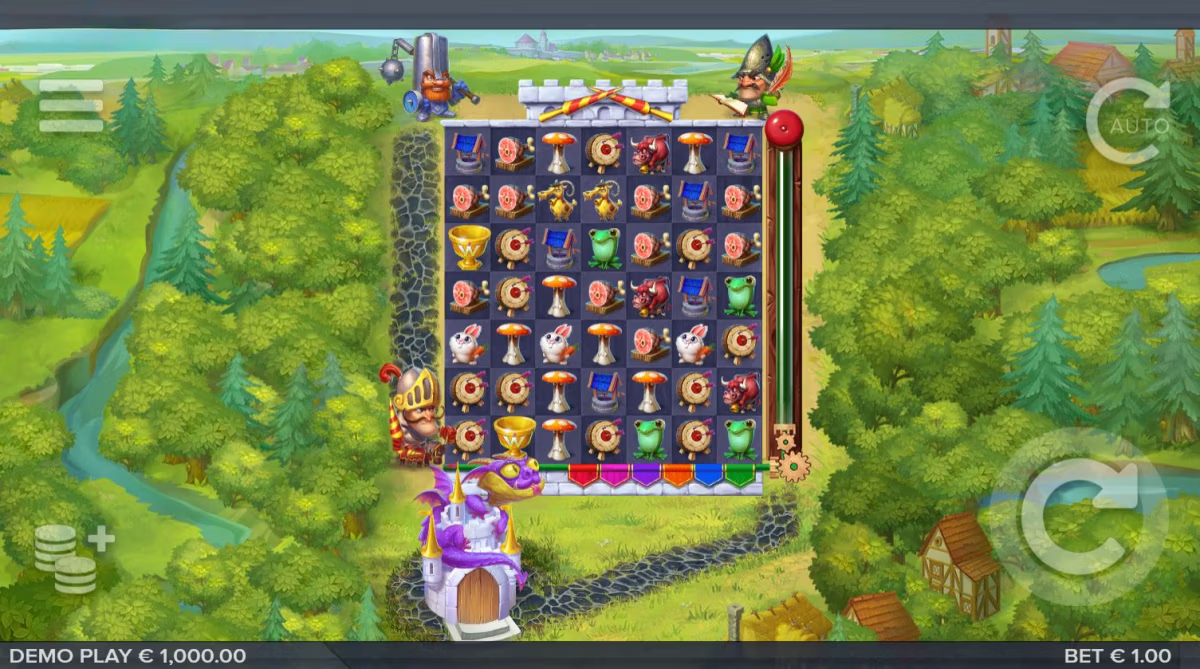
Rather than counting identical symbols along fixed paylines, Micro Knights looks for groups of at least five connected matching symbols. Connections can run horizontally or vertically. When a group qualifies, those symbols disappear, new ones fall into their places, and the game checks again. This repeating process is called an avalanche.
A single paid drop can therefore contain several evaluations. A win on the first board is not necessarily the end of the sequence. Just as importantly, a long avalanche is not a promise of a large payout: the symbol type, cluster size and published paytable still determine what is awarded.
Wild symbols can substitute for ordinary symbols, but not for bonus symbols. The crown scatter has a separate role in unlocking Free Drops. That distinction matters because a board full of wilds does not automatically count as a scatter-triggering result.
The Symbol Queue Is the Real Twist
The queue sits below the playing grid and stores ordinary symbols moved there by Sir Charge. It is more than a decorative reserve. Matching symbols in the queue can connect to groups on the grid, produce additional winning clusters, or increase the size of a cluster that already pays.
Consider a simplified illustration. Four connected matching symbols on the grid would be short of the five-symbol minimum. If an eligible symbol from the queue can join them under the game’s connection rules, the combined group may become a payable cluster. This is an explanation of the rule, not a prediction of what will happen in any drop.
The queue gives the game an unusual feedback loop: symbols displaced during one part of the action can contribute to later wins. It also makes the presentation harder to read at first glance. Watching the queue in a Micro Knights demo is useful because the significance of a knight’s move is not always apparent from the 7×7 grid alone.
What the Three Knights Actually Do
Sir Charge moves selected ordinary symbols from a row into the queue after an avalanche sequence. Wilds and bonus symbols are not carried into it. The resulting queue can interact with newly falling symbols.
Sir Smash can increase the number of symbols in the queue’s groups by one. His effect improves the queue’s potential to complete or enlarge clusters, without guaranteeing a particular prize.
Sir Count tracks the symbols involved in winning clusters using a meter. Larger qualifying groups contribute more progress. Filling the meter grants a flag feature, which is played after the current avalanche flow ends. Multiple earned effects can restart the action.
These knight actions are game features, not player-controlled moves. There is no demonstrated timing trick or stake pattern that lets someone choose when Sir Charge will run or which flag will appear.
Six Flag Features and Their Different Jobs
Flag features can appear in the base game as the meter fills and can also influence the Free Drops bonus. They do not all work in the same way. Some directly change the grid; others make the queue more important.
| Flag feature | Confirmed effect | Why it matters |
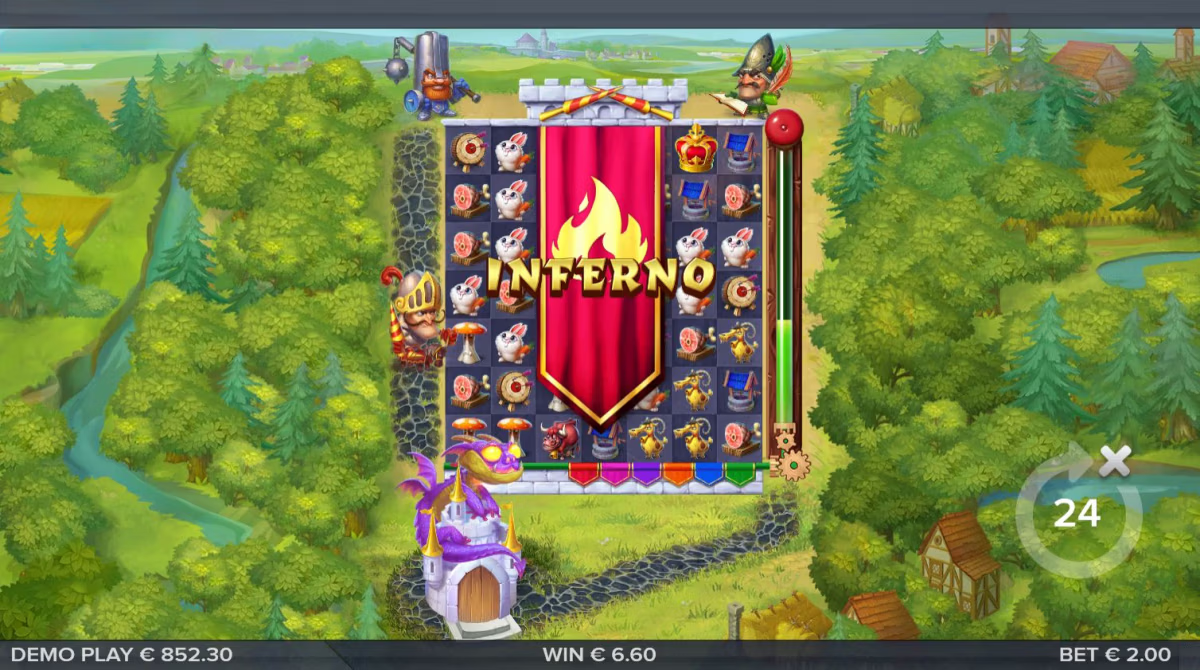
| Inferno | Removes low-value symbols from the grid | Creates space for another avalanche evaluation |
| Extra Wilds | Adds 3 to 15 wilds at random positions | Can help form connected winning clusters |
| Super Size | Drops a 2×2, 3×3 or 4×4 large symbol, producing a guaranteed cluster win | Guarantees that feature’s cluster payout, not a specific overall amount |
| Charge | Moves 2 to 5 rows into the queue | Builds the reserve that can join later clusters |
| Epic Charge | Moves the whole grid into the queue and refills the board | Restarts the avalanche with a substantially enlarged queue |
| Boosted Queue | Allows queued symbol groups to be used simultaneously, regardless of their normal order | Can create several connections during the new evaluation |
There is an important difference between a guaranteed cluster win and a guaranteed profitable game round. Super Size ensures a paying combination from that modifier. It does not establish that the full round will recover a player’s stake, particularly after other losing rounds are considered.
The mechanics also explain why two apparently similar drops can play out differently. A flag that removes weak symbols acts on the board; a flag that expands the queue changes the supply of symbols available to complete future clusters. Neither effect tells you when the next valuable combination will appear.
Free Drops: The Bonus Round Worth Understanding
Landing three crown scatter symbols triggers five Free Drops. Unlike a basic free-spins round with a fresh, independent-looking screen on every spin, Micro Knights carries its queue and meter forward during the bonus. That persistence is central to the design.
The feature begins with an empty queue and meter. As wins accumulate, they can rebuild both. Their progress is retained across the free drops, which gives successive rounds the chance to work with the symbols and meter progress established earlier in the bonus. The published rules also allow a retrigger; its occurrence depends on the game result, not on a player’s choice.
Five drops can sound modest next to slots offering 10 or 20 free spins. Here, however, the number of symbol evaluations inside a drop can change if avalanches and flag features continue. Comparing free-spin counts alone would miss what Micro Knights is designed to do. The useful question is whether you enjoy watching connected cluster and queue interactions develop over multiple evaluations.
Free Drops are not an assurance of winning. The bonus can conclude with a small payment, and the maximum win remains an upper limit rather than an expected outcome.
RTP, Volatility and the 2,500× Maximum Win
At a reported 96% RTP, the theoretical house edge is 4% for that configuration. As a simple illustration, €1,000 of total wagers would correspond to €960 in expected returns across the game’s mathematical long run, not €960 promised back to one player. Short sessions can finish far above or below that figure.
The advertised maximum of 2,500× the stake is a ceiling on a game result. On a €1 stake, that arithmetic would mean €2,500. The multiplier does not describe the chance of reaching it, and increasing the stake does not turn a rare outcome into a more likely one.
Public volatility labels differ, which makes certainty about a single rating inappropriate. If volatility is a deciding factor, consult the selected casino’s game information and budget for the possibility of extended losing stretches. The published €0.20 to €100 stake range belongs to a specific euro-denominated ruleset; a licensed operator may apply different limits in a particular market.
How to Try the Micro Knights Demo
The Micro Knights demo lets you learn the layout and bonus logic without staking withdrawable money. ELK Studios has a Play option on its game page, and some casino listings provide an explicit demo button. Access can depend on your location, age and the operator’s policies.
For a useful first look, pay attention to three things:
- Watch how a five-symbol cluster is formed. Trace horizontal and vertical connections, then follow the replacement symbols after an avalanche.
- Follow the queue beneath the grid. Notice what Sir Charge removes, what stays on the board, and how stored symbols are later used.
- Observe the flag meter during Free Drops. The persistent meter and queue explain more about this game’s bonus than the starting count of five drops.
A demo is a way to understand mechanics and assess whether the pace appeals to you. Its virtual-credit wins cannot be withdrawn, and a good demo sequence has no predictive value for a future real-money session.
Who Is Micro Knights Best Suited To?
Micro Knights is a stronger fit for players who like grid-based cluster games, cascading outcomes and bonus systems that have several interacting parts. The shifting queue gives each sequence a visual story: first symbols are removed, then stored, then reused to help complete further clusters.
It is less suitable for someone who wants instantly readable paylines or a minimal set of modifiers. The combination of three knights, six flags, a meter and a queue can be busy, especially on a small screen. A demo is the sensible place to decide whether that complexity feels entertaining or distracting.
There is also a limitation for anyone focused mainly on the biggest advertised payouts. The 2,500× cap is clearly defined, but it says little about a typical session or the likelihood of a major win. For real-money play, check that the operator is permitted in your jurisdiction, review its exact game rules, and set a fixed spending limit rather than treating bonuses as a way to recover losses.
FAQ
Is Micro Knights a paylines slot?
No. It uses a 7×7 cluster-pays system in which at least five matching symbols must connect horizontally or vertically, with eligible queue symbols also able to contribute.
Can Micro Knights Free Drops be retriggered?
Yes. The published game rules allow the bonus to trigger again. A retrigger is still random and should not be assumed during any given set of five Free Drops.
Does Micro Knights have a bonus-buy feature?
The reviewed game listings do not show a bonus-buy option. Check the controls of the specific version being offered rather than assuming a purchase feature is available.
Can a free demo pay real money?
No. Demo balances and winnings are virtual. They cannot be cashed out, and their results do not forecast what will happen during real-money play.
What is the most important feature to watch in Micro Knights?
The symbol queue. It allows symbols moved off the grid to help form or enlarge later clusters, making it the clearest mechanical difference from an ordinary cascading slot.
Conclusion
Micro Knights turns a playful medieval battle into an unusually layered cluster slot. Its strongest idea is the relationship between the 7×7 grid, the knights’ actions and the symbol queue, while five Free Drops with persistent progress give that relationship room to develop. Choose it if those mechanics appeal to you, not because the 96% reference RTP or 2,500× maximum win suggests a predictable result. The demo is the most practical way to decide whether the game is enjoyable before considering real-money play.