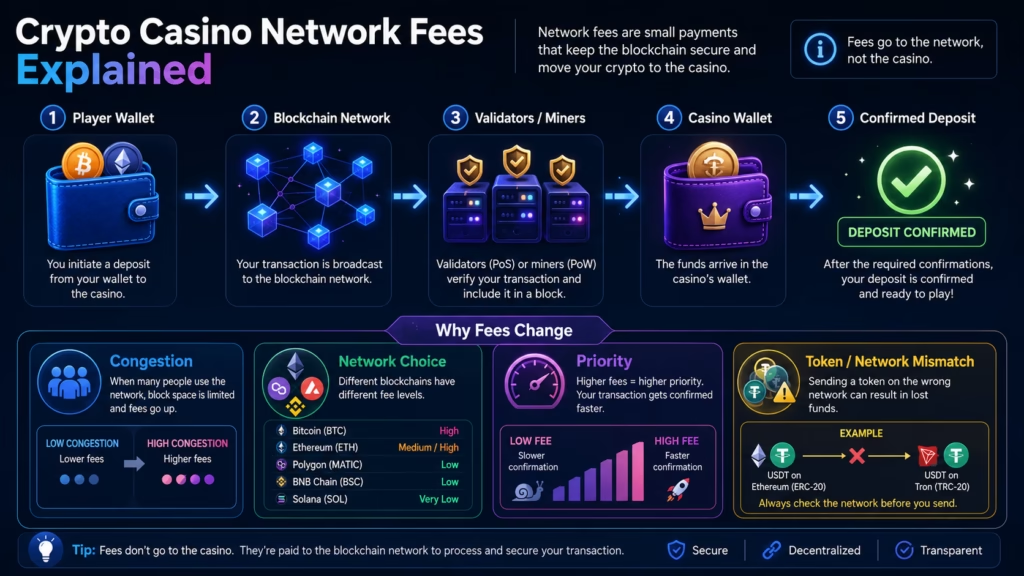
Crypto casino network fees are blockchain transaction costs paid when cryptocurrency moves between a wallet, exchange, or casino address. They are separate from the amount you deposit or withdraw and may also be separate from any fee charged by the casino itself. The final cost depends mainly on the blockchain, current network demand, transaction complexity, and the casino’s own withdrawal policy.
Quick takeaways
- A network fee goes to the blockchain’s miners, validators, or protocol, not automatically to the casino.
- Bitcoin casino transaction fees usually depend on transaction size and the fee rate, not directly on how much BTC you send.
- Ethereum and ERC-20 token transfers use gas, so fees can rise when the network becomes busy.
- The same stablecoin can have very different transfer costs depending on whether it uses Ethereum, TRON, Solana, or another supported network.
- Before depositing, verify the exact cryptocurrency, blockchain network, minimum deposit, minimum withdrawal, and casino withdrawal fee.
Crypto payments may suit players who already understand wallets and blockchain transfers. Beginners should be more cautious because sending funds through the wrong network or to an incompatible address can result in a difficult or sometimes irreversible recovery process.
What Are Crypto Casino Network Fees?
A crypto casino network fee is the cost required to record or process a cryptocurrency transaction on its blockchain. When you send Bitcoin, Ether, USDT, USDC, or another cryptocurrency to a casino, the transaction must normally be validated and added to the relevant network.
The casino does not necessarily determine this fee. The blockchain’s fee mechanism usually determines how expensive an on-chain transfer is at that moment.
Network fees can affect both deposits and withdrawals, but the party paying them may differ. For a deposit, the network fee is commonly paid by the wallet sending the cryptocurrency. For a withdrawal, the casino sends the transaction, so the operator may absorb the blockchain cost, charge a fixed withdrawal fee, deduct the network fee from the withdrawal, or use another policy stated in its terms.
That distinction matters because a casino advertising ‘no deposit fees’ does not necessarily mean transferring cryptocurrency to the casino is free.
Network Fee vs Casino Withdrawal Fee vs Exchange Fee
| Fee | Who determines it? | When it may apply |
| Blockchain network fee | Blockchain and transaction conditions | Sending crypto on-chain |
| Casino withdrawal fee | Casino operator | Withdrawing from casino balance |
| Exchange or wallet withdrawal fee | Exchange or wallet provider | Moving crypto from an exchange to the casino or another wallet |
A player could therefore encounter more than one fee during a single deposit and withdrawal cycle. For example, a centralized exchange may charge its own withdrawal fee when sending BTC to a casino. Later, the casino may charge a separate withdrawal fee when sending BTC back. Neither amount should automatically be assumed to equal the actual blockchain fee paid for the transaction.
Check each fee independently instead of treating every crypto charge as a ‘network fee’.
How Bitcoin Casino Transaction Fees Work
Bitcoin transaction fees are generally based on the virtual size of the transaction and the fee rate selected in satoshis per virtual byte, commonly written as sat/vB.
A simplified calculation is:
Bitcoin transaction fee = transaction virtual size x fee rate
If a transaction is 150 vB and the chosen fee rate is 10 sat/vB, the transaction fee would be approximately 1,500 satoshis.
This is only an example. The appropriate fee rate changes with demand for Bitcoin block space.
Bitcoin casino transaction fees are therefore not simply a percentage of the deposit. Sending $5,000 worth of BTC does not automatically require a larger network fee than sending $500. Transaction structure and required block-space priority are more important factors.
A transaction with more inputs can also be larger than a simple transaction, which can increase its total fee even when the transferred BTC value is relatively small.
Why Bitcoin Network Fees Change
Bitcoin fees change because transactions compete for limited block space. When demand increases, users who want faster confirmation may choose higher fee rates.
This explains why two casino deposits made on different days can have noticeably different costs even when the same amount of BTC is transferred.
Wallets often estimate an appropriate fee automatically. Choosing an unnecessarily aggressive confirmation target can result in paying more than necessary, while selecting a fee that is too low can cause the transaction to remain unconfirmed longer.
How Ethereum and ERC-20 Casino Fees Work
Ethereum network fees are calculated using gas. A transaction consumes a certain amount of gas, and the cost depends on the gas used together with the network’s base fee and priority fee.
A simplified formula is:
Ethereum fee = gas used x (base fee + priority fee)
The base fee is determined by the protocol and responds to network demand. A priority fee is an additional amount used to incentivize validators to include a transaction.
This has an important consequence for crypto casino users: sending an ERC-20 token such as USDT or USDC can require more gas than a basic ETH transfer because token transfers involve smart-contract execution.
For that reason, seeing ‘USDT supported’ is not enough information. You also need to know which network the casino supports.
USDT on Ethereum and USDT on another blockchain may have very different transaction costs and incompatible deposit addresses.
TRON and TRC-20 Casino Network Fees
TRON uses a resource model based primarily on Bandwidth and Energy rather than Ethereum’s gas structure. Bandwidth is associated with transaction data, while Energy is used for smart-contract execution. When available resources are insufficient, TRX can be consumed according to network rules.
This distinction is especially relevant to TRC-20 tokens such as USDT because a token transfer involves a smart contract rather than a simple native TRX transfer.
A common mistake is assuming that every TRON transaction has the same cost. Actual resource usage, available Bandwidth or Energy, wallet configuration, and current network parameters can affect the amount required.
Players should therefore check the fee displayed by their wallet immediately before sending a TRC-20 casino deposit rather than relying on an old fee figure from an article or forum post.
Solana Casino Transaction Fees
Solana transactions require a fee paid in SOL. Transaction costs consist of a base fee and may include a prioritization fee when a sender wants a greater chance of faster scheduling during periods of competition.
Solana can therefore be attractive when a casino and wallet both support the required token and network, but the correct network still matters more than simply choosing whichever option appears cheaper.
For example, a casino that accepts USDC on Solana requires a Solana-compatible USDC deposit. Sending an Ethereum version of USDC to that address should not be assumed to work.
Why the Same Cryptocurrency Can Have Different Fees
The cryptocurrency ticker alone does not always identify the blockchain being used.
Stablecoins are the clearest example. A casino could potentially support USDT through one or several networks, such as Ethereum or TRON. These networks use different fee models.
This means the useful question is not simply ‘What is the USDT casino withdrawal fee?’ The better questions are:
- Which USDT network does the casino support?
- Does the casino charge its own withdrawal fee?
- Is the displayed fee fixed or variable?
- What is the minimum withdrawal?
- Does the casino deduct the fee from the requested amount?
- Do your wallet and casino support exactly the same blockchain?
Network compatibility should always be confirmed before copying a deposit address.
Crypto Casino Deposit Fees Explained
A crypto casino may advertise zero deposit fees while the player’s wallet still charges or requires a blockchain network fee.
Suppose you send BTC from your personal wallet. Your wallet creates and broadcasts the transaction, so you normally need enough BTC to cover both the amount being sent and the Bitcoin network fee.
A casino may credit the amount received after the required number of confirmations. Confirmation policies differ between operators and cryptocurrencies, so the casino’s payment page should be checked before depositing.
Small deposits deserve particular attention. A network fee that looks insignificant on a large transfer can represent a meaningful percentage of a small deposit.
Crypto Casino Withdrawal Fees Explained
Crypto withdrawal costs are less standardized because the casino controls how withdrawals are processed.
An operator may:
- cover the blockchain fee itself;
- deduct a network fee from the withdrawal;
- charge a fixed crypto withdrawal fee;
- use different fees for different coins or networks;
- set minimum withdrawal amounts;
- batch multiple withdrawals into fewer blockchain transactions.
The blockchain fee shown on a block explorer may therefore differ from the amount charged to an individual player.
Before depositing, check the withdrawal page rather than assuming that low deposit costs mean low withdrawal costs.
How to Choose a Crypto Network With Lower Fees
Choosing a cheaper network should start with compatibility, not the lowest advertised fee.
First, confirm that the casino supports the exact asset and blockchain you intend to use. If several networks are available for the same stablecoin, compare the wallet’s estimated sending fee and the casino’s withdrawal rules for each one.
Second, consider the size of the transaction. Saving a small amount on network fees matters more when making repeated small transfers.
Third, consider where the cryptocurrency will go after withdrawal. A low-cost network is less useful if your receiving wallet or exchange does not support it and you later need an additional bridge or conversion.
The lowest-cost route is therefore the route with the lowest total transfer cost, not necessarily the blockchain with the lowest individual transaction fee.
How to Reduce Crypto Casino Network Fees
Check the fee before confirming
Wallet fee estimates can change rapidly. Review the actual amount immediately before sending rather than relying on yesterday’s network conditions.
Avoid unnecessary transfers
Moving crypto from exchange to wallet, wallet to casino, casino back to wallet, and wallet back to exchange can create several separate fees. Fewer unnecessary on-chain transfers generally mean fewer opportunities to pay network charges.
Compare supported networks
If a casino legitimately supports several networks for the same token, compare the complete deposit and withdrawal process before choosing one. Do not select a different network simply because it appears cheaper unless both the sending wallet and receiving casino explicitly support it.
Check minimum withdrawals
A low network fee does not help if the casino has a high minimum withdrawal or adds a separate operator fee.
Review the final amount received
When comparing casinos, calculate what is likely to reach your external wallet after applicable casino withdrawal charges rather than comparing only the advertised blockchain fee.
Common Crypto Casino Fee Mistakes
Sending through the wrong blockchain: A token existing on multiple networks does not mean the addresses are interchangeable.
Ignoring the casino withdrawal fee: Network costs and operator charges are separate.
Making very small BTC transfers during expensive network conditions: A fixed blockchain cost can become large relative to the amount transferred.
Assuming a stablecoin always has a stable transaction fee: The token price may be stable, but the blockchain fee can vary.
Copying an old fee estimate: Network conditions and protocol parameters can change.
Sending the full wallet balance: Some networks require their native token to pay transaction fees, so leaving no native balance can prevent a later transaction.
What to Check Before Choosing a Crypto Casino
Crypto casino payment quality should be evaluated through transparency rather than promises of ‘instant’ or ‘free’ transactions.
- The exact supported cryptocurrencies.
- The supported network for each token.
- Minimum deposit requirements.
- Minimum and maximum withdrawals.
- Casino withdrawal fees.
- Whether fees are fixed or variable.
- Required blockchain confirmations.
- Expected withdrawal processing requirements.
- KYC and account verification rules.
- Whether the casino clearly publishes its payment terms.
A casino with transparent withdrawal rules may be easier to evaluate than one advertising low fees without explaining how withdrawals are actually charged.
Crypto does not remove normal gambling risks. Network efficiency does not improve the odds of casino games or make gambling a reliable way to earn money.
How This Information Was Reviewed
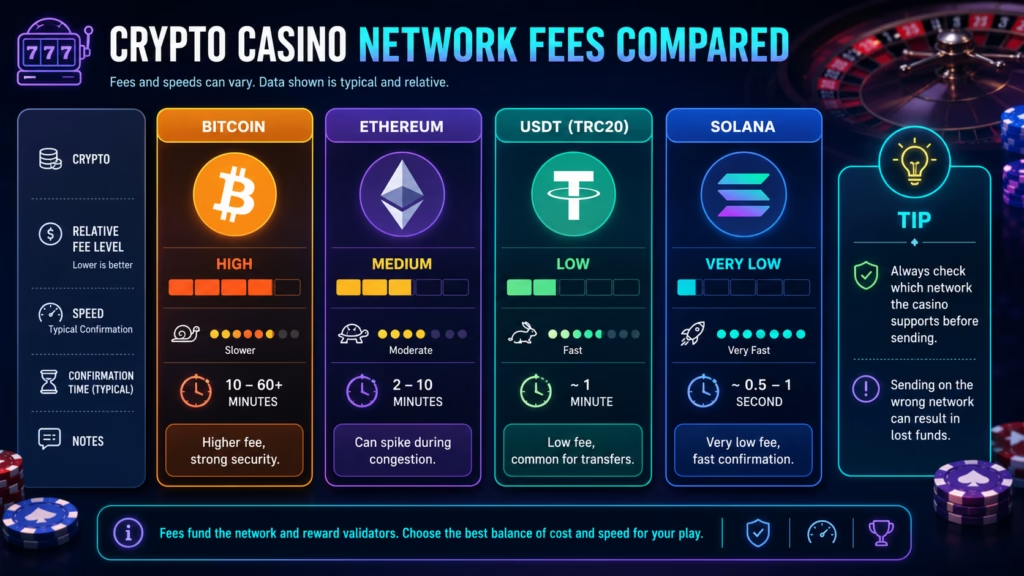
The fee explanations in this guide are based on the underlying transaction mechanisms used by Bitcoin, Ethereum, TRON, and Solana rather than fixed fee estimates that can quickly become outdated. Bitcoin fees depend on transaction size and fee rate, Ethereum uses gas with base and priority fees, TRON uses Bandwidth and Energy resources, and Solana uses its own base and prioritization fee model.
Casino-specific fees, minimum withdrawals, supported networks, processing times, and verification requirements can change independently of blockchain rules. Check the casino’s current payment terms and the sending wallet’s fee estimate immediately before transferring funds.
Crypto casino payments should be treated as a payment method for entertainment, not as a way to make gambling profitable. Set spending limits before playing and never assume lower transaction fees improve your probability of winning.
FAQ
What are crypto casino network fees?
Crypto casino network fees are blockchain transaction costs required to process cryptocurrency transfers. They are normally determined by the blockchain’s fee mechanism and transaction conditions, although a casino can separately charge its own deposit or withdrawal fee.
Does a crypto casino receive the network fee?
Usually not. A blockchain network fee is normally paid through the network’s transaction mechanism rather than directly to the casino. A casino may separately charge a withdrawal or processing fee, so the two costs should be checked independently.
Why are Bitcoin casino transaction fees sometimes high?
Bitcoin casino transaction fees can rise when demand for block space increases. The total cost depends mainly on the transaction’s virtual size and fee rate in sat/vB, rather than simply on the amount of BTC being transferred.
Does sending more Bitcoin mean paying a higher fee?
Not necessarily. Bitcoin network fees are primarily related to transaction size and the selected fee rate, so transferring a larger BTC value does not automatically mean paying a proportionally larger fee.
Why can USDT casino fees be different between casinos?
USDT can operate on different blockchain networks, and each network has its own fee structure. Casinos may also apply their own withdrawal charges. Compare both the supported USDT network and the casino’s withdrawal policy.
Are ERC-20 casino deposits more expensive than other crypto transfers?
ERC-20 transfers can become relatively expensive when Ethereum gas costs rise because token transfers require blockchain computation. The actual cost changes with gas usage and network conditions, so the wallet’s current estimate should be checked before sending.
Who pays the network fee when withdrawing from a crypto casino?
The casino creates the withdrawal transaction, but its policy determines who ultimately bears the cost. The operator may absorb the fee, deduct it from the withdrawal, or charge a separate fixed amount.
Can I avoid crypto casino network fees completely?
Not in every case. Some casinos or payment systems may absorb certain fees, but ordinary on-chain transactions usually require network resources. Comparing supported networks and avoiding unnecessary transfers can reduce total costs.
What happens if I send crypto using the wrong network?
Sending cryptocurrency through an unsupported network can result in funds not being automatically credited and recovery may be difficult or unavailable. Always confirm the exact asset and network shown on the casino deposit page before sending.
Do lower crypto transaction fees improve my chances of winning?
No. Transaction fees affect the cost of moving cryptocurrency, not the mathematical odds of casino games. Casino outcomes remain governed by the individual game’s rules, RTP, house edge, and random outcome mechanism where applicable.
Brief Conclusion
Crypto casino network fees depend on more than the cryptocurrency name. Bitcoin uses transaction size and fee rates, Ethereum and ERC-20 tokens use gas, TRON relies on Bandwidth and Energy, and Solana has its own fee model.
The key comparison is the total cost of depositing and withdrawing. Check the exact blockchain, wallet fee, casino withdrawal fee, minimum withdrawal, and receiving-network compatibility before sending funds.
Choosing a lower-cost network can reduce payment friction, but it does not change casino odds or make gambling profitable. Use crypto casinos only as entertainment and set clear spending limits before playing.