Crypto casinos in New Zealand allow players to fund online casino accounts with cryptocurrencies such as Bitcoin and, depending on the operator, other digital assets. The important issue in 2026 is not simply whether a casino accepts crypto. New Zealand has introduced a new licensing system for online casinos, and the market is currently moving through a transitional period before the regulated system becomes fully operational.
For New Zealand players looking at crypto casinos New Zealand or Bitcoin casinos NZ, the main points are:
- The Online Casino Gambling Act 2026 is already in force.
- New Zealand online casino licences are expected to start being issued in early 2027.
- Operators that served New Zealand before 1 May 2026 may continue during the transitional period until 1 December 2026, but they cannot advertise to New Zealand customers.
- From 1 December 2026, only operators that successfully progress through the new licensing process may continue serving the New Zealand market while applications are assessed.
- Cryptocurrency does not remove identity verification, responsible gambling or payment compliance requirements.
The Department of Internal Affairs, or DIA, is responsible for implementing the new online casino regime. Players should therefore judge a crypto casino primarily by its regulatory status, withdrawal rules, security and account protections, rather than simply by the number of cryptocurrencies it accepts.
Are Crypto Casinos Legal in New Zealand?
Online casino regulation in New Zealand changed significantly in 2026. The Online Casino Gambling Act 2026 received Royal assent on 28 April 2026 and created a dedicated framework for licensing online casino operators that serve customers located in New Zealand.
As of August 2026, the licensing system is still being implemented. Operators which were already providing online casino services to people in New Zealand before 1 May 2026 can continue operating until 1 December 2026. They are not permitted to advertise to people in New Zealand during this transitional period.
The regulatory position changes again on 1 December 2026. Up to 15 online casino operators are expected to obtain the right through an auction process to apply for a New Zealand licence. Operators progressing through the application process can operate under an exemption while their licence applications are assessed. Other operators will be required to leave the New Zealand market.
The DIA expects actual licences to begin being issued from early 2027.
| Period | Position for New Zealand online casinos |
| August to 30 November 2026 | Eligible pre-existing operators may continue operating, but advertising is restricted |
| From 1 December 2026 | Only operators progressing through the NZ licensing process may continue |
| From early 2027 | New Zealand online casino licences are expected to begin being issued |
For a player, this means an overseas licence alone should not be treated as proof that a casino has been approved under the new New Zealand system. Once licences are issued, the DIA plans to maintain a public register of licensed operators. Licensed casinos will also be required to display a registration icon intended to help customers identify approved platforms.

What Is a Crypto Casino?
A crypto casino is an online casino that accepts one or more cryptocurrencies for deposits, withdrawals or both.
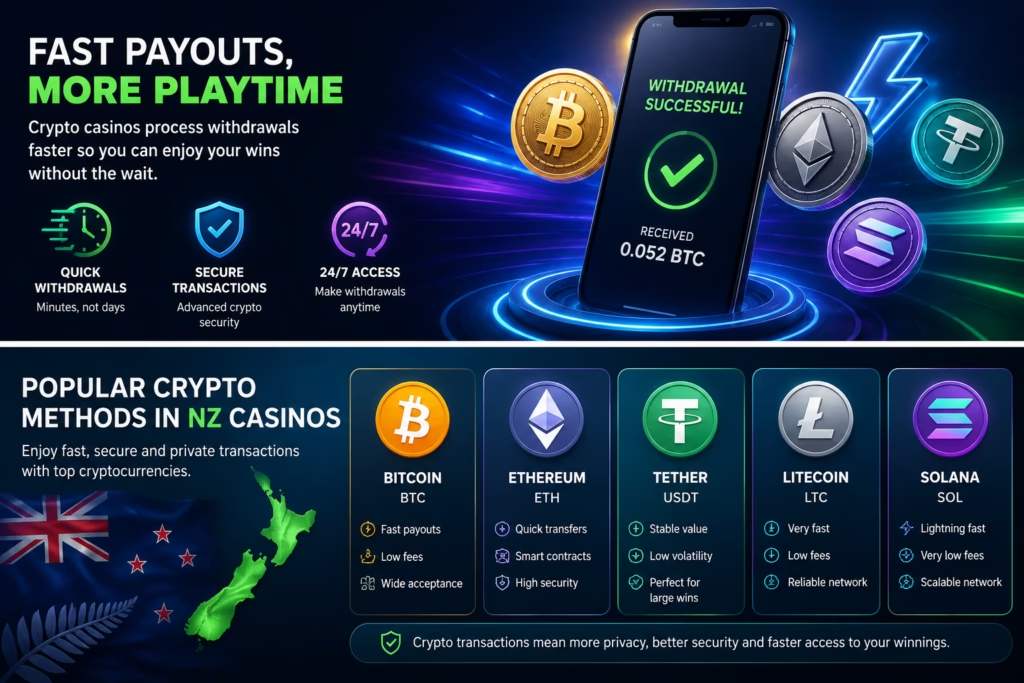
Bitcoin is the most recognisable option, which is why searches for Bitcoin casinos NZ are common, but international crypto casinos may also support assets such as Ethereum, Litecoin or stablecoins. Availability varies substantially between operators and should always be checked before creating an account.
Crypto does not change the underlying casino games. Slots, blackjack, roulette and other games still operate according to their normal game rules, mathematical house edge and random outcome mechanisms. Cryptocurrency is primarily a payment method.
That distinction matters because using Bitcoin cannot improve the RTP of a slot or the probability of winning a roulette bet. Casino games remain gambling products with negative expected value for the player over the long term.
Will New Zealand Licensed Casinos Accept Bitcoin?
New Zealand’s 2026 online casino regulations establish detailed payment rules, but players should not assume that every future licensed operator will support cryptocurrency.
The regulations prohibit payment methods involving credit contracts, including credit cards. They also require customers to maintain only one registered deposit method at a time on each gambling platform. A separate withdrawal method may be registered.
The rules cited above do not by themselves establish that every licensed operator must accept, or will be permitted to accept, Bitcoin or another specific cryptocurrency. Actual crypto availability will depend on an operator’s payment infrastructure and compliance with the final requirements applying to its licence.
For that reason, the safest approach is to verify three separate points:
- Whether the operator may legally serve customers in New Zealand.
- Whether the exact cryptocurrency and blockchain network are supported for deposits.
- Whether withdrawals can be returned in cryptocurrency and what verification is required first.
A casino displaying a Bitcoin logo is not enough to answer any of these questions.
KYC Still Matters at Crypto Casinos
Cryptocurrency should not be confused with anonymous casino gambling.
Under the new New Zealand framework, licensed platforms must verify customer accounts and maintain identity-related information. The Online Casino Gambling Act also requires operators to ensure customers are at least 18 years old. Technical minimum standards introduce additional account authentication, audit trails and security requirements.
Licensed platforms must also use reasonable mechanisms to confirm that customers accessing their New Zealand gambling platforms are physically located in New Zealand.
A future NZ-regulated crypto casino can therefore require proof of identity, age and location even when the deposit originated from a blockchain wallet.
Players should be particularly cautious when a site markets cryptocurrency as a way to avoid every form of KYC. Lack of meaningful verification may create withdrawal problems and can be a warning sign when evaluating an operator.
Bitcoin vs Stablecoins for Casino Payments
Bitcoin and stablecoins solve different payment problems.
Bitcoin has high liquidity and widespread recognition, but its NZD value can move significantly between the time a player deposits and withdraws. A player can therefore gain or lose value from the cryptocurrency itself independently of casino results.
Stablecoins are designed to track another asset, commonly the US dollar, so they generally reduce this particular type of price volatility. However, stablecoins introduce their own issuer, blockchain and counterparty risks.
Network selection is equally important. Sending a supported token through an unsupported blockchain can result in funds being delayed or potentially unrecoverable.
Before transferring cryptocurrency, check the casino’s supported asset, network, minimum deposit, required blockchain confirmations, withdrawal network and applicable fees.
Crypto Casino Deposits and Withdrawals
Crypto transactions can be fast at the blockchain level, but that does not mean every casino withdrawal is instant.
A withdrawal normally involves two separate processes. First, the casino must approve the withdrawal according to its internal account, KYC, security and bonus rules. Second, the cryptocurrency transaction must be broadcast and confirmed on the relevant blockchain.
This distinction explains why claims such as “instant Bitcoin withdrawals” should be treated carefully. Blockchain settlement can be quick while casino-side processing still takes considerably longer.
Before depositing, examine withdrawal terms rather than focusing only on deposit speed. Important details include withdrawal limits, pending periods, identification requirements, blockchain fees and whether bonuses impose wagering requirements.
How to Evaluate a Crypto Casino in New Zealand
Regulatory status should come before bonuses when choosing a crypto casino.
During the 2026 transition, players should check current DIA information because the list of operators legally permitted to serve New Zealand will change as the licensing process progresses. From 2027, the planned public register of licensed online casinos should provide a much clearer verification method.
Other practical criteria include payment transparency, game information, withdrawal rules, account security and responsible gambling controls.
The new minimum standards require licensed operators to provide accessible tools for setting time, deposit and spending limits. If a player increases or removes an existing limit, the system must impose a waiting period of at least 24 hours before that change takes effect.
Strong account security also matters more with cryptocurrency because blockchain transfers normally cannot simply be reversed through a bank chargeback. Multi-factor authentication, withdrawal verification and clear wallet procedures can therefore be particularly valuable.
Crypto Casino Bonuses: Read the Rules Before Depositing
A crypto bonus should be judged by its wagering conditions, not its headline percentage.
For example, a large Bitcoin deposit bonus may be less attractive if it carries high wagering requirements, restrictive maximum bets, short expiry periods or limits on withdrawing winnings.
Bonus availability can also vary by country, cryptocurrency and account status.
The useful questions are simple: How much must be wagered? Which games count? Is there a maximum bet while wagering? Does the bonus expire? Are withdrawals capped?
If these conditions are difficult to find before depositing, the bonus should not be treated as a reason to choose the casino.
Common Crypto Casino Mistakes
One common mistake is assuming that blockchain transactions make a casino automatically trustworthy. Blockchain technology can verify a transfer, but it does not prove that an operator will process withdrawals fairly or resolve disputes properly.
Another mistake is sending the correct cryptocurrency through the wrong blockchain network. A USDT deposit, for example, can exist across multiple networks, and the receiving casino may support only specific ones.
Players also sometimes leave substantial cryptocurrency balances inside casino accounts. A casino wallet is not the same thing as a self-custody wallet. Funds held by an operator remain exposed to that operator’s security and operational risks.
Finally, cryptocurrency should not make gambling losses feel less real. A loss of 0.001 BTC still represents economic value even when the account balance is displayed in crypto rather than New Zealand dollars.
Crypto and Tax Records in New Zealand
New Zealand’s Inland Revenue treats cryptoassets as property for tax purposes and requires NZD values to be calculated when a crypto transaction forms part of taxable cryptoasset activity.
That does not mean every casual casino withdrawal automatically creates taxable gambling income. Tax treatment depends on the nature of the activity and the circumstances involved.
Crypto users should nevertheless maintain records showing deposits, withdrawals, transaction dates, asset quantities and NZD values. Anyone gambling frequently, trading crypto professionally or dealing with significant amounts should obtain tax advice rather than assuming that blockchain transactions have no tax consequences.
Responsible Gambling With Cryptocurrency
Crypto casino games should be treated as paid entertainment, not an investment or way to generate income.
Using cryptocurrency can make spending harder to judge because balances are often displayed in BTC, ETH or tokens rather than familiar NZD amounts. Converting a planned gambling budget into New Zealand dollars before depositing can make the financial risk easier to understand.
Set a fixed spending limit before playing, avoid replacing losses with additional deposits and never borrow money to gamble. The new NZ regulatory framework specifically includes deposit, spending and time controls as part of its harm-minimisation requirements.
If gambling becomes difficult to control, New Zealand’s Gambling Helpline provides free support on 0800 654 655 and by text on 8006.
How This Information Was Reviewed
This guide evaluates crypto casinos using New Zealand regulatory status, payment rules, identity verification, withdrawal transparency, account protection and responsible gambling requirements.
Legal information was checked against the Online Casino Gambling Act 2026, the Online Casino Gambling Regulations 2026 and current guidance from New Zealand’s Department of Internal Affairs. Because the licensing system is still being implemented, an operator’s eligibility to serve New Zealand customers should be checked again before depositing.
Cryptocurrency support, fees, blockchain networks, withdrawal limits and bonus conditions are operator-specific and should always be verified directly in the relevant terms.
Neither cryptocurrency, RTP, bonuses nor any casino strategy can guarantee a profit. Casino gambling should be treated as entertainment, and players should stop if spending exceeds predetermined limits.
FAQ
Are crypto casinos legal in New Zealand?
New Zealand introduced the Online Casino Gambling Act 2026 and is currently transitioning to a licensed online casino market. Eligible operators that served New Zealand before 1 May 2026 may continue until 1 December 2026 without advertising, after which only operators progressing through the new licensing process can remain. Licences are expected to begin being issued in early 2027.
Are Bitcoin casinos legal in NZ?
Bitcoin itself does not determine whether an online casino may serve New Zealand customers. The important factor is the operator’s status under New Zealand’s online casino rules. Players should check current DIA information and, once licences begin being issued, the official register of licensed operators.
Can I deposit Bitcoin at a New Zealand online casino?
Bitcoin deposits depend on whether the individual operator supports Bitcoin and whether that payment method is permitted under its compliance arrangements. New Zealand’s new regulations specify how payment methods must be managed but do not mean every licensed casino will automatically accept cryptocurrency.
Are crypto casino withdrawals instant?
Crypto casino withdrawals are not necessarily instant. The casino may need to complete KYC, security and withdrawal checks before broadcasting the blockchain transaction. Network confirmation speed only affects the blockchain portion of the withdrawal.
Do crypto casinos require KYC in New Zealand?
Future New Zealand licensed online casinos will be subject to identity, age and account-verification requirements. Paying with cryptocurrency therefore should not be interpreted as a way to bypass KYC. Licensed online casino gambling is restricted to customers aged 18 or older.
Can I use a credit card at a licensed New Zealand online casino?
The Online Casino Gambling Regulations 2026 prohibit operators from accepting payment methods involving a credit contract, with credit cards given as an example.
Is Bitcoin better than a stablecoin for casino deposits?
Neither option is universally better. Bitcoin carries greater price volatility, while stablecoins are designed to maintain a relatively stable reference value but introduce issuer and network-specific risks. The correct choice also depends on which assets and blockchain networks the casino supports.
Are crypto casino winnings guaranteed to be withdrawable?
No. A legitimate balance can still be subject to identity verification, withdrawal limits, security checks and valid bonus conditions. Players should read withdrawal and wagering rules before depositing rather than after a large balance has accumulated.
Do I have to pay tax on crypto casino withdrawals in New Zealand?
There is no single answer based only on the fact that a withdrawal uses cryptocurrency. Inland Revenue treats cryptoassets as property, while the tax treatment of money received depends on the nature of the underlying activity. Keeping transaction records and obtaining professional tax advice is sensible when significant amounts or taxable crypto activity are involved.
How can I identify a licensed New Zealand online casino?
Once New Zealand licences begin being issued, the DIA plans to publish a public register of licensed operators, and licensed platforms will have to display a registration icon. Until the licensing system is fully operational, players should rely on current DIA information rather than assuming an international licence equals New Zealand approval.
In short
Crypto casinos in New Zealand are entering a completely new regulatory environment. In August 2026, the market is still in transition, with New Zealand licences expected from early 2027 and major operating restrictions taking effect on 1 December 2026.
For players interested in Bitcoin casinos NZ, the strongest selection criteria are regulatory status, transparent withdrawals, supported blockchain networks, KYC procedures, account security and responsible gambling controls. Cryptocurrency can change how deposits and withdrawals are processed, but it does not improve casino odds or make gambling a reliable source of income.