Crypto casinos are not automatically legal or illegal in the United States simply because they accept Bitcoin, Ethereum, USDT or another cryptocurrency. The key issue is whether the underlying online casino is authorized under the gambling laws of the state where the player is physically located. Cryptocurrency is a payment method, not a legal loophole.
As of August 2026, seven states have live regulated real-money online casino markets: Connecticut, Delaware, Michigan, New Jersey, Pennsylvania, Rhode Island and West Virginia. Maine legalized internet casino gaming in 2026, but its regulated market is still being implemented and licensed operators have not yet launched.
The main points are simple:
- Bitcoin does not make an otherwise illegal online casino legal.
- A foreign or offshore gambling license does not automatically authorize a casino to accept players in a U.S. state.
- Legal U.S. online casino gaming generally requires a state-authorized operator, age verification and geolocation.
- Players should verify the operator with the relevant state gaming regulator rather than relying on claims such as “crypto-friendly” or “licensed offshore.”
- Gambling winnings remain potentially taxable even when winnings are received in cryptocurrency.
For players interested in crypto casinos, the most important distinction is therefore not Bitcoin versus dollars. It is regulated U.S. online casino versus an operator that is not authorized in the player’s state.
Does Federal Law Ban Crypto Casinos?
There is no federal law that simply says all cryptocurrency casinos are legal or all cryptocurrency casinos are illegal. U.S. internet gambling law works through a combination of federal rules and state gambling laws.
The Unlawful Internet Gambling Enforcement Act, commonly called UIGEA, defines unlawful internet gambling by reference to gambling that is illegal under applicable federal or state law. UIGEA also recognizes qualifying intrastate internet gambling when the activity is expressly authorized by the state and includes safeguards such as age verification and location verification.
This distinction matters because changing the payment method from U.S. dollars to Bitcoin does not change the underlying gambling activity. If an operator is not authorized to offer online casino gambling in a particular state, accepting cryptocurrency does not create a separate exemption.
In practical terms, the question should not be “Does this casino take Bitcoin?” The better question is “Is this casino legally authorized to accept real-money casino wagers from someone physically located in my state?”
Bitcoin Casino Legality by State
The legal status of online casino gaming varies significantly by state.
| State | Real-Money Online Casino Status | What Crypto Players Should Know |
| Connecticut | Live and regulated | Online casino play is permitted through authorized platforms for players 21+ physically located in Connecticut. |
| Delaware | Live and regulated | State-authorized internet casino games are available to players 21+ located in Delaware. |
| Michigan | Live and regulated | Only authorized internet gaming operators may legally offer online casino gaming under Michigan’s regulated system. |
| New Jersey | Live and regulated | Licensed internet casinos operate under New Jersey gaming regulation. |
| Pennsylvania | Live and regulated | Licensed iGaming operators are regulated by the Pennsylvania Gaming Control Board. |
| Rhode Island | Live and regulated | Regulated online casino gaming launched in 2024 and is available to eligible players located within Rhode Island. |
| West Virginia | Live and regulated | Licensed interactive casino gaming is authorized for players 21+ located within the state. |
| Maine | Legalized, implementation underway | Internet gaming was legalized in 2026, but the regulated market is not yet fully operational as of August 2026. |
| Nevada | Online poker only | Nevada should not be treated as a general legal online casino state for slots and standard online casino games. |
| Other states | No state-regulated full online casino market | Availability of an offshore website does not mean the operator is authorized by the state. |
Connecticut law, for example, requires online casino players to be at least 21 and physically present in Connecticut when wagering. West Virginia similarly requires players to be at least 21 and allows licensed operators to accept mobile wagers from people physically located in the state.
Maine is an important 2026 exception. The state has legally authorized internet gaming, but its Gambling Control Unit was still conducting rulemaking during the summer of 2026. Its official licensing information states that applications are available but are not yet being accepted.
Are Offshore Crypto Casinos Legal for U.S. Players?
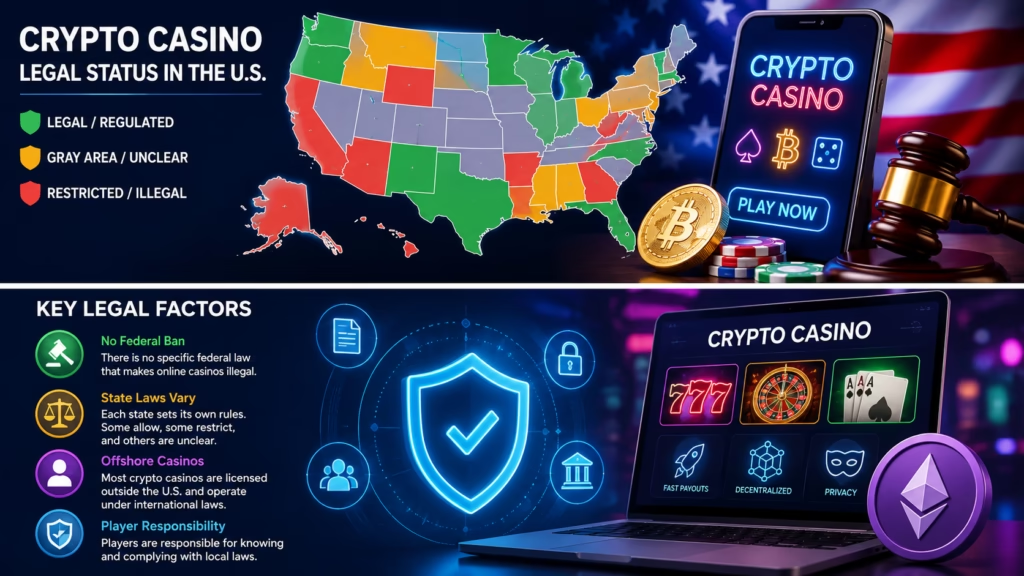
An offshore casino accepting U.S. players should not be assumed to be legal simply because it has a gambling license from another country.
A Curaçao, Anjouan, Isle of Man or other foreign license may regulate an operator in that licensing jurisdiction, but it does not automatically give that operator permission to offer online casino gambling in every U.S. state.
Michigan provides a clear real-world example. The Michigan Gaming Control Board has issued cease-and-desist orders against multiple offshore gambling sites that offered casino games and accepted cryptocurrencies such as Bitcoin, Ethereum and Litecoin. The regulator’s position was based on the operators lacking authorization to offer internet gaming in Michigan, not on cryptocurrency itself being prohibited.
This is one of the most important distinctions when evaluating crypto casinos. A site can be technically accessible from the United States and still lack authorization to offer gambling in the player’s state.
The legal exposure of an individual player can also differ from the legal exposure of an operator, and state statutes are not identical. Players should therefore avoid assuming that “the site accepts Americans” means “the site is legal for Americans.”
Does Accepting Bitcoin Make a Casino Legal?
No. Bitcoin is a payment method and does not determine whether casino gambling itself is authorized.
The same principle applies to Ethereum, Litecoin, USDT, USDC and other digital assets. A casino cannot normally bypass state gambling licensing requirements by replacing bank cards or ACH payments with blockchain transactions.
Michigan’s enforcement actions are particularly useful here because several targeted unlicensed operators specifically offered cryptocurrency deposits. The presence of Bitcoin did not change the regulator’s conclusion that the operators were offering unauthorized gambling.
Conversely, a legal state-regulated online casino does not automatically have permission to accept every cryptocurrency. Payment methods offered by regulated operators must comply with the rules and controls applicable in that jurisdiction. Some states allow additional funding methods only when approved by the gaming regulator.
How to Check Whether a Crypto Casino Is Legal in Your State
The safest way to evaluate a casino is to verify the operator rather than relying on the casino’s advertising.
1. Check the state regulator’s licensed operator list
A legitimate regulated U.S. casino should be connected to an operator authorized by the relevant state gaming regulator. State regulators generally publish or maintain information identifying authorized online gaming operators.
2. Check your physical location
Legal online casino states generally use geolocation. Your home address alone is not enough. You normally have to be physically inside the state while placing real-money wagers.
Trying to disguise your location with a VPN or other location-spoofing method can violate casino rules and defeat controls specifically required by gambling regulation.
3. Check the minimum age
Regulated U.S. online casino markets generally require casino players to be at least 21. Exact rules should be confirmed for the state and operator before playing.
4. Verify the actual company behind the website
A familiar casino name is not enough. Check whether the domain, operating company and platform appear on the regulator’s authorized list. Clone websites and offshore operators can use branding that makes them appear more established than they actually are.
5. Check deposits and withdrawals before sending crypto
Cryptocurrency transactions can be difficult or impossible to reverse. Before transferring Bitcoin or another digital asset, check withdrawal limits, identity verification requirements, bonus wagering requirements, supported networks and whether the operator is actually authorized in your state.
What About No-KYC Crypto Casinos?
A “no KYC casino” should not automatically be considered an advantage for a U.S. player.
State-regulated online casinos need mechanisms to determine who is gambling, whether the person meets the minimum age requirement and whether the player is physically located in the permitted jurisdiction. For this reason, a casino advertising completely anonymous real-money play with no meaningful identity or location checks is unlikely to resemble the standard regulatory model used by U.S. state-licensed iGaming operators.
Privacy and verification should also be distinguished. A legitimate casino should protect personal information, but regulated gambling still requires compliance procedures.
Are Crypto Casino Winnings Taxable in the United States?
Cryptocurrency does not make gambling winnings tax-free.
Gambling winnings are generally taxable income under U.S. federal tax rules. Digital assets such as Bitcoin and stablecoins are generally treated as property for federal income tax purposes.
If gambling winnings are paid in cryptocurrency, keeping records of the U.S. dollar value when the digital assets are received can be important. A later sale, exchange or other disposition of the cryptocurrency may also produce a separate capital gain or loss because digital assets are treated as property.
Using cryptocurrency itself can create additional recordkeeping compared with gambling entirely in dollars. Anyone dealing with significant winnings or frequent crypto transactions should consider professional tax advice rather than assuming blockchain transactions fall outside U.S. reporting rules.
Common Myths About Crypto Casino Legality
“Bitcoin casinos are legal because cryptocurrency is decentralized.” False. Decentralization of the payment network does not override state gambling laws.
“An offshore gambling license makes the casino legal in the United States.” Not necessarily. A foreign license does not automatically authorize gambling in a U.S. state.
“If the website works in my state, I am allowed to use it.” Accessibility is not proof of authorization. Offshore websites can be accessible even when they are not authorized by the state.
“A VPN makes online gambling legal.” No. Changing the location reported by a device does not change the law governing where the wager is actually made.
“Crypto winnings are tax-free.” No. Gambling income and digital asset tax rules can both be relevant.
How to Choose the Lower-Risk Option
Players who want the clearest regulatory protection should start with the official gaming regulator for their state and confirm that the casino is authorized there.
After confirming legality, compare practical factors such as withdrawal processing, deposit limits, account verification, responsible gambling controls, game availability and supported payment methods. If cryptocurrency is not listed as an approved deposit option, the existence of an unofficial workaround should not be treated as proof that the transaction is permitted.
Players living outside a state with regulated online casino gaming should be particularly careful with sites marketed as “U.S. crypto casinos.” An offshore operator’s willingness to accept a deposit is not the same thing as authorization from a U.S. gaming regulator.
Casino gambling should be treated as entertainment rather than a way to generate income. Cryptocurrency does not change the mathematical house advantage of casino games, and fast blockchain deposits can make it especially important to set spending limits before playing.
How This Information Was Reviewed
This overview is based on the federal rules governing unlawful internet gambling, current state gaming laws and regulator information, including material from gaming authorities in states with regulated or developing online casino markets.
The legal status of online gambling can change as states adopt legislation, regulations and licensing programs. Maine demonstrates why the distinction between “legalized” and “live” matters: internet gaming has been authorized there, but the state was still completing rulemaking and licensing preparations in August 2026.
Players should therefore confirm the current status directly with their state gaming regulator before depositing money or cryptocurrency. This article provides general information and is not individualized legal or tax advice.
FAQ
Are crypto casinos legal in the US?
Crypto casinos can be legal in the United States when the underlying online casino is legally authorized in the state where the player is located. Cryptocurrency itself does not make an unauthorized casino legal.
Which US states have legal online casinos in 2026?
Connecticut, Delaware, Michigan, New Jersey, Pennsylvania, Rhode Island and West Virginia have live regulated full online casino markets. Maine legalized internet gaming in 2026 but was still completing its regulatory and licensing process as of August 2026. Nevada regulates online poker but should not be treated as a full online casino market.
Is Bitcoin gambling legal in every state?
No. Bitcoin gambling is not automatically legal in every state. The legality of the casino activity depends primarily on state gambling law, operator authorization, player location and the type of gambling being offered.
Can Americans legally play at offshore crypto casinos?
An offshore casino should not be assumed to be legal for a U.S. player. A foreign gambling license does not automatically authorize the operator in a U.S. state, and state regulators can take action against offshore casinos that accept residents without authorization.
Does a Curaçao license make a crypto casino legal in the US?
No. A Curaçao or other foreign license can establish authorization in the issuing jurisdiction, but it does not replace any gambling license or authorization required by a U.S. state.
Can I use a VPN to play at a crypto casino from a restricted state?
A VPN does not change the legal location of the player or make an unauthorized wager legal. Regulated U.S. online casinos use geolocation controls specifically to determine whether players are physically inside an authorized jurisdiction.
Do legal US online casinos require KYC?
Regulated online casino systems generally require identity, age and location verification. Requirements differ by state and operator, but completely anonymous gambling is inconsistent with the verification controls used in regulated U.S. iGaming markets.
Are Bitcoin casino winnings taxable?
Gambling winnings are generally taxable under U.S. federal tax rules, and receiving or disposing of cryptocurrency can create additional digital asset reporting obligations. Accurate transaction records may therefore be important.
Is Maine online casino gambling legal now?
Maine legalized internet gaming in 2026, but legalization does not mean that regulated casinos are already available. As of August 2026, the state was still developing rules and preparing the licensing process.
Short Conclusion
Crypto casinos are not automatically legal in the United States because they use Bitcoin or another cryptocurrency. The decisive factors are the player’s state, the type of gambling and whether the operator has the authorization required in that jurisdiction. Seven states currently have live regulated full online casino markets, while Maine has legalized iGaming but is still implementing its market. For the clearest legal and consumer protection, verify the casino through the relevant state regulator before depositing cryptocurrency, and treat gambling as entertainment rather than a source of income.