
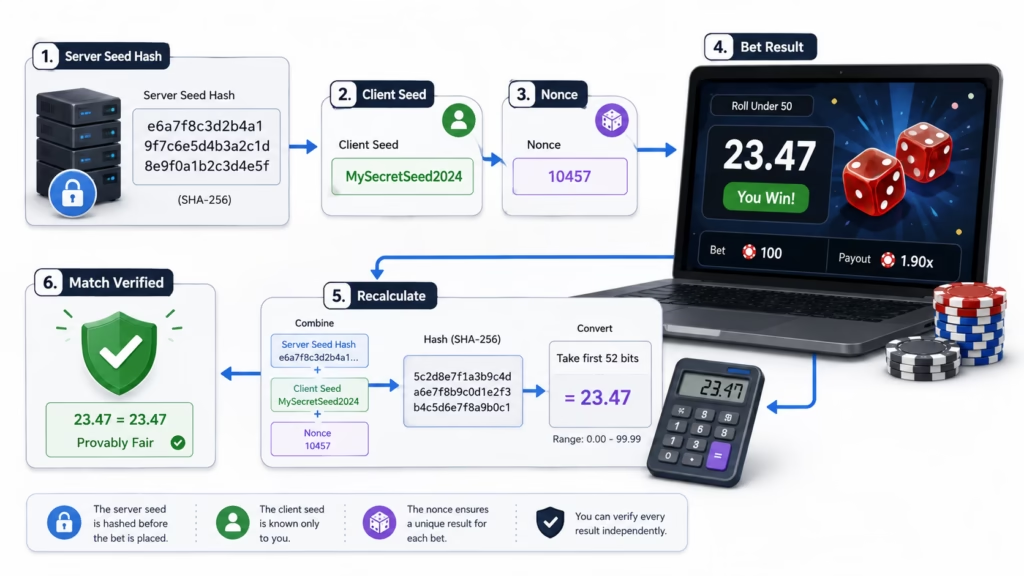
A provably fair casino bet can be verified by comparing the cryptographic data generated before and after the wager. In most systems, the casino commits to a hidden server seed before the bet, combines it with a client seed and nonce to generate the result, then reveals the server seed later so you can independently reproduce the calculation.
The important point is that provably fair technology does not make a bet more likely to win. It gives you a way to check whether the casino changed the predetermined cryptographic inputs after your wager was placed.
Quick takeaways:
- A server seed hash should be available before the bet.
- The server seed itself is normally revealed after it is rotated or the betting session ends.
- Your client seed and nonce identify the specific bet being verified.
- A casino verifier should reproduce the same result from the same inputs.
- Provably fair verification checks result integrity, not whether a casino will process withdrawals or treat customers fairly in other areas.
Provably fair games are particularly useful for players who want greater transparency in crypto casino games such as dice, crash, mines, limbo, roulette-style games and other mathematically generated formats. Players should be more cautious when a casino uses the term “provably fair” but does not disclose seeds, hashes, the calculation method or a usable verification tool.
What Does Provably Fair Mean?
Provably fair is a cryptographic system designed to let players verify that a casino game result was generated from information committed to before the wager was settled.
The casino typically creates a secret value called the server seed. Instead of immediately revealing that seed, the casino publishes a cryptographic hash of it. A hash works like a one-way fingerprint. You can calculate a hash from the original seed, but obtaining the original seed from the hash should be computationally impractical when a secure cryptographic hash function is implemented correctly.
The player’s client seed is then combined with the casino’s server seed and usually a nonce, which is a counter that changes between bets. The game applies its published algorithm to these values and converts the resulting cryptographic output into a game result.
After the server seed is revealed, the player can calculate its hash and confirm that it matches the hash shown before the bet. The same inputs can then be passed through the casino’s published verification algorithm to check whether they reproduce the recorded outcome.
What You Need to Verify a Provably Fair Bet
Server Seed
The server seed is the secret value initially controlled by the casino. It should remain hidden while it is active because revealing it too early could potentially allow future outcomes to be calculated in some implementations.
Once the casino rotates or reveals the seed, you can use it to verify previous bets associated with that seed.
Hashed Server Seed
The hashed server seed is the casino’s cryptographic commitment to the secret server seed.
For example, if a casino uses SHA-256, the process is conceptually:
SHA256(server seed) = server seed hash
The casino should provide the hash before the relevant wagers occur. After the server seed is revealed, hashing it again should generate exactly the same value.
If the values do not match, the revealed server seed is not the same seed represented by the original commitment.
Client Seed
The client seed adds player-controlled or independently generated information to the result-generation process.
Some casinos allow you to manually change the client seed. Others automatically generate one while still displaying it in the fairness interface.
Allowing the player to select a client seed can reduce the casino’s exclusive control over the inputs used to generate results, although the exact security properties depend on the casino’s full implementation.
Nonce
A nonce is usually an incrementing number associated with each wager.
- First wager: nonce 0
- Second wager: nonce 1
- Third wager: nonce 2
- Fourth wager: nonce 3
The nonce lets a casino generate different cryptographic outputs while continuing to use the same server and client seeds.
Different platforms may format the nonce differently, so use the exact value shown in the bet record.
Bet Result
You also need the actual result recorded by the casino.
For a dice game, this might be 42.71.
For a crash game, it could be a crash multiplier.
For Mines, the calculation may determine the positions of mines.
The cryptographic output often needs additional mathematical processing before becoming the displayed game result. This conversion method is an important part of the verification algorithm.
How to Verify a Provably Fair Bet Step by Step
The exact procedure varies between casinos, but most provably fair systems can be checked using the following process.
1. Find the Provably Fair Information for the Bet
Open the casino’s bet history, fairness page or individual wager details.
Look for:
- hashed server seed
- revealed server seed
- client seed
- nonce
- bet ID
- game result
- verification algorithm or verifier
If several of these values are unavailable, independent verification may be limited.
2. Check the Original Server Seed Hash
Before using the revealed server seed, identify the hashed server seed that was associated with the wager.
This is critical because the hash is the casino’s commitment to the hidden seed.
Simply receiving a server seed after the game is not enough. You need evidence that the casino committed to that specific seed before the result was finalized.
3. Reveal or Rotate the Server Seed
Many casinos do not reveal an active server seed immediately.
You may need to click a button such as:
- Rotate Seed
- Change Seed
- Reveal Seed
- Generate New Seed
The casino then replaces the active server seed and reveals the old one. Do not expect every casino to use the same terminology.
4. Hash the Revealed Server Seed
Calculate the cryptographic hash of the revealed server seed using the same hashing function specified by the casino.
If the casino uses SHA-256:
SHA256(revealed server seed)
The generated hash must match the hashed server seed committed to before the wager.
Even a tiny change in the seed produces a substantially different cryptographic hash.
5. Enter the Client Seed and Nonce
Copy the exact client seed and nonce associated with the wager.
Do not manually simplify, shorten or reformat these values unless the casino’s published verification specification explicitly requires it.
Cryptographic calculations are sensitive to the exact input. Changing one character can produce an entirely different output.
6. Reproduce the Cryptographic Result
Many provably fair games use constructions based on cryptographic hash functions or HMAC, often with algorithms such as SHA-256 or SHA-512.
A simplified implementation might calculate something conceptually similar to:
HMAC-SHA256(server seed, client seed + nonce)
However, this is only an example.
One casino might use:
clientSeed:nonce
Another might use:
clientSeed-nonce
A game may also include additional counters or rounds of calculation.
Always use the exact algorithm published for that specific game and operator. A generic provably fair calculator cannot reliably verify every casino implementation.
7. Convert the Hash Into the Game Result
The cryptographic hash itself usually looks like a long hexadecimal string rather than a recognizable casino result.
The casino’s algorithm converts part or all of that hash into a numerical value.
For example, an implementation might:
- read selected hexadecimal characters;
- convert them into an integer;
- normalize the integer into a value between 0 and 1;
- apply the game’s mathematical formula;
- convert that value into a roll, multiplier, card, mine location or another result.
This conversion stage is essential.
Two casinos could generate identical cryptographic hashes but translate them into game outcomes differently.
8. Compare the Calculated and Recorded Results
The final calculated outcome should match the wager shown in your casino history.
If the results match, the bet is cryptographically consistent with the disclosed seeds, nonce and published algorithm.
If they do not match, first check for common verification mistakes before assuming manipulation.
Example of a Provably Fair Verification
Imagine that a dice casino displays the following data for a completed wager:
- Original server seed hash: Hash A
- Revealed server seed: Seed B
- Client seed: Player123
- Nonce: 74
- Recorded roll: 63.42
The first verification is:
HASH(Seed B) = Hash A
If the two hashes match, the revealed server seed corresponds to the casino’s previous commitment.
Next, the casino’s documented algorithm combines:
Seed B + Player123 + 74
The resulting cryptographic value is then converted using the casino’s dice formula.
If the calculation returns 63.42, the recorded wager is consistent with the provably fair data.
The numbers above are illustrative. Real implementations use different seed formats, hashing functions and result-conversion formulas.
Using a Provably Fair Casino Verifier
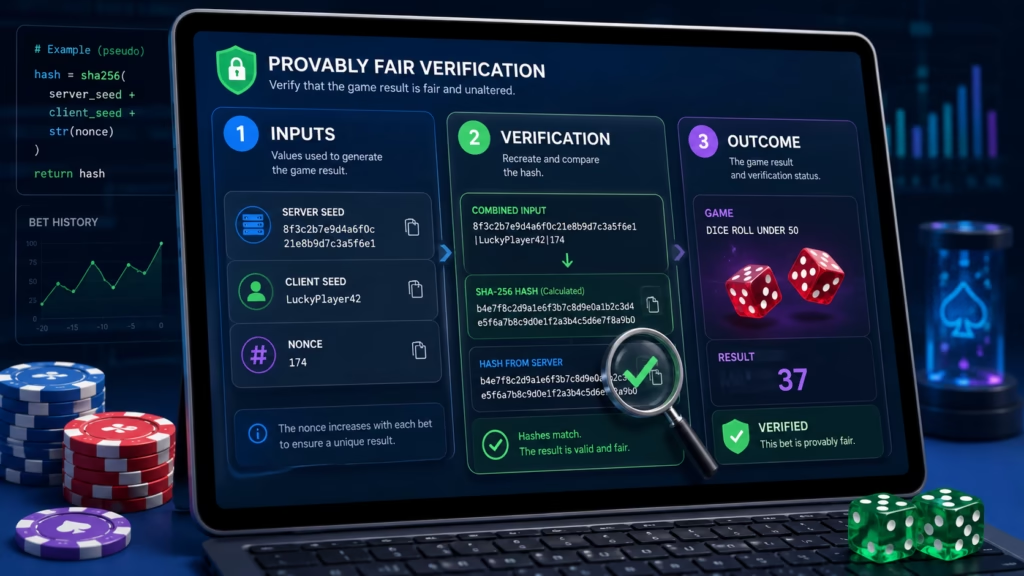
A provably fair casino verifier automates the calculations that would otherwise need to be performed manually.
A typical verifier asks for:
- server seed
- client seed
- nonce
- game or algorithm
- sometimes an additional round or cursor value
After entering the information, the tool calculates the expected result.
The safest verifier is one whose calculation method can be inspected and compared with the casino’s published algorithm. A calculator that merely says “verified” without showing how the result is produced offers less transparency.
For technically inclined players, independently reproducing the calculation with open-source code can provide another level of verification, provided the implementation exactly matches the casino’s documented method.
How to Tell Whether a Provably Fair System Is Actually Useful
The phrase “provably fair” alone is not enough. A useful implementation should give players enough information to independently reproduce past results.
Look for these characteristics:
1. The server seed hash is shown before betting. Without a pre-bet commitment, the main cryptographic protection is weakened.
2. The old server seed can be revealed. Verification requires access to the original secret after it is no longer being used.
3. Client seeds are visible. Players need the same inputs used by the game.
4. Nonce values can be identified. Each wager needs to be mapped to the correct calculation.
5. The algorithm is documented. A hash without a documented result-generation method does not allow complete independent reproduction.
6. Individual bets can be verified. The system should let you connect cryptographic inputs to an actual wager.
7. The result can be reproduced outside the casino interface. Independent verification is more meaningful than a casino simply confirming its own result.
Provably Fair vs RNG Testing
Provably fair verification and traditional RNG testing address related but different questions.
A provably fair system lets an individual player reproduce a specific result using disclosed cryptographic inputs.
Traditional RNG testing generally examines whether a random-number system behaves according to defined technical and statistical requirements. Such testing may be performed by specialized testing laboratories when applicable to the operator or jurisdiction.
Neither method means a player can predict future results.
For a player checking a particular crypto casino wager, provably fair verification offers something conventional casino games often do not: the ability to independently reproduce the result of that specific bet.
Common Provably Fair Verification Mistakes
Verifying the Wrong Server Seed
A casino may rotate server seeds regularly. Using a seed belonging to another betting session will produce the wrong result.
Match the seed to the exact wager being checked.
Using the Wrong Nonce
An incorrect nonce changes the cryptographic calculation.
If bet number 74 used nonce 73 because counting started at zero, entering 74 could return a completely different result.
Check the casino’s documentation rather than guessing.
Ignoring the Game-Specific Formula
Verifying the hash is only one part of the process.
The casino may apply additional calculations to convert cryptographic output into the final game result. You need the correct conversion formula for the specific game.
Assuming “Verified” Means the Casino Is Completely Trustworthy
Provably fair verification proves a narrow technical point.
It can show that a particular outcome corresponds to previously committed cryptographic data. It does not automatically prove that:
- withdrawals will be processed quickly;
- account restrictions are fair;
- bonus rules are reasonable;
- a casino is properly regulated;
- customer service will resolve disputes;
- the casino has strong financial controls.
Casino selection and provably fair verification should therefore be treated as separate checks.
Can a Casino Change a Provably Fair Result?
A properly implemented commitment system is designed to make changing the committed server seed after the fact detectable.
The casino first publishes the hash of the hidden server seed. If it later substitutes a different server seed, the newly calculated hash should no longer match the original commitment.
That is the key protection provided by the system.
However, users still depend on the casino correctly implementing and documenting the entire process. A poorly designed or incomplete system can provide less assurance than a transparent implementation with reproducible calculations.
Does Provably Fair Mean You Can Predict the Next Bet?
Provably fair technology should not reveal enough information to calculate future outcomes while the relevant server seed remains secret.
Knowing the client seed, nonce and server seed hash does not normally give you the hidden server seed itself when a suitable cryptographic hash function and implementation are used.
After the server seed is revealed, it is normally replaced so the revealed value applies only to historical verification.
Any service claiming it can predict future casino outcomes simply because a game is provably fair should be treated with extreme skepticism.
Does Provably Fair Change the House Edge?
Provably fair verification does not remove the house edge.
The fairness mechanism controls how results can be verified. The game’s payout mathematics determine its house edge.
A casino can therefore operate a correctly verifiable game that still has a mathematical advantage for the house.
Before playing, check the game’s rules, payout table and published RTP or house-edge information where available. RTP represents a long-term mathematical expectation and does not predict the outcome of a particular session.
How to Choose a Provably Fair Casino
If provably fair verification matters to you, evaluate the implementation rather than the marketing label.
Prefer casinos that clearly display:
- the pre-bet server seed hash
- client seed controls or information
- nonce values
- previous server seeds
- individual bet details
- the exact verification algorithm
- a functional bet verifier
- understandable rules for each provably fair game
Also evaluate the casino separately for areas such as withdrawals, terms, account verification requirements, responsible gambling tools and applicable regulatory information.
A strong provably fair implementation is useful, but it should be one part of the overall casino evaluation rather than the only criterion.
How This Information Was Reviewed
The verification method described here is based on the core cryptographic components commonly used in provably fair casino systems: precommitted server seed hashes, server seeds, client seeds, nonces and reproducible result-generation algorithms.
The exact implementation should always be checked against the casino’s own fairness documentation because seed formatting, cryptographic functions, nonce handling and game-result conversion formulas can differ between operators and games.
Provably fair technology verifies how a result was generated. It does not increase your probability of winning, remove the game’s house edge or guarantee that every other part of a casino’s operation is fair.
Casino games should be treated as entertainment rather than a source of income. Set spending limits before playing and stop if gambling is causing financial or personal problems.
FAQ
How do I verify a provably fair bet?
To verify a provably fair bet, obtain the original server seed hash, revealed server seed, client seed, nonce and game result. Hash the revealed server seed to confirm it matches the original commitment, then use the casino’s published algorithm to reproduce the wager result.
What is a server seed in a provably fair casino?
A server seed is a secret cryptographic value generated by the casino and used as one of the inputs for game outcomes. The casino normally publishes a hash of the server seed before betting and reveals the original seed later so previous wagers can be verified.
What is a client seed?
A client seed is another input used alongside the server seed when generating provably fair outcomes. It may be generated automatically or selected by the player, depending on the casino. The same client seed must be used when independently verifying a wager.
What does the nonce do in a provably fair game?
The nonce distinguishes individual wagers generated from the same server and client seeds. It commonly increases after every bet, allowing the cryptographic algorithm to produce a different result for each wager.
Can I verify a provably fair casino bet manually?
Yes. A bet can be verified manually if the casino provides its server seed, original seed hash, client seed, nonce and complete calculation method. You may need a hashing or HMAC tool and the casino’s exact game-result conversion formula.
Can a provably fair casino manipulate a bet?
A properly implemented provably fair system is designed to make changes to previously committed cryptographic inputs detectable. Verification still depends on the quality and transparency of the casino’s implementation, so the term “provably fair” should not be accepted without checking how the system works.
Does provably fair mean the casino has no house edge?
No. Provably fair technology verifies result generation, while the house edge comes from the game’s payout mathematics. A game can be cryptographically verifiable and still have a built-in mathematical advantage for the casino.
Can provably fair games be predicted?
Provably fair verification is intended for checking previous bets, not predicting future ones. The active server seed normally remains secret until it is retired, preventing players from reproducing future calculations using the information publicly available during betting.
Why does my provably fair verifier show a different result?
A mismatched result can be caused by an incorrect server seed, client seed, nonce, seed formatting, algorithm or game-specific conversion formula. Compare every input with the casino’s original bet record and use the verification procedure documented for that exact game.
Is a provably fair casino automatically safe to use?
No. Provably fair technology only addresses the integrity and reproducibility of game results. Withdrawal policies, casino terms, account verification, regulatory status, responsible gambling controls and dispute handling need to be evaluated separately.
Brief Conclusion
To verify a provably fair casino bet, first confirm that the revealed server seed produces the same hash the casino committed to before betting. Then combine the server seed, client seed and nonce according to the casino’s published algorithm and reproduce the recorded result.
A successful verification shows that the wager is consistent with the committed cryptographic data. It does not guarantee a win, remove the house edge or prove that every other aspect of the casino is trustworthy. Use provably fair verification as one transparency check, not as a strategy for beating casino games.