
Provably fair casino games use cryptographic data to let players independently check whether a game result was generated from values committed before the bet was settled. A typical system combines a server seed, client seed, and nonce, processes them through a cryptographic function, and converts the resulting bytes into a dice roll, multiplier, card position, mine location, Plinko path, or another game event.
The important distinction is that provably fair technology does not promise that a player will win. It provides a method for checking how a particular result was generated. The game can still have a house edge, and changing seeds does not turn a negative-expectation casino game into a profitable one.
Quick takeaways:
- Provably fair games allow individual results to be independently verified.
- The server seed is normally committed through a cryptographic hash before play.
- The client seed adds player-controlled input to the calculation.
- The nonce produces a different result for each bet using the same seed pair.
- The exact algorithm and result-conversion method can differ between casinos and games.
Provably fair games are particularly useful for players who want more transparency than a conventional trust-the-RNG model provides. Players should be more cautious when a casino claims to be provably fair but does not publish its algorithm, expose the required seeds, explain its result conversion, or provide a practical way to verify completed bets.
What Does Provably Fair Mean in Online Casino Games?
A provably fair system is a cryptographic commitment and verification process designed to make casino results independently checkable.
Instead of simply telling the player that an internal random number generator produced a legitimate result, a provably fair game gives the player the information required to reproduce or verify that result after the relevant server seed is revealed.
The underlying idea is relatively simple:
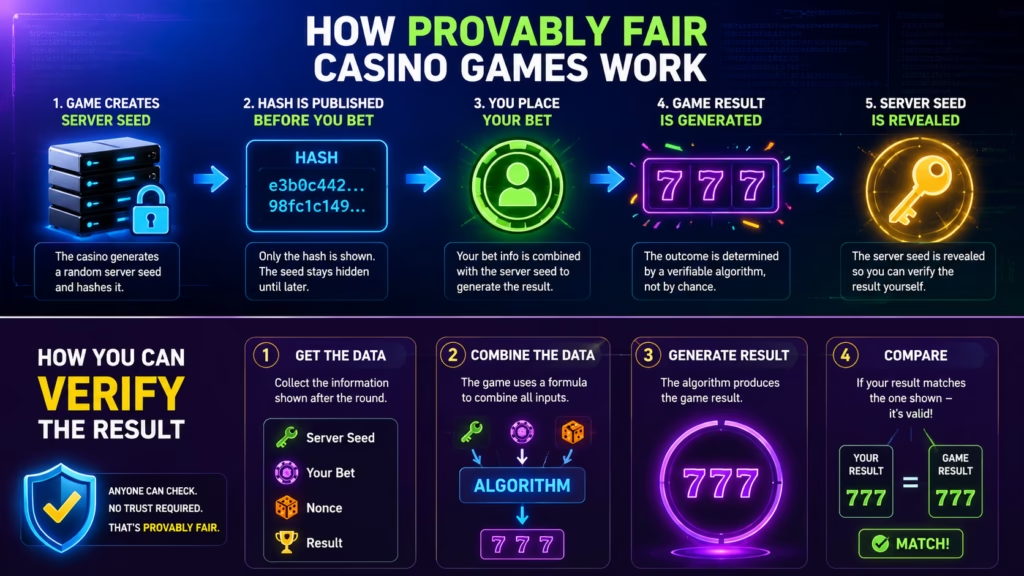
1. The casino generates a secret server seed.
2. The casino shows the player a cryptographic hash of that seed.
3. A client seed is added to the calculation.
4. A nonce identifies the individual bet.
5. The combined values generate cryptographic output.
6. The output is converted into a game result.
7. Later, the original server seed is revealed.
8. The player can verify that the revealed seed matches the original hash and reproduce the game calculation.
A secure hash is useful for this commitment because changing the original input produces a different digest. SHA-256 is a widely used cryptographic hash algorithm that produces a fixed-length digest from input data.
Provably fair therefore replaces part of the trust requirement with a mathematical verification process.
How the Provably Fair Algorithm Works
The exact provably fair algorithm depends on the casino, but many implementations follow the same basic architecture.
A common design generates random bytes using HMAC-SHA256 with a server seed, client seed, nonce, and sometimes an additional round or cursor value when more random data is required.
Conceptually, the process looks like this:
Server seed + client seed + nonce -> cryptographic calculation -> random bytes -> game-specific conversion -> result
HMAC is a keyed hashing mechanism. In one common implementation, the server seed acts as the HMAC key while information derived from the client seed and nonce becomes the message being processed.
The output itself usually is not displayed directly to the player. It must first be converted into a value that makes sense for the game.
- Dice may convert the output into a number within a defined range.
- Plinko may use several values to determine successive left or right movements.
- Mines may use values to determine mine positions.
- Blackjack may require many values for card selection.
- Crash or Limbo may apply a mathematical formula to generate a multiplier.
This conversion stage matters. Two casinos can both use HMAC-SHA256 while using different game-event calculations. A verifier therefore needs the casino’s actual implementation, not merely the seeds.
What Is a Server Seed?
The server seed is a secret value generated by the casino and used as one of the main inputs in the provably fair calculation.
Before bets are placed, a properly documented provably fair system generally exposes a hash of the server seed rather than the server seed itself. The hash acts as a commitment to the hidden value.
The player cannot normally see the active server seed because knowing all inputs could make future deterministic results calculable.
After the seed is rotated or retired, the casino reveals the original server seed. The player can hash the revealed value and compare the result with the hash displayed before the bets were made.
If the hashes match, the player can confirm that the revealed server seed corresponds to the value committed earlier.
This is one of the central protections in a provably fair system. The operator should not be able to secretly replace a losing server seed with another value after the outcome is known without causing the commitment hash to change.
What Is a Client Seed?
The client seed is the player-side input used together with the casino’s server seed.
Some platforms automatically generate an initial client seed, while others allow the player to enter a custom value.
The client seed is important because the final sequence does not depend exclusively on information controlled by the casino.
However, choosing a particular client seed does not improve the mathematical odds of winning.
A seed such as ‘my-lucky-seed-123’ is not inherently luckier than ‘7f3a92c8’. Both simply change the deterministic sequence generated from the complete set of inputs.
Changing a client seed can produce a different future result sequence, but it does not remove the game’s house edge or increase its long-term expected return.
What Is a Nonce?
A nonce is usually an incrementing number that distinguishes one bet from another when the same server seed and client seed remain active.
A typical sequence might look like:
- First bet: nonce 0
- Second bet: nonce 1
- Third bet: nonce 2
- Fourth bet: nonce 3
Changing the nonce changes the cryptographic input, which produces a new output.
Without a changing value such as a nonce, repeatedly processing identical seeds through a deterministic cryptographic function would reproduce the same output.
Some implementations also use a cursor, round number, or similar counter when one bet requires more random bytes than a single hash output conveniently provides.
A Simple Provably Fair Example
Imagine a player opens a provably fair Dice game.
The casino has a secret server seed: SERVER_SECRET_X
Instead of revealing that value immediately, the casino shows its SHA-256 hash.
The player uses CLIENT_ABC as the client seed. The first bet uses nonce 0.
These values are processed according to the casino’s published algorithm. The algorithm produces cryptographic bytes, and the Dice conversion formula transforms those bytes into a result such as 42.37.
The next bet uses the same seeds but nonce 1, so it produces a different cryptographic output.
After the player rotates the server seed, the casino reveals SERVER_SECRET_X.
The player can now:
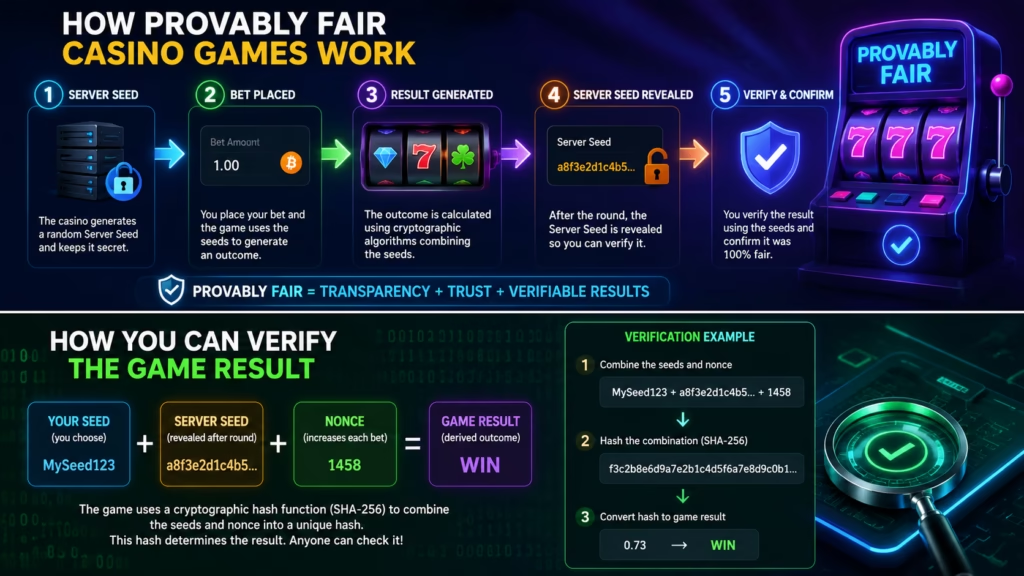
1. Hash SERVER_SECRET_X.
2. Confirm that its hash matches the commitment shown earlier.
3. Recalculate the cryptographic output for the chosen client seed and nonce.
4. Apply the published Dice conversion formula.
5. Compare the reconstructed value with the recorded game result.
If every value matches, the particular bet has passed the mathematical verification process defined by that implementation.
How to Verify a Provably Fair Casino Bet
Verifying a provably fair bet generally requires more than checking whether a casino displays the words ‘provably fair.’
First, locate the fairness information attached to the completed bet or seed session. Depending on the casino, this may include the client seed, nonce, hashed server seed, revealed server seed, game identifier, and sometimes a cursor or round value.
Next, verify the server seed commitment. Hash the revealed server seed using the algorithm specified by the operator and compare the result with the server seed hash displayed before the seed was revealed.
Then reproduce the random output using the casino’s published algorithm.
Finally, apply the correct game-specific conversion.
This last step is essential. Verifying the HMAC output alone proves that the cryptographic calculation matches, but the player must also understand how those bytes were mapped to the actual game event.
Some casinos provide an internal verifier. Third-party or locally executed verifiers may also be useful when their implementation can be independently inspected. The safest approach is to compare the calculation against the casino’s published technical specification rather than trusting a verifier simply because it produces a green check mark.
Provably Fair vs Traditional RNG
Provably fair technology and conventional casino RNG systems solve related problems in different ways.
| Feature | Provably Fair | Traditional RNG |
| Player can usually verify individual results | Yes, when full data and methodology are provided | Usually not directly |
| Cryptographic seeds visible | Often | Usually no |
| Server commitment before play | Common | Not normally exposed |
| Independent technical testing | May still be relevant | Often central to trust model |
| House edge still applies | Yes | Yes |
| Guarantees winning | No | No |
A traditional RNG may rely heavily on external testing, certification, regulatory oversight, and internal security controls.
Provably fair systems add another layer: the player can reconstruct the defined calculation for specific results.
The two approaches are not necessarily opposites. A casino platform can use cryptographically generated randomness, independent testing, licensing controls, and provably fair verification together.
Does Provably Fair Mean the Casino Cannot Cheat?
Provably fair technology can make certain forms of result manipulation detectable, but the phrase should not be interpreted as proof that every aspect of a casino is trustworthy.
A provably fair algorithm can help verify whether a result was generated from the committed seeds using the published calculation.
It does not automatically answer whether the casino will process a withdrawal, whether bonus terms are reasonable, whether the operator is financially reliable, whether the game has a favorable RTP, whether the casino is properly regulated in a player’s jurisdiction, or whether the entire website has been independently audited.
A casino could theoretically publish a valid provably fair game while having poor withdrawal policies or unfavorable terms elsewhere.
Provably fair verification should therefore be treated as one trust criterion, not a substitute for evaluating the operator itself.
Does Changing Seeds Improve Your Odds?
Changing a server or client seed does not create better odds when the game mathematics remain unchanged.
A new seed pair creates a different deterministic sequence of potential results. The player normally does not know the hidden active server seed, so changing the client seed does not provide useful knowledge about whether the next result will win.
There is no meaningful concept of a seed being due, hot, cold, or exhausted.
A long losing sequence also does not prove that changing seeds will improve the next bet.
The relevant mathematical factors remain the game’s probability model, payout table, RTP, house edge, and rules. Seed rotation changes the cryptographic inputs, not the underlying expected value of the game.
Provably Fair Does Not Remove the House Edge
A provably fair game can be mathematically transparent and still favor the casino over the long run.
Fairness of result generation and fairness of payout mathematics are different questions.
For example, a game could transparently prove that a particular random value was generated correctly while paying slightly less than the mathematically fair payout for that probability. That difference creates the house edge.
Players evaluating a provably fair game should therefore examine both how the result is generated and how the result is paid.
RTP and house edge describe long-run game mathematics. They do not predict whether an individual session will win or lose.
How to Choose a Provably Fair Casino
A strong provably fair implementation should be transparent enough that a technically capable player can reproduce a result without relying entirely on the casino’s own verifier.
Published algorithm
The casino should explain which cryptographic functions and inputs are used.
Visible server-seed commitment
Players should be able to see the hash or other commitment associated with the hidden server seed before the relevant results are generated.
Server-seed revelation
The original seed should become available after rotation or another clearly defined event so previous bets can be checked.
Client-seed control
A system is more transparent when the player can independently select or modify the client seed.
Clear nonce handling
The operator should explain how individual bets are separated and how the nonce changes.
Game-specific conversion documentation
Knowing that a casino uses SHA-256 or HMAC-SHA256 is not enough. The documentation should explain how cryptographic bytes become the actual outcome.
Independent verification
Ideally, the calculation should be reproducible outside the casino interface.
For players comparing crypto casinos, these criteria are more useful than simply looking for a ‘Provably Fair’ badge.
Common Provably Fair Myths
“Provably fair means I can predict the next result”
No. The active server seed is normally hidden specifically so players cannot calculate future results.
“Changing my client seed gives me better luck”
No. A different seed changes the result sequence but does not improve the game’s expected return.
“A losing streak means the algorithm is broken”
Not necessarily. Random or pseudorandom sequences can contain long winning and losing runs.
“Provably fair means there is no house edge”
No. A game can be perfectly verifiable while still having a mathematical casino advantage.
“The casino’s verifier proves everything”
Not by itself. A stronger test is whether the published algorithm can be independently reproduced using the recorded inputs.
How This Information Was Reviewed
Provably fair systems should be evaluated at three separate levels: the cryptographic commitment, the generation of random data, and the conversion of that data into a game result.
The explanation above follows established cryptographic principles for secure hashing and HMAC together with common provably fair implementations that use server seeds, client seeds, nonces, and game-specific conversion logic.
Players should still check the specific casino’s fairness documentation because implementations are not universally identical. Seed formats, hashing functions, nonce handling, cursor logic, and game-event formulas can differ.
Provably fair verification also does not change RTP, house edge, volatility, betting limits, bonus conditions, withdrawal rules, or the probability of losing money. Casino games should be treated as entertainment, and players should set financial and time limits before playing.
FAQ
What is a provably fair casino game?
A provably fair casino game is a game that provides cryptographic information allowing players to verify how specific results were generated. Most implementations combine a hidden server seed, a client seed, and a nonce, then reveal enough information after play for previous results to be independently recalculated.
How do provably fair casino games work?
Provably fair casino games typically commit to a hidden server seed before play, combine it with a client seed and nonce, process the values through a cryptographic algorithm, and convert the resulting bytes into a game outcome. After the server seed is revealed, the player can verify both the commitment and the result calculation.
What is a provably fair algorithm?
A provably fair algorithm is the documented procedure that converts cryptographic inputs into a verifiable casino result. A common design uses HMAC-SHA256 with server and client data, although the exact formula and game-result conversion can differ between operators.
Can a casino change a provably fair result after I bet?
A correctly implemented commitment scheme is designed to make an unnoticed change to the committed server seed detectable. Once the casino has published the server-seed hash, revealing a different seed later should produce a different hash. Verification still depends on the operator publishing enough information to reproduce the complete calculation.
Can I predict a provably fair game?
Normally no. The active server seed remains hidden until it is rotated or retired, preventing the player from knowing all the information required to calculate future results. Provably fair technology is primarily designed for retrospective verification, not prediction.
Should I change my client seed regularly?
Changing the client seed is useful if you want to control your contribution to the cryptographic input, but it does not improve your expected odds. A new client seed produces a different deterministic sequence while the underlying game probabilities and house edge remain unchanged.
Are provably fair casinos safer than normal online casinos?
Provably fair technology provides stronger transparency for game-result verification, but it does not prove that an entire casino is safe or reliable. Licensing status, security practices, withdrawal policies, bonus terms, responsible gambling controls, and reputation should be evaluated separately.
Does provably fair mean there is no RNG?
No. Provably fair games still require a mechanism for producing unpredictable-looking outcomes. Cryptographic functions can generate deterministic pseudorandom data from seeds, with the important advantage that the resulting sequence can later be reproduced and verified from the same inputs.
Does provably fair mean the RTP is 100%?
No. Provably fair and RTP describe different properties. Provably fair concerns whether the defined result-generation process can be verified, while RTP describes the theoretical percentage of wagers returned over a very large number of plays. A provably fair game can still have a house edge.
Can provably fair games still produce long losing streaks?
Yes. Verifiable randomness does not guarantee evenly distributed wins over a short session. Losing streaks can occur even when every result is calculated correctly. Players should not increase bets or chase losses because they believe a win is due.
Brief Conclusion
Provably fair casino games use cryptographic commitments and reproducible calculations to make individual outcomes independently checkable. The usual model combines a server seed, client seed, and nonce, then converts cryptographic output into a game-specific result.
The strongest implementations publish enough technical information for players to verify both the server-seed commitment and the final game calculation outside the casino’s own interface.
Provably fair technology improves transparency, but it does not remove the house edge, predict future results, guarantee withdrawals, or make gambling profitable. Evaluate the fairness system together with the game’s mathematics, casino terms, operator reliability, and responsible gambling controls.