Crypto casinos are not automatically illegal in the UK simply because they accept Bitcoin, Ethereum or another cryptoasset. For players in Great Britain, the decisive legal issue is whether the casino is licensed by the UK Gambling Commission to provide remote gambling to British consumers. A foreign gambling licence on its own does not authorise an operator to serve players in England, Scotland or Wales.
The UK Gambling Commission also permits licensed operators to use digital currencies as payment methods, provided they can meet licensing, anti-money laundering, customer verification and social responsibility requirements. Cryptoassets receive additional scrutiny because the regulator considers them a higher-risk payment method from an AML perspective.
Key points for UK players:
- A crypto casino serving players in Great Britain normally needs an active UK Gambling Commission licence.
- Bitcoin or another cryptocurrency can be accepted by a licensed operator, but crypto does not remove KYC or AML requirements.
- A Curacao, Malta or other overseas licence does not replace a UK Gambling Commission licence when the casino serves Great Britain.
- Casinos advertising “no KYC” access to British players should be treated with particular caution because UK-licensed remote operators must verify customer identity before permitting gambling.
- Using an unlicensed gambling website does not generally make the player the party conducting the illegal gambling activity. The regulatory offence concerns operators providing unlicensed gambling facilities, but players using such sites lose important UK regulatory protections.
Are Crypto Casinos Legal in the UK?
Crypto casinos can operate legally for customers in Great Britain when the operator holds the appropriate Gambling Commission licence and complies with the same regulatory framework that applies to other licensed online casinos.
The Gambling Commission does not create a separate legal category that allows a casino to bypass normal gambling regulation merely because deposits and withdrawals are made in Bitcoin. Its guidance specifically recognises digital currencies as possible payment methods and requires operators that accept them to meet anti-money laundering and social responsibility obligations.
This means the important distinction is not crypto casino versus fiat casino. It is UKGC-licensed casino versus casino that is not authorised to serve Great Britain.
A remote operator may be incorporated outside Britain. That does not itself make the casino illegal. An operator serving consumers in Great Britain still needs the appropriate British licence regardless of where the business is based.
What Licence Does a Crypto Casino Need?
An online casino contracting directly with customers in Great Britain generally requires a Remote Casino Operating Licence from the UK Gambling Commission.
The licence covers online casino products including slots, roulette, blackjack, poker and other casino games. The same licensing requirement applies whether deposits arrive through conventional payment systems or approved arrangements involving cryptoassets.
Cryptoassets add compliance requirements rather than replacing the normal licence. Operators must consider customer payment methods in their money laundering and terrorist financing risk assessments and comply with reporting obligations when payment methods or payment processors change.
For a player, this produces a simple rule: do not treat “crypto licensed” or an overseas licence as equivalent to UK authorisation. Check the actual operator and domain against the Gambling Commission register.
Can UKGC-Licensed Casinos Accept Bitcoin?
Yes. Gambling Commission guidance explicitly addresses operators accepting digital currencies and cryptoassets either directly or through payment processors.
However, accepting Bitcoin is not as simple as adding a wallet address. The operator must understand and control risks including source of funds, customer identification, cryptocurrency price fluctuations, deposit-limit and AML monitoring, security of cryptoassets, payment processor arrangements, suspicious transactions, and money laundering and terrorist financing exposure.
The Commission’s 2026 risk assessment continues to identify funds connected with cryptoassets as a risk factor in the remote gambling sector.
As a result, a legitimate Bitcoin casino for UK players may actually perform more, rather than fewer, checks when cryptocurrency is involved.
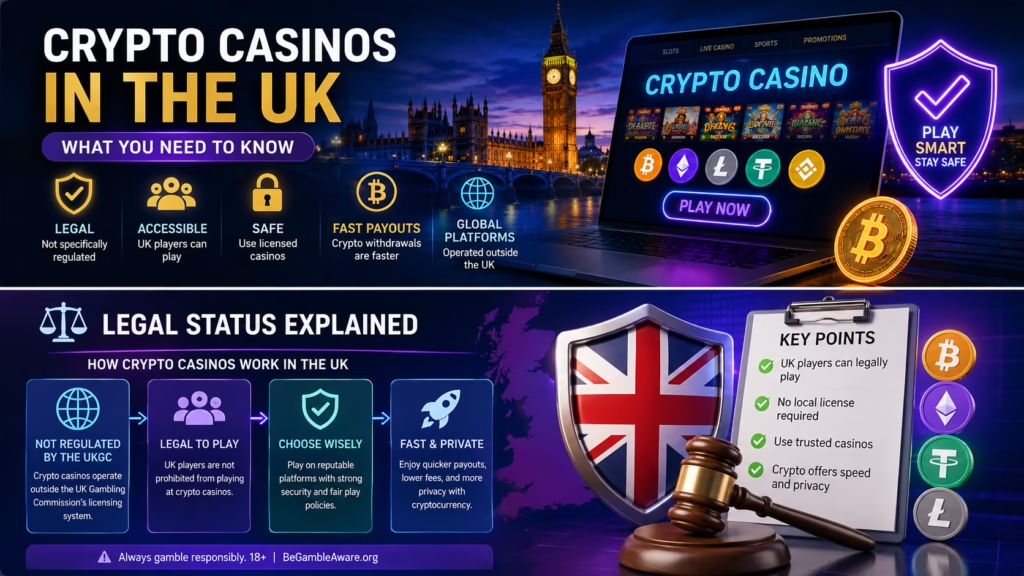
Why “No KYC Crypto Casinos” Are a Problem for UK Players
A casino offering British customers completely anonymous real-money gambling without identity verification does not fit the normal UKGC-regulated model.
Remote Gambling Commission licensees must obtain and verify identifying information before permitting a customer to gamble. The minimum requirements include verification relating to the customer’s name, address and date of birth.
Age must also be verified before a customer can deposit money, use free-to-play casino games or gamble with real money or bonuses. Crypto does not provide an exemption.
Sites may advertise instant anonymous registration, no ID ever, VPN-friendly gambling, deposits from unidentified wallets or access despite GAMSTOP. Those features can appeal to players seeking privacy, but they should not be confused with normal British regulatory protections.
UKGC Crypto Casino vs Offshore Crypto Casino
| Feature | UKGC-Licensed Crypto Casino | Offshore Casino Without UKGC Licence |
| Can lawfully provide gambling to GB consumers | Yes, within its licence | No |
| Bitcoin or crypto may be accepted | Yes, if compliant | Often |
| Identity verification | Required | Depends on operator |
| AML controls | Required | Depends on jurisdiction |
| UK licence register entry | Yes | No |
| UK responsible gambling rules | Required | Not necessarily |
| National self-exclusion participation | Required for applicable remote licensees | Usually not |
| UK regulatory action and complaint framework | Available within regulated system | UKGC protection is limited or absent |
How to Check Whether a Bitcoin Casino Is Legal for UK Players
The most reliable method is to verify the casino in the Gambling Commission’s public register rather than trusting a badge or logo on the casino website.
1. Find the licensing statement
A licensed gambling website should identify the licensed company and its Gambling Commission account number.
2. Search the UKGC register
Search using the operator name, trading name or casino domain. The official register lists licence status, trading names and registered domains.
3. Match the domain
A genuine licence held by one company does not automatically authorise an unrelated website. Confirm that the exact casino domain is associated with the operator.
4. Check licence status
The licence should be active. The register can also show regulatory action taken against the operator.
5. Examine the crypto terms
Before depositing Bitcoin, Ethereum, USDT or another cryptoasset, check supported networks, minimum deposit, minimum withdrawal, blockchain confirmation requirements, withdrawal processing rules, conversion between crypto and GBP, network fees, KYC and source-of-funds requirements, bonus wagering terms, and whether withdrawals must return through a particular payment route.
Is a Curacao-Licensed Crypto Casino Legal in the UK?
A Curacao licence alone does not authorise an online casino to provide gambling to customers in Great Britain.
The same principle applies to licences from other foreign jurisdictions. An overseas licence may regulate an operator elsewhere, but operators serving British consumers still need the necessary British operating licence.
This distinction matters because many Bitcoin casinos for UK players appear in search results despite operating offshore. A website accepting British registrations or GBP does not prove that it is authorised in Great Britain. Always verify the UKGC licence separately.
Is It Illegal for a UK Player to Use an Unlicensed Crypto Casino?
The Gambling Commission distinguishes between the operator conducting unlawful gambling activity and the consumer accessing the website.
Individuals who gamble with illegal websites are not generally the party conducting the illegal gambling activity simply by using the site. The unlawful conduct concerns gambling companies offering services to consumers in Great Britain without the required licence.
That does not make using an offshore casino equivalent to using a regulated one. Players on unlicensed websites may lack safeguards covering fair treatment, self-exclusion, customer verification, complaints, withdrawal practices and regulatory enforcement.
Using a VPN to circumvent geographical restrictions is also a warning sign. If a casino blocks Great Britain because it is not authorised there, bypassing that restriction does not turn the casino into a UK-regulated operator.
Crypto Casinos and GAMSTOP
Applicable UKGC-licensed remote gambling operators must participate in the national multi-operator self-exclusion system.
An offshore crypto casino outside the UK-regulated market may not participate in GAMSTOP. Sites deliberately promoted as “not on GAMSTOP” therefore require particular caution.
If someone has chosen self-exclusion, searching for crypto casinos specifically to bypass that restriction defeats the protection the exclusion was intended to create. Gambling should remain entertainment and should not be used to recover losses or generate income.
Can UK Crypto Casinos Accept Credit Cards?
UKGC-licensed remote gambling operators must not accept credit-card payments for gambling, including payments routed through a money service business.
Crypto should not be viewed as a mechanism for bypassing that restriction. A casino accepting cryptocurrency does not receive permission to ignore UK payment rules merely because a blockchain transaction sits somewhere in the payment chain.
For players, an operator openly promoting credit-card gambling alongside claims of being fully UK regulated deserves additional verification.
Are Crypto Casino Winnings Tax-Free in the UK?
The taxation of cryptoassets creates a separate issue from the taxation of gambling itself.
Cryptoassets are treated by HMRC as assets for tax purposes, and individuals commonly fall within Capital Gains Tax rules when disposing of cryptoassets. A disposal can include selling tokens for money, exchanging one token for another or using tokens to pay for goods or services.
Therefore, a player should not assume that every later transaction involving cryptocurrency received from a casino has no tax consequences simply because the original funds arose from gambling.
The exact treatment depends on the circumstances, acquisition value, subsequent value changes and the individual’s tax position. Significant crypto transactions should be checked against current HMRC guidance or discussed with a qualified tax professional.
What Makes a Crypto Casino Safer for UK Players?
A strong starting point is regulatory status rather than the number of supported coins.
- An active UK Gambling Commission licence for the operator and domain.
- Transparent company information.
- Clearly explained Bitcoin and crypto payment rules.
- KYC and AML procedures.
- Published withdrawal conditions.
- Responsible gambling tools.
- Clear bonus wagering rules.
- Transparent treatment of network fees and cryptocurrency conversion.
- Appropriate self-exclusion options.
- A clear complaints procedure.
Fast crypto withdrawals, large bonuses or anonymous registration do not compensate for missing regulatory protection.
Crypto gambling also combines two forms of financial risk. Casino outcomes are uncertain, while the cryptoasset itself can change significantly in market value. A player can therefore experience both gambling losses and cryptocurrency price movements.
Common Myths About UK Crypto Casino Law
“Bitcoin casinos are banned in Britain”
Not as a category. The Gambling Commission has specific guidance for licensed operators accepting digital currencies. The payment method does not eliminate licensing obligations.
“A foreign casino licence is enough”
No. A foreign licence does not substitute for the Gambling Commission licence required to provide gambling to consumers in Great Britain.
“Crypto means no KYC”
Not at a UKGC-regulated online casino. Remote licensees must verify customer identity before allowing gambling.
“A UK-accessible website must be legal”
No. Illegal operators can remain technically accessible to British consumers. Accessibility alone does not prove legal authorisation.
A Note About Northern Ireland
The Gambling Commission’s core consumer licensing framework described above applies to Great Britain, meaning England, Scotland and Wales.
The term “UK crypto casinos” is commonly used in search, but Northern Ireland has a different gambling-law framework. Players located there should not assume that every Great Britain-specific licensing rule applies in exactly the same way.
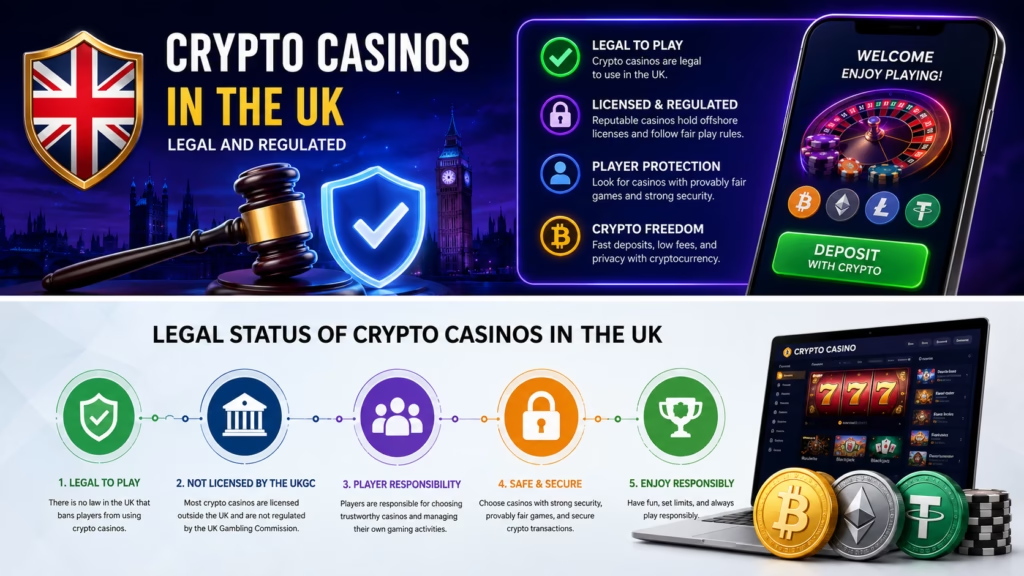
How This Information Was Reviewed
The legal assessment is based primarily on current Gambling Commission licensing requirements, its Licence Conditions and Codes of Practice, its cryptoasset and AML guidance, and its 2026 assessment of money laundering risks in the British gambling industry.
The most important fact for players to verify is the specific casino operator and website domain in the current Gambling Commission register. Payment options, supported cryptocurrencies, withdrawal conditions and bonus rules can change between operators.
Crypto casino games remain gambling. Neither Bitcoin, blockchain technology, RTP, bonuses nor payment speed can guarantee a profit or improve the random outcome of casino games. Set spending limits before gambling and stop if gambling is no longer entertainment.
FAQ
Are crypto casinos legal in the UK?
Crypto casinos can legally serve consumers in Great Britain when the operator holds the necessary UK Gambling Commission licence and complies with licensing, identity verification, AML and responsible gambling requirements. Cryptocurrency itself is not an exemption from gambling law.
Can UK players gamble with Bitcoin legally?
Bitcoin can be used as a gambling payment method within a compliant licensed operation. Players should verify the casino’s UKGC licence and confirm that Bitcoin is officially supported by that operator before sending funds.
Does the UK Gambling Commission allow cryptocurrency?
Yes. The Gambling Commission has guidance covering digital currencies and cryptoassets and explains the obligations operators must meet when accepting them. Cryptoassets receive enhanced scrutiny because of AML, source-of-funds and identification risks.
Are no-KYC Bitcoin casinos legal for UK players?
A casino offering completely anonymous gambling to customers in Great Britain would not match normal UKGC remote gambling requirements. Licensed remote operators must verify customer identity before permitting gambling.
Is a Curacao crypto casino legal for UK players?
A Curacao licence by itself is not sufficient to authorise an operator to provide online gambling to consumers in Great Britain. The relevant operator normally needs a Gambling Commission licence for the British market.
How do I know whether a crypto casino has a UK licence?
Search the Gambling Commission public register using the casino name, company name or domain. Confirm that the licence is active and that the website you intend to use corresponds with the operator’s registered details.
Do UK Bitcoin casinos require ID?
A UKGC-regulated remote casino must verify customer identity before allowing the customer to gamble. Crypto deposits do not remove that requirement, and additional source-of-funds checks may be necessary when crypto activity increases the customer’s risk profile.
Can a UK casino ask where my Bitcoin came from?
Yes. A licensed operator may need information about the source of funds or wealth to satisfy anti-money laundering obligations. Funds linked to cryptoassets may receive increased scrutiny.
Are offshore crypto casinos safe for UK players?
An offshore licence does not provide the same British regulatory protection as a UKGC licence. Players may face higher risks involving complaints, withdrawals, privacy, self-exclusion and regulatory recourse.
Can cryptocurrency make casino gambling profitable?
No payment method changes the underlying mathematics or randomness of casino games. Bitcoin may change how money is deposited and withdrawn, but it does not create guaranteed wins or remove the house edge. Gambling should be treated as entertainment rather than a source of income.
Brief Conclusion
Crypto casinos are not banned in Great Britain, but cryptocurrency does not create a loophole in UK gambling law. A Bitcoin casino serving players in England, Scotland or Wales normally needs an appropriate UK Gambling Commission licence, even when it already holds an overseas gambling licence.
For UK players, the safest practical test is simple: verify the operator and exact domain in the Gambling Commission register before depositing crypto. Treat anonymous no-KYC access, VPN instructions, GAMSTOP avoidance and claims that a foreign licence is “enough for UK players” as warning signs rather than benefits.