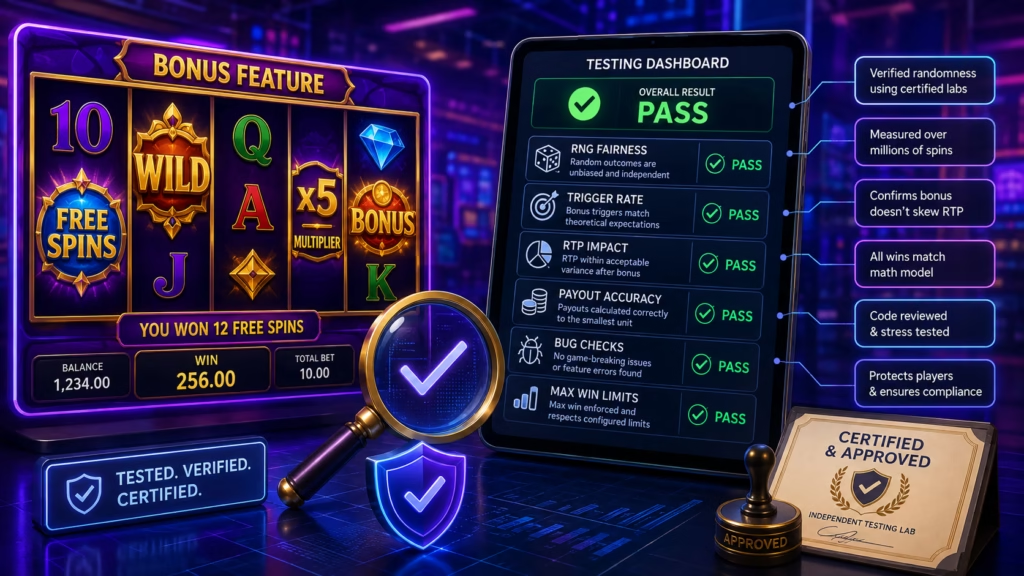
Slot game testing and certification is the process used to verify that a slot’s mathematics, random outcomes, bonus rules, displayed information and software behavior match the approved game design. Bonus features are not tested only by triggering them a few times. Independent laboratories may review source code, examine the mathematical model, run large simulations, test individual feature paths and confirm that the game behaves correctly when sessions are interrupted.
A successful test does not mean that a slot will pay frequently or give every player a fair result during a short session. It means the tested game version met the applicable technical requirements for a particular jurisdiction or certification scope.
Key points
- The random number generator and bonus-selection logic are evaluated separately from animations.
- Theoretical RTP calculations normally include the mathematical contribution of bonus rounds.
- Free spins, multipliers, respins, collections and player choices are tested under normal and unusual conditions.
- Game rules must accurately describe how features trigger, operate and award prizes.
- Material changes to bonus mathematics or game rules may require retesting.
- Certification confirms compliance of a specific version, not guaranteed winnings for players.
Slot game testing and certification is particularly relevant to players comparing regulated casino games, developers preparing a release and operators selecting games for a licensed platform. Players should be cautious when a casino does not identify its licence, game provider, rules or available RTP information.
What Does Slot Game Testing and Certification Mean?
Slot game testing checks whether the actual software follows its documented mathematical and operational rules. Certification usually follows satisfactory testing and identifies the game version, RTP configuration, software signature, platform scope and test result.
Three different processes are often confused:
1. Developer quality assurance finds visual bugs, crashes and gameplay errors before submission.
2. Independent laboratory testing evaluates the game against specified technical standards.
3. Regulatory acceptance or approval determines whether that tested product may be supplied or released in a particular market.
An independent laboratory does not create one universal approval that automatically covers every country. Each jurisdiction can set its own requirements, although regulators may use common technical standards or accept previous testing when the scope is suitable.
How Are Slot Bonus Features Tested?
Slot bonus features are tested by comparing the game’s code and observed behavior with its mathematical specification, rules and artwork. Testers verify every significant route through the bonus, including triggers, retriggers, prize calculations, player selections, maximum limits and recovery after technical interruptions.
1. The Laboratory Reviews the Game Documentation
The provider normally supplies a technical package describing how the slot is intended to work. Depending on the game and jurisdiction, the submission may include:
- mathematical calculations;
- reel strips or symbol-weighting tables;
- paytables;
- bonus trigger conditions;
- free-spin and retrigger rules;
- multiplier logic;
- jackpot contributions;
- maximum-win limits;
- source code or executable files;
- software version numbers and digital signatures;
- game rules and help-screen text.
The documentation gives testers a reference against which the software can be evaluated. A feature cannot be assessed properly when the trigger, probability, prize calculation or state transitions are not clearly defined.
2. The RNG and Outcome Mapping Are Examined
The random number generator produces values that the game converts into symbols, bonus results or other random events. Testing therefore covers both the RNG output and the scaling or mapping process that transforms raw numbers into game outcomes.
Testing procedures may include reviewing RNG documentation, checking for known weaknesses, inspecting source-code implementation and statistically testing both raw output and scaled or shuffled data. Technical standards generally require random outcomes to be unpredictable and distributed according to the approved probabilities.
For a slot bonus, testers may examine whether:
- the trigger is selected according to the approved probability;
- all eligible bonus outcomes remain available;
- previous wins or losses do not secretly alter future probabilities;
- the game does not discard an RNG result and replace it with a more dramatic display;
- separate RNG implementations behave as documented.
A compliant game should not change the likelihood of a bonus because of prizes obtained in previous games or adapt its theoretical return according to past payouts unless such behavior is explicitly permitted and disclosed under the applicable rules.
3. The Bonus Mathematics and RTP Are Verified
Theoretical RTP represents the long-term mathematical proportion of stakes returned as prizes under defined conditions. In a slot with bonus rounds, the calculation may combine the return from the base game with the return contributed by free spins, multipliers, jackpots or other features.
Testers calculate the expected return from the mathematical model and compare it with the stated RTP. They may then use simulations, emulation and manual testing to confirm that the implemented software produces results consistent with that model.
A simple illustration is:
- base-game contribution: 65%;
- free-spin contribution: 25%;
- other feature contribution: 6%;
- total theoretical RTP: 96%.
These figures are only an example. Real slot mathematics may contain multiple RTP settings, bet-dependent features, progressive contributions or more complex probability branches.
Certification does not mean a player will receive the stated RTP during one session. RTP is a long-term theoretical measurement, and individual results remain random.
4. Every Bonus Trigger and State Is Tested
A bonus feature is usually treated as a series of defined states rather than one animation. Testers check how the game enters the feature, records progress, awards prizes and returns to the base game.
Common test cases include:
- landing the exact number of required scatters;
- landing more triggering symbols than the minimum;
- retriggering on the first or last free spin;
- reaching a multiplier cap;
- collecting the final symbol needed for a feature;
- completing a hold-and-respin round with no new symbols;
- awarding simultaneous line wins and feature prizes;
- reaching the maximum win during an unfinished bonus;
- changing stake before a feature is triggered;
- attempting an unavailable player selection.
The purpose is to confirm that every valid route produces the correct result and every invalid action is rejected safely.
5. Rules, Counters and Player Information Are Checked
A mathematically correct feature can still fail testing when its rules or displays are misleading. Players must be able to understand how the bonus starts, what choices are available and how prizes are calculated.
Testing standards may require progress toward non-random feature triggers to be displayed, collected achievements to be shown, held symbols to be identified and multi-spin bonuses to retain a visible counter. The game should also make clear when the player is in bonus mode.
Testers may compare:
- the paytable with the coded payouts;
- advertised multipliers with available multiplier values;
- displayed free spins with the actual number awarded;
- maximum-win statements with software limits;
- bonus-buy prices with the amount deducted;
- player choices with their true effect on the result.
A pick feature that appears skill-based may require a clear explanation when the choices only reveal prizes that were already determined randomly.
6. Interruptions and Recovery Are Tested
Online bonus rounds must behave correctly when the connection fails, the browser closes or the gaming platform restarts. A technical interruption should not silently remove an earned feature or produce a second payment for the same completed event.
Testing may examine whether the system can:
- restore the correct number of remaining free spins;
- preserve collected symbols and multipliers;
- reconstruct the last completed game state;
- prevent duplicate bets or awards;
- finish an unresolved bonus according to the game rules;
- record sufficient history for investigation.
For physical gaming devices and external bonus systems, standards may also require recovery or compensation for an already triggered feature and enough historical information to reconstruct bonus play.
7. The Tested Version Is Identified
A test report normally identifies exactly what was evaluated. Relevant details may include the game name, software number, digital signature, RTP, platform version, supported clients and testing result.
Digital signatures or hashes matter because two games with the same public title may use different software builds or RTP configurations. A certificate for one version should not automatically be treated as evidence for every later version.
How Different Bonus Features Are Evaluated
| Bonus feature | Main testing focus |
| Free spins | Trigger accuracy, number of spins, retriggers, special reel sets, remaining-spin counter and final payout |
| Multipliers | Activation conditions, stacking rules, caps, eligible wins and reset behavior |
| Hold-and-respin | Symbol locking, respin counter, reset conditions, collected values and full-screen awards |
| Pick bonuses | Number of choices, prize selection, automatic selection rules and whether apparent skill affects the outcome |
| Mystery bonuses | Random selection process, eligibility, prize range and correct disclosure |
| Bonus buys | Purchase cost, player confirmation, feature entry, RTP treatment and jurisdictional availability |
| Progressive bonuses | Contribution calculations, eligibility, jackpot values, award locking and communication failures |
| Community features | Player eligibility, timing, shared event rules and independence or interaction of player outcomes |
The exact tests depend on the feature design. A fixed set of free spins requires fewer decision paths than a multi-stage feature containing collections, player choices, persistent meters and progressive prizes.
Source-Code Review vs Simulation vs Manual Testing
No single testing method is sufficient for every part of a slot.
Source-code review checks how the RNG, mapping, prize calculations, limits and feature states are implemented. It is useful for identifying logic that may not appear during ordinary play.
Mathematical analysis verifies probabilities, prize values and theoretical RTP without waiting for rare outcomes to appear naturally.
Large-scale simulation runs many game cycles to compare observed results with expected behavior. Simulation can identify distribution errors, but statistical variation must be considered.
Manual testing confirms that rules, buttons, counters, sounds, displays and player interactions work correctly. It is especially important for paths such as bonus purchases, selections and interrupted sessions.
Integration testing checks the game on the intended platform, wallet and client configuration. A previously tested game may need additional work when connected to a different RNG, platform or delivery environment.
Does Certification Guarantee That a Slot Is Fair?
Certification provides evidence that the submitted game version passed the defined testing scope. It does not guarantee that every casino is authorised, every displayed RTP is identical or every future software update remains covered.
A regulated slot can also produce long losing sequences without malfunctioning. Randomness allows uneven short-term results, while theoretical RTP describes performance over a very large number of plays.
Players should distinguish between three questions:
- Was the game tested?
- Is this exact version approved or accepted for the relevant market?
- Is the casino legally authorised to offer it?
A certificate answers only the questions included within its scope.
When Does a Bonus Feature Need to Be Retested?
A bonus feature may require retesting when a software change can affect fairness, game rules, RNG processing, mapping or prize mathematics. Changes that affect these areas are commonly treated as major changes under regulatory testing frameworks.
Changes likely to require careful assessment include:
- altering bonus-trigger probabilities;
- adding or removing prize values;
- changing free-spin reel strips;
- modifying multiplier behavior;
- introducing a bonus buy;
- changing RTP configurations;
- adjusting maximum-win logic;
- moving outcome generation to a different RNG or platform.
A purely visual correction may receive different treatment, but the provider and operator should follow the rules of the relevant jurisdiction rather than assuming that an update is minor.
Common Myths About Slot Certification
“A certified slot pays every player fairly in the short term”
Certification does not smooth individual results. A tested random game may still produce several wins close together or a long sequence without a meaningful prize.
“Laboratories only test the RNG”
Slot game testing covers more than raw randomness. It can include mathematics, RTP, mapping, rules, artwork, feature logic, software behavior, platform integration and reporting.
“The bonus animation determines the prize”
The animation normally presents a result generated according to the game’s approved logic. Testers check that the display does not contradict or improperly replace the selected result.
“One certificate covers the slot everywhere”
Certification scope is tied to specified standards, versions and configurations. Acceptance in one market does not automatically establish approval in another.
“A higher RTP means the bonus will trigger sooner”
RTP does not state when a feature will appear. Two slots can have similar RTP values but very different bonus frequencies, prize distributions and volatility.
How Players Can Check a Slot’s Credibility
Players cannot reproduce a laboratory audit, but they can check several practical signs before playing:
1. Confirm that the casino identifies its regulator and licence details.
2. Open the slot’s rules or paytable before placing a wager.
3. Check the listed RTP, especially when multiple versions may exist.
4. Confirm the game provider and title.
5. Look for clear bonus rules, limits and purchase costs.
6. Check whether the regulator publishes approved suppliers, games or test laboratories.
7. Avoid assuming that a logo alone proves the current game version is certified.
Bonus terms, promotional wagering requirements and casino deposit offers are separate from the slot’s internal bonus features. Casino promotion conditions should be checked independently.
How This Information Was Reviewed
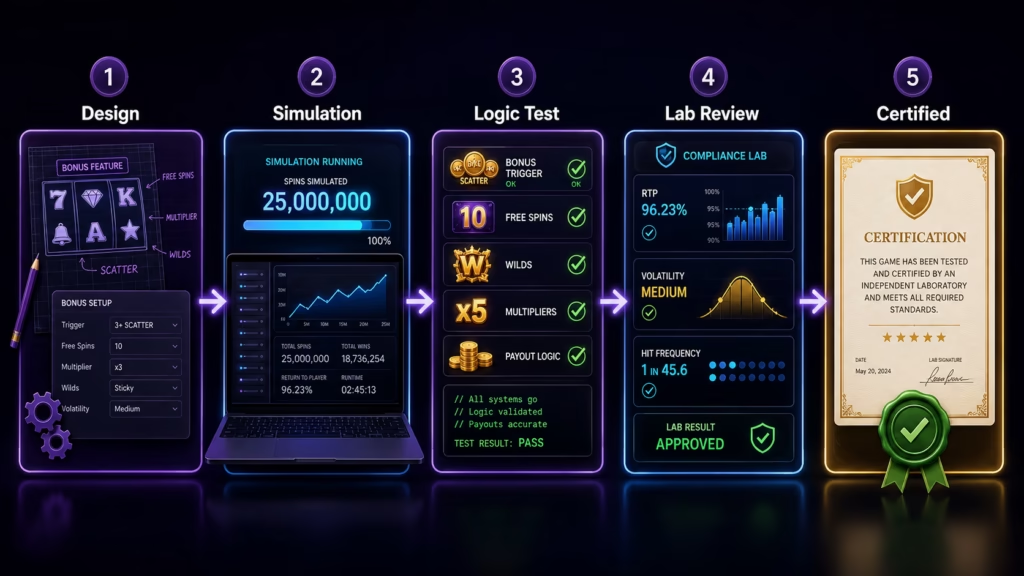
This explanation is based on the main stages used in recognised technical testing frameworks: RNG evaluation, mathematical verification, software testing, feature-state testing, rule disclosure, integration review and version identification.
Exact certification requirements vary between jurisdictions, test laboratories and product types. Players should verify the casino licence, game rules, displayed RTP and applicable conditions for the version they are using.
RTP, volatility and bonus frequency cannot predict a specific session. Slot games should be treated as paid entertainment, not as a source of income. Set spending and time limits before playing, and stop when gambling is no longer comfortable or affordable.
FAQ
Who Tests Slot Bonus Features?
Slot bonus features may be tested internally by the developer and independently by an approved or recognised testing laboratory. The regulator or licensing authority determines what external assurance is required before the game can be offered in its jurisdiction.
Are Free Spins Tested Separately From the Base Game?
Free spins are tested as part of the complete slot and as a distinct feature state. Testing covers their trigger, reel configuration, number of spins, retriggers, multipliers, counters, payouts and contribution to the game’s theoretical RTP.
How Do Laboratories Test Rare Bonus Outcomes?
Laboratories use mathematical analysis, controlled test tools, source-code review and large simulations to evaluate rare outcomes. Testers do not need to wait for an extremely uncommon jackpot or maximum win to appear during ordinary manual play.
Is RTP Checked During Slot Certification?
RTP is commonly checked by reviewing the mathematical model and comparing the implemented game with theoretical and simulated results. The displayed RTP must match the relevant tested configuration, but it does not predict what one player will receive.
Are Bonus Buy Features Tested?
Bonus buy features can be tested for purchase price, player confirmation, eligibility, feature entry, prize logic, RTP treatment and rule disclosure. Availability also depends on local regulation, so a tested bonus buy may still be disabled in some markets.
Can a Certified Slot Change Its Bonus Frequency?
A provider may develop another approved configuration or update, but a change affecting bonus probability, RTP or fairness may require additional testing. Players should not assume that every casino offers the same mathematical version of a slot.
Does a Pick Bonus Involve Real Skill?
Many pick bonuses use player interaction without allowing skill to improve the mathematical result. Testing checks whether the displayed choices operate as documented and whether the rules explain any difference between genuine decision-making and an entertainment-only reveal.
What Happens If a Connection Drops During Free Spins?
The game and platform should handle the interruption according to their approved rules, usually by restoring the unresolved state, completing the result or applying a defined recovery process. The exact procedure should be checked in the game and casino rules.
Can a Tested Slot Still Malfunction?
A tested slot can still experience a software, platform or communication fault after release. Certification reduces compliance risk but does not make software incapable of failure. Operators should investigate faults, preserve records and correct affected outcomes according to applicable requirements.
Does Certification Mean a Player Will Win?
Certification does not increase or guarantee a player’s chance of winning. It indicates that a specific game version was evaluated against defined requirements. Every spin remains random, and gambling should be approached with fixed limits.
Brief Conclusion
Slot game testing and certification verifies the RNG, mathematical model, RTP, bonus triggers, prize calculations, player information, recovery behavior and software version. Independent testing can show that a feature operates according to its approved design, but it cannot guarantee short-term returns or winnings. Players should use regulated casinos, read the paytable, check the available RTP and treat every slot as entertainment rather than a way to make money.