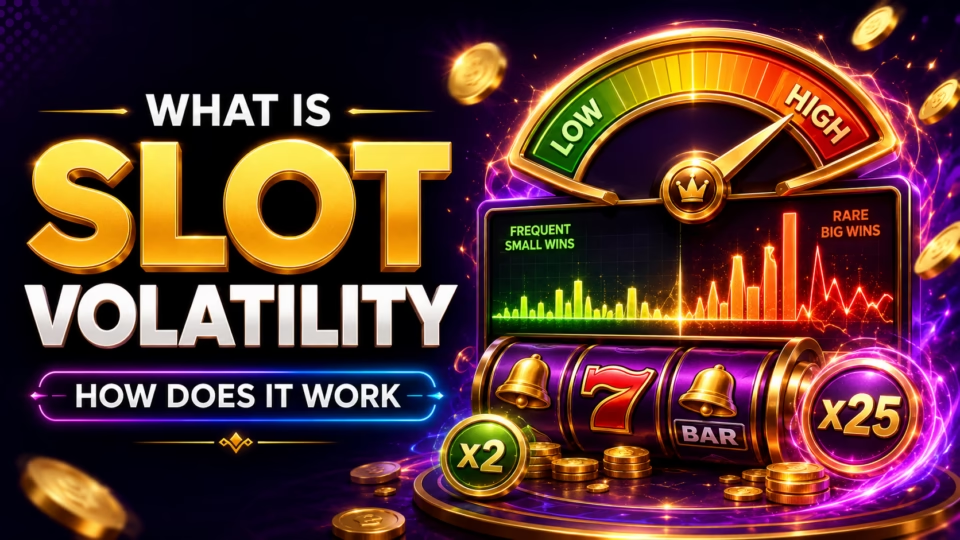
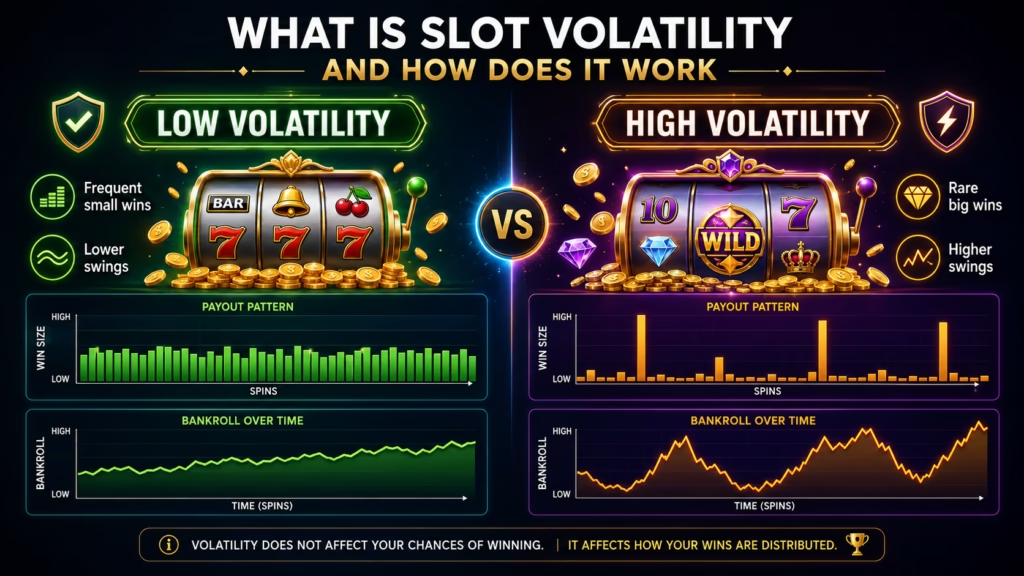
Slot volatility describes how a slot distributes its payouts over time. A low-volatility slot usually produces smaller, more regular wins, while a high-volatility slot tends to produce more uneven results, with longer stretches between meaningful payouts and the possibility of larger individual wins. Volatility does not tell you whether you will win, and it cannot predict the outcome of any particular spin.
Quick takeaways:
- Low volatility: generally smaller but more regular payouts.
- Medium volatility: a balance between payout frequency and payout size.
- High volatility: more uneven results and potentially larger individual payouts.
- Volatility is not RTP: RTP concerns theoretical long-term return, while volatility concerns how payouts are distributed.
- Volatility is not hit frequency: a slot can register frequent small wins and still have substantial volatility if much of its value is concentrated in rare features or larger prizes.
Slot volatility matters most when choosing a game that fits your preferred playing style and budget. Players who prefer steadier sessions may favor lower volatility, while players comfortable with larger swings may prefer higher-volatility games. Regardless of volatility, every spin remains random, and slots should be treated as entertainment rather than a way to make money.
What Does Volatility Mean in Slots?
Volatility in slots is a measure of how much payout results can vary during play. It is sometimes described as variance, although the mathematical meaning of variance can be more specific than the simplified volatility labels shown by casinos and game developers.
A low-volatility slot spreads more of its theoretical payout across relatively common, smaller wins. A high-volatility slot may concentrate more value in less common bonus rounds, multipliers, jackpots or high-value symbol combinations.
This difference changes how two slots can feel even when their RTP percentages are similar.
For example, imagine two hypothetical slots with the same long-term RTP. One may frequently return small portions of the player’s stake, creating a relatively steady balance. The other may return little during many spins before producing a considerably larger payout. Their theoretical return could be similar, but their volatility would make the playing experience very different.
How Does Slot Volatility Work?
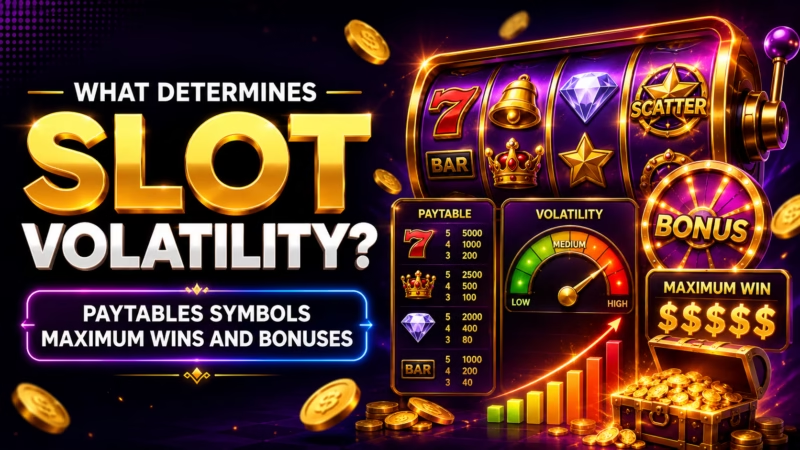
Slot volatility is created by the game’s mathematical payout model. Symbol probabilities, payout values, bonus mechanics, multipliers, jackpots and other features determine how the game’s theoretical return is distributed among possible outcomes.
Developers can structure a slot so that a relatively large portion of its payout value comes from ordinary base-game combinations. This normally creates a steadier experience.
Alternatively, a game can place substantial value behind difficult-to-trigger events such as:
- free spins;
- large multipliers;
- premium symbol combinations;
- expanding or transforming symbols;
- bonus jackpots;
- maximum-win scenarios.
When more theoretical value is concentrated in less frequent outcomes, results can become more volatile.
The exact mathematics behind a slot is generally more complicated than the simple low, medium and high labels shown to players. Unless a provider publishes detailed probability information, a volatility rating should be treated as a practical classification rather than a precise prediction of what will happen during a session.
Low vs Medium vs High Volatility Slots
Low-Volatility Slots
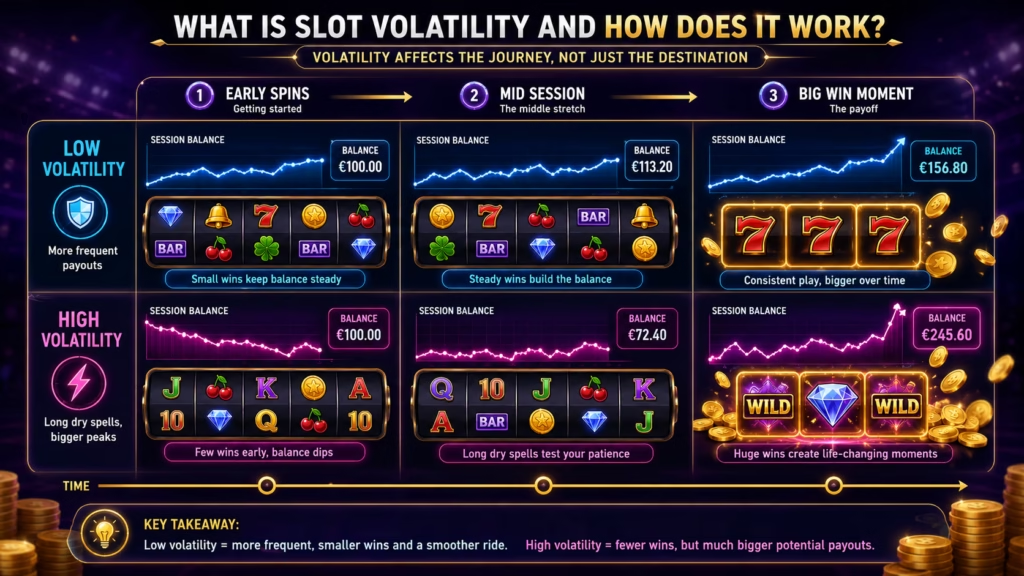
Low-volatility slots are designed to produce comparatively smaller swings in results. They commonly appeal to players who prefer frequent interaction with winning combinations and want their playing balance to change more gradually.
Low volatility may suit:
- players using smaller entertainment budgets;
- beginners learning how slot mechanics work;
- players who dislike long stretches without meaningful returns;
- players who prefer longer sessions over chasing large individual payouts.
The tradeoff is that the largest outcomes may represent a smaller part of the game’s overall appeal.
Low volatility still does not mean low risk. A random slot can consume a player’s entire budget regardless of its volatility classification.
Medium-Volatility Slots
Medium-volatility slots try to balance regular smaller payouts with opportunities for larger results. Many games fall somewhere in this broad middle range because it can accommodate different playing styles.
A medium-volatility slot may include frequent base-game activity while reserving more valuable payouts for free spins, multipliers or other bonus features.
Medium volatility may appeal to players who do not want either extreme. However, the label “medium” is not standardized across the industry. One provider’s medium-volatility game can behave differently from another provider’s.
High-Volatility Slots
High-volatility slots produce greater swings and usually place more importance on comparatively uncommon high-value outcomes. They can have extended periods where the player’s balance falls without a significant payout offsetting previous stakes.
High-volatility games often appeal to players who accept irregular results in exchange for access to stronger potential multipliers, bonus combinations or maximum-win possibilities.
A high volatility rating does not mean a large payout is due after a losing streak. Each random spin remains independent according to the game’s underlying rules and random number generation.
Players using high-volatility slots should be particularly careful about session budgets because short-term results can vary sharply.
Slot Volatility vs RTP
Slot volatility and RTP measure different characteristics of a casino game. RTP describes the theoretical proportion of stakes that a game is designed to return over a very large number of plays, while volatility describes how unevenly those theoretical payouts may be distributed.
Consider two hypothetical games with an RTP of 96%.
A lower-volatility version might distribute much of its return through relatively common small and medium payouts.
A higher-volatility version could theoretically return the same percentage while concentrating more value in rare bonus outcomes and larger prizes.
Neither game guarantees that an individual player will receive 96% of their money back. RTP is a long-term statistical property of the game and does not predict a short session.
A player choosing a slot should therefore look at both RTP and volatility rather than treating either number as a complete description of the game.
Slot Volatility vs Hit Frequency
Hit frequency measures how often a spin produces a defined winning result, while volatility measures the size and distribution of payouts. The concepts can influence each other, but they are not interchangeable.
A slot could technically record many winning spins that return less than the original stake. Those outcomes increase the game’s hit frequency without necessarily making the player’s balance stable.
For example, a $1 spin that returns $0.30 may count as a winning combination under the game’s rules even though the player’s balance has fallen by $0.70.
This is why hit frequency alone does not tell you whether a slot has low volatility.
Volatility provides broader information about the potential swings in results, while hit frequency focuses on how often qualifying wins occur.
How Can You Tell a Slot’s Volatility?
The most reliable starting point is the game’s official information, paytable or help screen. Some providers explicitly classify games as low, medium, medium-high or high volatility.
If an official rating is unavailable, game characteristics may provide clues, but they should not be treated as proof.
Features commonly associated with greater volatility can include:
- large advertised maximum-win potential;
- substantial multipliers;
- valuable but difficult-to-trigger bonus rounds;
- progressive or fixed jackpots;
- bonus features where a small number of outcomes account for substantial payout potential.
Features associated with lower volatility may include more regular base-game payouts and fewer extreme multiplier mechanics.
However, visual design cannot reliably reveal a slot’s mathematical model. Two games with similar reels and bonus features can have very different probability structures.
Always check the official game information where available.
Does High Volatility Mean Bigger Wins?
High volatility can mean that a larger share of a slot’s theoretical payout is associated with larger individual outcomes, but it does not mean a player will receive a big win.
The important distinction is between potential and probability.
A game may advertise a large maximum win while making the outcome that produces it exceptionally rare. The maximum payout therefore tells you what may be mathematically possible under the rules, not what is likely to occur during normal play.
High-volatility slots can also produce small wins. The classification describes the overall payout distribution rather than guaranteeing that every win will be large.
Does High Volatility Mean Fewer Wins?
High volatility often produces more noticeable gaps between meaningful payouts, but high volatility does not automatically mean that every winning combination occurs less frequently.
A high-volatility game could still have many small winning combinations while concentrating much of its total payout value in rare larger events.
This distinction matters because players sometimes confuse a game’s hit rate with its volatility.
If you want to understand how a particular slot behaves, check both its volatility classification and any published hit-frequency information. If the provider does not disclose those figures, avoid assuming exact probabilities from a short demo or real-money session.
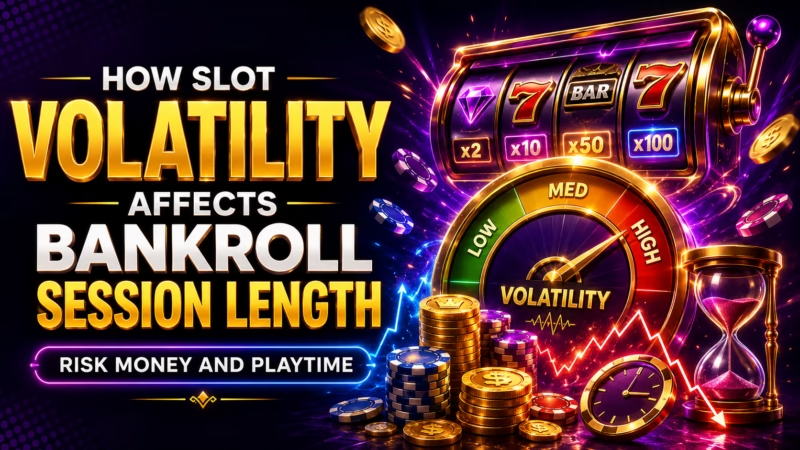
How Volatility Affects Your Bankroll
Higher volatility generally creates greater short-term balance swings, so bankroll limits become especially important.
Suppose two players begin with the same entertainment budget. The player choosing a low-volatility game may experience many relatively small changes in balance. The player choosing a highly volatile slot might see the same budget decline much faster if the game’s valuable features do not occur during that session.
This does not mean increasing the bankroll makes high-volatility slots safer or more profitable. A larger budget simply allows more spins before a predetermined loss limit is reached.
A practical approach is to decide before playing:
- how much money you are prepared to spend on entertainment;
- how much you will stake per spin;
- how long you intend to play;
- what loss limit ends the session.
Do not increase bets because a slot has not paid recently. Previous losing spins do not make a future winning outcome due.
Which Slot Volatility Should You Choose?
The right volatility level depends on the type of playing experience you prefer, not on which category is supposedly more profitable.
Choose lower volatility if you generally prefer:
- smaller balance fluctuations;
- regular base-game activity;
- smaller stakes across a larger number of spins;
- less dependence on rare bonus outcomes.
Medium volatility may make sense if you want a mixture of ordinary payouts and stronger bonus potential without moving fully toward either extreme.
Higher volatility may appeal if you:
- understand that long losing stretches can occur;
- accept greater short-term balance swings;
- prefer games built around multipliers or large bonus outcomes;
- can maintain strict spending limits without chasing losses.
No volatility level changes the fundamental fact that slot outcomes are random.
Common Myths About Slot Volatility
A High-Volatility Slot Is Due to Pay
A high-volatility slot does not become due after a losing streak. Random outcomes do not create a debt that the machine must repay to an individual player.
The fact that a game can produce large payouts does not tell you when those payouts will occur.
Low Volatility Means You Cannot Lose Quickly
Low volatility does not protect a player’s bankroll. Smaller and more regular wins can reduce the feeling of extreme swings, but losses can still accumulate.
A low-volatility classification should not be interpreted as a safety rating.
High RTP Means Low Volatility
A high RTP does not determine a slot’s volatility. A game can theoretically have a relatively high RTP and still distribute its payouts through highly uneven outcomes.
RTP and volatility should be evaluated separately.
Demo Mode Reveals the Exact Volatility
A short demo session cannot reliably establish a slot’s true mathematical volatility. Random variation can make the same game appear unusually generous or unusually harsh over a limited number of spins.
Demo play can help you understand the interface and features, but it should not be used to predict future results.
Practical Tips for Comparing Slot Volatility
When comparing slots, start with information provided by the developer rather than relying on screenshots, advertising language or a few spins.
Check:
- Published volatility rating. Look for low, medium or high classifications in the official game information.
- RTP. Treat RTP as a separate long-term metric rather than a substitute for volatility.
- Paytable. Review how strongly premium combinations differ from ordinary payouts.
- Bonus structure. Determine whether much of the game’s appeal depends on free spins, jackpots or multipliers.
- Maximum win. Use it to understand payout potential, not expected results.
- Bet range. Choose a stake that fits your predetermined entertainment budget.
- Casino version. Some games can be offered in different mathematical configurations, so check the information shown by the operator before playing.
These criteria provide a better picture of a slot than judging volatility from a few random outcomes.
How This Information Was Reviewed
The explanation of slot volatility is based on the relationship between payout distribution, RTP, hit frequency, bonus mechanics and short-term variance. Exact mathematical models differ between games and providers, so volatility classifications should be checked against the official game rules, paytable or provider information whenever available.
RTP, volatility, hit frequency and maximum-win figures describe different aspects of a slot and none can predict the result of an individual session. Casino operators may also offer different versions or configurations of some games, so displayed RTP and rules should be checked before playing.
Slots involve financial risk and random outcomes. They should be used only for entertainment with predetermined time and spending limits. Stop playing if gambling is no longer enjoyable or if losses are affecting money needed for normal expenses.
FAQ
What is slot volatility?
Slot volatility describes how widely a slot’s payouts can vary. Low-volatility games generally distribute more value through smaller, more regular payouts, while high-volatility games tend to produce greater swings and place more value in comparatively uncommon larger outcomes.
What does volatility mean in slots?
Volatility means the level of variation in a slot’s payout pattern. It helps describe whether the game tends to produce relatively steady results or more dramatic changes between losing periods and larger payouts. It cannot predict what will happen on the next spin.
Is high or low volatility better?
Neither volatility level is objectively better. Low volatility may suit players who prefer steadier balance changes, while high volatility may appeal to players comfortable with larger fluctuations and less predictable short-term results. Both involve random outcomes and financial risk.
Does high volatility mean higher RTP?
No. High volatility does not mean higher RTP. RTP describes theoretical long-term return, while volatility describes how payouts are distributed. A high-volatility and low-volatility slot can have similar RTP percentages.
Can a high-volatility slot pay frequently?
Yes. A high-volatility slot can still produce frequent winning combinations if many of them are relatively small. Hit frequency and volatility measure different characteristics, so frequent hits do not automatically indicate low volatility.
Are high-volatility slots more likely to give big wins?
High-volatility slots may allocate more of their payout potential to larger outcomes, but this does not mean a large win is likely during any particular session. Large maximum payouts can be associated with very low-probability events.
How do I check a slot’s volatility?
Check the provider’s official game information, help section or paytable for a published volatility rating. If no rating is given, game features can provide clues, but they cannot confirm the underlying mathematical volatility.
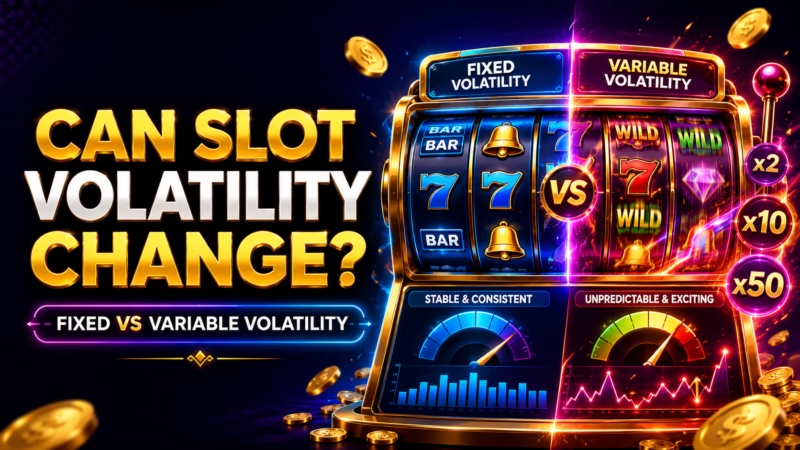
Can changing my bet affect slot volatility?
The underlying volatility of a standard slot generally comes from its mathematical model rather than the player’s stake size. However, some games have bet-dependent features or different modes that may alter available payouts or mechanics, so the specific game rules should always be checked.
Can volatility predict when a slot will pay?
No. Volatility cannot predict the timing of a winning spin or bonus. It describes the overall distribution of possible outcomes rather than a sequence of future results. A losing streak does not make a large payout due.
Brief Conclusion
Slot volatility explains how unevenly a slot distributes its payouts, not whether the game will be profitable. Low-volatility slots generally provide smaller and steadier results, medium-volatility games sit between the two extremes, and high-volatility slots can produce larger short-term swings with more value concentrated in stronger outcomes.
For a useful comparison, evaluate volatility together with RTP, hit frequency, paytable structure, bonus mechanics and bet range. None of these metrics predicts an individual spin or guarantees a return, so choose a game that fits your entertainment budget and play within predetermined limits.