Slot volatility cannot be measured reliably from a few dozen or even a few hundred spins. A small sample can show how a slot behaved during one short session, but it is usually too noisy to reveal the game’s underlying volatility. For a rough empirical estimate, thousands of spins are more useful, while tens of thousands or more may be needed for a substantially more stable statistical picture.
The number of spins required also depends on what you are trying to measure. Volatility is not simply the percentage of winning spins. A meaningful assessment considers the size of payouts, their frequency, the distribution of wins, the frequency of large wins and the variance or standard deviation of returns.
Quick takeaways:
- 100 to 500 spins are generally too few to estimate slot volatility.
- 1,000 to 5,000 spins may reveal obvious behavioral patterns, but uncertainty remains high.
- 10,000 or more spins provide a better basis for comparing payout distributions.
- Highly volatile slots may require much larger samples because important large payouts occur infrequently.
- A spin sample cannot predict what will happen during the next session.
Testing volatility is mainly useful for analysts, researchers and players trying to understand how different slot designs behave statistically. It should not be used as a system for predicting wins or deciding when a slot is “due” to pay.
What Is Slot Volatility?
Slot volatility describes how widely a game’s payouts can vary around its expected return. In practical terms, it helps describe whether a game tends to produce smaller, more regular payouts or less frequent payouts that may include much larger amounts.
Low-volatility slots generally concentrate more of their payout distribution around smaller wins. High-volatility slots may distribute a greater portion of their theoretical return through less frequent and potentially larger payouts.
Volatility should not be confused with RTP. RTP describes the theoretical percentage of wagered money that a game is designed to return over a very large number of plays. Volatility describes the variation in how those returns may be distributed.
Two slots can therefore have similar RTP values while producing very different short-term experiences.
How Many Spins Do You Need to Test Slot Volatility?
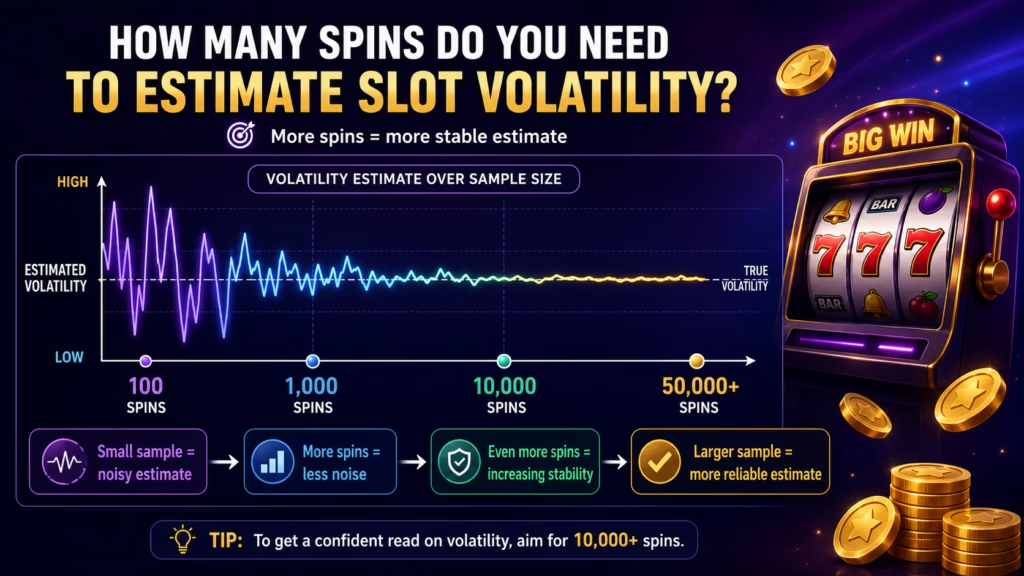
There is no universal number of spins that guarantees an accurate volatility estimate. The required sample depends on the game’s payout distribution and on how precise you want the estimate to be.
A practical interpretation looks like this:
| Number of spins | What the sample may tell you | Main limitation |
| 100 to 500 | Very rough impression of gameplay | Dominated by short-term randomness |
| 1,000 to 5,000 | Some indication of hit patterns and payout sizes | Rare events may be missed |
| 10,000 to 50,000 | More useful statistical comparison | Large wins can still distort results |
| 100,000+ | Much stronger empirical dataset | Still not identical to the mathematical game model |
These ranges are not certification standards. They are useful ways to understand why larger samples produce more informative observations.
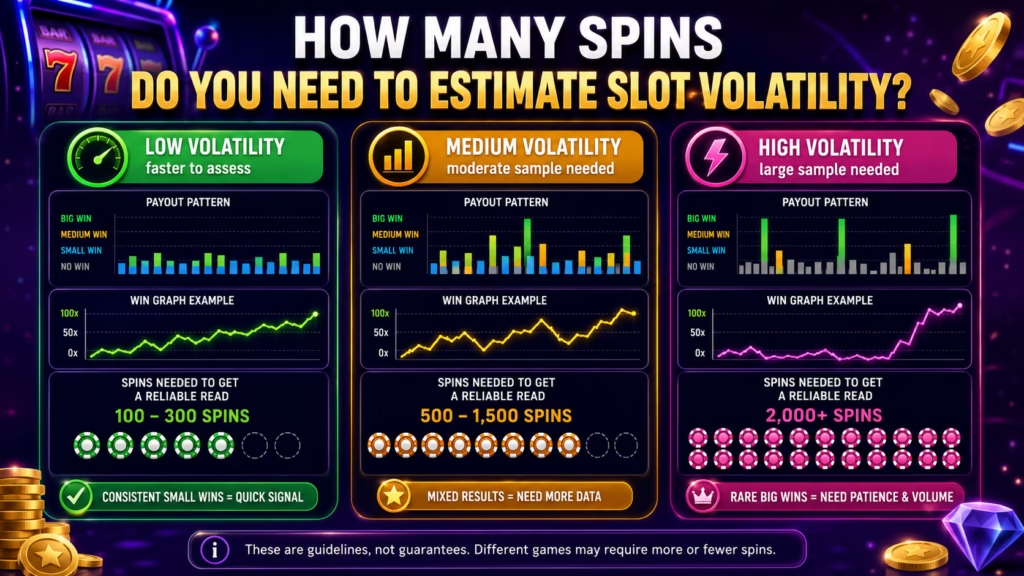
A high-volatility slot can be particularly difficult to classify from a small sample. If a meaningful part of its theoretical return is concentrated in rare bonus outcomes or large multipliers, a test may need to run for a long time before enough of those events appear.
Why 100 Spins Cannot Tell You a Slot’s True Volatility
One hundred spins represent only a tiny sample of a random game’s possible outcomes.
Imagine two players testing the same slot. One encounters a strong bonus within the first 40 spins. The other completes 100 spins without triggering one. Their results could look completely different even though both are playing the same mathematical game.
This is sampling variance.
A short session can therefore make a high-volatility slot temporarily appear stable, or make a relatively low-volatility slot appear unusually aggressive.
The problem becomes even larger when the slot contains rare high-value events. Missing one important payout category can change the apparent distribution substantially.
How to Measure Slot Volatility More Properly
A useful volatility test should record every spin rather than simply comparing the starting and ending bankroll.
- Stake.
- Total payout.
- Net result.
- Whether the spin produced a win.
- Size of the win relative to the stake.
- Bonus activation, if relevant.
- Large multiplier or jackpot-style events, if applicable.
The resulting dataset can then be analyzed statistically.
Calculate Average Return per Spin
For a sample of n spins, calculate the return from every individual spin and then calculate the average.
For example, if all spins use the same one-unit stake, the returns might look like:
0, 0.5, 0, 2, 0, 0, 10, 0…
The average gives information about the sample return, but it does not measure volatility by itself.
Calculate Variance
Variance measures how far individual outcomes tend to spread from the average outcome.
A simplified sample variance formula is:
s² = Σ(xᵢ – x̄)² / (n – 1)
where:
- xᵢ is the return from an individual spin,
- x̄ is the average return,
- n is the number of recorded spins.
Larger variance generally means outcomes are more widely dispersed.
Calculate Standard Deviation
Standard deviation is the square root of variance:
s = √s²
Standard deviation is often easier to interpret when comparing datasets because it expresses dispersion in the same units as the measured values.
For slot analysis, a larger standard deviation generally indicates that individual spin outcomes are spread more widely around the mean.
Hit Frequency Is Not the Same as Volatility
Hit frequency measures how often a spin produces a payout. It does not show how payouts are distributed by size.
A slot could theoretically produce frequent small wins while also including rare extreme payouts. Another could produce fewer wins but keep most payouts within a narrower range.
Looking only at hit frequency can therefore give a misleading impression of volatility.
A stronger analysis combines:
- hit frequency,
- average payout,
- median payout,
- variance,
- standard deviation,
- frequency of larger wins,
- bonus frequency,
- payout distribution by win size.
Volatility describes the entire distribution, not one isolated metric.
Why High-Volatility Slots Need Larger Samples
High-volatility games are especially sensitive to rare events.
Suppose a slot has several ordinary payout categories plus a very rare large payout. If that large payout does not occur during a 5,000-spin test, the observed distribution may underestimate the game’s true variance.
If it occurs once during a small test, the opposite problem can happen. That single result may dominate the dataset and make the measured volatility appear unusually high.
Increasing the number of spins reduces the influence of individual observations, although rare events can still require very large samples.
This is one reason professional mathematical analysis of casino games is fundamentally different from simply playing a few thousand spins and reporting the result.
1,000 vs 10,000 vs 100,000 Spins
The difference between sample sizes is mainly about statistical stability.
1,000 Spins
One thousand spins can reveal obvious characteristics, such as whether the sample contained many small wins or relatively few larger wins.
It is still a small sample for estimating the underlying payout distribution. Bonus rounds and rare outcomes can heavily influence the result.
10,000 Spins
Ten thousand spins provide much more information about common outcomes and allow better comparisons between payout categories.
However, the results can still differ considerably from another independent 10,000-spin test, particularly for highly volatile games.
100,000 Spins
One hundred thousand spins create a much stronger empirical sample and usually capture common and moderately uncommon events many more times.
Even this does not guarantee that every rare event will occur at its mathematically expected frequency. Extremely rare outcomes remain difficult to evaluate purely through manual sampling.
Can You Estimate Volatility From Demo Spins?
Demo mode can be useful for observing game mechanics, payout patterns and bonus behavior, but it should not automatically be treated as proof of the slot’s official volatility.
The most reliable source for an officially stated volatility level is information supplied by the game provider or within the game’s documentation, when such information is available.
If using demo play for independent analysis, the same statistical limitations apply. A few hundred demo spins cannot establish the complete mathematical payout distribution.
Demo testing is therefore better viewed as behavioral observation rather than a replacement for the game’s mathematical specification.
Common Mistakes When Testing Slot Volatility
Using Bankroll Loss as the Measurement
A player losing quickly does not prove that a slot is highly volatile.
Short-term loss can occur in any random slot. Volatility must be evaluated through the distribution of individual outcomes rather than one bankroll trajectory.
Calling Every Infrequent-Win Slot High Volatility
Low hit frequency and high volatility are related in some games, but they are not interchangeable.
Win size distribution matters just as much as win frequency.
Treating One Bonus as Representative
A single bonus round can produce a weak, average or unusually large result.
Using one bonus outcome to classify an entire slot introduces severe sampling bias.
Assuming More Spins Predict the Next Spin
A larger dataset improves statistical estimation of past observed behavior. It does not make future individual spins predictable.
If a random slot has produced poor results for thousands of spins, that does not mean a large payout is now required to occur.
A Practical Method for Comparing Two Slots
If the goal is to compare two slots rather than calculate their exact mathematical volatility, use the same testing methodology for both games.
Keep the stake constant relative to the unit being measured and collect the same number of spins.
Then compare:
- percentage of zero-return spins,
- hit frequency,
- median winning payout,
- average winning payout,
- standard deviation,
- percentage of wins above 5x stake,
- percentage above 10x stake,
- frequency and distribution of bonus outcomes.
The larger the sample, the more meaningful the comparison becomes.
If one game produces noticeably greater dispersion across a large dataset, that provides evidence that its observed volatility is higher. It still does not establish the provider’s exact mathematical volatility unless the full game model is known.
Can You Calculate the Exact Volatility of a Slot From Spins?
Observed spins provide an estimate, not necessarily the exact theoretical volatility of the game.
Exact theoretical volatility requires knowledge of the underlying probability distribution. That means knowing the probabilities and payout values of all relevant outcomes in the game’s mathematical model.
Public players normally do not have access to every internal probability required for such a calculation.
Large-scale spin testing can approximate how a game behaves, but empirical estimates should be distinguished from mathematical specifications produced from the complete game model.
How Many Spins Are Enough for a Useful Conclusion?
For casual observation, several thousand spins can provide more information than a typical playing session, but they should not be treated as definitive.
For stronger comparative analysis, tens of thousands of spins are more appropriate because they reduce the influence of short-term randomness and provide more observations across different payout categories.
For highly volatile games containing very rare events, substantially larger datasets may still be necessary.
The correct sample size therefore depends less on finding a magical number and more on asking whether the dataset is large enough to represent the payout events that materially influence the game’s variance.
What Slot Volatility Can and Cannot Tell You
Volatility can help describe the type of payout experience a slot is mathematically designed to produce.
It may help distinguish games that concentrate returns into frequent smaller payouts from games where returns are distributed more unevenly.
Volatility cannot tell you:
- when the next win will occur,
- whether a bonus is approaching,
- whether a losing streak must end,
- how much you will win or lose in one session,
- whether one slot is more profitable for an individual player.
Each spin remains random according to the game’s underlying mechanics.
Players who prefer more stable bankroll movement may generally find lower-volatility games more comfortable. Players considering high-volatility games should understand that substantial fluctuations and extended periods without meaningful payouts may occur.
In either case, slot play should be treated as entertainment rather than a method of earning money.
How This Information Was Reviewed
The methodology in this guide separates several concepts that are often incorrectly combined: RTP, hit frequency, payout distribution, variance and standard deviation.
A spin-based volatility estimate should therefore be based on individual outcomes and their distribution rather than anecdotal sessions or bankroll changes.
Official game information, paytables and provider documentation should be checked whenever an exact RTP or officially assigned volatility level is required. Casino versions of the same game may sometimes differ in configuration, so game-specific information should be verified before drawing conclusions.
Neither RTP nor volatility predicts the outcome of an individual session. Players should set spending and time limits in advance and stop playing when gambling is no longer entertainment.
FAQ
How many spins are needed to estimate slot volatility?
Several thousand spins can provide a rough behavioral picture, but tens of thousands are more useful for statistical comparison. Highly volatile slots may require substantially larger samples because rare large payouts can have a major effect on measured variance.
Are 100 spins enough to measure slot volatility?
No. One hundred spins are normally far too few to make a reliable volatility estimate because random short-term variation can dominate the sample. The presence or absence of a single bonus or large payout can completely change the result.
Are 1,000 spins enough to test a slot?
One thousand spins can reveal basic patterns, but they are usually insufficient for a stable volatility estimate. Rare bonuses and large payouts may be missing or overrepresented in such a small sample.
Is 10,000 spins enough to measure volatility?
Ten thousand spins can provide a useful empirical dataset for comparing common payout patterns, but the estimate can still be unstable in highly volatile games. Rare events may require much larger samples.
What is the best statistic for measuring slot volatility?
Variance and standard deviation are central measures because they quantify how widely individual returns are distributed around the average. Hit frequency and payout-size distribution should also be examined to understand how that volatility is produced.
Does a low hit frequency mean high volatility?
Not necessarily. Hit frequency only measures how often payouts occur. Volatility depends on both the frequency and magnitude of outcomes, so two slots with similar hit frequencies can still have different levels of volatility.
Can RTP be used to determine slot volatility?
No. RTP and volatility measure different properties. RTP describes theoretical long-run return, while volatility describes the dispersion of payouts. Two slots can have similar RTP percentages but very different payout distributions.
Can demo mode reveal a slot’s volatility?
Demo mode may help produce an empirical estimate when a large number of spins is recorded, but it does not reveal the complete mathematical model. Official provider information should be checked when an officially assigned volatility level is required.
Can spin testing predict when a slot will pay?
No. Historical spin results do not reveal when the next win or bonus will occur. A large sample can help estimate statistical characteristics of a game, but individual future outcomes remain random.
Does a larger sample guarantee an accurate volatility measurement?
No. Larger samples generally improve statistical stability, but extremely rare outcomes may remain underrepresented. Exact theoretical volatility requires the complete probability distribution of the game rather than only observed spins.
In short
There is no fixed number of spins that perfectly measures slot volatility. A few hundred spins are too unreliable, several thousand may reveal rough patterns, and tens of thousands provide a stronger basis for comparison. High-volatility slots may require much larger samples because rare payouts can strongly influence variance. The most meaningful approach is to analyze individual payout distribution, variance and standard deviation rather than bankroll changes or hit frequency alone. Volatility describes statistical behavior, not what will happen on the next spin.