
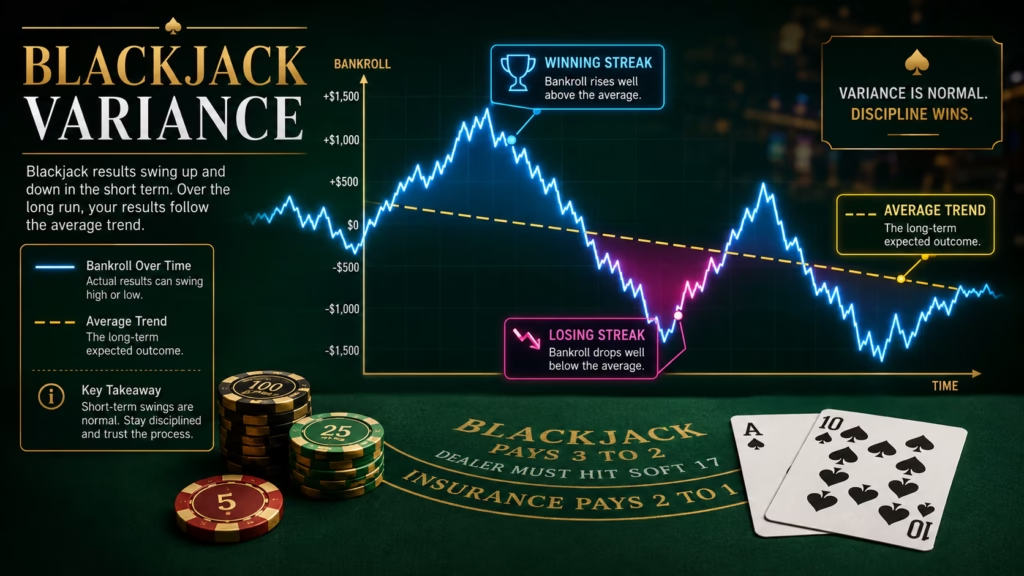
Blackjack variance is the natural short-term fluctuation between what mathematics predicts over the long run and what actually happens during a session. A player can follow correct basic strategy and still experience large winning or losing streaks because individual hands are random and outcomes such as blackjacks, doubles and splits create different-sized wins and losses. Variance describes the size of those fluctuations, while expected value describes the long-term mathematical direction of the game.
Key points:
• Blackjack variance explains why short sessions can produce results far above or below the mathematical expectation.
• Bet size has a major effect on bankroll swings because monetary volatility scales directly with the amount wagered.
• Rules such as double after split, surrender and dealer soft 17 can affect both expected return and variance.
• Correct basic strategy improves expected value, but it cannot eliminate short-term losses.
• A winning session does not prove a strategy is profitable, and a losing session does not prove the strategy is incorrect.
Blackjack variance matters most to players trying to understand why a relatively low house edge does not translate into smooth results. It is especially important when comparing tables, choosing bet sizes or evaluating a short run of results. Players should be more cautious when normal fluctuations begin to influence betting decisions, particularly if losses lead to larger wagers or attempts to recover money quickly. Chasing losses is a warning sign of gambling-related harm.
What Is Blackjack Variance?
Blackjack variance measures how widely individual results can differ from the average expected result. A blackjack hand does not simply produce either a one-unit win or a one-unit loss. Natural blackjacks may pay more than an ordinary win, surrender can lose half a wager, doubling exposes two units, and splitting can create several separate hands. These possible outcomes make the distribution of results wider than a simple even-money coin-flip model.
Variance is normally discussed together with standard deviation. Variance is the average squared distance of outcomes from their expected value, while standard deviation is the square root of variance and is easier to interpret because it is expressed in betting units. Under one six-deck ruleset, with the dealer standing on soft 17, double after split, late surrender and resplitting aces allowed, variance was about 1.303 per initial hand and standard deviation was about 1.142 betting units. These figures are specific to that ruleset rather than universal blackjack constants.
Blackjack Variance vs House Edge
Blackjack variance and house edge describe different parts of the game. House edge measures the casino’s expected long-term advantage under a particular set of rules and strategy assumptions. Variance measures how far actual short-term results can move around that expectation. A table can therefore have a relatively small house edge while still producing substantial blackjack bankroll swings.
Consider a simplified example using the six-deck ruleset above. With a $10 initial wager for 100 hands, the mathematical expected loss is only about $2.77 under a simulated return of approximately -0.277%, but one standard deviation of the session is roughly $114. These numbers do not mean a player should expect to lose exactly $2.77 or finish within a specific range. They show why normal short-term fluctuation can be dramatically larger than the long-term expected loss.
This difference is one of the most important concepts in casino mathematics. Expected value becomes increasingly useful across large samples, while variance can dominate what a player sees during an individual session. Short-term winnings therefore do not remove the casino’s mathematical advantage, and short-term losses can be much larger than the theoretical average loss.
What Causes Blackjack Bankroll Swings?
Blackjack bankroll swings come from several sources acting together: random card sequences, variable payouts, doubling, splitting, rule differences and changes in bet size. Even when two players make identical strategic decisions, they can finish similar sessions with very different results simply because they receive different sequences of cards.
Doubling Down
Doubling down can increase short-term variance because the player puts an additional unit at risk on one hand. Under common rule comparisons, allowing double after split can improve expected value while increasing variance. This illustrates an important distinction: a mathematically favorable rule can simultaneously improve expected return and make individual results more volatile.
A player should therefore not avoid a correct basic-strategy double simply because the larger wager feels uncomfortable. If the planned bet size makes standard doubles financially stressful, the underlying wager may already be too large for the player’s entertainment budget.
Splitting Pairs
Splitting creates multiple hands from one original wager and requires an additional bet for each new hand. Resplitting can increase the amount exposed during a single round even further. Because several units may ultimately be won or lost, split situations contribute to wider possible round outcomes than a normal hit-or-stand decision.
This is why blackjack bankroll planning based only on the table minimum can be misleading. A $20 table does not mean the maximum amount committed to every round is $20. Correctly played doubles and splits can require substantially more money on the table during particular hands.
Surrender
Surrender generally reduces the severity of some losing outcomes because an eligible hand can be abandoned for half the original wager instead of being played to a potential full-unit loss. In common blackjack models, surrender can improve expected return and reduce variance compared with otherwise similar rules.
Surrender availability still depends on the blackjack rules. Players should check whether the game offers late surrender, early surrender or no surrender and use the basic-strategy chart appropriate to that exact ruleset.
How Blackjack Rules Affect Variance and Expected Value
Blackjack rules should not be judged only by how volatile they feel. Some rules primarily change the house edge, some affect variance, and others influence both. Rule comparisons also assume that the player adjusts basic strategy correctly.
| Blackjack rule | Typical mathematical effect |
| Dealer stands on soft 17 | Better expected return than dealer hitting soft 17 and often slightly lower variance. |
| Double after split allowed | Improves expected return but can increase variance. |
| Surrender allowed | Improves expected return and can reduce variance. |
| Resplitting aces allowed | Slightly improves expected return with a small variance effect. |
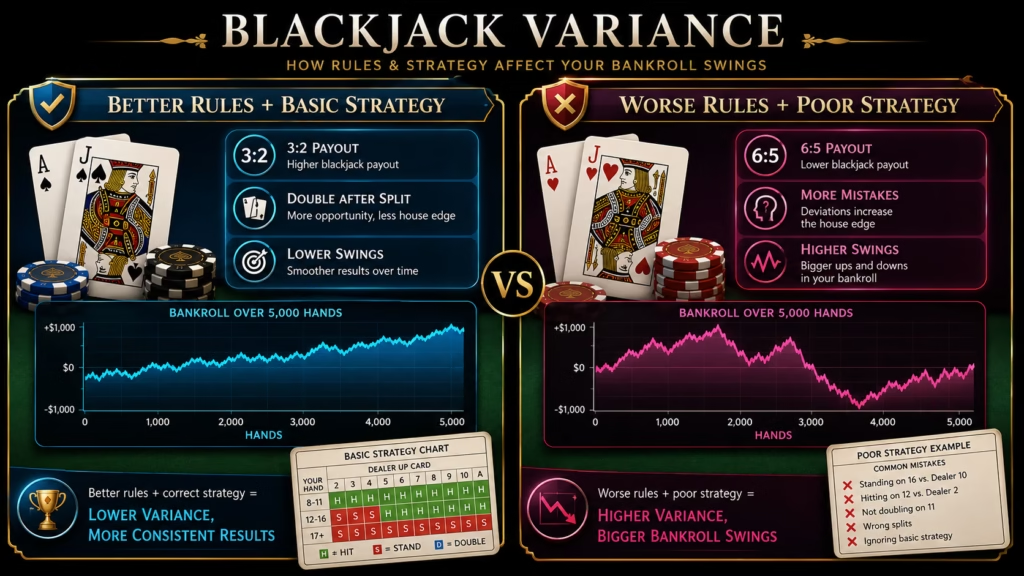
| Blackjack pays 6:5 | Significantly worse expected return than a traditional 3:2 payout. |
| Fewer decks | Can improve expected return when other rules remain identical. |
The blackjack payout is particularly important. Changing a standard blackjack payout from 3:2 to 6:5 reduces the player’s expected return by about 1.39 percentage points under commonly used comparison assumptions. That difference is much larger than many common rule adjustments such as switching between dealer standing or hitting soft 17.
A player comparing tables should therefore look at the complete ruleset rather than choosing a game simply because it uses fewer decks. A single-deck table with a poor blackjack payout can be mathematically worse than a multi-deck game offering 3:2 blackjack and more favorable doubling or surrender rules.
How Basic Strategy Affects Blackjack Variance
Basic strategy is designed to select the decision with the best mathematical expected value for a player’s hand against the dealer’s visible card under a defined set of rules. Basic strategy does not attempt to create smooth bankroll results, prevent losing streaks or predict the next card.
This creates a situation that can initially seem counterintuitive. Correct strategy sometimes tells the player to put more money at risk by doubling or splitting. Those actions may increase the size of individual bankroll movements, but avoiding them simply to reduce volatility can sacrifice expected value when the rules and hand call for the play.
Strategy mistakes can also increase expected losses. Decisions should therefore be based on a basic-strategy chart matched to the table’s number of decks, soft-17 rule, doubling restrictions, surrender availability and other relevant conditions. The optimal decision can change when the rules change.
Does Bet Size Change Blackjack Variance?
Bet size does not change the underlying randomness of the cards, but it directly changes the monetary size of blackjack bankroll swings. If the same game is played with wagers twice as large, approximately the same statistical fluctuations measured in betting units translate into roughly twice as much money gained or lost.
This distinction makes betting units useful when discussing blackjack variance. A fluctuation of 15 units means $75 to someone wagering $5 per initial hand and $750 to someone wagering $50. The mathematical pattern can be similar while the financial consequences are completely different.
Changing bets after wins or losses does not remove blackjack variance. Progressive systems such as increasing wagers after a loss alter how much money is exposed to future random outcomes, but they do not change the underlying probability structure of the blackjack rules. Larger wagers can instead make a normal losing sequence more expensive.
Why Short-Term Blackjack Results Can Be Misleading
A short blackjack session is a poor test of whether a strategy works because variance can be much larger than expected value over a limited number of hands. A player may make mathematically correct decisions and lose heavily, while another player may make poor decisions and finish ahead. Neither result changes the mathematics of the decisions themselves.
The same problem applies to perceived winning and losing streaks. Previous independent outcomes do not create a requirement that the next hand must compensate for earlier results. Increasing a wager because several hands have just been lost does not make the next wager inherently more likely to win.
For this reason, bankroll swings should not be interpreted as evidence that a table is due, that a dealer has become hot or cold, or that losses must soon reverse. Blackjack variance explains why clusters of favorable and unfavorable outcomes can occur without providing a reliable prediction of what happens next.
Practical Ways to Handle Blackjack Bankroll Swings
The most practical response to blackjack variance is not trying to eliminate randomness. It is controlling how much financial exposure that randomness creates.
• choose an initial wager small enough that normal doubles and splits remain affordable;
• compare blackjack payouts and table rules before playing;
• use the correct basic strategy for the specific ruleset;
• avoid increasing wagers simply to recover previous losses;
• decide on spending and time limits before starting;
• stop when gambling is no longer entertainment.
Spending limits and time limits are useful safer-gambling tools. These limits are most effective when established before play rather than changed in reaction to short-term results.
Common Myths About Blackjack Variance
“A low house edge means small losses”
A low house edge means the average mathematical cost per unit wagered is relatively small over a sufficiently large sample. It does not place a ceiling on what can be lost during a particular session. Short-term variance can produce losses many times larger than the theoretical expected loss.
“Basic strategy prevents big losing streaks”
Basic strategy reduces expected losses by making mathematically appropriate decisions. It cannot control the order of cards or eliminate variance. Long sequences of unfavorable outcomes remain possible even when every decision is correct.
“After enough losses, a win becomes more likely”
Past losses do not guarantee that a future hand will recover them. Blackjack outcomes depend on the cards remaining and the rules of the game, not on a bankroll’s need to return to a previous level. Treating losses as something that must soon reverse can encourage chasing behavior.
“A smaller number of decks always means a better game”
Fewer decks can improve expected return when other rules are held constant, but casinos can combine a low deck count with less favorable payouts or restrictions. The entire ruleset should be evaluated, particularly the blackjack payout, dealer soft-17 rule, doubling rules and surrender options.
How This Information Was Reviewed
The conclusions in this guide are based on standard blackjack expected-value analysis, mathematical modeling and rule comparison. Exact variance and house-edge figures depend on the rules being analyzed, so values from one blackjack game should not automatically be applied to another.
Before playing, check the table rules or official game information for the blackjack payout, number of decks, dealer soft-17 rule, doubling restrictions, splitting rules and surrender availability. RTP, house edge and variance describe statistical behavior across repeated play. They do not guarantee the result of a particular hand or session.
Blackjack should be treated as paid entertainment rather than a source of income. Set limits before playing, never use money needed for essential expenses and avoid chasing losses. If gambling becomes difficult to control, stopping and using available responsible-gambling tools is more appropriate than changing betting systems.
FAQ
What does variance mean in blackjack?
Blackjack variance measures how widely actual results can fluctuate around their mathematical expected value. High short-term variance means a session can finish substantially ahead or behind expectation even when the player uses correct strategy. Variance does not predict whether the next hand will win or lose.
What causes blackjack bankroll swings?
Blackjack bankroll swings are caused by random card sequences combined with variable outcomes such as natural blackjacks, doubles, splits and surrender. Bet size determines how large those statistical fluctuations become when expressed in money.
Is blackjack a high-variance casino game?
Blackjack has meaningful short-term variance because one initial hand can produce several possible financial outcomes, especially after doubles and splits. Its exact variance depends on the rules and strategy used, so there is no single standard-deviation figure that applies to every blackjack game.
Does basic strategy reduce blackjack variance?
Basic strategy is primarily designed to improve expected value rather than minimize variance. Some correct basic-strategy decisions, particularly doubles and splits, can increase short-term bet exposure even though they are mathematically preferable to alternative decisions.
Does doubling down increase bankroll swings?
Doubling can increase bankroll swings because two betting units are exposed instead of one. Rules permitting additional doubling opportunities can improve expected return while also increasing variance.
Does surrender reduce blackjack variance?
Surrender can reduce variance because qualifying hands can be ended with a half-unit loss rather than remaining exposed to a possible full-unit loss. In many blackjack models, surrender also improves expected return.
Can a good blackjack player still have a long losing streak?
Yes. Correct strategy cannot eliminate random short-term fluctuations. A player can make mathematically optimal decisions and still experience substantial losses because expected value becomes clearer only across large samples, while variance dominates many shorter sessions.
Do betting systems reduce blackjack variance?
Changing bet sizes can change the monetary pattern of bankroll swings, but a betting progression does not alter the underlying probabilities of the blackjack game. Increasing wagers after losses can make an unfavorable sequence considerably more expensive and should not be treated as a method for guaranteeing recovery.
Which blackjack rules should I check before playing?
Check the blackjack payout, dealer soft-17 rule, number of decks, double-after-split rule, resplitting restrictions and surrender availability. These conditions affect expected return, available strategy decisions and, in some cases, variance.
Can blackjack variance be eliminated?
No. Blackjack is a game with random outcomes, so short-term fluctuations cannot be eliminated through strategy. Players can limit their financial exposure by choosing affordable wagers, setting spending and time limits and refusing to chase losses.
Brief Conclusion
Blackjack variance explains why bankroll results can move sharply even when the underlying house edge is relatively small. Rules, doubles, splits, surrender and bet size all influence the size or financial impact of these fluctuations. Basic strategy improves mathematical decision-making but does not remove randomness or guarantee winning sessions.
The practical lesson is simple: compare the full blackjack ruleset, use strategy appropriate to those rules and size wagers so normal bankroll swings remain within predetermined entertainment limits. Short-term results should never be treated as proof that future outcomes can be predicted or that previous losses must be recovered.